Petrin Tower and Hill — Prague's Quiet Side
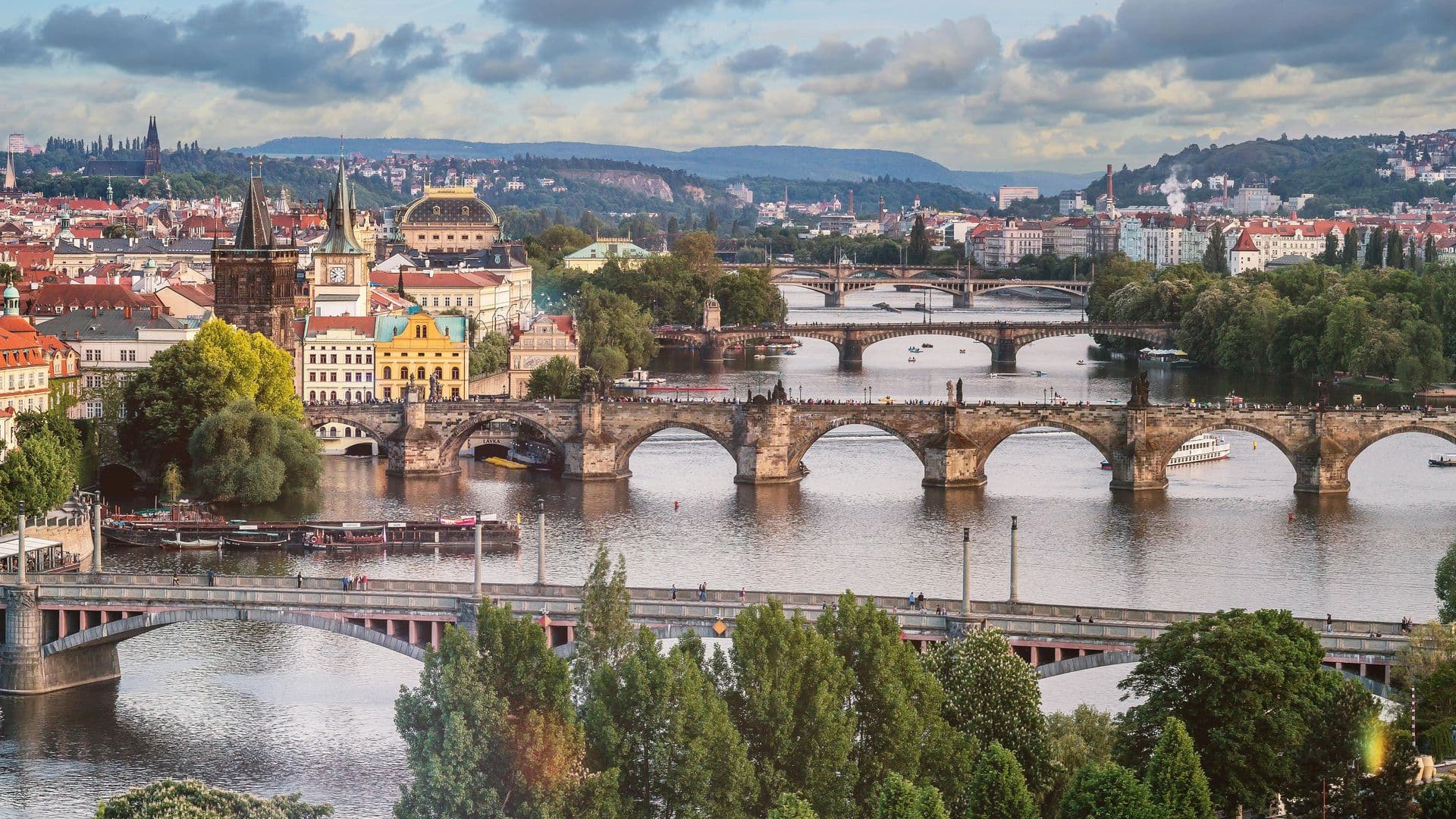
There's a forested hill on the west bank of the Vltava, visible from half the city, that most visitors never bother to climb. Petřín rises 327 metres above sea level directly behind Malá Strana, and from its summit you can see Prague laid out in every direction — the castle, the Old Town spires, the river bends, and on clear days, the distant Krkonoše mountains. It takes twenty minutes to walk up, or five minutes on the funicular, once it reopens after reconstruction.
We bring guests here on our Prague Castle and Lesser Town private tour and on our All Prague in One Day tour, and every time, the response is the same: why don't more people come here? The answer is simple — Petřín isn't on the standard tourist circuit. It requires a deliberate detour. That detour is one of the best decisions you can make in Prague.
The Funicular
The Petřín funicular (lanová dráha) climbs the hill from Újezd street in Malá Strana in about four minutes, stopping once at Nebozízek (a midway station with a restaurant terrace and a good view). A 30- or 90-minute transit ticket is not valid on the funicular — you need a 24-hour or 72-hour Prague transport ticket, or a separate funicular ticket.
The original funicular opened in 1891 for the Jubilee Exhibition that also brought the tower and the mirror maze to the hilltop. It was water-powered then — the descending car carried a tank of water that pulled the ascending car up. The system was replaced by electric motors in 1932 and rebuilt after a landslide closed it from 1965 to 1985.
A practical note for when the funicular is running: it gets a queue on sunny weekend afternoons. The wait is rarely more than one or two departures (15-20 minutes), but if you'd rather not wait, the walking paths from Újezd or from Strahov are pleasant and shaded. The climb is moderate — families with children do it comfortably.
The Tower
Petřínská rozhledna — the Petřín Lookout Tower — was built for the same 1891 Jubilee Exhibition, deliberately modelled on the Eiffel Tower at one-fifth scale. It stands 63.5 metres tall, and because it sits on a hill that already rises above the city, the observation platform at the top is actually higher above sea level than the top of the Eiffel Tower itself. The tower's designers, the Czech Tourist Club, knew exactly what they were doing.
The climb is 299 steps via a double-helix spiral staircase — one staircase for going up, one for coming down. There's also a small elevator for those who prefer it. The stairs are narrow and the tower sways very slightly in wind, which adds to the experience.
From the top, the panorama is extraordinary. Prague Castle sits below you to the north. The Old Town's church spires cluster to the northeast. The Vltava traces its path through the city in a series of bends, with the bridges strung across it like rungs on a ladder. On clear days, you can pick out Říp Mountain to the north — the legendary landing place of Father Čech, the mythical ancestor of the Czech people.
The best time for the tower is late afternoon into sunset. The crowds thin after 5 PM, the light turns golden, and the city below begins to glow. Winter visits are quieter and colder — bring layers — but the visibility is often better than in summer's haze.
Admission is around 150 CZK for adults. Combined tickets with the mirror maze are available and save a few crowns.
The Mirror Maze
Next to the tower stands the Zrcadlové bludiště — the mirror maze — housed in a miniature castle that was also built for the 1891 exhibition. Inside, a corridor of mirrors distorts and multiplies your reflection in unexpected ways. It's simple, old-fashioned fun — the kind of attraction that existed before screens and that still works perfectly well without them.
The maze ends in a room of curved fun-house mirrors that stretch and compress your reflection. Children lose themselves in here. Adults pretend they're above it, then spend five minutes pulling faces in the distortion mirrors anyway.
At the back of the maze building, a large diorama painting depicts the defence of Charles Bridge by Prague students against Swedish invaders in 1648 — the last battle of the Thirty Years' War. The painting is melodramatic in the best 19th-century tradition, full of smoke, swords, and collapsing masonry. It's easy to walk past, but the historical detail rewards a closer look.
The Rose Garden and Observatory
The Petřín rose garden (Růžový sad) blooms from late May through September, with several thousand rose bushes arranged along paths with benches and views south toward the Smíchov district. It's an excellent place to sit and read, or to wait for sunset with a view that doesn't require climbing anything.
Adjacent to the garden, the Štefánik Observatory has been open to the public since 1928, offering telescope viewings of the sun during the day and stars and planets in the evening. The observatory hosts public observing sessions — check their schedule for current times. On clear nights, seeing the moon's craters or Saturn's rings through a proper telescope, with the city lights below you, is a memorable experience. Admission is around 75 CZK.
The Hunger Wall
Running along the southern slope of Petřín, the Hladová zeď (Hunger Wall) is a medieval fortification built by Charles IV in 1360. According to legend, Charles commissioned the wall as a public works project to feed the poor during a famine — hence the name. Whether the famine story is historical fact or later embellishment is debated, but the wall itself is impressively preserved: thick stone, crenellated parapets, stretching from Újezd up and over the hill.
Our top-category guide team knows every Petrin shortcut.
The wall makes for a good walking route up or down the hill, with a path running alongside it through the trees. It connects the Malá Strana base of Petřín to the upper gardens near Strahov, and following it gives a sense of the scale of Charles IV's building ambitions — this man didn't think small.
Strahov Monastery — Just Over the Hill
At the top of Petřín's western slope, a ten-minute walk from the tower, sits the Strahovský klášter — Strahov Monastery, founded in 1143 and still home to an order of Premonstratensian monks. The monastery is known for two things: its library and its brewery.
The Strahov Library contains two magnificent halls — the Theological Hall (1679) and the Philosophical Hall (1794) — both lined floor-to-ceiling with ancient volumes and decorated with ceiling frescoes. You view them from the doorways; entry into the halls themselves is restricted. The Theological Hall's baroque stucco work and the Philosophical Hall's vast ceiling painting by Franz Anton Maulbertsch are both worth the modest admission.
The Strahov Monastery Brewery sits in the monastery courtyard and serves its own unfiltered lagers alongside hearty Czech food. The setting — a working monastery courtyard with views toward Petřín — is as good as the beer. After a morning on the hill, the brewery makes a logical and rewarding lunch stop.
When to Visit
Petřín works in every season, but each has its character. Spring brings blossoming cherry and apple trees across the hillside — late April is peak bloom. Summer evenings are ideal for sunset from the tower. Autumn turns the forested slopes gold and red, and the walking paths are at their most atmospheric. Winter is quietest, and on rare snowy days the hill becomes a scene from a 19th-century painting.
The tower and mirror maze are open daily, with slightly shorter hours in winter (typically closing at 6 PM instead of 10 PM). The rose garden and observatory are seasonal — roughly April through October.
Weekday mornings are always calmest. Weekend afternoons in summer draw local families and the occasional tour group, but even at its busiest, Petřín never approaches the crowd density of Prague Castle or Old Town.
Petřín Funicular — Closed for Reconstruction (New Cars Coming)
The Petřín funicular — one of Prague's most beloved and nostalgic transport links — is out of service for a complete modernisation. The original 1985 carriages are being replaced with brand-new cars, the track infrastructure is being overhauled, and the stations at Újezd, Nebozízek, and Petřín summit are receiving accessibility upgrades.
The Prague Public Transit Company (DPP) has not confirmed a firm reopening date. We recommend checking the DPP website or their social media channels closer to your visit for the latest status.
What's changing:
- New carriages — The 1985 CKD-built cars, which had become iconic with their red-and-cream livery, are being retired after four decades. The replacements will be larger, air-conditioned, and fully accessible for wheelchairs and pushchairs — a significant upgrade for families and visitors with mobility needs.
- Modernised track system — The funicular runs on a single track with a passing loop at Nebozízek station. The track bed, cables, and braking systems are all being replaced.
- Station renovations — The lower station at Újezd is getting a redesigned entrance and waiting area. Nebozízek (the mid-station, popular for its terrace restaurant) will have improved platforms.
A bit of history:
The Petřín funicular first operated in 1891, built for the Jubilee Exhibition as a way to transport visitors up the 130-metre hillside. It ran on a water-ballast counterweight system until 1914, was damaged in a landslide in 1965, and reopened in 1985 with the electric carriages that have served Prague ever since. The route is 510 metres long with a maximum gradient of 29.6% — steep enough that the views out the rear window during the ascent are genuinely dramatic.
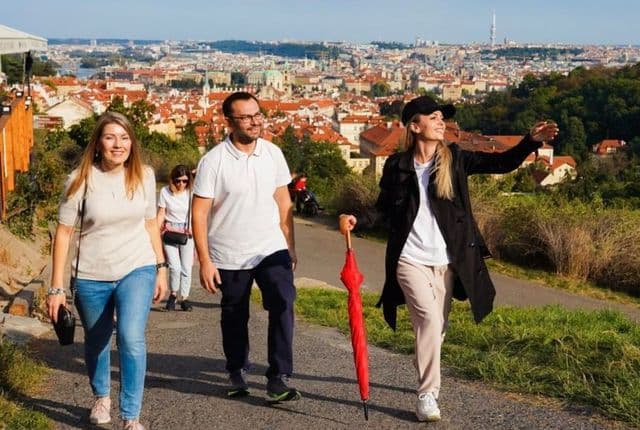
While you wait for reopening: The hill is fully accessible on foot from multiple directions. The walk from Újezd takes 15-20 minutes and passes along the medieval Hunger Wall. From Pohořelec (near Prague Castle), you can walk downhill to the tower in about 10 minutes.
A 30- or 90-minute transit ticket is not valid on the funicular — you need a 24-hour or 72-hour Prague transport ticket, or a separate funicular ticket. Seniors 65+ with a passport ride free.
How to Get to Petřín Tower (Funicular Update 2026)
Getting to Petřín Tower is straightforward, but there's one major caveat in 2026: the Petřín funicular is closed for a complete overhaul — new carriages are replacing the 1985 originals. Check the Prague Public Transit (DPP) website closer to your travel date for the reopening status.
While the funicular is closed, here's how to reach the tower:
Walking from Újezd (the most popular route) From the Újezd tram stop (trams 9, 12, 15, 20, 22), enter Petřín park through the gate near the Hunger Wall. The uphill walk takes about 15-20 minutes at a comfortable pace. The path is paved but steep in sections — wear proper shoes. Along the way you'll pass the Hunger Wall (Hladová zeď), a 14th-century fortification built by Charles IV partly as a public works project to feed the poor during famine.
Walking from Strahov / Pohořelec If you're coming from Prague Castle or the Strahov Monastery area, you can enter Petřín from the top and walk downhill to the tower — a much easier approach. From the Pohořelec tram stop, follow Strahovská street south past the monastery, enter the park, and you'll reach the tower in about 10 minutes.
Walking from Kinského zahrada (south approach) Enter through Kinský Garden from Švandovo divadlo tram stop. This is the least crowded approach and takes you through one of Prague's most elegant English-style parks. Allow 20 minutes uphill.
Insider detail: The area around the tower is one of the few spots in central Prague where you can genuinely escape crowds, especially on weekday mornings. The rose garden adjacent to the tower blooms from late May through October, and the observatory (Štefánikova hvězdárna) next door offers daytime solar observations and evening stargazing sessions — a detail most visitors overlook entirely.
The tower itself is a 63.5-metre steel structure built in 1891 as a loose homage to the Eiffel Tower — though at roughly one-fifth the height. The 299-step climb to the top rewards you with a panorama that, on clear days, extends to the Krkonoše mountains 150 km away.
Experience It With a Private Guide
Petřín connects to some of Prague's best stories — the 1891 exhibition that gave the city its mini Eiffel Tower, the medieval public works project behind the Hunger Wall, and the monks who've been brewing beer on the hilltop since the 12th century. On our Prague Castle and Lesser Town tour, we include the hill as part of a walk that descends through Malá Strana's baroque streets — architecture above, gardens and views below.
Exclusively yours, with your own guide — we shape the route around what you want to see.
Our All Prague in One Day tour covers Petřín alongside the castle, Old Town, and Vyšehrad for a complete picture of the city in a single day. And for an evening that's nothing like a hill walk, our medieval dinner at U Pavouka Tavern offers fire dancers, sword fights, and unlimited mead in a vaulted stone cellar.
Browse all our private tours in Prague.
Frequently Asked Questions
How do I get to Petrin Hill?
The funicular from Ujezd street in Mala Strana is the easiest way up once it reopens after reconstruction. You can also walk up from Ujezd, from Strahov Monastery, or from the castle district. The climb takes 15 to 20 minutes on foot.
How much does the Petrin Tower cost?
Around 150 CZK for adults. Combined tickets with the mirror maze are available. A 30- or 90-minute transit ticket is not valid on the funicular — you need a 24-hour or 72-hour ticket, or a separate funicular ticket. The hill and gardens are free.
Is Petrin Hill worth visiting with children?
Absolutely. The funicular ride, the tower climb, and the mirror maze are highlights for children. The hill itself is a large park with open lawns and paths — plenty of space to run. The rose garden and observatory add interest for older children.
What is the best time to visit Petrin?
Late afternoon into sunset for the tower views. Weekday mornings for quiet walks. Late April for cherry blossoms on the hillside. The tower is open year-round, with shorter winter hours.
You May Also Like
Want to see Prague for yourself?
Take our flagship Prague tour-6-640x430.jpg&w=3840&q=75)