Powder Tower Prague — One of the Last Remaining City Gates
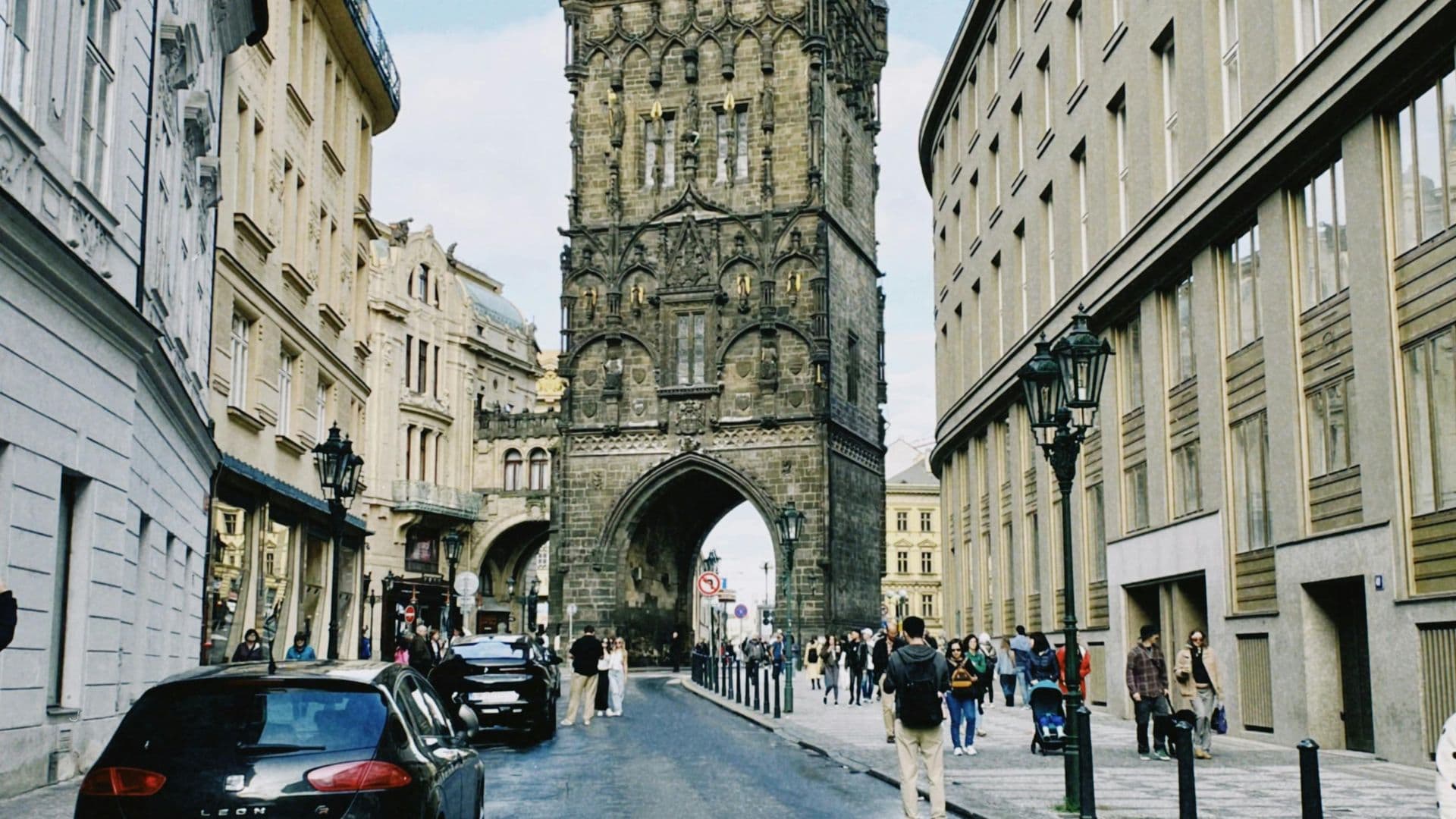
The Prašná brána stands at the entrance to the Old Town like a dark Gothic exclamation point — 65 metres of blackened stone rising above the traffic of Náměstí Republiky. It is one of the original thirteen gates that once punctured Prague's medieval fortifications, and one of only two that survive (the other is the Lesser Town Bridge Tower at the far end of Charles Bridge). Most visitors photograph it and walk through. A fifteen-minute climb to the top adds a perspective that the street-level glance misses entirely.
We stop at the Powder Tower on our private tours because it connects three stories at once: medieval fortification, royal ceremony, and the explosive material that gave it its name.
A Gate Built for a King
Construction began in 1475, during the reign of King Vladislav II Jagiellon. The gate was intended to replace an older entrance to the Old Town and to serve as a grand ceremonial portal — a statement of royal authority at the border between the city and the royal district. Vladislav had his court at the Královský dvůr (Royal Court), which stood on the site now occupied by the Municipal House, directly adjacent to the gate.
The architect was Matěj Rejsek, who also designed the ornamental gallery of the Old Town Bridge Tower. Rejsek gave the Powder Tower a similar treatment: elaborate Gothic tracery, sculptural decoration, and a sense of vertical ambition that stretches the basic form of a city gate into something closer to a cathedral tower.
But the project was interrupted. In 1483, a civil uprising forced Vladislav to move his court from the Old Town to Prague Castle, where the Bohemian kings remained from that point forward. Without royal patronage, construction slowed and eventually stopped. The tower was left with a temporary roof, unfinished and partly bare, for roughly four centuries.
Why "Powder Tower"?
The name comes from its use in the 17th century as a gunpowder storage facility. After the tower lost its ceremonial function — the city walls had become obsolete as the city expanded — it served various mundane purposes. Storing gunpowder in a medieval gate tower was practical but risky. The powder was eventually moved to safer locations, but the name stuck.
Before it became the Powder Tower, it was simply called the New Tower (Nová věž), to distinguish it from the older gate it replaced. The "Prašná brána" name appeared in common use from the 17th century onward. It's one of those Prague names that tells you more about the building's second life than its original purpose.
The 19th-Century Restoration
The Powder Tower you see today is substantially a product of the 1875-1886 restoration led by the architect Josef Mocker. Mocker was Prague's most active Gothic revivalist — he also worked on St. Vitus Cathedral, the Old Town Bridge Tower, and Karlštejn Castle. His approach was interventionist: he completed what the medieval builders hadn't finished, added sculptural programs, and gave the tower its current pointed roof.
The result is a building that looks thoroughly medieval but is partly Victorian. The sculptures on the facade — Czech kings, patron saints, allegorical figures — are Mocker's additions, not Rejsek's. The interior vaulting and the gallery at the top are also from the restoration period. This doesn't diminish the tower — it makes it a characteristic example of how 19th-century Prague rebuilt its medieval identity, sometimes more enthusiastically than the medieval builders themselves.
One detail that reveals the restoration: look at the stone color. The lower courses are darker — original 15th-century sandstone, blackened by centuries of Prague air. The upper sections are slightly lighter, where Mocker's masons used newer stone. The boundary between old and new is visible if you know to look.
The Observation Gallery
The tower is open to visitors, and the climb takes you up a narrow spiral staircase — 186 steps — to an observation gallery at approximately 44 metres. The view is excellent: the Old Town rooftops to the west, the Municipal House directly below, Na Příkopě stretching toward Wenceslas Square, and the towers of the Týn Church and Old Town Hall rising above the medieval street grid.
The gallery is enclosed with Gothic tracery openings rather than open-air, which means you're looking through stone frames rather than standing in the wind. The effect is photogenic — the tracery creates natural frames for the cityscape. The interior of the tower contains a small exhibition on Prague's medieval fortifications and the tower's history.
Budget fifteen to twenty minutes for the visit: five minutes up, five to ten minutes at the top, five minutes down. The staircase is narrow and passing other visitors requires patience, but the tower is rarely as crowded as the Old Town Hall tower or the castle viewpoints.
The Coronation Route
The Powder Tower's original purpose was ceremonial, and its most important function was as the starting point of the Královská cesta (Royal Route) — the path that Bohemian kings followed on their way to be crowned at St. Vitus Cathedral. The route ran from the Royal Court through the Powder Tower gate, down Celetná street, across the Old Town Square, along Karlova street, over Charles Bridge, through Malá Strana, and up to the Castle.
This route is still walkable — and walking it is one of the best ways to experience the historical core of Prague. Every building along the way was designed to be seen from this procession, and the facades get progressively grander as the route approaches the Castle. When we guide our guests along this path, the Powder Tower serves as the starting frame: the gate through which the procession entered the city.
The last coronation to follow this route was that of Ferdinand V in 1836. But the path itself remains embedded in Prague's street layout — a medieval procession route that has become the city's most walked tourist corridor, though few of the walkers know they're following a king's footsteps.
Seeing the Powder Tower With a Private Guide
The Powder Tower is a quick visit — fifteen to twenty minutes — but its significance extends far beyond the climb. It connects to the coronation route, to the Municipal House next door, to the city's medieval fortifications, and to the 19th-century restoration movement that gave Prague much of its current appearance.
On our All Prague in One Day private tour, we use the Powder Tower as the gateway to the Old Town, explaining its layers as we begin the walk along the Royal Route. Exclusively yours, with your own guide.
For an evening that takes the medieval theme further, continue with a medieval dinner at U Pavouka Tavern — fire dancers, spit-roasted meats, and mead in a Gothic cellar that would have been familiar to the kings who passed through the Powder Tower's gate.
Browse all our private tours in Prague.
Frequently Asked Questions
How tall is the Powder Tower?
The Powder Tower stands approximately 65 metres tall. The observation gallery is at about 44 metres, reached by 186 steps via a narrow spiral staircase. The climb takes about five minutes.
Why is it called the Powder Tower?
The tower was used to store gunpowder in the 17th century, after it lost its ceremonial function as a city gate. The gunpowder was eventually moved elsewhere, but the Czech name Prasna brana (Powder Gate) stuck and has been used ever since.
How long does it take to visit the Powder Tower?
Budget fifteen to twenty minutes — five minutes climbing the spiral staircase, five to ten minutes at the observation gallery enjoying the views and the small exhibition, and five minutes descending. It is one of Prague's quickest worthwhile visits.
What is the connection between the Powder Tower and the Municipal House?
The two buildings stand side by side and share a short covered passage. The Municipal House was built in 1905-1912 on the site of the Royal Court, where Bohemian kings lived when the Powder Tower was constructed in 1475. The Powder Tower served as the ceremonial gate to the royal residence.
You May Also Like
Want to see Prague for yourself?
Take our flagship Prague tour-6-640x430.jpg&w=3840&q=75)