Vysehrad — Prague's Other Castle That Most Visitors Skip
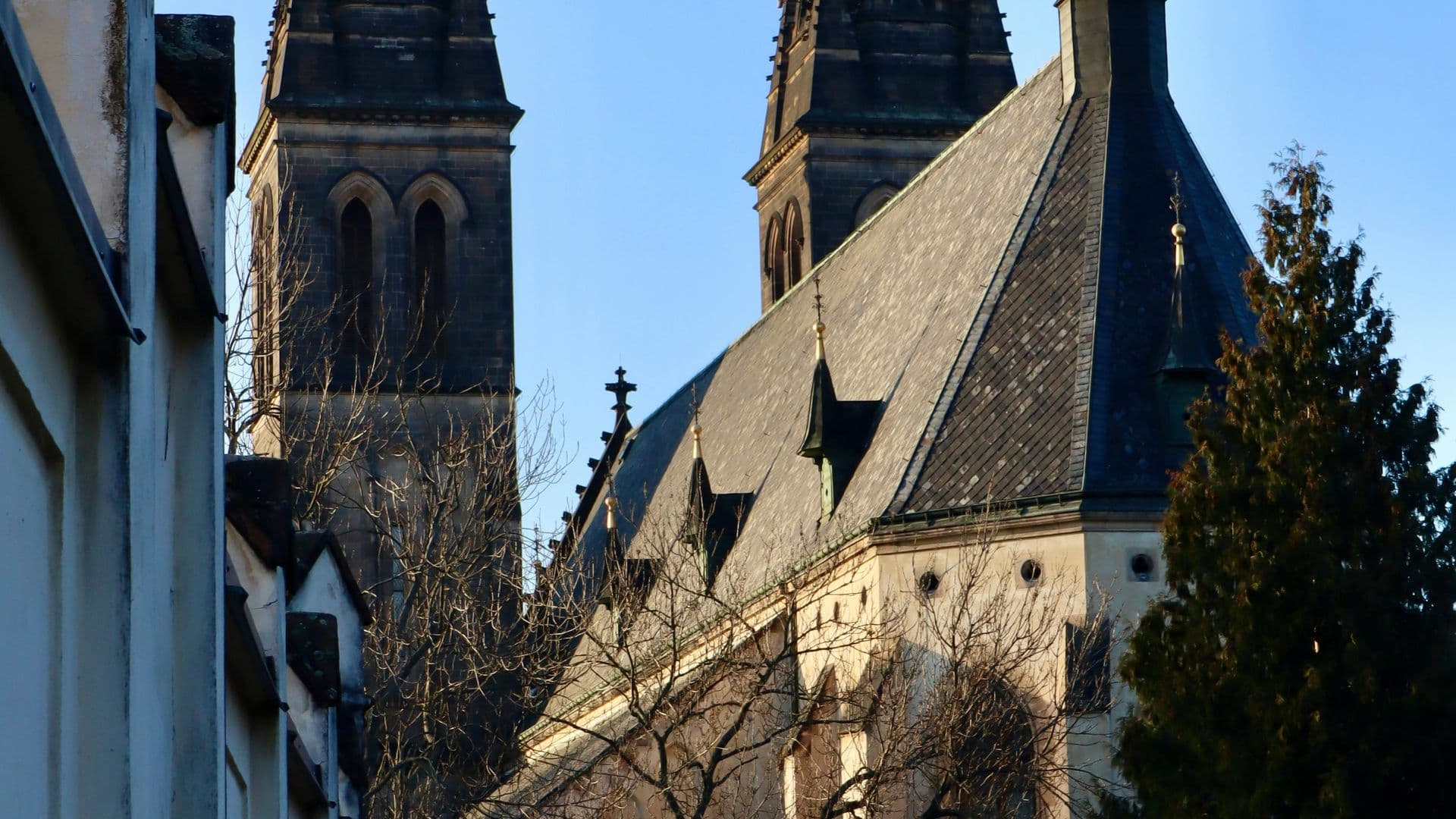
Prague has two ancient fortresses on high ground above the Vltava. Everyone visits one. Almost no one visits the other. Vyšehrad sits on a rocky bluff at the southern end of the city, older in legend than Prague Castle itself, and on most days you'll share its ramparts with a handful of locals walking their dogs. That's the draw — and that's what makes it worth the trip.
We include Vyšehrad in our All Prague in One Day tour, and the reaction from guests is consistently the same: they had no idea this place existed. A 10th-century fortress with Romanesque foundations, a neo-Gothic basilica, one of Europe's great cemeteries, and panoramic views that rival anything from Prague Castle — all without a queue, a ticket line, or a crowd.
The Legend and the History
According to Czech mythology, the princess Libuše stood on the cliffs of Vyšehrad and prophesied the founding of a great city — Prague. She pointed across the river to where a man was carving a threshold (práh) for his house, and declared that on that spot a city would rise whose glory would touch the stars. The scene is central to Bedřich Smetana's opera *Libuše* and to Czech national identity. On our private Vyšehrad walking tour, the cliffs Libuše stood on are still the first stop — and the view across the river is unchanged from her age to yours.
The historical record is more measured but no less interesting. Vyšehrad was a royal seat in the 11th century under Vratislav II, who moved his court here from Prague Castle after quarreling with his brother, the Bishop of Prague. He built a fortified palace, a basilica, and what was then the most important religious chapter in Bohemia. For about a century, Vyšehrad was the political centre of the Czech lands.
Charles IV revived Vyšehrad in the 14th century, connecting it to the New Town walls and decreeing that every coronation procession must begin here before proceeding to Prague Castle. The route was symbolic — it linked the mythic origin of Czech sovereignty to the working seat of power. After the Hussite Wars in the 15th century, Vyšehrad was largely destroyed and never regained its former prominence. What remains is a fortress converted to baroque fortifications by the Habsburgs, sitting atop layers of medieval and Romanesque foundations.
The Basilica of St Peter and St Paul
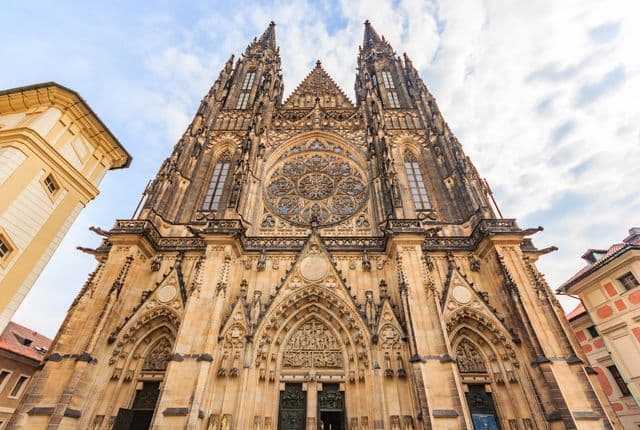
The Basilika svatého Petra a Pavla dominates the Vyšehrad skyline with its twin neo-Gothic spires, visible from across the river. The current building dates from the late 19th century, but the site has held a church since the 11th century. Inside, the Art Nouveau frescoes painted by František Urban and his collaborators between 1902 and 1903 cover every surface — walls, vaults, columns — in patterns that combine medieval motifs with Slavic decorative elements.
The effect is unusual. Unlike the baroque interiors of Prague's more famous churches, the Vyšehrad basilica feels distinctly Czech — designed during the National Revival as a statement of cultural identity rather than imperial devotion. The Romanesque stone sarcophagus believed to contain the remains of an early Přemyslid ruler sits in the crypt, though its exact provenance is debated.
Admission is modest — around 50 CZK — and the interior is rarely crowded. Photography is permitted. On a weekday morning, you may have the nave to yourself.
Slavín Cemetery — Where Czech Greatness Rests
The Slavín is a collective tomb and national monument at the eastern end of the Vyšehrad cemetery, and the cemetery itself is one of the most remarkable burial grounds in Europe. More than 600 notable Czech artists, composers, scientists, and writers are buried here, their graves marked by sculptural works that often rival the art they created in life.
Walk through the rows and you'll find Antonín Dvořák, whose grave is marked by a simple cross and a small bust. Bedřich Smetana lies nearby — the composer whose *Má vlast* gave Vyšehrad its most famous musical tribute. Alfons Mucha, the Art Nouveau master, is here as well, along with the writers Karel Čapek (who gave the world the word "robot") and Božena Němcová.
The Slavín monument itself, designed by Antonín Wiehl with a winged angel on top, is inscribed with the words *"Ač zemřeli, ještě mluví"* — "Though they have died, they still speak." It's one of those rare monuments where the sentiment matches the reality. The work of the people buried here still defines Czech culture.
The cemetery is beautifully maintained and free to enter. Unlike the grand cemeteries of Paris or Vienna, it remains a working parish cemetery as well — local families still tend graves alongside the national monuments. That mix of the ordinary and the extraordinary gives it a character that purely monumental cemeteries lack.
The Casemates and Gorlice Hall
Vyšehrad's casemates — the underground passages within the baroque fortification walls — are one of the fortress's best-kept features. Originally built as ammunition storage and defensive tunnels, parts of the system are now open to the public as a guided tour.
The highlight is Gorlice Hall, a vast underground space that houses six of the original baroque statues from Charles Bridge. These are the originals — not the copies that stand on the bridge today. Seeing them at ground level, in the cool half-light of the casemates, gives a completely different sense of their scale and craftsmanship. The expressions on the saints' faces, the texture of the stone, the details of their robes — none of this is visible from the bridge, where you see them from below at a distance.
The casemate tour takes about 30 minutes and costs around 90 CZK. Groups are small and guides are knowledgeable. The temperature underground stays cool year-round, so bring a layer even in summer.
The Ramparts and the Views
Vyšehrad's fortification walls form a walking circuit around the entire bluff, and the views from the ramparts are among the finest in Prague — with the critical advantage that almost no one is up here to block them.
From the northern ramparts, you look directly across the river toward Prague Castle and the spires of Old Town. The full sweep of the Vltava, from the railway bridge in the south to the castle district in the north, unfolds below you. On clear mornings, the light hits the river surface and the castle glows above the city.
The western ramparts face Smíchov and Petřín Hill, with a view down into the valley that few photographs capture. The southern side looks toward the residential districts and the Nusle Bridge — the enormous motorway viaduct that carries the D1 highway and the metro across the Nusle Valley.
Photographers find the northern ramparts best at sunset, when the light catches the castle and the river turns golden. But the truth is, every direction has something worth framing, and you'll rarely have to wait for someone to step out of your shot.
The Grounds
Beyond the fortress walls, the Vyšehrad park fills the interior of the fortifications with green lawns, old trees, and quiet paths. Locals come here to jog, read, and walk their dogs. The ruins of a Romanesque bridge and the remains of a medieval gatehouse are scattered among the greenery — archaeology exposed but not fenced off, integrated into the daily life of the park.
The rotunda of St Martin (Rotunda svatého Martina), dating from the 11th century, is one of the oldest surviving buildings in Prague. It's tiny — barely six metres in diameter — and it sits in the grass near the main gate as if it has always been there, which it more or less has. The rotunda is not open to the public on a regular schedule, but its exterior alone is worth a moment.
A small information centre near the main entrance has maps and brochures, and a cafe on the grounds serves coffee and light meals with a view over the park. It's not a destination cafe, but it's a perfectly pleasant place to sit after walking the ramparts.
How to Get There
Vyšehrad is a ten-minute metro ride from the city centre. Take the red line (C) to Vyšehrad station, then walk through the park toward the fortress — the spires of the basilica are visible from the station. The walk takes about five minutes along a tree-lined path.
You can also approach from the river side, walking south along the Vltava embankment from the dancing house area. This route takes about 25 minutes on foot and gives you a dramatic approach — the fortress walls rise above you as you near the bluff. Tram 2 or 3 to Výtoň puts you at the base of the hill with a short uphill walk to the gate.
Budget at least 90 minutes for a comfortable visit — enough for the cemetery, the basilica, the ramparts, and the casemates. A full morning is better if you want to sit on the walls and absorb the views.
Park and Garden Walks
If you enjoyed the views and greenery at Vysehrad, Riegrovy Sady is the natural next stop. This hilltop park in the Vinohrady neighbourhood is where locals go on warm evenings to spread a blanket on the grass and watch the sun set behind Prague Castle. The park's beer garden is one of the city's best, and the panoramic view of the Old Town skyline is completely unobstructed -- a quieter, more relaxed alternative to the tourist-heavy viewpoints.
Experience It With a Private Guide
Vyšehrad is one of those places where the stories transform the stones. The legends, the cemetery, the hidden statues in the casemates — they all connect to the larger story of Prague, but you wouldn't know it from the signage alone. On our All Prague in One Day private tour, we include Vyšehrad alongside the castle, Old Town, and the Jewish Quarter — a complete picture of Prague that most single-day itineraries miss entirely.
Exclusively yours, with your own guide — we move at your pace and spend time where it interests you most.
For a completely different Prague experience in the evening, our medieval dinner at U Pavouka Tavern pairs well with a day that began on Vyšehrad's ancient ramparts. Roasted meats, unlimited mead, fire dancers, and a vaulted stone cellar — it's the perfect contrast to a contemplative morning among the graves of Dvořák and Smetana.
Browse all our private tours in Prague.
Curious about Prague's original castle? Our private Vyšehrad Fortress tour walks the ramparts, the Slavín cemetery and the Romanesque rotunda — the city's most peaceful views and its founding myth in two hours. Pay by card online or cash on the day. Free cancellation up to 24 hours before your tour.
Frequently Asked Questions
Is Vysehrad free to visit?
The fortress grounds, ramparts, park, and cemetery are free and open year-round. The basilica interior costs about 50 CZK and the casemate tour about 90 CZK. There is no general admission fee for the complex.
How long does a visit to Vysehrad take?
At least 90 minutes for the key sights — cemetery, basilica, ramparts, and casemates. A leisurely half-day allows time to walk the full rampart circuit, explore the park, and sit with a coffee.
Is Vysehrad worth visiting compared to Prague Castle?
They offer different experiences. Prague Castle is grand, monumental, and crowded. Vysehrad is quieter, more atmospheric, and connects to a deeper layer of Czech mythology and history. Most visitors who make the trip say they wish they had come sooner.
How do I get to Vysehrad?
Take the red metro line (C) to Vysehrad station, then walk five minutes through the park to the fortress gate. Tram 2 or 3 to Vyton brings you to the base of the hill from the river side.
You May Also Like
Want to see Prague for yourself?
Take our flagship Prague tour-6-640x430.jpg&w=3840&q=75)