Dancing House Prague — The Story of the Building Everyone Photographs
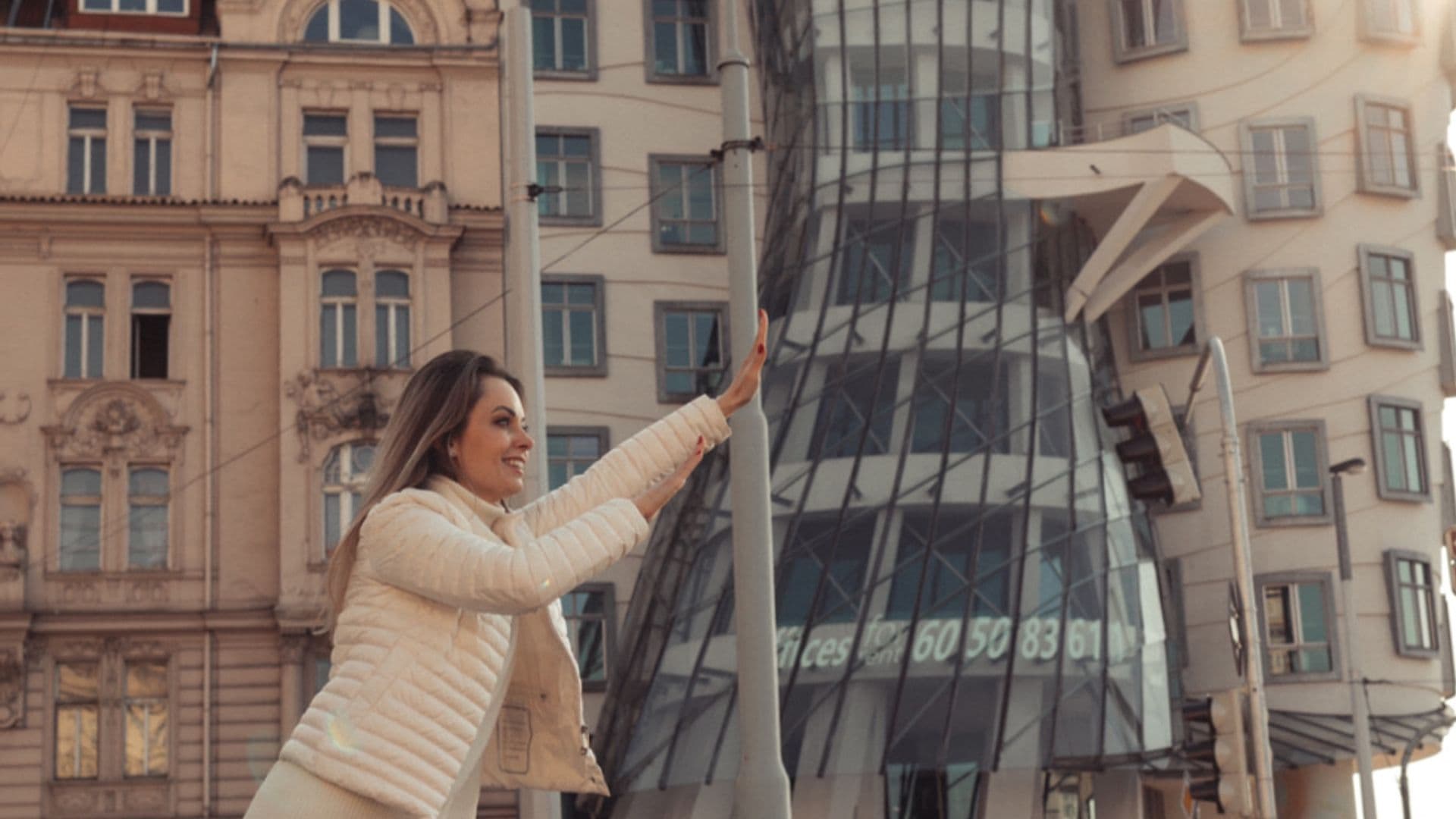
The Tančící dům sits on the Vltava embankment at the corner of Rašínovo nábřeží and Jiráskovo náměstí, and it looks exactly like its nickname suggests — two figures mid-dance, one curving into the other. The building has been photographed millions of times since its completion in 1996, but most visitors snap the picture, check the name on their phone, and move on. The story behind it is more interesting than the photo.
We pass the Dancing House on our private walking tours and it always provokes a reaction — admiration, confusion, or the conviction that it doesn't belong. All three responses are historically correct. Here's what happened and why the building matters.
Gehry, Milunic, and a Bomb Site
The site where the Dancing House stands was empty for decades. During the Allied bombing of Prague on 14 February 1945, a stray American bomb destroyed the building that had occupied this corner. The rubble was cleared, but the gap in the otherwise continuous row of 19th-century apartment buildings remained unfilled through the entire communist era.
In the early 1990s, the plot was acquired by the Dutch insurance company Nationale-Nederlanden. The architect chosen for the project was Vlado Milunić, a Czech-Croatian architect who had lived and worked in Prague for years. Milunić wanted to create something that would acknowledge the gap — not fill it with a pastiche of the surrounding Neo-Baroque facades, but respond to them with something deliberately contemporary.
Milunić brought in Frank Gehry as a collaborating architect. Gehry was already famous for his deconstructivist work, and his involvement elevated the project from a local curiosity to an international event. The two architects worked together, with Milunić handling the functional planning and Gehry contributing the sculptural form — the curved glass tower and the concrete tower that lean into each other.
Fred and Ginger — The Nickname That Stuck
The building was originally intended to be called "Fred and Ginger" after Fred Astaire and Ginger Rogers — the glass tower (with its curved, skirt-like panels) being Ginger, and the solid concrete tower (upright, slightly leaning) being Fred. The metaphor is a pair of dancers: one rigid, one fluid, locked together in movement.
Gehry reportedly disliked the nickname, and the official name became the neutral "Dancing House." But the Fred and Ginger label persisted because it's more evocative and because the resemblance, once suggested, is impossible to unsee. The building dances — that's not a metaphor layered on afterward; it's the architect's intention made literal in glass and concrete.
The Controversy — Does It Belong?
When the design was unveiled, Prague's architectural establishment split sharply. The building sits in a row of late 19th-century facades along the embankment — solid, symmetrical, historicist. The Dancing House breaks every rule those buildings follow: it curves where they're straight, it's asymmetrical where they're balanced, it uses glass and exposed concrete where they use plaster and stone.
Václav Havel lived in the apartment building directly next door — at Rašínovo nábřeží 78 — and he actively supported the project. Havel saw the Dancing House as a symbol of post-communist creativity: Prague liberating itself from the conformity of the previous regime and embracing boldness. His endorsement carried weight, but it didn't silence the critics. Some architects and preservationists argued that the building was an act of architectural colonialism — a Western star architect imposing his signature on a city that didn't need it.
Thirty years later, the debate has cooled. The building has been absorbed into Prague's skyline. Most Praguers have made their peace with it, even if they wouldn't want another one. It remains the only Gehry building in the Czech Republic.
What's Inside
The Dancing House is not just a sculpture — it's a functioning office building. The upper floors house commercial offices, and most of the interior is not accessible to the public. But two spaces are worth knowing about.
The rooftop terrace and bar (Ginger & Fred Restaurant, now operating under various names through the years) offers panoramic views of the Vltava, Prague Castle, and Vyšehrad. The terrace is small but well-positioned — you look north toward the castle and south along the river bend. The drinks are priced for the view, not the neighborhood, but on a clear evening the panorama justifies it. Access is via the elevator inside the building.
The gallery on the ground floor rotates exhibitions, primarily contemporary art and photography. It's a small space — fifteen to twenty minutes is sufficient — but it provides a reason to step inside rather than just photographing the exterior.
The Embankment — Rašínovo Nábřeží
The Dancing House sits on one of Prague's finest riverside stretches. Rašínovo nábřeží runs along the east bank of the Vltava from Jiráskův most (Jirásek Bridge) south toward Vyšehrad. The embankment is lined with handsome apartment buildings, mostly from the 1890s-1910s, and the Dancing House's contrast with its neighbors is more dramatic from the river walk than from the street.
Walking south along the embankment from the Dancing House takes you past the Vytoň area — a quiet residential stretch where boats are moored along the bank — and eventually to the base of Vyšehrad, the ancient fortress overlooking the river. Walking north crosses the Jirásek Bridge and connects to the National Theatre and the Old Town beyond.
The best photograph of the Dancing House is taken from the opposite bank — cross the Jirásek Bridge and walk south along Hořejší nábřeží on the Smíchov side. From there, you see the building in context: its neighbors, its relationship to the river, and the way the curved glass catches afternoon light.
Seeing the Dancing House With a Private Guide
The Dancing House is a five-minute stop or a twenty-minute story. The building makes more sense when someone explains the bomb site, the Havel connection, and the architectural debate — details that transform it from a quirky building into a chapter of Prague's post-1989 reinvention.
On our All Prague in One Day private tour, we pass the Dancing House as part of the full sweep from medieval Prague through the communist era to the modern city. Exclusively yours, with your own guide.
For an evening after exploring modern Prague, try a medieval dinner at U Pavouka Tavern — from deconstructivism to Gothic vaulted cellars in the same day.
Browse all our private tours in Prague.
For Prague without the Charles Bridge crowds, our private Vyšehrad Fortress tour walks the ridge where the city began — Smetana and Dvořák's resting place, a Romanesque rotunda, and views most tourists never find.
Frequently Asked Questions
Who designed the Dancing House in Prague?
The building was designed by Czech-Croatian architect Vlado Milunić in collaboration with the Canadian-American architect Frank Gehry. Milunić handled the functional design, Gehry contributed the sculptural form. It was completed in 1996.
Can you go inside the Dancing House?
The upper floors are private offices. The rooftop bar and terrace are open to the public and offer panoramic views of Prague. A small gallery on the ground floor hosts rotating exhibitions. No ticket is needed for the rooftop — you simply take the elevator up and buy a drink.
Why is it called Fred and Ginger?
The two towers resemble a dancing couple — the curved glass tower is Ginger Rogers and the upright concrete tower is Fred Astaire. The nickname was part of the original concept, though Gehry preferred the more neutral "Dancing House."
Is the Dancing House worth visiting or just photographing?
Both. The rooftop terrace offers excellent views of the Vltava, Prague Castle, and Vyšehrad. The best exterior photograph is taken from the opposite bank of the river, where you see the building in context with its 19th-century neighbors.
You May Also Like
Want to see Prague for yourself?
Take our flagship Prague tour-6-640x430.jpg&w=3840&q=75)