Hluboká Castle: The Complete Guide to the Most Beautiful Castle in the Czech Republic
In 1837, Johann Adolf II of Schwarzenberg and his wife Eleonore attended Queen Victoria's coronation in England. They saw Windsor Castle. And they decided they must have something like it at home.
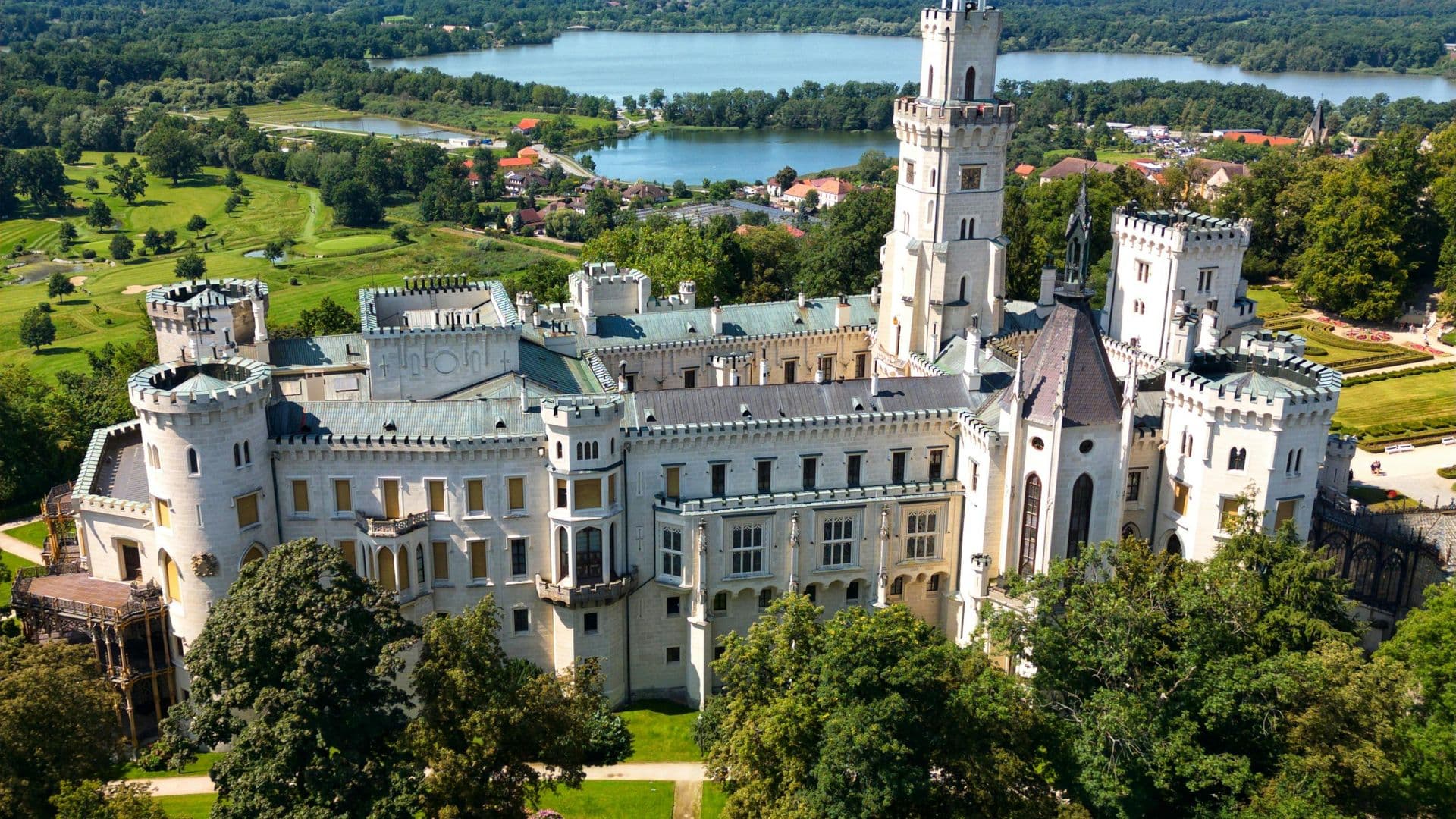
What followed was one of the great acts of aristocratic ambition in Bohemian history — a complete reconstruction of their South Bohemian castle in the Neo-Gothic style, modelled explicitly on Windsor, completed in 1871, and universally considered today the most beautiful castle in the Czech Republic.
A Hluboká Castle day trip from Prague takes you 145 kilometres south of the city to see the result. Having seen it, it is hard to argue with the verdict.
The castle that wanted to be Windsor
The original fortress on this site was built by King Ottokar II of Bohemia in the second half of the 13th century. It changed hands many times over the following centuries — passing through royal ownership, the Lords of Hradec, the Marradas family and eventually the Schwarzenbergs, who acquired Hluboká in 1661 and retained it for nearly 300 years.
It was Johann Adolf II and his wife Eleonore who transformed Hluboká into what you see today. Inspired by Windsor Castle after their visit to England for Queen Victoria's coronation, they commissioned Vienna architect Franz Beer to carry out a complete reconstruction in the romantic Neo-Gothic style. Work began in 1841 and was completed in 1871. The result: 140 rooms, 11 towers and a silhouette that stops visitors in their tracks.
The comparison to Windsor is not accidental or approximate. Beer studied Windsor closely and replicated specific architectural details — the battlements, the towers, the proportions of the walls. Set above the Vltava River and surrounded by a vast English landscape park, Hluboká achieves something rare: a 19th-century castle that looks genuinely ancient, genuinely grand and genuinely at home in its landscape.
The interior
If the exterior of Hluboká surprises, the interior overwhelms.
The Schwarzenbergs were one of the great aristocratic collecting families of Central Europe, and the castle reflects several lifetimes of acquisition. The state rooms contain 57 Flemish tapestries — among the finest collections of their kind in Central Europe. Original Schwarzenberg furniture accumulated over generations. A portrait gallery spanning five centuries of family history. A library of over 12,000 volumes, the oldest dating to the 16th century — used by the Schwarzenbergs, who were known as voracious, polyglot readers.
Unlike many Czech castles where the interiors feel stripped after decades of Communist-era state management, Hluboká feels lived in. Because it was — until 1939, when the last owner, Adolph Schwarzenberg, emigrated overseas to escape the Nazis. The Gestapo seized the castle in 1940. In 1947, the Communist government nationalised it under a special law — the Lex Schwarzenberg — targeting the family's extensive Czech holdings. The family never returned. But the interiors survived remarkably intact.
The English park and the Vltava
The castle sits at the centre of a vast English landscape park stretching along both banks of the Vltava River. This is not a formal garden — it is a designed landscape in the English tradition, with winding paths, mature trees, ponds and views carefully composed to show the castle to maximum effect from every angle.
Walking through the park is one of the great pleasures of a Hluboká visit. The approach along the river gives you the castle reflected in the water. The path up through the park delivers you to the gates with the towers rising above. In autumn, when the trees turn, the effect is extraordinary.
Hluboká and Český Krumlov
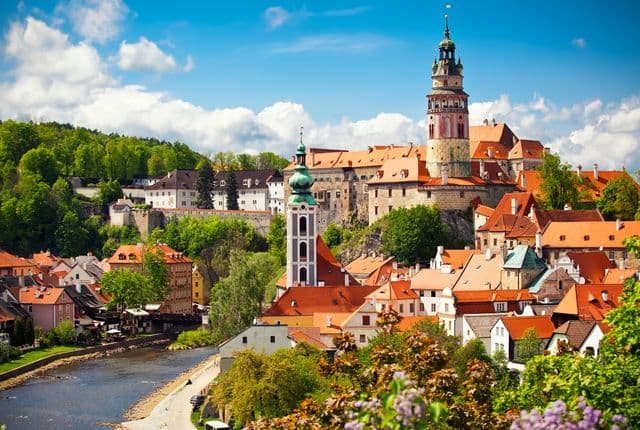
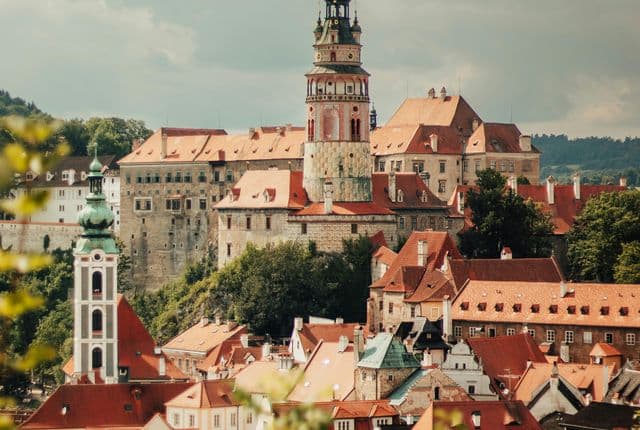
Hluboká combines naturally with Český Krumlov — and not just because both are in South Bohemia. Both were Schwarzenberg properties. The family's history connects them: the same dynasty that built Hluboká as a Windsor-inspired residence also owned and shaped Český Krumlov for generations. Together they tell the story of the most powerful aristocratic family in Bohemian history.
This day trip is best with a guide who handles the logistics and storytelling. Meet our team.
Geographically the two castles are around 30 kilometres apart. A private day trip combining both gives you the most beautiful castle in Bohemia and the most beautiful medieval town in Europe in a single extraordinary day.
Practical information
Getting there: Hluboká nad Vltavou is approximately 145 kilometres from Prague — around 2 hours by private car. The town of Hluboká is small; the nearest large town is České Budějovice, just 7 kilometres away.
The castle tour: Hluboká can only be visited on a guided tour. Several circuits are available covering different parts of the castle. The main state rooms circuit — which includes the tapestries, the portrait gallery and the main reception rooms — takes around 50 minutes. Book in advance in high season.
Opening hours: The castle is open year-round, with reduced hours in winter and closed on Mondays outside of July and August. Check current opening times before your visit.
How long do you need? The castle tour plus time in the park takes around 2 to 3 hours. Combined with Český Krumlov, it makes a full and extraordinary day from Prague.
Why go with a private guide
The exterior of Hluboká speaks for itself — you do not need a guide to appreciate the silhouette above the river or the drama of the approach through the park. What a guide adds is the story behind what you are looking at: who the Schwarzenbergs were, why they chose Windsor as their model, what happened to the family and the castle after 1939, and why 57 Flemish tapestries ended up in a Neo-Gothic castle in South Bohemia.
Without that context, Hluboká is a beautiful building. With it, it becomes a chapter in one of the great aristocratic stories of Central Europe.
Our private Hluboká Castle day trip from Prague includes door-to-door transport from your hotel, a licensed guide for the full visit and everything at your own pace. The trip combines naturally with Český Krumlov — both Schwarzenberg properties, both in South Bohemia, together the finest day from Prague.
Frequently asked questions
How far is Hluboká Castle from Prague? Approximately 145 kilometres — around 2 hours by private car. Our private Hluboká Castle day trip from Prague includes hotel pickup and drop-off from anywhere in the city.
Why is Hluboká called the Czech Windsor Castle? Because it was deliberately modelled on Windsor Castle in England. In 1837, Johann Adolf II of Schwarzenberg and his wife Eleonore attended Queen Victoria's coronation, saw Windsor, and commissioned Vienna architect Franz Beer to rebuild their South Bohemian castle in the same Neo-Gothic style. The reconstruction was completed in 1871.
Can Hluboká be combined with Český Krumlov? Yes — and it is one of the best combinations in the Czech Republic. Both castles are Schwarzenberg properties in South Bohemia, around 30 kilometres apart. Together they make one of the most extraordinary day trips from Prague.
Is Hluboká Castle open year-round? Yes, with reduced hours in winter. Outside of July and August the castle is closed on Mondays. It can only be visited on a guided tour. Check current opening times and book in advance during high season.
What is the best thing about Hluboká Castle? Different visitors give different answers. The exterior silhouette above the Vltava is unlike anything else in Bohemia. The 57 Flemish tapestries inside are among the finest in Central Europe. The English park is one of the most beautiful in the country. It is rare to find a castle where every element — setting, architecture, interiors — is equally extraordinary.
Planning your trip? See our day trips from Prague for details.
Planning your trip? See our Prague tour prices for details.
Want to see Prague for yourself?
Tour Hluboká Castle in South Bohemia