John Lennon Wall Prague — The Story Behind the Paint
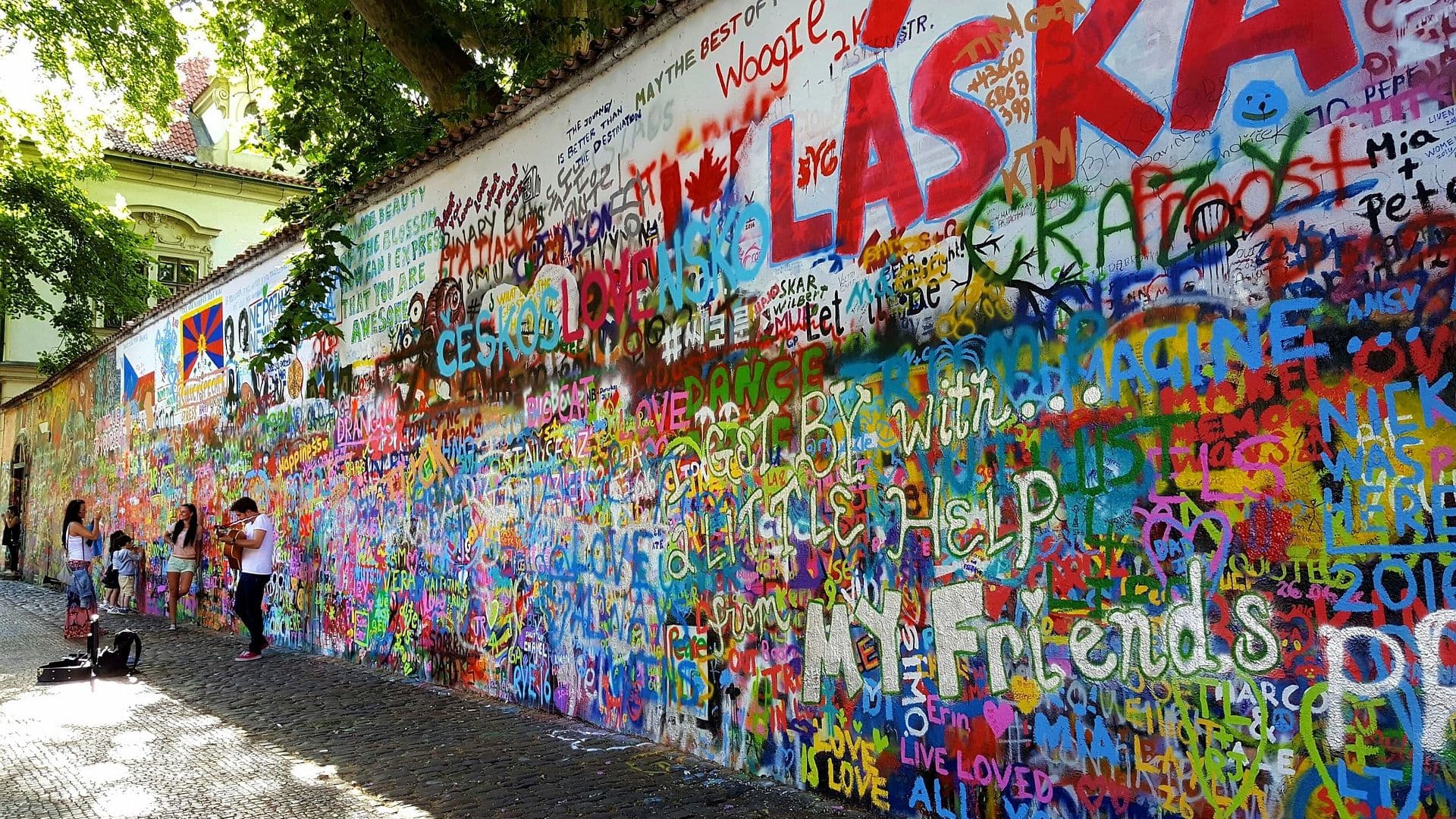
The wall is easy to find. Walk south from Charles Bridge on the Malá Strana side, turn into Velkopřevorské náměstí (Grand Priory Square), and you'll see it — a stretch of masonry covered edge to edge in spray paint, marker, stickers, and layers of acrylic. Beatles lyrics. Peace signs. Love declarations in thirty languages. It looks like chaos, and it is, but it's chaos with a story that runs deeper than most visitors realize.
We pass the wall with our guests on the Charles Bridge and Old Town private tour, and there's always the same two-part reaction: first the phones come out for the photo, then the question — why is this here?
How It Started
When John Lennon was murdered in New York on December 8, 1980, young people in Prague turned this wall into a memorial. It belonged — and still belongs — to the Sovereign Order of Malta, whose Grand Priory sits directly behind it. Someone painted a portrait of Lennon. Others added lyrics from "Imagine" and "Give Peace a Chance." Flowers appeared at the base.
In 1980s Czechoslovakia, this was not harmless nostalgia. The communist regime viewed Western rock music as ideological subversion, and a public memorial to Lennon — a symbol of counterculture and pacifism — was a direct provocation. The StB (secret police) investigated the wall, tried to identify the painters, and the authorities whitewashed it repeatedly. Each time, within days or even hours, new messages, new portraits, and new lyrics reappeared.
The regime called the wall's supporters *"lennonisté"* and treated them as a political threat. Undercover agents monitored the square. Young people who were caught painting faced interrogation and sometimes worse. The wall became a proxy fight — not about Lennon specifically, but about the right to express anything that hadn't been approved by the state.
By the late 1980s, the wall had become so symbolically loaded that the French Embassy, which faces the square, reportedly asked the Czech authorities to stop the cycle of painting and whitewashing because the confrontations were disturbing the diplomatic compound. The authorities kept whitewashing. The painters kept painting.
After the Velvet Revolution
When the communist regime fell in November 1989, the wall survived. It could have become a preserved artifact — frozen in time, roped off, explained by a plaque. Instead, it kept being painted. The messages shifted from political protest to personal expression — love letters, travel quotes, song lyrics, political slogans from new causes. The surface is repainted so frequently that nothing survives more than a few weeks. What you see today is not what was there yesterday, and it won't be what's there tomorrow.
In 2014, a group of art students painted the entire wall white and wrote "Wall Is Over" — a reference to Lennon's "War Is Over" campaign. The reaction was immediate and angry. Many assumed it was vandalism or censorship. It turned out to be a sanctioned art project, but it raised a real question: who owns the wall's meaning? The white lasted about a day before new paint covered it.
The Knights of Malta, who own the property, have generally tolerated the painting, though in recent years they've worked with the city to manage it — installing cameras, setting boundaries for street vendors, and occasionally commissioning organized murals. The wall has found an awkward balance between spontaneous expression and managed attraction.
What's There Now
The wall is approximately 12 metres long and 3 metres high — smaller than most people expect. The paint is thick, layered, textured. In some spots you can feel the ridge lines of hundreds of coats beneath the current surface. The colours are vivid, constantly refreshed.
On any given day you'll find: Beatles lyrics (always), peace symbols (always), declarations of love in languages you may not recognize, political messages that range from thoughtful to naive, and the occasional genuine piece of art that rises above the general noise. The quality varies enormously. Some of it is beautiful. Some of it is marker scrawl. That's the point — nobody curates it.
Vendors sell spray paint cans near the square, and contributing to the wall is tacitly permitted. If you add something, be aware that it will be painted over within days. Permanence is not the medium here.
The Square and What's Nearby
Velkopřevorské náměstí deserves a moment beyond the wall itself. The Grand Priory of the Knights of Malta stands directly behind the wall — its baroque facade and coat of arms visible if you step back far enough. The French Embassy, in the Buquoy Palace, faces the square from the opposite side. The small Church of Our Lady below the Chain (Kostel Panny Marie pod řetězem), one of the oldest churches in Malá Strana, sits at the edge of the square with a courtyard that's open but overlooked.
From the wall, it's a two-minute walk to Kampa Island. Cross the footbridge over the Čertovka channel — the narrow waterway that separates Kampa from the mainland — and you're on the island with its park, the Kampa Museum, and the David Černý baby sculptures. The connection is natural: the wall, the island, and Charles Bridge above form a triangle that covers some of the most interesting ground in Malá Strana in about thirty minutes of walking.
The wall is also less than five minutes on foot from the Wallenstein Garden, with its peacocks, bronze statues, and bizarre grotto wall. If you're in this part of Malá Strana, combining the two makes a satisfying loop.
A private guide makes all the difference when exploring this part of Prague.
Why It Matters Beyond the Photo
Every day, dozens of visitors stand in front of the wall, take a selfie, and leave. That's fine — the wall is photogenic and the photo is free. But the wall's significance isn't in the paint. It's in the fact that people risked real consequences to put it there.
In the 1980s, painting a peace sign on a wall in Prague could get you arrested. The wall's power came from the act of painting, not from what was painted. It was a refusal to accept that public space belonged exclusively to the state. The regime understood this, which is why they kept sending crews to whitewash it — and why the painters kept coming back.
Today the context is different. Nobody risks arrest for painting the Lennon Wall. But the cycle of creation and erasure — paint, weather, overpainting, new paint — keeps the wall alive in a way that a plaque or a museum display never could. It's still changing. It's still unfinished. That's what makes it more than a photo opportunity.
Experience It With a Private Guide
The Lennon Wall is a two-minute stop or a twenty-minute story, depending on whether someone tells you what happened here. On our Charles Bridge and Old Town private tour, we walk through Malá Strana after crossing the bridge and stop at the wall to tell the full story — the 1980s confrontation, the secret police, the whitewashing cycles, and why a wall in a quiet square became one of the symbols of Prague's resistance.
Exclusively yours, with your own guide — we set the pace and choose the route based on what interests you.
For a completely different evening experience, our medieval dinner at U Pavouka Tavern trades protest art for fire dancers, roasted meats, and unlimited mead in a vaulted cellar. It's the kind of contrast that makes a day in Prague memorable.
Browse all our private tours in Prague.
Frequently Asked Questions
Where exactly is the John Lennon Wall?
On Velkoprevorskeho namesti (Grand Priory Square) in Mala Strana, about a two-minute walk south from Charles Bridge on the west bank. Follow Lazenska street from the bridge and turn right into the square.
Can I paint on the Lennon Wall?
Painting on the wall is tacitly permitted. Vendors nearby sell spray paint cans. Be respectful of what others have added, and know that your contribution will be painted over within days or weeks.
Is the John Lennon Wall free to visit?
Yes — the wall is on a public square and there is no admission fee. It is accessible at any time, day or night.
How long should I spend at the Lennon Wall?
Most visitors spend five to ten minutes — enough for photos and a quick look. With a guide who can explain the history, fifteen to twenty minutes gives you the full story. The surrounding square and nearby Kampa Island add another thirty minutes of worthwhile exploring.
You May Also Like
Want to see Prague for yourself?
Take our flagship Prague tour-6-640x430.jpg&w=3840&q=75)