Prague's Churches — 7 Worth Stepping Inside
Prague has over a hundred churches, chapels, and religious buildings. Most visitors see them from the outside — the spires, the facades, the towers against the skyline. But the real reward is inside, and only a handful are genuinely worth the time it takes to enter, pay attention, and look up.
We walk past dozens of churches every week with our guests, and over 17 years of guiding in Prague we've narrowed the list to seven that deliver something you won't forget. Here they are — with what to notice, when to go, and the details that most guidebooks skip.
1. St. Vitus Cathedral
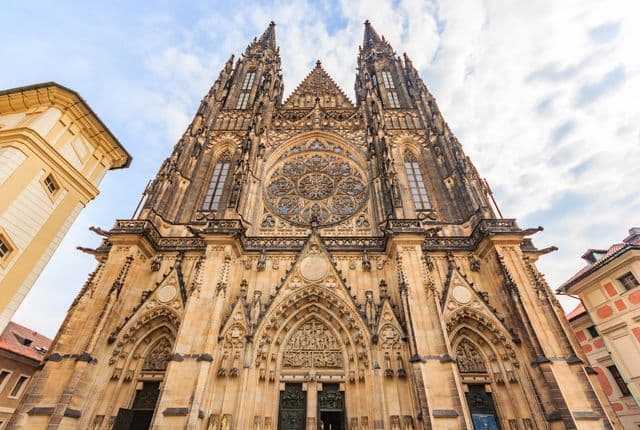
Katedrála sv. Víta dominates Prague Castle and the city skyline. It took nearly 600 years to complete — construction began in 1344 under Emperor Charles IV and wasn't officially finished until 1929. The result is a building that spans Gothic, Renaissance, and Art Nouveau in a single structure.
What to notice inside: the Mucha window. Alfons Mucha designed the stained-glass window on the north side of the nave in 1931 — Saints Cyril and Methodius in his unmistakable style, all flowing lines and jewel colours. Most visitors photograph the rose window above the main entrance. The Mucha window is better.
The Chapel of St. Wenceslas is inlaid with over 1,300 semi-precious stones — jasper, amethyst, chalcedony. Above the chapel, behind a locked door with seven keys held by seven different officials, sit the Czech Crown Jewels, displayed publicly only on extraordinary occasions.
Best time to visit: early morning, right when Prague Castle opens. By 11 AM the cathedral fills with tour groups. On our Prague Castle and Lesser Town private tour, we time the visit to catch the light through the east windows before the crowds arrive.
2. Church of Our Lady before Týn
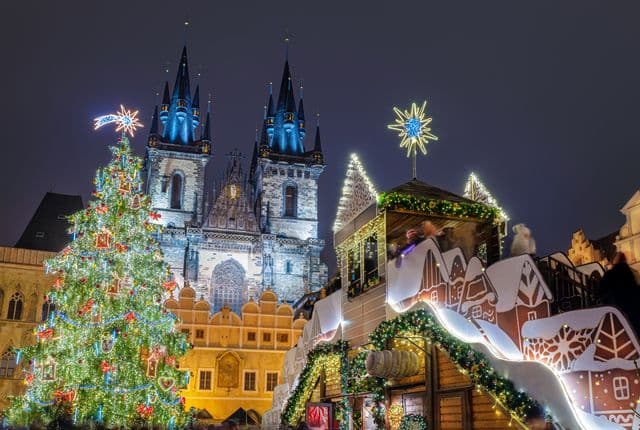
Kostel Matky Boží před Týnem — the twin-spired Gothic church that defines the Old Town Square skyline. The spires are slightly asymmetrical on purpose, though you need to look carefully to spot it. The south tower is marginally wider than the north, said to represent the masculine and feminine sides.
Inside, the church is darker and more atmospheric than St. Vitus. The treasure is the tombstone of Tycho Brahe, the Danish astronomer who died in Prague in 1601. His red marble grave slab is in the right aisle, near the front.
Insider tip: the entrance is not obvious. You don't walk through the main facade — instead, enter through a narrow passage in the arcade of buildings that front the square. Look for the small doorway on the Ungelt courtyard side. Many visitors circle the square looking for the front door and give up.
3. St. Nicholas Church, Malá Strana
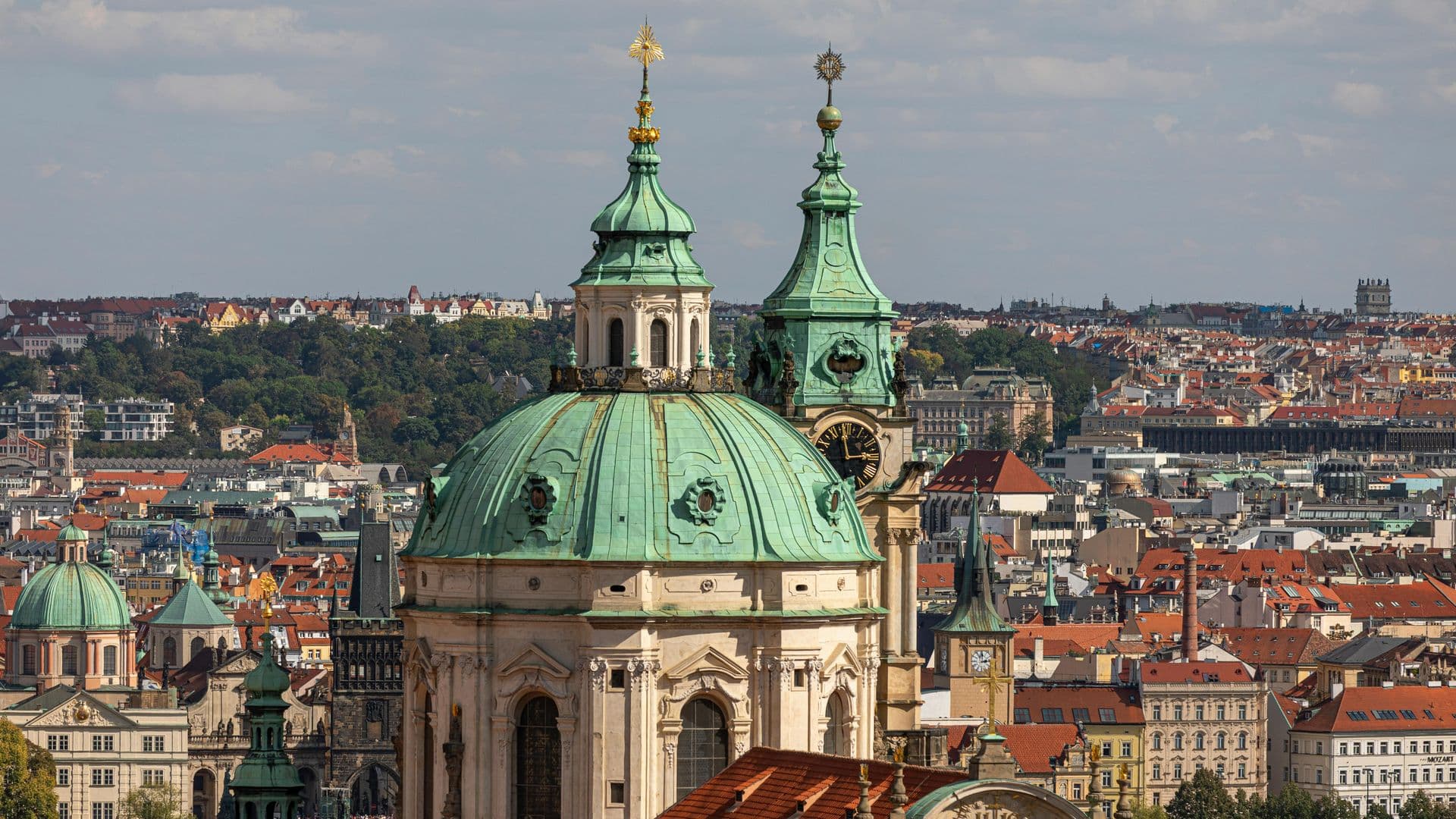
Kostel sv. Mikuláše in Malá Strana is the finest baroque church in Prague and one of the most important baroque buildings in Central Europe. Built by the Jesuits between 1703 and 1755, it was designed by the Dientzenhofer family — father and son — who created an interior of almost overwhelming richness.
The ceiling fresco by Johann Lukas Kracker depicts the life of St. Nicholas and covers over 1,500 square metres — one of the largest ceiling paintings in Europe. Stand in the centre of the nave and look up: the fresco is designed to create an illusion of infinite space, with painted architecture extending the real architecture seamlessly into the sky.
The acoustics in St. Nicholas are extraordinary. Mozart played the organ here during his stay in Prague in 1787. Today, the church hosts evening concerts almost nightly — mostly chamber music and organ recitals. The quality varies, but the setting is always worth it. The sound fills the dome in a way that recording cannot capture.
Best time to visit: mid-afternoon on a weekday. The light through the western windows is warm and golden, and the tour groups have mostly moved on to the castle. We pass through on our Prague Castle and Lesser Town tour and always time it for when the light is right.
4. Church of St. James the Greater
Kostel sv. Jakuba Většího on Malá Štupartská, just behind Old Town Square, has the longest nave of any church in Prague and some of the most ornate baroque decoration in the city. But most people come — or come back — for one detail.
Hanging on the wall to the right of the entrance is a mummified human forearm, dark and shrivelled, suspended from an iron chain. The story: a thief tried to steal the jewels from the statue of the Madonna on the main altar. The statue seized his arm and would not let go. The monks had to amputate the arm to free him. They hung it at the entrance as a warning, and it has been there for over 400 years.
Whether you believe the legend or not, the forearm is genuinely there and genuinely old. It's one of the most unusual objects in any European church, and most visitors either don't notice it or mistake it for a piece of sculpture.
Beyond the forearm, St. James has remarkable acoustics — the long nave creates a resonance that makes organ music feel physical. The church holds regular organ concerts, and the instrument itself, an 18th-century baroque organ, is one of the finest in Prague. The 21 altars lining the nave are each different, richly gilded and theatrical in the way that only the Jesuits could produce.
Insider tip: visit during one of the free organ concerts (check the schedule posted at the entrance). The combination of the baroque interior, the acoustics, and that forearm swinging gently near the door creates an atmosphere no other Prague church can match.
5. Church of Our Lady Victorious — Infant Jesus of Prague
Kostel Panny Marie Vítězné on Karmelitská in Malá Strana houses the Pražské Jezulátko — the Infant Jesus of Prague. This 47-centimetre wax figure, originally from Spain, has been venerated here since 1628 and is one of the most visited Catholic devotional objects in the world.
The statue has a wardrobe of over 60 garments, donated by believers from across the globe. The robes are changed according to the liturgical calendar — white for Easter, purple for Lent, royal red for Pentecost. A small museum upstairs displays a selection of the outfits, including gifts from heads of state.
The church itself is modest by Prague standards — an early baroque structure, relatively plain compared to St. Nicholas down the street. But the steady stream of pilgrims from Latin America, the Philippines, and Southern Europe gives it a genuinely international atmosphere.
Best time to visit: early morning before 9 AM, when the church is quiet and the pilgrims haven't yet arrived in numbers. The small courtyard outside has a calm that evaporates by midday.
6. Strahov Monastery
Strahovský klášter sits above Malá Strana, a short walk from Prague Castle. Founded in 1143 by Premonstratensian monks who still live there, it's one of the oldest continuously operating monasteries in Europe.
A private guide makes all the difference when exploring this part of Prague.
The main draw is the library — two halls that rank among the most beautiful rooms in Prague. The Theological Hall (1679) has carved walnut bookcases and a ceiling fresco on the theme of true wisdom. The Philosophical Hall (1794) is grander — a double-height room with a ceiling painting that took Anton Maulbertsch just six months to complete.
You view both halls from the doorway — visitors don't enter the rooms. The lighting is dim, by design. Stand still for a minute and let your eyes adjust; the detail in the ceiling frescoes only becomes apparent after the first 30 seconds.
The monastery brewery in the courtyard produces its own beer — St. Norbert — named after the order's founder. It's one of the few monastic breweries still operating in the Czech Republic. After the library, a cold Sv. Norbert amber in the courtyard garden is a ritual we recommend to every guest.
Insider tip: the monastery terrace behind the brewery offers one of the quietest viewpoints in Prague — a sweeping panorama over Malá Strana rooftops toward the Old Town. Almost no one goes there.
7. Loreto
Loreta on Loretánské náměstí, a few minutes' walk from Prague Castle, is a pilgrimage complex built around a replica of the Santa Casa — the house in Nazareth where, according to tradition, the Angel Gabriel appeared to Mary. Copies of the Santa Casa spread across Europe in the 17th century; Prague's version, completed in 1631, is one of the finest.
The complex includes an ornate baroque cloister, the Church of the Nativity, and a treasury that holds one extraordinary object: the Prague Sun (Pražské slunce), a diamond monstrance encrusted with 6,222 diamonds. It was commissioned in 1699 by Ludmila Eva Franziska of Kolowrat and is one of the most valuable liturgical objects in Central Europe.
The carillon in the Loreto tower plays a hymn every hour — 27 bells from 1694, one of the oldest functioning carillons in Europe. Stand in the square and listen as the melody drifts across the Hradčany quarter. The sound is thinner and more delicate than you expect — not grand church bells, but something closer to a music box scaled up to architectural size.
Best time to visit: late morning, after the Prague Castle crowds have passed and before the afternoon tour buses arrive. The complex is small enough to see in 45 minutes, and the courtyard has benches where you can sit and listen for the carillon on the hour.
Practical Notes
Most Prague churches charge a small admission fee — typically 100-150 CZK. St. Vitus Cathedral's nave is free; the inner chapels and crypt require a Prague Castle ticket. St. James and Our Lady before Týn are free. Strahov Library and Loreto charge separate admissions.
Photography rules vary. Most churches allow photos without flash. St. Vitus prohibits tripods. Strahov Library allows photography from the doorway only.
Dress code is loosely observed — covered shoulders and knees are expected in active churches, though enforcement is rare outside of Mass times. For an experience that combines several of these churches with the historical context that connects them, our Charles Bridge and Old Town walking tour passes three churches on this list, and we can step inside any that interest you.
See Them With a Private Guide
Churches in Prague reward patience and context. A guide who knows when to visit, where to stand, and what to look for turns a 10-minute walk-through into something that stays with you. The Mucha window in a certain light, the acoustics of St. James during an organ recital, the forearm's shadow on the wall — these are things you can only experience at the right moment.
On our Prague Castle and Lesser Town tour, we cover St. Vitus, St. Nicholas, and Strahov in depth. Our Charles Bridge and Old Town tour includes Týn Church, St. James, and the Infant Jesus. Exclusively yours, with your own guide — we adjust the route to your interests.
For an evening that ends in a medieval cellar church atmosphere, the medieval dinner at U Pavouka takes place in 15th-century vaulted spaces that echo the same stone and candlelight.
Browse all our private tours in Prague.
Frequently Asked Questions
Are Prague's churches free to enter?
Some are. The Church of St. James and Church of Our Lady before Týn are free. St. Vitus Cathedral's nave is free, but the chapels and crypt require a Prague Castle ticket. Strahov Monastery, Loreto, and the Infant Jesus museum have separate admission fees, typically 100-200 CZK.
Which Prague church has the best interior?
St. Nicholas in Malá Strana has the most impressive baroque interior in the city — the ceiling fresco alone covers 1,500 square metres. For Gothic atmosphere, St. Vitus Cathedral is unmatched. For something unexpected, St. James combines ornate baroque decoration with a mummified forearm at the entrance.
Can you attend Mass in Prague churches?
Yes. Most churches on this list hold regular services, typically on Sundays and some weekdays. Mass times are posted at each entrance. Services are mostly in Czech, though the Infant Jesus church occasionally holds Mass in other languages for visiting pilgrim groups.
What is the mummified object in St. James church?
It is a human forearm — not a hand, as many sources incorrectly state. According to the legend, it was amputated from a thief who tried to steal from the Madonna statue and found his arm supernaturally seized. The forearm has hung at the entrance for over 400 years.
You May Also Like
Want to see Prague for yourself?
Take our flagship Prague tour-6-640x430.jpg&w=3840&q=75)