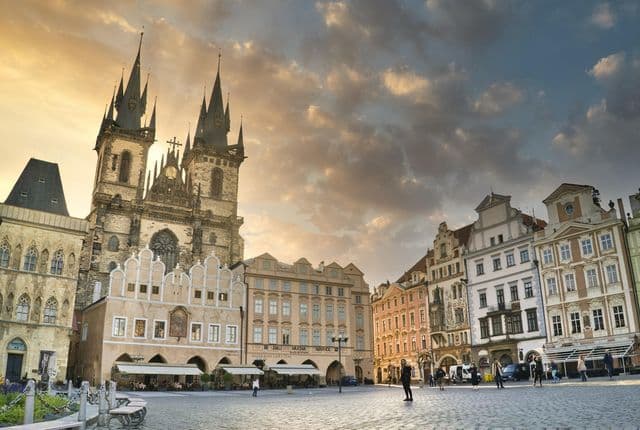
Jewish Quarter Prague (Josefov): Visitor Guide & What to See
Quick Answer
Prague's Jewish Quarter — locally known as Josefov — is a UNESCO World Heritage neighborhood in the heart of Old Town, between the Vltava River and Old Town Square. It's home to six historic synagogues, the haunting Old Jewish Cemetery with around 12,000 visible tombstones above graves layered up to 12 deep, and a Franz Kafka statue. Most sites belong to the Jewish Museum and share a single ticket (around 600 CZK / €25). The Old-New Synagogue — the oldest active synagogue in Europe — is included in the same ticket. The quarter is closed Saturdays and Jewish holidays. Plan 2–4 hours for a complete visit. A private tour of Josefov turns the UNESCO neighborhood into a guided narrative of synagogue by synagogue, century by century.
Table of Contents
- What Is the Jewish Quarter of Prague?
- A Thousand Years of History in Five Minutes
- What to See in Josefov
- Tickets, Hours, and Practical Info
- Pařížská Street: The Modern Jewish Quarter
- Who This Experience Suits
- How Much Time to Budget
- Tips from a Licensed Prague Guide
- Combining Josefov With Other Prague Sites
- Frequently Asked Questions
Most visitors come to Prague for the castle, the bridge, and the beer. The Jewish Quarter is the part of Prague that asks you to slow down. It's the part most people remember longest after they go home.
We've guided thousands of visitors through Josefov over the years, and the reactions follow a pattern: surprise at how compact it is, quiet attention at the Old Jewish Cemetery, and genuine emotion at the Pinkas Synagogue, where the names of 80,000 Czech Jewish victims of the Holocaust are written on the walls. It is not a long visit — most people spend two to four hours — but it is a visit that stays with you.
This guide covers what's inside Josefov, how the ticketing works, what to expect, and how to make the visit part of a great day in Old Town Prague.
What Is the Jewish Quarter of Prague?
Josefov is a small neighborhood within Prague's Old Town, named after Holy Roman Emperor Joseph II, whose late-18th-century reforms emancipated the city's Jewish population. Before 1850, the area was officially called the Jewish Town; before that, the Jewish Ghetto. Today the streets, the cemetery, and the synagogues that survived the late-19th-century redevelopment form one of the most significant Jewish heritage sites in Europe.
The quarter has been a UNESCO World Heritage Site since 1992, included as part of the historic center of Prague.
Walking distances to Josefov
From | Walking time |
|---|---|
Old Town Square (Astronomical Clock) | 3 minutes |
Charles Bridge | 8 minutes |
Wenceslas Square | 12 minutes |
Náměstí Republiky metro (Line B / yellow) | 7 minutes |
Staroměstská metro (Line A / green) | 2 minutes |
The most convenient way to arrive is the Staroměstská metro station — exit toward Pařížská Street and you're already in Josefov.
A Thousand Years of History in Five Minutes
Jewish settlement in Prague is documented from the 10th century, when Jewish merchants arrived along trade routes between Eastern and Western Europe. Communities formed in several parts of the city, often suffering pogroms during periods of religious tension.
In 1215, the Fourth Lateran Council ordered Christian rulers across Europe to segregate Jewish populations. Prague's Jews were moved to the area north of Old Town Square — the beginning of the Jewish Ghetto. Walls and gates separated the quarter from the rest of the city. Movement in and out was restricted.
The golden age of the Prague Jewish community came in the 16th century, under the relatively tolerant Holy Roman Emperor Rudolf II and the Jewish mayor Mordechai Maisel, who paved the streets, financed synagogue construction, and turned the quarter into a center of European Jewish learning. The most famous figure of the era was Rabbi Judah Loew ben Bezalel — known as the Maharal of Prague — scholar, mystic, and the figure later credited with creating the Golem.
Pogroms continued. The 1389 massacre killed an estimated 1,500 people. Devastating fires struck in 1689 and again in subsequent decades.
By the late 1700s, Joseph II's reforms allowed Jews to live anywhere in the city. Many wealthier families left Josefov for healthier neighborhoods. The quarter gradually became the poorest part of Prague — overcrowded, without basic sanitation.
In the late 19th century, city planners decided to redevelop. Most of the medieval Jewish Town was demolished and replaced with the wide, Parisian-style boulevards you see today, including Pařížská Street. Six synagogues, the Jewish Town Hall, and the Old Jewish Cemetery survived the demolition. They are what remains.
Then came the Holocaust. Of approximately 92,000 Jews living in Bohemia and Moravia in 1939, an estimated 80,000 were murdered. The names of every known victim are written by hand on the walls of the Pinkas Synagogue, organized by hometown. It is one of the most powerful Holocaust memorials anywhere in the world.
The Jewish community in Prague today numbers a few thousand — small but active. The synagogues, the cemetery, and the museum exist to remember the rest.
What to See in Josefov
The Old-New Synagogue (Staronová synagoga)
Built around 1270, the Old-New Synagogue is the oldest active synagogue in Europe. Services are still held here. The interior is austere — twin naves, brick vaulting, an early Gothic ark. Look for the gilded grilles around the bimah and the iron grill on the women's gallery.
According to Prague legend, the Golem of Rabbi Loew lies in the synagogue's attic, dormant since the 16th century. The attic remains closed to visitors.
The Old-New Synagogue is included in the single Jewish Museum ticket.
The Spanish Synagogue (Španělská synagoga)
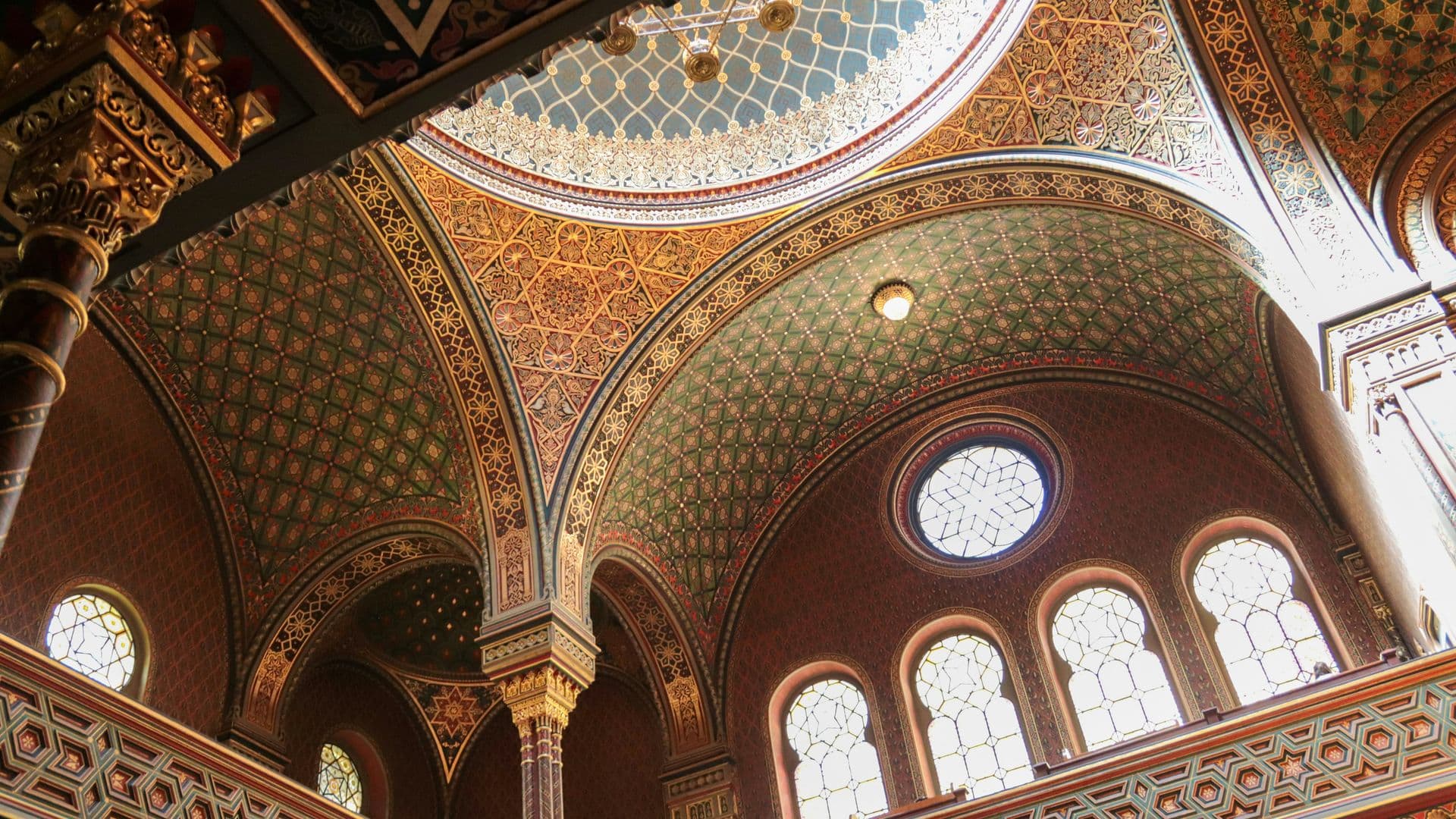
Built in 1868 in the Moorish Revival style, the Spanish Synagogue is the visually most stunning interior in Josefov. The walls and ceiling are covered in geometric Islamic-influenced patterns — gold, turquoise, deep red — every surface ornamented. Concerts are held here regularly, and attending one is one of the most memorable evenings in Prague.
The exhibition inside covers Jewish life in Bohemia in the 19th and 20th centuries, including the story of the Terezín ghetto.
Outside the Spanish Synagogue stands the Franz Kafka statue — a bronze figure 3.75 meters tall, sculpted by Jaroslav Róna and unveiled in 2003. Kafka was born nearby in 1883.
The Pinkas Synagogue (Pinkasova synagoga)
Built in 1535, the Pinkas Synagogue is now the central Holocaust memorial of the Czech Republic. The walls of the main hall are covered with the names — written by hand — of the approximately 80,000 Czech and Moravian Jews murdered in the Holocaust. Names are organized by hometown. The reading is slow because that is the point.
The upstairs gallery displays children's drawings made at the Terezín ghetto between 1942 and 1944 — drawings by children who, in almost every case, did not survive.
This is the most emotionally heavy part of any Josefov visit. Take your time.
The Maisel Synagogue (Maiselova synagoga)
Originally built in 1592 by mayor Mordechai Maisel, the Maisel Synagogue burned down in the great fire of 1689 and was rebuilt; the current Neo-Gothic appearance dates from a late-19th-century renovation. The exhibition inside covers Jewish life in Bohemia from the 10th to the 18th century — the medieval period and the early modern period.
The Klausen Synagogue (Klausová synagoga)
The largest synagogue in Josefov, built in 1694 in the early Baroque style. Originally three buildings (a synagogue, a hospital, and a Talmud-Torah school) merged into one. The exhibition focuses on Jewish religious traditions — circumcision, marriage, holidays, and the practices of the Hevra Kadisha (the burial society).
The High Synagogue (Vysoká synagoga)
Currently closed to the public. Adjacent to the Jewish Town Hall. Worth knowing about even though you can't go inside.
The Old Jewish Cemetery (Starý židovský hřbitov)
The Old Jewish Cemetery is the most evocative space in Josefov. The oldest gravestone dates to 1439; the cemetery was used for burials until 1787. Approximately 12,000 visible gravestones stand crowded together at angles — but beneath them lie an estimated 100,000 actual graves, layered in some places up to twelve deep, because Jewish religious law forbade exhumation and the community ran out of horizontal space.
The most visited grave is that of Rabbi Loew (the Maharal). Visitors traditionally place small stones on the tombstone — the Jewish equivalent of laying flowers. Other notable graves include those of Mordechai Maisel and the historian David Gans.
The visit is short — perhaps fifteen to twenty minutes — but the weight of the place is hard to describe. Stone tombstones leaning at every angle, layered centuries deep, the buildings of modern Prague rising around the wall. It is a place that survived because the Nazis intended it as part of a "Museum of an Extinct Race" — preserving what they intended to destroy.
The Jewish Town Hall and the Jewish Museum
The Jewish Town Hall (Židovská radnice), with its distinctive Hebrew-numeral clock, is not open to the general public, but the building is photographed often.
The Jewish Museum itself is not a single building — it's the umbrella organization that manages the Maisel, Pinkas, Klausen, and Spanish Synagogues, the Old Jewish Cemetery, the Ceremonial Hall, and the Robert Guttmann Gallery. One combined ticket gives you access to all of them.
Tickets, Hours, and Practical Info
Prague Jewish Town Ticket
The standard ticket — the Prague Jewish Town Ticket — gives you entry to all main Jewish Museum sites:
- Maisel Synagogue
- Pinkas Synagogue
- Klausen Synagogue
- Spanish Synagogue
- Old Jewish Cemetery
- Jewish Ceremonial Hall
- Robert Guttmann Gallery
Ticket validity: 3 opening days for individuals and families; same day only for groups of 6+. Each site can be entered once during the validity period.
Old-New Synagogue Ticket
The Old-New Synagogue is included in the single ticket (even though it's owned by the Prague Jewish Community, not the Jewish Museum).
Combined Ticket: Museum Sites + Old-New Synagogue
The most popular option for first-time visitors is the combined ticket that includes both the Prague Jewish Town Ticket sites AND the Old-New Synagogue. This is the easiest way to see everything in one purchase.
For current ticket prices, exhibition schedules, and to book online (recommended in summer to skip queues), see the official site at jewishmuseum.cz.
Opening Hours
Season | Hours |
|---|---|
Summer (April–October) | 9:00 AM – 6:00 PM |
Winter (November–March) | 9:00 AM – 4:30 PM |
Closed: Saturdays (Sabbath) and Jewish holidays. The Old-New Synagogue closes one hour before the Sabbath begins on Fridays.
The Jewish holiday calendar varies year to year — Rosh Hashanah, Yom Kippur, and Passover are the most likely to coincide with a tourist's visit. The current calendar is on jewishmuseum.cz.
Photography
Photography for personal use is allowed inside the synagogues — without flash, lights, or tripod. Inside the Pinkas Synagogue (the Holocaust memorial), most visitors put their cameras down out of respect.
Accessibility
The cemetery and several of the synagogues have steps and uneven surfaces. The Jewish Museum publishes accessibility info on its website; some sites are partially wheelchair accessible, others are not. Plan ahead if mobility is a concern.
Pařížská Street: The Modern Jewish Quarter
When the medieval Jewish Town was demolished in the late 19th century, the planners built Pařížská Street (Paris Street) — a wide, Parisian-style boulevard running from Old Town Square to the river. Today it is the most expensive shopping street in Prague, home to luxury fashion houses (Louis Vuitton, Dior, Cartier, Prada) and high-end cafés.
The contrast is striking. On one side of Pařížská: the gleaming windows of contemporary luxury. A few steps east or west: the synagogues and the cemetery that survived everything else.
These stories come alive when told by someone who knows them deeply. Our licensed guides share what the plaques don't say.
The street itself is worth a walk for the architecture — Art Nouveau and Neo-Renaissance facades from the 1900s, clean and confident, completely different in feel from the surviving medieval streets nearby. It also makes Josefov a strange place: a UNESCO heritage site, a Holocaust memorial, and a luxury shopping district, all overlapping.
Who This Experience Suits
Josefov is one of the most universally recommended sites in Prague, but the experience has a particular weight. Here's our honest assessment:
Best for history-minded travelers
If you read history books on holiday, Josefov is essential. The layered narrative — medieval ghetto, Renaissance flourishing, Joseph II reforms, late-19th-century redevelopment, the Holocaust, the post-1989 revival — fits into a small geographic area. Two hours here teaches more than two hours in most museums.
Best for adults and older children (12+)
The themes are heavy. Children below 12 may struggle with the Pinkas Synagogue's Holocaust memorial — and that's appropriate, the memorial is meant to be heavy. Older children with some history background often find the visit profoundly moving.
Best for first-time Prague visitors
If you're in Prague for the first time, Josefov is one of three or four sites that should be on your list (alongside Charles Bridge, Prague Castle, and Old Town Square). It rounds out the city's complexity — the beautiful and the painful are inseparable here.
Best for travelers researching ancestry
If you have Czech Jewish ancestry, even casually, Josefov is meaningful in a personal way. The Pinkas Synagogue's victim list and the Jewish Museum's archives can sometimes help with research; tour guides who specialize in Jewish heritage tours offer ancestry-focused itineraries.
Possibly not for you if
- You're hoping for a "fun" sightseeing morning — Josefov is not that
- You have very young children and limited patience for slow, somber spaces
- You're visiting on Saturday or a major Jewish holiday (most sites are closed)
- You strongly dislike crowds — the cemetery and Spanish Synagogue can be busy in summer
How Much Time to Budget
Quick visit (1.5–2 hours): Spanish Synagogue + Old Jewish Cemetery + Pinkas Synagogue. The essentials.
Standard visit (2.5–3 hours): All four main museum synagogues + Old Jewish Cemetery. This is what most guided tours cover.
Full visit (3.5–4 hours): Everything above plus the Old-New Synagogue, plus a walk down Pařížská Street, plus time at the Kafka statue. This works well as a half-day in Old Town.
The combined museum ticket is valid for three opening days, so there's no need to do everything in one go. Many visitors split the experience: synagogues one morning, the cemetery and Old-New Synagogue another day.
Tips from a Licensed Prague Guide
Visit early. Doors open at 9 AM. The cemetery and the Spanish Synagogue are noticeably less crowded before 10:30 AM, especially in summer.
Don't try to do everything in one go. The Holocaust memorial in Pinkas Synagogue is emotionally heavy. A break — coffee, a walk, lunch — between Pinkas and the next site helps you absorb what you've seen.
Read the names. At Pinkas, slow down. Read a name. Then read another. The names are organized by hometown, so you can find a town from your travels and read the families. This is the closest most travelers will come to grasping what 80,000 deaths actually means.
Place a stone, not flowers. At Rabbi Loew's grave in the Old Jewish Cemetery, the Jewish tradition is to place a small stone on the tombstone, not flowers. Stones don't fade, the gesture says — memory is permanent.
Skip the audio guide if you have a guided tour booked. A knowledgeable human guide is significantly more useful than the audio. If you're going alone, the audio guide is fine but won't compete with a private guide who can read your interests in real time.
Dress modestly inside the synagogues. Shoulders covered, no shorts or short skirts in active synagogues. Men are typically given a paper kippah at the Old-New Synagogue.
Don't photograph people praying. The Old-New Synagogue is an active place of worship. If a service is in progress, put the camera away.
Combine with Old Town Square. Josefov is three minutes from the Astronomical Clock. The two areas pair perfectly into a half-day or full-day Old Town walk.
Combining Josefov With Other Prague Sites
Most of our guests don't visit Josefov alone — they combine it with other Old Town landmarks for a richer day. Three combinations work especially well:
The Charles Bridge & Old Town Walking Tour covers the Astronomical Clock, the Old Town Square, Charles Bridge, and includes time in Josefov as part of a structured 2-hour experience. This is the most natural pairing — Josefov sits between Old Town Square and the river, exactly along the natural walking route.
The All Prague in One Day tour covers the Old Town (including Josefov), Charles Bridge, Prague Castle, and Vyšehrad in a single comprehensive 5-hour day. This is the right choice for short-trip visitors who want to see everything Prague has to offer.
For a slower, more focused visit, a private walking tour with a licensed guide can be tailored entirely around Josefov — useful if you have ancestry interests, photography goals, or specific historical questions.
For visitors who prefer not to walk, the Best of Prague Car Tour covers all the major Old Town and Castle landmarks by private car with hotel pickup, with stops including the Jewish Quarter.
We arrange the Jewish Quarter as part of any private tour package. A guided visit makes a real difference — the names on the Pinkas walls, the symbolism on the cemetery tombstones, the architectural details of the Spanish Synagogue, all become much more meaningful with someone who can interpret them.
For lunch or dinner around Josefov, see our where to eat in Prague guide — the area has excellent kosher and non-kosher options within a few minutes' walk.
Frequently Asked Questions
Where is the Jewish Quarter in Prague?
The Jewish Quarter (Josefov) is in Prague's Old Town, between Old Town Square and the Vltava River. The most convenient access is via the Staroměstská metro station on Line A (green), about a 2-minute walk from the main synagogues.
How much does it cost to visit the Jewish Quarter in Prague?
Entry to Josefov as a neighborhood is free — you can walk the streets, see the Jewish Town Hall, and visit the Kafka statue without a ticket. To enter the synagogues and the Old Jewish Cemetery, you need the Prague Jewish Town combined ticket (around 600 CZK / €25). The Old-New Synagogue is included in the same ticket.
What are the Jewish Quarter Prague opening hours?
The Jewish Museum sites are open Sunday through Friday: 9:00 AM to 6:00 PM in summer (April–October) and 9:00 AM to 4:30 PM in winter (November–March). Closed Saturdays (Sabbath) and major Jewish holidays. The Old-New Synagogue closes one hour before the Sabbath begins on Fridays.
Why is the Jewish Quarter closed on Saturdays?
Saturday is the Sabbath in Judaism, a day of rest. All sites administered by the Jewish community — including the synagogues and cemetery — are closed. If you have only one day in Prague and it's a Saturday, you can still walk through the neighborhood, see Pařížská Street, and visit the Kafka statue, but the interiors will be closed.
How long does it take to visit Prague's Jewish Quarter?
A focused visit covering the main highlights (Spanish Synagogue, Pinkas Synagogue, Old Jewish Cemetery) takes about 1.5 to 2 hours. A complete visit including all four main museum synagogues and the Old-New Synagogue takes 3 to 4 hours. The combined museum ticket is valid for 3 opening days, so the visit can be split across multiple days.
What's the difference between the Old-New Synagogue and the other synagogues?
The Old-New Synagogue is the oldest active synagogue in Europe (built around 1270) and is still used for daily worship by Prague's Jewish community. The other Josefov synagogues are now museums managed by the Jewish Museum — they're no longer active places of worship, although special events and concerts are sometimes held in them. The Old-New Synagogue is included in the single Jewish Museum ticket.
Is the Old Jewish Cemetery worth visiting?
Yes. The Old Jewish Cemetery is one of the most evocative spaces in Prague — around 12,000 visible tombstones above graves layered in places up to 12 deep, the oldest dating to 1439. It is small, quiet, and unlike any other cemetery in Europe. Most visitors find it the most memorable part of the Josefov visit.
Who was Rabbi Loew and the Golem of Prague?
Rabbi Judah Loew ben Bezalel — known as the Maharal of Prague — was a 16th-century rabbi, scholar, and mystic who led Prague's Jewish community during its golden age under Emperor Rudolf II. According to Prague legend, Rabbi Loew created the Golem, a clay figure brought to life to protect the Jewish community. The Golem is said to lie dormant in the attic of the Old-New Synagogue. Rabbi Loew is buried in the Old Jewish Cemetery; visitors traditionally place small stones on his tombstone.
Is Prague's Jewish Quarter suitable for children?
Older children (12 and up) with some history background usually find Josefov meaningful. Younger children may struggle with the Pinkas Synagogue (Holocaust memorial) and the slow, somber atmosphere of the cemetery. If you're traveling with young children, a shorter visit focused on the Spanish Synagogue (the most visually impressive) and a quick walk through the cemetery may work better than the full ticket.
Can I visit the Jewish Quarter without a guide?
Yes — self-guided visits are common, especially for visitors who prefer to set their own pace. Audio guides are available at all ticket offices for around 80 CZK. A guided tour with a licensed guide adds significantly more depth and context, especially for first-time visitors and travelers researching Jewish heritage.
Are there kosher restaurants in Prague's Jewish Quarter?
Yes — Prague has several kosher restaurants in and around Josefov, certified by the Prague Jewish community. Specific establishments and their certifications change over time, so we recommend checking current options on a kosher dining directory or contacting the Prague Jewish Community for an up-to-date list close to your visit.
Is photography allowed in the synagogues?
Yes — photography for personal use is allowed inside the synagogues, without flash, lights, or tripods. At the Pinkas Synagogue (Holocaust memorial), most visitors put their cameras away out of respect, although photography is technically permitted. Inside the Old-New Synagogue, photography during active services is not permitted.
What should I wear to visit the Jewish Quarter?
Modest clothing is recommended for the active synagogues. Shoulders should be covered; shorts or very short skirts may be discouraged. The Old-New Synagogue typically provides paper kippahs (head coverings) for men; women in some synagogues are asked to cover their hair. The cemetery and museum exhibitions have no specific dress code.
Where is Franz Kafka's statue in Prague?
Franz Kafka's statue stands on Dušní Street, next to the Spanish Synagogue, in the heart of Josefov. The bronze figure is 3.75 meters tall and was sculpted by Jaroslav Róna; it was unveiled in 2003. The piece references Kafka's story "Description of a Struggle." Kafka himself was born in 1883 in a building at the edge of the Jewish Quarter, on the corner of what is today U Radnice and Maiselova streets, very close to Old Town Square.
How do I book a Jewish Quarter tour with a private guide?
Tours can be arranged through our contact page. Specify your dates, number of travellers, and any specific interests (general history, Holocaust focus, Kafka and literary Prague, ancestry research). We pair you with a guide whose expertise matches your interests, and confirm within 24 hours. Private tours start from a single traveller and can be combined with other Prague sites for half-day or full-day itineraries. You can also book directly from our private Jewish Quarter tour page.
*About the Author: Uliana Formina is a licensed Prague guide with 17 years of experience leading private tours through the historic center. She has guided over 10,000 guests through Josefov, the Old Town, Charles Bridge, and Prague Castle, and frequently works with families researching Czech Jewish ancestry.*
*Last fact-checked: April 2026. Information about Jewish Museum opening hours, ticket structure, and site availability verified through the official museum sources. Specific exhibition content, prices, and seasonal hours can change — confirm directly with jewishmuseum.cz before your visit if details matter to your plans.*
Want to see Prague for yourself?
Tour the Old Town and Jewish Quarter