Literary Prague — Kafka, Kundera and Bookshops Worth Visiting
Prague is a city that has been written about, argued over, and reimagined in fiction for centuries. Kafka walked these streets with dread and wonder. Kundera left them behind and spent a lifetime writing about what that departure meant. Hašek drank in every pub from Žižkov to the Old Town and turned the whole absurd business of empire into a novel that still makes people laugh out loud.
We take book lovers through Prague regularly, and the conversation always deepens when the city's literary geography comes into focus. The building where Kafka was born. The café where Kundera's characters might have sat. The pub that inspired the most beloved satire in Czech literature. This is a guide to reading Prague through its writers — and to the bookshops and cafés where that tradition continues.
Kafka's Prague
Franz Kafka was born on 3 July 1883 at the corner of Maiselova and Kaprova streets, on the edge of the Old Town Square. A small bust marks the site today — the original building was largely demolished and rebuilt, but the location is exact. Kafka never left Prague for more than brief periods. The city was his obsession and his cage.
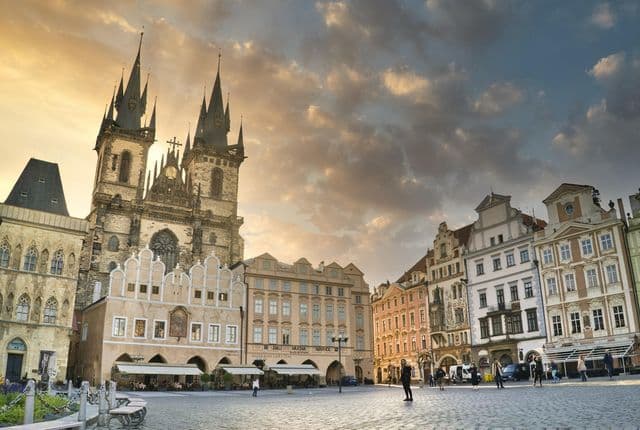
The Blue Fox House (U Minuty) — the ornate Renaissance building with sgraffito decoration directly on Old Town Square, adjacent to the Astronomical Clock, was the Kafka family home from 1889 to 1896. Young Franz grew up looking out at the square. The sgraffito façade — depicting biblical and mythological scenes — is one of the most photographed details on the square, and most visitors walk past without knowing Kafka lived behind it.
The Workers' Accident Insurance Institute on Na Poříčí Street is where Kafka worked as an insurance clerk from 1908 to 1922. The building — a heavy, institutional structure — still stands and still serves as an office building. Kafka wrote most of *The Trial* and *The Metamorphosis* in the evenings after leaving this office. The daily monotony of insurance work and the Kafkaesque bureaucracy of the Austro-Hungarian system were not metaphors for him; they were Tuesday.
The Old Jewish Cemetery in Josefov — where tombstones lean against each other in layered centuries of burial — is often cited as a visual source for the claustrophobic, compressed spaces in Kafka's writing. Kafka himself is buried at the New Jewish Cemetery in Žižkov (Strašnice section), where his grave — a simple, angular headstone — receives visitors daily. A private Jewish Quarter tour from Prague brings these literary connections to life on the ground.
Insider detail: The Franz Kafka Museum on Cihelná Street in Malá Strana houses original manuscripts, first editions, and personal correspondence. The permanent exhibition, "The City of K," traces the real Prague beneath Kafka's fictional landscapes. The courtyard features David Černý's sculpture of two men urinating into a pool shaped like the Czech Republic — a piece of Kafka-adjacent absurdism that divides opinion but never fails to start a conversation.
For a deeper walk through Kafka's Prague, our full Kafka guide maps every significant location in detail.
Milan Kundera's Prague
Milan Kundera was born in Brno in 1929 and studied and taught in Prague before emigrating to France in 1975, where he lived until his death in 2023. His relationship with Prague was defined by departure — and by the impossibility of returning to a city that the Soviet occupation had fundamentally changed.
*The Unbearable Lightness of Being* (1984) is set partly in Prague during the 1968 Soviet invasion and its aftermath. Kundera's Prague is not a city of landmarks but of private spaces — apartments, bedrooms, the interior life of people living under political pressure. The novel's physical geography is deliberately vague, but readers have traced Tomáš's walks through Malá Strana and the streets near the Vltava.
Café Slavia — the grand café on the Vltava embankment opposite the National Theatre — is where Czech intellectuals gathered for decades. Kundera was part of that world before 1968, and the café's atmosphere — large windows facing the river, marble tables, a sense of European grandeur layered over political tension — permeates his writing. The café still operates and still attracts writers and thinkers, though the tourists now outnumber them.
Insider detail: Kundera's books were banned in Czechoslovakia after his emigration and remained unavailable domestically until after 1989. Today, Czech translations of his French-language novels sit alongside his earlier Czech-language work in Prague bookshops — a bibliographic timeline of exile and return that you can hold in your hands.
Jaroslav Hašek and the Good Soldier Švejk
Jaroslav Hašek (1883–1923) was a bohemian, prankster, anarchist, and author of *The Good Soldier Švejk* — the unfinished satirical novel about a bumbling Czech soldier navigating the absurdity of World War I under Austro-Hungarian command. Švejk is the most beloved character in Czech literature, and his spirit — cheerful subversion of authority through apparent stupidity — is woven into Czech national identity.
U Kalicha (The Chalice) on Na Bojišti Street is the pub where Švejk's story begins. Hašek drank there, and the novel's opening line sends Švejk to U Kalicha to meet his friend Bretschneider. The pub still operates, leaning heavily into its literary fame with Švejk-themed décor, Hašek memorabilia, and a tourist-oriented menu. The beer is fine; the atmosphere is worth experiencing once.
Hašek himself frequented dozens of Prague pubs — he was a prodigious drinker and a habitual wanderer. The neighbourhood of Žižkov, east of the centre, was his territory. Its pubs, which remain cheaper and more local than those in the Old Town, carry an echo of the world Hašek inhabited.
Insider detail: Hašek once ran a fictional political party called the Party of Moderate Progress Within the Bounds of the Law, held genuine campaign rallies in Vinohrady pubs, and published a satirical manifesto. He was arrested more than once for public disturbance. The line between his fiction and his life was always blurred — which is exactly how Švejk operates.
Best Bookshops in Prague
Shakespeare and Sons
Located on Krymská Street in Vršovice (with a second location in Malá Strana on U Lužického semináře), Shakespeare and Sons is Prague's finest English-language bookshop. The selection favours literary fiction, Central European history, philosophy, and poetry. The staff read what they sell and make genuine recommendations.
The Vršovice branch has a café attached, and the combination of good coffee, serious books, and a quiet Vršovice side street makes it a place you might lose an entire afternoon. The Malá Strana branch is smaller but well-curated, and its location near Charles Bridge makes it a natural stop during a walking tour.
Globe Bookstore and Café
Globe, on Pštrossova Street near the National Theatre, has been a gathering point for Prague's English-speaking literary community since 1993. The bookshop stocks fiction, non-fiction, and Czech literature in translation. The café serves good food and hosts regular literary events — readings, book launches, discussions.
Insider detail: Globe nearly closed in the 2010s but was saved by its community and a change of ownership. It is one of the last surviving English-language bookshop-cafés from Prague's 1990s expatriate boom — a period when the city attracted a wave of American and British writers, including some who stayed and some who wrote about leaving.
Palác Knih Luxor
The largest bookshop in Prague, occupying multiple floors on Wenceslas Square. The ground floor stocks international bestsellers and travel guides; the upper floors go deeper into Czech literature, academic texts, and children's books. The English-language section is substantial.
Palác Knih Luxor is not a boutique — it is a proper, large-format bookshop in the style of Waterstones or Powell's. If you want to browse widely and find Czech authors in translation alongside international titles, this is where to go.
Literary Cafés
Café Louvre
Café Louvre, on Národní třída, has operated since 1902. Kafka, Einstein, and the writers of the Prague Circle reportedly visited. The café occupies the first floor of a grand building, with high ceilings, large windows, and a billiard room in the back that still uses original tables.
The food is solid traditional Czech-continental (svíčková, Wiener schnitzel, good pastries), and the coffee is properly prepared. It is a working café — Praguers use it for meetings and reading, not just tourists revisiting the past.
Insider detail: The billiard room hosted a regular game between Kafka's circle and a group of engineering students in the 1910s. Whether Kafka himself played is debated, but his close friend Max Brod certainly did.
Café Slavia
Café Slavia's position — facing the National Theatre across a broad boulevard, with the river visible through the windows — makes it the most dramatically sited café in Prague. Its association with Czech intellectual life goes back to the 19th century, through the First Republic, the Nazi occupation, the communist era (when it served as an informal meeting point for dissidents), and into the present.
The interior features a well-known painting by Viktor Oliva, *The Absinthe Drinker* (1901), which hangs on the far wall and has become an icon of Prague café culture. Order a coffee, sit by the window, and watch the Vltava — it is the same view that Czech writers have been staring at for over a century.
Prague Writers' Festival
The Prague Writers' Festival (Pražský festival spisovatelů) was founded in 1991, shortly after the Velvet Revolution, and has hosted Nobel laureates, international novelists, and Czech authors for public readings and conversations. Past participants have included Salman Rushdie, Umberto Eco, and Herta Müller.
The festival typically takes place in spring or early summer, with events held at venues across the city — including some of the cafés and theatres mentioned above. Check the official website for the current year's programme.
Insider detail: The festival's founding was itself a literary act — a declaration that Prague, after decades of censorship, was open again to the world's writers. The first editions featured authors whose books had been banned in Czechoslovakia, reading their own words aloud in the city that had tried to silence them.
Experience It With a Private Guide
Literary Prague is not a self-guided checklist — it is a conversation between places and stories that requires local knowledge to connect. Our guides know which building Kafka stared at from his office window, which café Hašek was thrown out of, and which bookshop stocks the Czech translations that tourists overlook.
Our Charles Bridge and Old Town tour passes through the heart of Kafka's Prague — the Old Town Square, Josefov, and the lanes where the Austro-Hungarian bureaucracy that shaped his imagination stood.
For the underground side of Prague's creative history, our Hidden Prague Underground and Alchemy tour explores the occult, alchemical, and mystical traditions that influenced Prague's literary imagination from Rudolf II through the Surrealists.
And for a theatrical evening that feels pulled from a different century, our medieval dinner at a candlelit tavern puts you inside a setting that Hašek would have appreciated — rowdy, atmospheric, and entirely committed to the performance.
See all our private Prague tours — exclusively yours, with your own guide.
Frequently Asked Questions
Where is Kafka buried?
Franz Kafka is buried at the New Jewish Cemetery (Nový židovský hřbitov) in the Strašnice section of Žižkov, Prague 3. The cemetery is open to visitors on most days except Saturday. His grave is marked by a distinctive angular headstone and is well-signposted from the cemetery entrance.
Is Café Slavia worth visiting?
Yes, for the atmosphere and the view. The food is decent café fare, and the coffee is good. The real draw is the setting — facing the National Theatre and the river, with over a century of literary and intellectual history embedded in the room.
Can I visit Kafka's birthplace?
The original building was largely demolished, but a small bust and memorial plaque mark the exact location at the corner of Maiselova and Kaprova streets. The Franz Kafka Museum on Cihelna Street in Mala Strana offers the most comprehensive exhibition of his life and manuscripts.
Where can I buy English books in Prague?
Shakespeare and Sons (Vrsovice and Mala Strana locations), Globe Bookstore on Pstrossova Street, and the English-language section of Palac Knih Luxor on Wenceslas Square all stock substantial English-language selections.
What should I read before visiting Prague?
Start with Kafka's *The Trial* for the atmospheric weight of the city. Follow with Kundera's *The Unbearable Lightness of Being* for Prague under political pressure. Add Hasek's *The Good Soldier Svejk* for the Czech sense of humour. These three books cover Prague's literary identity from three completely different angles.
For a deeper, expert-led visit, consider a private Jewish Quarter tour from Prague — fully customized to your interests.
You May Also Like
Want to see Prague for yourself?
Discover Prague's underground tour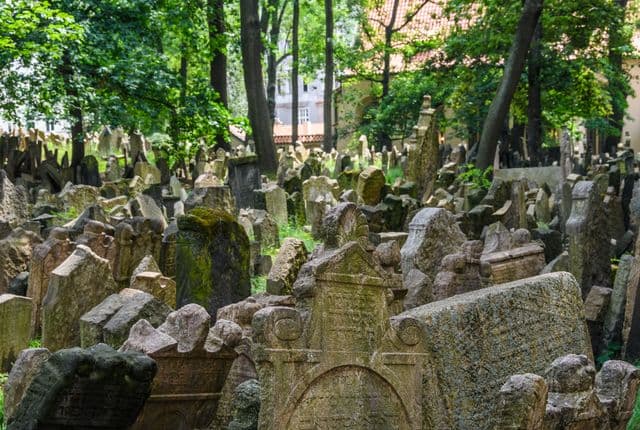
-6-640x430.jpg&w=3840&q=75)