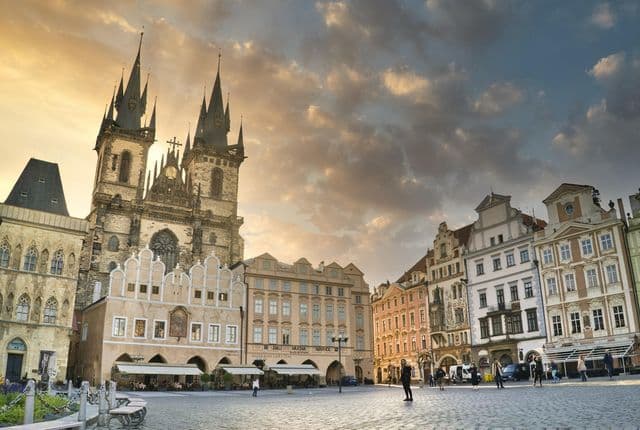
The Velvet Revolution — Prague in November 1989
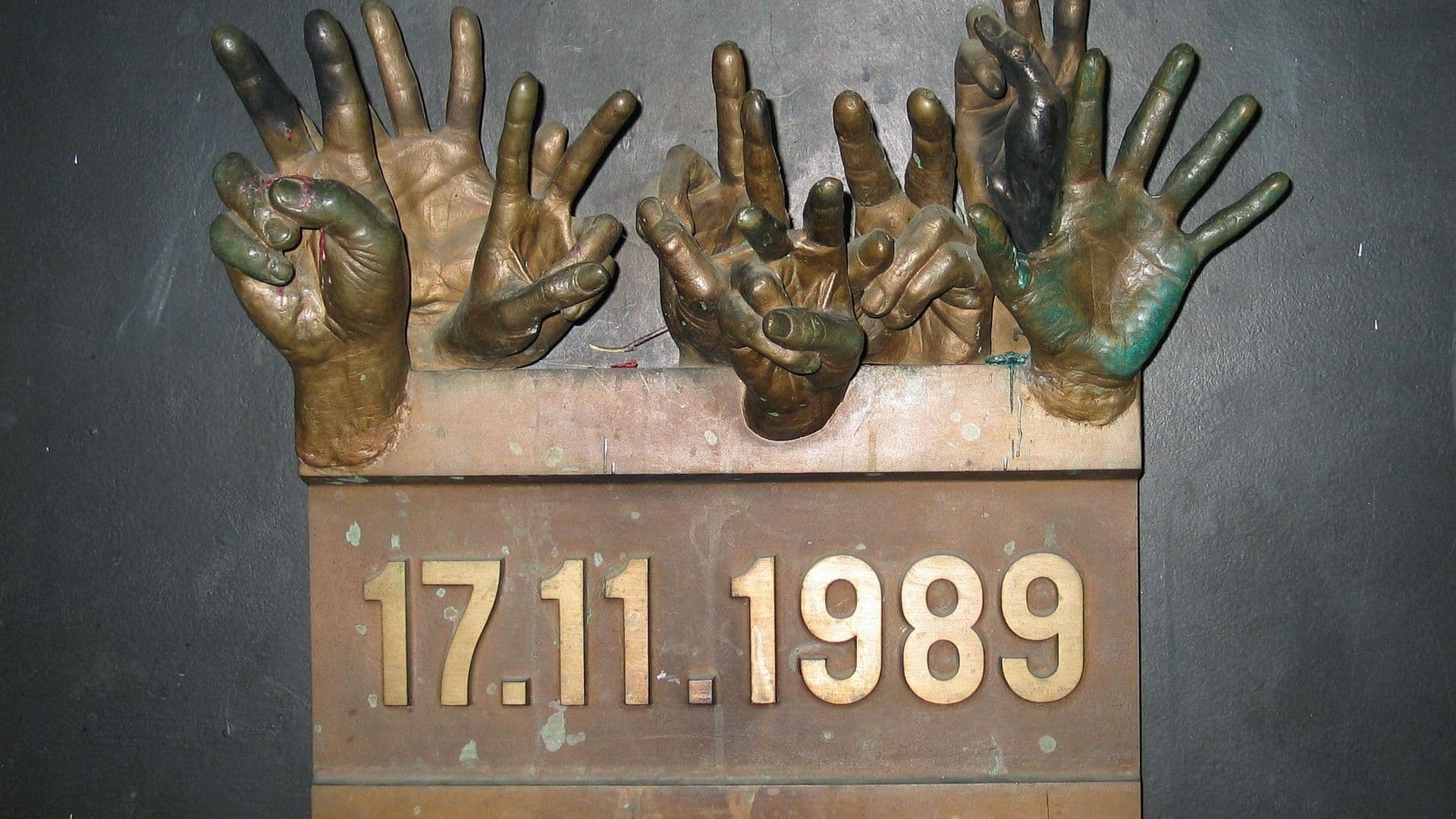
On the evening of 17 November 1989, roughly 15,000 university students marched through Prague to commemorate the 50th anniversary of a Nazi crackdown on Czech students. By the time they reached Národní třída, riot police had sealed both ends of the street. What followed — a brutal beating of unarmed young people — set off a chain of events that brought down the Czechoslovak communist government in eleven days.
We tell this story on our tours because it's not distant history. Many of the people you'll pass on a Prague street lived through it. The sites are still there, most unmarked except for a few memorials. Here's what happened, why it mattered, and where you can find the traces today.
The Student March — November 17
The march was officially permitted as a memorial for International Students' Day, itself rooted in 1939, when the Nazis closed Czech universities and executed nine student leaders. The route was supposed to end at Vyšehrad cemetery, where the students would lay flowers at the grave of the poet Karel Hynek Mácha.
But the crowd kept growing. By late afternoon, thousands of people who weren't students had joined. The marchers turned toward the city centre, chanting and carrying candles. On Národní třída, just a few hundred metres from the National Theatre, they walked into a line of helmeted riot police carrying white shields.
The police attacked without warning. Students sat on the ground, held up their hands, chanted "We have bare hands." The officers beat them anyway — with truncheons, methodically, for roughly thirty minutes. Hundreds were injured. A rumour spread that a student named Martin Šmíd had been killed. The rumour was false, but it electrified the city.
The Week That Changed Everything
What made the Velvet Revolution possible was speed. Within 48 hours of the Národní třída beating, theatres across Prague went on strike. Actors stood on stages and told audiences what had happened. Students occupied their faculties. Workers at the ČKD factory — a traditional stronghold of the Communist Party — voted to support a general strike.
On 19 November, Václav Havel and a group of dissidents, actors, and intellectuals founded Občanské fórum (Civic Forum) at the Činoherní klub theatre. Havel had spent years in prison for his writing, and until that week he was known mainly to fellow dissidents and Western audiences. Within days, he was negotiating with the government.
The daily rhythm became a pattern: mornings of organizing, afternoons of printing leaflets and spreading information through networks of friends and colleagues, evenings on Wenceslas Square. There was no social media, no mobile phones. People passed around typewritten bulletins and listened to Radio Free Europe. Factories sent delegations to Prague to see for themselves. The information spread by word of mouth and by the sheer size of the crowds.
The Balcony Speeches — Wenceslas Square
Václavské náměstí (Wenceslas Square) became the revolution's open-air parliament. Every evening, hundreds of thousands of people packed the 750-metre boulevard from the National Museum to Na Příkopě. The noise was extraordinary — a constant jingling of keys, the gesture that meant "it's time to go home," directed at the communist leadership.
The speeches were delivered from the balcony of the Melantrich publishing house, about halfway down the square. Havel spoke there, as did the dissident priest Václav Malý, the singer Marta Kubišová (banned from performing since 1970), and Alexander Dubček — the hero of the 1968 Prague Spring, who had been living in enforced obscurity in Bratislava for twenty years. When Dubček appeared on the balcony on 24 November, the crowd erupted. It was the first time most of them had seen him in person.
One detail we often share with guests: the Melantrich balcony was chosen partly by accident — the building housed a publishing company with opposition sympathies, and it happened to have a balcony facing the square at the right height. The building still stands at Václavské náměstí 36, and if you look up you can see the narrow terrace where those speeches were made. There's no plaque on it.
Why "Velvet"?
The name *sametová revoluce* — the Velvet Revolution — stuck because of what didn't happen. No shots were fired. No barricades were built. No government buildings were stormed. The transfer of power was accomplished through mass demonstrations, a two-hour general strike on 27 November, and negotiations between Civic Forum and the increasingly isolated communist leadership.
This was extraordinary for Central Europe, where power changes in the 20th century had typically involved tanks, invasions, or executions. The contrast with Romania — where the revolution turned violent in December 1989 — was stark.
But "velvet" shouldn't imply effortless. The revolution succeeded because of decades of groundwork by dissidents like Havel, the signatories of Charta 77 (Charter 77), and the underground networks that kept independent thought alive during the long years of normalization. It also depended on Mikhail Gorbachev's refusal to intervene — a decision that was by no means certain at the time. Soviet troops were still stationed in Czechoslovakia in November 1989.
Havel and Civic Forum
Václav Havel was 53 years old in November 1989. He had spent nearly five years in prison for his political activities, most recently in 1989 itself — he was released in May, just six months before the revolution. He was a playwright by profession, and his political writings — particularly the 1978 essay "The Power of the Powerless" — had become foundational texts for Central European dissidents.
Civic Forum operated out of the Laterna Magika theatre on Národní třída, just metres from the site of the student beating. The theatre's basement became the revolution's improvised headquarters — a space crammed with typewriters, ringing phones, cigarette smoke, and people who had been strangers a week earlier. Decisions that shaped the future of the country were made on fold-out tables between performances.
On 29 December 1989, the Federal Assembly elected Havel president of Czechoslovakia. He served as the last president of the federation and the first president of the independent Czech Republic after the peaceful dissolution in 1993. He remained in office until 2003 and died in 2011.
The Key Sites You Can Visit Today
Národní třída — The Memorial at Number 16
The spot where the police attacked the students is marked by a small bronze relief of hands at Národní třída 16. It's set into the arcade wall at about waist height — a row of raised hands, palms open. Most tourists walk past without noticing. Candles and flowers appear here every November 17, which is now a Czech national holiday (Den boje za svobodu a demokracii — Day of the Fight for Freedom and Democracy).
The relief was created by the sculptor Miroslav Krátký, and it's deliberately understated. There's no grand monument, no eternal flame. That restraint is very Czech.
These stories come alive when told by someone who knows them deeply. Our licensed guides share what the plaques don't say.
Wenceslas Square and the Melantrich Building
The square looks different now — commercial, noisy, full of fast-food outlets and currency exchanges. But the proportions are unchanged, and standing at the top near the National Museum, looking down the full length of the boulevard, you can begin to imagine what it looked like filled with 300,000 people. The equestrian statue of Saint Wenceslas — patron saint of Bohemia — served as a gathering point during the revolution, just as it had during the Prague Spring in 1968 and during the Nazi occupation.
The Melantrich building (no. 36) is now occupied by shops and offices. The balcony is visible from the street but not accessible to visitors.
Letná Park — The Largest Demonstration
The single largest gathering of the revolution took place on 25 November on the Letná Plain above the Vltava River. An estimated 800,000 people assembled on the open plateau — nearly the entire adult population of Prague at the time. The same spot where a giant statue of Stalin had stood until 1962 became the site of the regime's effective end.
Today the Letná metronome stands on the old Stalin plinth. The views over the river and the Old Town are unchanged, and on a quiet afternoon it's a powerful place to stand and think about what happened here.
Václav Havel's Prague
Havel lived at Rašínovo nábřeží 78 — an apartment on the Vltava embankment, south of the National Theatre. The building is private, but the exterior is visible from the waterfront path. After his death in 2011, a small Havel memorial bench appeared near the Žofín palace on Slovanský ostrov (Slavic Island), and a more formal Havel Library (Knihovna Václava Havla) operates at Ostrovní 13 in the New Town, hosting exhibitions and events related to his legacy.
What Changed Overnight
The speed of transformation in early 1990 was disorienting. Censorship ended. Travel restrictions lifted — Czechs queued at the Austrian and German borders just to walk across and come back, because they could. Political prisoners were released. Street names changed (Gottwaldov became Zlín again, Leninova became Evropská). The secret police (StB) were formally dissolved, though their files took years to become fully accessible.
The economic transformation was more painful. The rapid privatization of the 1990s enriched some and impoverished others. The "velvet divorce" — the peaceful split of Czechoslovakia into the Czech Republic and Slovakia on 1 January 1993 — passed without violence but with considerable Slovak resentment about the terms.
Prague itself changed physically. The grey facades were repainted. Western shops, restaurants, and hotels opened. Tourism exploded. The city that had been largely unknown to Western travellers in 1988 became one of Europe's most visited capitals within a decade.
Walking the Revolution With a Private Guide
The Velvet Revolution left few grand monuments — its legacy is in street corners, balconies, and buildings that look ordinary until someone explains what happened there. That's exactly what a walking tour with context can do.
On our All Prague in One Day private tour, we walk through the revolution's key locations alongside medieval, Habsburg, and communist-era Prague — because the 1989 story only makes sense against the longer arc. Exclusively yours, with your own guide.
For an evening that connects Prague's deep past to its modern freedom, follow it with a medieval dinner at U Pavouka — a vaulted 15th-century tavern where the walls remember centuries the communists tried to erase.
For more on the decades that preceded November 1989, read our guide to the best things to do in Prague, or browse all our private Prague tours.
Frequently Asked Questions
What happened on November 17 in Prague?
On 17 November 1989, a peaceful student march commemorating International Students' Day was attacked by riot police on Národní třída. The brutal beating of unarmed students sparked eleven days of mass protests that ended communist rule in Czechoslovakia. November 17 is now a Czech national holiday.
Where is the Velvet Revolution memorial in Prague?
The main memorial is at Národní třída 16 — a small bronze relief of raised hands set into the arcade wall. It marks the spot where police beat students on 17 November 1989. It's understated and easy to miss unless you know to look for it.
Who was Václav Havel?
Václav Havel was a playwright, dissident, and political prisoner who became the leader of Civic Forum during the Velvet Revolution. He was elected president of Czechoslovakia on 29 December 1989 and later served as the first president of the Czech Republic until 2003. He is widely regarded as one of the most important political figures in modern European history.
Why was it called the Velvet Revolution?
The name refers to the non-violent nature of the transition. No shots were fired, no buildings were stormed. Power was transferred through mass demonstrations, a general strike, and negotiations. The contrast with violent revolutions elsewhere — particularly Romania's bloody December 1989 — made the "velvet" metaphor stick.
You May Also Like
Want to see Prague for yourself?
Discover Prague's underground tour