Prague in World War II — Occupation, Resistance and Liberation
Prague survived the Second World War with its buildings largely intact. That physical survival can make it easy to forget what happened here — six years of occupation, a campaign of terror against the Czech population, the near-total annihilation of Bohemian and Moravian Jews, an assassination that triggered one of the war's worst reprisals, and an uprising in the final days that nearly destroyed the city after all.
We approach this topic with care on our tours, because the sites are real and the events they witnessed are among the darkest in European history. This is what happened in Prague between 1939 and 1945, and where the evidence remains.
March 1939 — The Occupation Begins
On 15 March 1939, German troops entered Prague at dawn. There was no fighting. Czechoslovakia had already been dismembered by the Munich Agreement of September 1938, which handed the Sudetenland to Hitler with British and French approval. The rump state that remained — stripped of its border fortifications and a third of its territory — was defenceless.
President Emil Hácha was summoned to Berlin overnight and, under extreme duress (he collapsed during the meeting and had to be revived), signed a document placing Bohemia and Moravia under German "protection." German tanks rolled through Wenceslas Square by morning. Hitler arrived at Prague Castle the same evening and spent the night there — the only night he ever slept in the castle.
The betrayal at Munich left a wound in Czech national consciousness that has never fully healed. The phrase "O nás bez nás" — "About us, without us" — referring to the fact that Czechoslovakia was not invited to the conference that decided its fate, remains one of the most bitterly quoted sentences in Czech politics.
The Protectorate of Bohemia and Moravia
Hitler declared the Protektorát Čechy a Morava — the Protectorate of Bohemia and Moravia — on 16 March 1939. On paper, it was a semi-autonomous territory with a puppet Czech government and a German Reichsprotektor who held real power. In practice, it was military occupation under a thin administrative veneer.
The first Reichsprotektor, Konstantin von Neurath, imposed immediate restrictions: Czech universities were closed in November 1939 (nine student leaders were executed, and over 1,200 students were sent to concentration camps — the event that later gave rise to International Students' Day on 17 November). The press was censored. Political parties were dissolved. Jews were stripped of property and civil rights under the same Nuremberg Laws applied in Germany.
But the occupation's character changed dramatically in September 1941 when Reinhard Heydrich arrived as Acting Reichsprotektor. Heydrich was one of the most powerful and feared men in the Nazi hierarchy — a primary architect of the Holocaust, chair of the Wannsee Conference, and head of the Reich Main Security Office. His appointment signalled that Berlin considered Czech resistance insufficiently suppressed.
Heydrich combined brutal repression with calculated economic management. He executed Czech resistance leaders, declared martial law, and crushed the underground networks. Simultaneously, he improved food rations for industrial workers to maintain war production. The strategy was effective and terrifying.
Operation Anthropoid — The Assassination of Heydrich
The decision to assassinate Heydrich was made by the Czechoslovak government-in-exile in London, led by President Edvard Beneš. The operation — codenamed Anthropoid — was carried out by two soldiers trained by the British Special Operations Executive: Jozef Gabčík (a Slovak) and Jan Kubiš (a Czech from Moravia).
On the morning of 27 May 1942, the two men ambushed Heydrich's open-top Mercedes as it slowed to take a hairpin bend in the Prague suburb of Libeň. Gabčík's Sten gun jammed. Kubiš threw a modified anti-tank grenade that detonated against the car's rear wheel, sending shrapnel and upholstery fragments into Heydrich's body. Heydrich drew his pistol and chased Gabčík briefly before collapsing. He died of sepsis on 4 June 1942 in Bulovka Hospital.
The assassination site is on the corner of what is now Zenklova and Na Vršovickém nábřeží streets in Libeň. A small memorial marks the curve where the attack took place. It's an ordinary Prague street — residential buildings, a tram stop — and that ordinariness is part of what makes it powerful.
The Reprisals — Lidice and Ležáky
The Nazi response was catastrophic. Heydrich's death triggered a wave of reprisals that killed an estimated 5,000 people. The most notorious were the destructions of Lidice and Ležáky — two Czech villages accused of sheltering the assassins or their contacts.
On 10 June 1942, all 173 men and boys over 15 in Lidice were shot. The women were sent to Ravensbrück concentration camp. The children were separated — a few deemed racially suitable for Germanization were given to German families; the rest were gassed at Chelmno extermination camp. The village was then burned, dynamited, and bulldozed flat. The name was removed from maps.
Ležáky suffered the same fate two weeks later — all adults were shot, the village destroyed.
Lidice has been rebuilt as a memorial site, 20 km northwest of Prague. The original village footprint is preserved as an open field, with a memorial, a museum, and Marie Uchytilová's haunting sculpture of the 82 murdered children. It is one of the most affecting memorial sites in Europe.
The Crypt — Church of Saints Cyril and Methodius
After the assassination, Gabčík and Kubiš, along with five other parachutists from earlier operations, hid in the crypt of the Orthodox Church of Saints Cyril and Methodius (Kostel svatých Cyrila a Metoděje) on Resslova ulice in the New Town. They were sheltered by Bishop Gorazd and several clergy members.
On 18 June 1942, a member of another parachute group — Karel Čurda — betrayed them to the Gestapo for a reward. The Germans besieged the church with 750 soldiers. The parachutists held out for hours in the crypt, fighting through a small ventilation window at street level. The Germans attempted to flood the crypt using fire hoses inserted through the window. Rather than surrender, all seven men either fell in combat or took their own lives.
The bullet holes are still visible in the church wall. The ventilation window through which the Germans pumped water is preserved at pavement level. Inside, the National Memorial to the Heroes of the Heydrich Terror occupies the crypt itself — the space is small, cold, and viscerally real. The personal items of the parachutists are displayed alongside the flooding equipment the Germans used. Bishop Gorazd, who refused to abandon his people, was executed along with the church elders.
This is one of the most important World War II sites in Prague. It receives fewer visitors than it deserves, partly because it's on a busy street with no grand exterior — just a modest Baroque church with a terrible history.
The Jewish Community — Deportation and Destruction
Before the war, the Jewish population of Bohemia and Moravia numbered approximately 118,000. The Nazi occupation destroyed this community with systematic thoroughness.
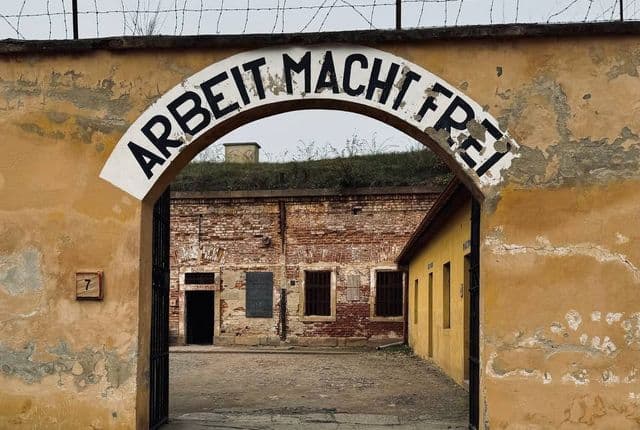
Beginning in late 1941, Jews from Prague and the wider Protectorate were deported to the Terezín ghetto (Theresienstadt) — a fortress town 60 km north of Prague repurposed as a transit camp and propaganda tool. Terezín was presented to the International Red Cross as a "model Jewish settlement," complete with staged cultural events and a propaganda film. The reality was overcrowding, disease, starvation, and a transit point to Auschwitz-Birkenau, Treblinka, and other extermination camps.
Of the roughly 140,000 Jews who passed through Terezín, approximately 33,000 died there and another 88,000 were murdered in extermination camps. Of Prague's prewar Jewish population, fewer than 10,000 survived.
The Pinkas Synagogue in Josefov — Prague's Jewish Quarter — bears witness in the most direct way possible. The names of 77,297 murdered Bohemian and Moravian Jews are inscribed on its interior walls, arranged by community, then alphabetically. The effect is overwhelming. Upstairs, an exhibition displays drawings made by children held at Terezín — approximately 15,000 children passed through the camp, and fewer than 1,500 survived. A guided Josefov tour gives context to what otherwise reads as a list of names.
The Jewish Quarter's survival is itself a dark irony. The Nazis preserved Prague's synagogues and Jewish cemetery not out of respect but as a planned "Museum of an Extinct Race" — a collection of confiscated artefacts documenting the people they intended to erase completely.
The Prague Uprising — May 1945
As the war entered its final days, Prague erupted. On 5 May 1945, Czech resistance fighters, civilians, and defecting soldiers of the Russian Liberation Army (ROA, under General Vlasov) launched an uprising against the German garrison. Barricades went up across the city — over 1,600 of them, built from paving stones, overturned trams, and furniture.
The fighting was fierce. The Germans held superior firepower and brought in reinforcements including SS units. Czech radio broadcast desperate appeals for help: "Voláme spojenecké armády" — "We are calling the allied armies." The American Third Army under General Patton had reached Plzeň, 80 km to the southwest, but was ordered to halt at the agreed demarcation line with the Soviets. The British also did not advance.
The ROA troops — Soviet prisoners of war who had fought for Germany but turned against them — played a critical and controversial role in the early phase. They helped liberate large parts of Prague before withdrawing westward to surrender to the Americans (most were handed over to the Soviets and executed or imprisoned).
The German garrison negotiated a withdrawal on 8 May. The Soviet Red Army entered Prague on 9 May 1945 — one day after V-E Day. The city was largely intact, though pockets of heavy damage scarred several neighbourhoods. The Old Town Hall's Gothic east wing, destroyed during the fighting, was never rebuilt — the gap is still visible on the Old Town Square today.
These stories come alive when told by someone who knows them deeply. Our licensed guides share what the plaques don't say.
What You Can Visit Today
Church of Saints Cyril and Methodius
Resslova 9a, New Town. The crypt memorial is open Tuesday through Sunday. The bullet holes in the exterior wall and the ventilation window at pavement level are visible at all times. Allow at least 30 minutes inside.
Pinkas Synagogue and the Jewish Museum
Part of the Jewish Museum in Prague circuit in Josefov. The wall inscriptions of the murdered and the children's drawings from Terezín are together one of the most powerful memorial experiences in any European city. Combined tickets cover the Old Jewish Cemetery, the Spanish Synagogue, and other sites.
Terezín Memorial
60 km north of Prague, reachable by bus in about an hour. The Small Fortress (former Gestapo prison), the Ghetto Museum, the Magdeburg Barracks, and the crematorium are all open to visitors. A full visit takes at least half a day. We can arrange private transport and guided visits.
Old Town Square — The Missing Wing
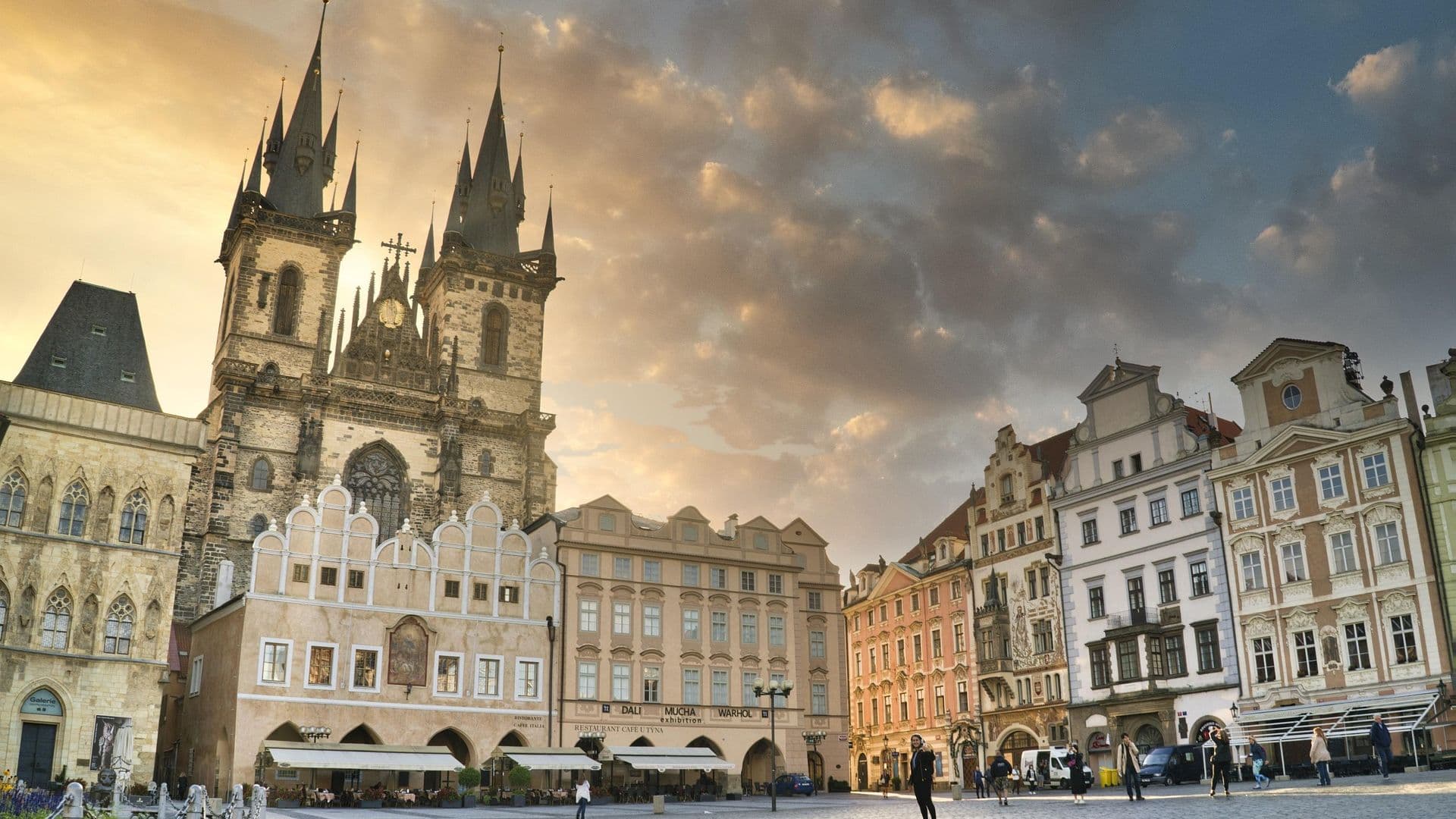
The gap on the east side of the Staroměstské náměstí (Old Town Square), where the Old Town Hall's Gothic wing stood before its destruction in May 1945, is visible to every visitor but understood by few. The astronomical clock survived; the wing next to it did not. Proposals to rebuild it have been debated for decades and never realized.
Heydrich Assassination Site
The curve on Zenklova/Na Vršovickém nábřeží in Libeň, with a small memorial. It's off the standard tourist track but accessible by tram. The ordinariness of the location is part of what makes it memorable.
Walking WWII Prague With a Private Guide
These are sites that demand context. A church with bullet holes is just a church unless someone explains what happened inside. The names on the Pinkas Synagogue wall are an undifferentiated mass of letters until a guide helps you understand the scale of what they represent.
On our All Prague in One Day private tour, we cover the wartime period alongside the medieval, Habsburg, and communist layers of Prague — because the city's story is continuous, and one chapter explains the next. Exclusively yours, with your own guide.
For the medieval foundations that preceded these 20th-century horrors, a medieval dinner at U Pavouka places you in vaulted cellars that stood through everything described in this article.
For a deeper exploration of Josefov and its prewar community, read our guide to the Prague Jewish Quarter, or browse all our private tours in Prague.
Operation Anthropoid — The Assassination That Changed WWII
On the morning of May 27, 1942, two Czechoslovak soldiers — Jozef Gabčík and Jan Kubiš — ambushed the open Mercedes of Reinhard Heydrich, the Acting Reich Protector of Bohemia and Moravia, at a hairpin bend in the Prague-Libeň district. Gabčík's Sten gun jammed. Kubiš threw a modified anti-tank grenade. The blast wounded Heydrich, who died of septicaemia eight days later in Bulovka Hospital.
It was the only successful assassination of a top-ranking Nazi official during the entire war — and the reprisals were devastating.
Hitler ordered the complete destruction of the village of Lidice on June 10, 1942: 173 men shot, women sent to Ravensbrück, children to extermination camps. The village of Ležáky suffered a similar fate days later. In Prague, the Gestapo arrested and executed over 1,300 people in the weeks following the assassination.
Gabčík, Kubiš, and five fellow paratroopers took refuge in the crypt of the Church of Saints Cyril and Methodius (Kostel sv. Cyrila a Metoděje) on Resslova Street in Nové Město. On June 18, 1942, after a betrayal by one of their associates, 700 SS soldiers besieged the church. The firefight lasted hours. The Nazis tried to flood the crypt through a fire hose pushed into a ventilation shaft. When ammunition ran out, the seven men took their own lives rather than surrender.
What to visit today:
The National Memorial to the Heroes of the Heydrich Terror occupies the church crypt where the paratroopers made their last stand. The bullet holes in the church's exterior wall are still visible — deliberately preserved. Inside, the crypt has been left largely as it was, with the ventilation shaft, the failed flooding attempt, and personal belongings of the soldiers on display. A small but powerful exhibition on the upper floor documents the operation from training in Britain to the aftermath.
The memorial is at Resslova 9a, Praha 2 — a 10-minute walk from Karlovo náměstí metro station. Admission is modest (75 CZK) and the visit takes about 45 minutes. It is, without exaggeration, one of the most emotionally impactful historical sites in Prague — yet most visitors pass the church without knowing what happened inside.
The assassination site itself — the bend at Zenklova and Na Vršovce streets in Praha 8 — is marked by a small memorial plaque and a bronze bust, reachable by tram 10 or 25.
Frequently Asked Questions
Was Prague bombed during World War II?
Prague suffered relatively little bombing compared to other European capitals. The most significant air raid occurred on 14 February 1945, when American bombers accidentally hit parts of Prague — possibly mistaking the city for Dresden. The heaviest damage came from ground fighting during the Prague Uprising in May 1945, which destroyed the east wing of the Old Town Hall.
Can you visit Terezin from Prague?
Yes. Terezin is about 60 km north of Prague, roughly an hour by bus or car. The memorial complex includes the Small Fortress, the Ghetto Museum, the Magdeburg Barracks, and the crematorium. A thorough visit takes at least four to five hours including travel.
Where is the Heydrich assassination site?
The assassination took place at a sharp curve on what is now the corner of Zenklova and Na Vrsovickem nabrezi streets in Prague's Liben district. A small memorial marks the spot. The Church of Sts Cyril and Methodius on Resslova street, where the parachutists made their last stand, is the more substantial memorial site.
Who liberated Prague in 1945?
The Prague Uprising began on 5 May 1945, led by Czech resistance fighters with initial help from Russian Liberation Army (ROA) troops. The German garrison negotiated a withdrawal on 8 May. The Soviet Red Army entered Prague on 9 May 1945. American forces had reached Plzen but were ordered not to advance further east.
Want a guided walk through the Jewish Quarter with a licensed local guide? Book our private Jewish Quarter tour — exclusively yours, door-to-door from your hotel.
You May Also Like
Want to see Prague for yourself?
Discover Prague's underground tour