Jewish History in Prague — Eight Centuries in Josefov
The Jewish community in Prague is one of the oldest in Europe, and its story spans eight centuries of resilience, persecution, intellectual achievement, and tragedy. Other cities have Jewish quarters. Prague has something different: a continuous history in a single neighbourhood where synagogues from the 13th century still stand beside apartment buildings from the 19th, and where the weight of what happened between those centuries is visible in every street.
If you've read our practical guide to visiting Josefov, this article goes deeper — not the logistics of visiting, but the history that makes the visit matter. This is the story of Jewish Prague from medieval settlement to post-1989 renewal. For visitors who want a guide alongside the history, see our private Josefov tour.
Early Settlement (13th Century)
Jews lived in Prague from at least the 10th century, but the defined Jewish quarter — the enclosed ghetto that would persist for centuries — took shape in the 13th century. The community settled in an area between the Old Town Square and the Vltava river, bounded by streets that still exist.
The Old-New Synagogue (Staronová synagoga) was built around 1270, making it one of the oldest active synagogues in Europe. Its Gothic vaulted ceiling and narrow interior have survived every disaster — fire, flood, pogrom, and occupation — for over 750 years. Services are still held here. The five-ribbed vault (unusual — most Gothic vaults have four or six ribs) gives the ceiling an asymmetry that visitors notice without being able to explain.
The name "Old-New" has several contested explanations. One holds that it was called "New" when built, then "Old-New" when a newer synagogue was constructed. Another derives from the Hebrew "al tnai" (on condition) — the legend that the synagogue was built from stones of the destroyed Temple in Jerusalem, to be returned when the Temple is rebuilt.
Pogroms and the Easter Accusation
Jewish life in medieval Prague was punctuated by violence. Pogroms — mob attacks on the Jewish quarter — occurred repeatedly, often triggered by accusations of ritual murder or the desecration of communion wafers.
The worst occurred in 1389, during Easter. A mob attacked the ghetto, killing an estimated 3,000 people — nearly the entire community. The massacre was among the deadliest pogroms in medieval European history. Rabbi Avigdor Kara, who survived, wrote an elegy for the dead that is still recited in Prague synagogues on Yom Kippur.
The cycle repeated for centuries: periods of relative tolerance followed by outbursts of persecution, often linked to political or economic crises that had nothing to do with the Jewish population itself. The community rebuilt each time, and each rebuilding left another layer in the quarter's architecture.
Rudolf II and the Golden Age (1576-1612)
The reign of Emperor Rudolf II marked the most prosperous period for Prague's Jewish community before the modern era. Rudolf moved his court from Vienna to Prague in 1583, and his eclectic intellectual interests — art, science, alchemy, philosophy — created an atmosphere of relative tolerance.
This was the era of Rabbi Judah Loew ben Bezalel — the Maharal of Prague (c. 1520-1609), one of the most important rabbinical scholars in Jewish history. He was a philosopher, mathematician, and educational reformer whose writings on Jewish ethics and theology remain studied today. His tomb in the Old Jewish Cemetery is the most visited grave in the cemetery — visitors still leave notes and stones on it.
And it was Rabbi Loew who became associated with the legend of the Golem — an artificial being created from clay and animated by mystical formulae to protect the Jewish community from persecution. According to the most popular version, Rabbi Loew formed the Golem from clay taken from the banks of the Vltava and brought it to life by inscribing the Hebrew word "emet" (truth) on its forehead. When the Golem became uncontrollable, Rabbi Loew erased the first letter, leaving "met" (death), and the creature crumbled.
The legend has no historical basis — it was elaborated in the 19th century — but it captures something real about the community's situation: the dream of protection in a world where violence could come at any moment. The attic of the Old-New Synagogue, according to tradition, still holds the remains of the Golem. The attic has never been opened to the public.
The Ghetto and Daily Life
Life in the Prague ghetto was defined by overcrowding. The community was confined to a few blocks, and as the population grew, buildings rose higher and streets narrowed. The quarter became one of the most densely populated areas in Europe — families crammed into buildings that leaned over alleys too narrow for a cart.
The Old Jewish Cemetery (Starý židovský hřbitov), in use from roughly 1439 to 1787, illustrates the compression. With no room to expand, the dead were buried in layers — up to twelve layers deep in some places, with approximately 12,000 tombstones visible above ground and an estimated 100,000 burials beneath them. The tombstones cluster and tilt at angles, creating a landscape unlike any other cemetery in Europe.
The cemetery is profoundly affecting. Our guests usually go quiet here. The sheer density of the stones, the age of the inscriptions, the awareness of how many people are buried in such a small space — it communicates something that words about demographics and persecution cannot.
Despite the confinement, the ghetto sustained a remarkable intellectual and commercial life. It had its own town hall (with a clock whose hands move counter-clockwise, following the Hebrew reading direction), its own markets, and synagogues serving different communities and traditions.
Josephine Emancipation — The Name "Josefov"
In 1781, Emperor Joseph II issued the Edict of Toleration, relaxing the restrictions on Jewish life. Jews could attend universities, enter professions previously closed to them, and live outside the ghetto walls. The quarter was named Josefov in his honour — a rare case of a persecuted community naming their neighbourhood after the ruler who eased their persecution.
The emancipation was gradual and incomplete. Full civil rights for Jews in the Czech lands came in stages throughout the 19th century. But the trajectory was clear: from a walled ghetto to legal equality within three generations.
The 19th Century — Prosperity and Assimilation
The 19th century transformed Prague's Jewish community. With legal barriers falling, Jewish families entered the professions, the arts, commerce, and industry. By the late 1800s, Jewish Prague was one of the most culturally productive communities in Central Europe.
The clearance (asanace) of the 1890s-1900s demolished most of the medieval ghetto. The cramped, unsanitary streets were replaced by wide boulevards lined with Art Nouveau apartment buildings — the Paris Avenue (Pařížská) that runs through Josefov today, now one of the most expensive shopping streets in Prague. Six synagogues and the cemetery survived; virtually everything else was destroyed.
The clearance was driven by public health concerns — the ghetto's density and lack of sanitation were real problems — but it also erased centuries of physical history. The synagogues that remain are islands of medieval and Renaissance architecture in a sea of 19th-century urban renewal.
Franz Kafka's Jewish Prague
Franz Kafka (1883-1924) was born into a German-speaking Jewish family in Prague. He lived most of his life within walking distance of the Old-New Synagogue, and his relationship with his Jewish identity was complicated — engaged but uneasy, drawn to Yiddish theatre and Zionist ideas but never fully religious.
Kafka's Prague was a city of overlapping identities: Czech, German, and Jewish communities sharing the same streets but inhabiting different cultural worlds. He wrote in German, lived in a Czech city, and belonged to a Jewish community that was increasingly assimilated but never entirely accepted. The tension shaped his writing — the bureaucratic absurdity, the isolation, the sense of being accused without understanding the charge.
His grave is in the New Jewish Cemetery in Žižkov — a larger, more orderly space than the medieval cemetery in Josefov. The grave is modest: a crystal-shaped granite marker bearing the names of Kafka and his parents. It draws a steady stream of literary pilgrims.
World War II — Deportation and Destruction
The German occupation of 1939 began the systematic destruction of Jewish Prague. The Nuremberg Laws were applied. Jewish businesses were confiscated. Jews were excluded from public life, forced to wear yellow stars, and subjected to escalating restrictions.
These stories come alive when told by someone who knows them deeply. Our licensed guides share what the plaques don't say.
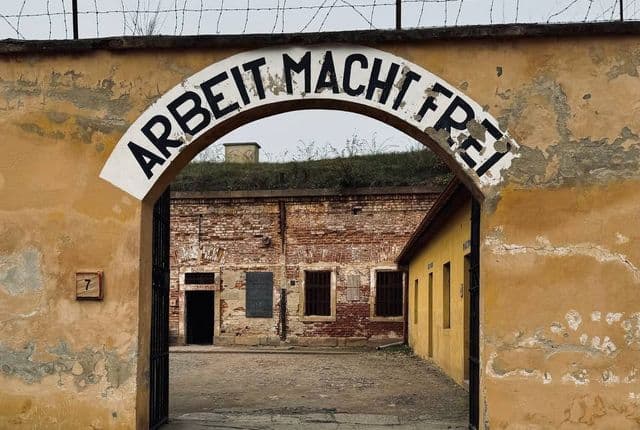
Between 1941 and 1945, the Nazis deported approximately 46,000 Jews from Prague — first to the transit camp at Terezín (Theresienstadt), then to extermination camps in the east, primarily Auschwitz. Of Prague's pre-war Jewish population of roughly 45,000, fewer than 5,000 survived.
The Terezín camp served a particular propaganda purpose: it was presented to the outside world as a "model settlement" — complete with staged cultural events, a café, and even a propaganda film. The reality was starvation, disease, and a transit point to the gas chambers.
Why the Synagogues Survived
The Prague synagogues were not destroyed — and the reason is chilling. The Nazis planned to preserve them as the centrepiece of a "Museum of an Extinct Race" (Museum einer untergegangenen Rasse). Objects were collected from destroyed Jewish communities across Bohemia, Moravia, and elsewhere — Torah scrolls, textiles, ceremonial silver, community records — and stored in the Prague synagogues.
The intention was to exhibit these objects after the war in a museum documenting a people who no longer existed. The synagogues survived the war because they were meant to serve as their community's tombstone.
After liberation, the collection became the basis of the Jewish Museum in Prague — one of the largest collections of Judaica in the world, now exhibited in the very synagogues where the Nazis stored their plunder. The Pinkas Synagogue bears the names of 77,297 Czech and Moravian Holocaust victims hand-painted on its walls — every name, every birth date, every date of death or deportation.
Standing in the Pinkas Synagogue and reading those names — wall after wall, floor to ceiling — is one of the most powerful experiences in Prague. Our guests who visit remember it years afterward.
The Communist Era (1948-1989)
The Communist period added another layer of difficulty. While the regime was officially anti-fascist, it was also periodically anti-Semitic — the Slánský trial of 1952, in which prominent Communist Party members (many of them Jewish) were convicted on fabricated charges, showed that anti-Jewish persecution could survive a change of political system.
The Jewish community during the Communist era was small and constrained. Religious practice was discouraged. The synagogues and cemetery were maintained as cultural monuments, but active Jewish life was limited. Many of those who survived the Holocaust had emigrated — to Israel, to the United States, to Western Europe — and those who remained lived in a system that was indifferent at best and hostile at worst.
Post-1989 Renewal
After the Velvet Revolution, the Jewish community began a careful process of renewal. Property was returned. Synagogues were restored. The Jewish Museum expanded its programmes. A new generation began exploring identities that had been suppressed or hidden for decades.
Today, Prague's active Jewish community numbers roughly 1,500-3,000 members (estimates vary depending on how membership is defined). The Old-New Synagogue holds regular services. The Chabad centre in Josefov serves both residents and visitors. Cultural events, educational programmes, and commemorative activities keep the community visible.
Josefov itself has become one of Prague's most visited districts. The tension between tourism and remembrance is real — luxury boutiques on Pařížská sit a hundred metres from the walls of the Pinkas Synagogue. But the synagogues, the cemetery, and the museum ensure that the history is not forgotten, even as the neighbourhood around them changes.
Experience It With a Private Guide
Jewish history in Prague requires context. The synagogues are small and their significance is not self-evident — a guide who can explain why the Old-New Synagogue has five ribs, why the cemetery has twelve layers, and why the Pinkas Synagogue walls are covered in names transforms the visit from sightseeing into understanding.
On our Charles Bridge and Old Town private tour, we walk through Josefov and cover the history at a depth that matches your interest. Our All Prague in One Day tour includes the Jewish Quarter as part of a full-day circuit of the city.
For an experience that connects medieval Prague to its living traditions, the Medieval Dinner Show takes place in the kind of vaulted cellars that were contemporary with the earliest synagogues in Josefov.
Browse all our private tours in Prague.
Frequently Asked Questions
How old is the Jewish community in Prague?
Jews have lived in Prague since at least the 10th century. The defined ghetto took shape in the 13th century, and the Old-New Synagogue, built around 1270, is one of the oldest active synagogues in Europe.
What is the Golem legend?
According to tradition, Rabbi Judah Loew ben Bezalel created an artificial being from clay in the 16th century to protect the Jewish community. The legend was elaborated in the 19th century and has become one of Prague's most famous stories. The attic of the Old-New Synagogue is said to hold the Golem's remains.
Why did the Nazis preserve the Prague synagogues?
The Nazis planned a "Museum of an Extinct Race" — a post-war exhibition documenting a people they intended to annihilate. Objects from destroyed Jewish communities were stored in the Prague synagogues. After liberation, this collection became the Jewish Museum in Prague.
Can you visit the Old Jewish Cemetery?
Yes. The Old Jewish Cemetery is part of the Jewish Museum in Prague circuit. It contains approximately 12,000 visible tombstones and an estimated 100,000 burials in layers up to twelve deep. Tickets are available at the museum entrance or online.
What happened to Prague's Jews during World War II?
Approximately 46,000 Jews were deported from Prague between 1941 and 1945, primarily to Terezin and then to Auschwitz. Fewer than 5,000 survived. The Pinkas Synagogue bears the names of 77,297 Czech and Moravian Holocaust victims on its walls.
Want to learn more on the ground? Our private Jewish Quarter tour covers the synagogues, the cemetery, and the stories behind Josefov.
You May Also Like
Want to see Prague for yourself?
Tour the Old Town and Jewish Quarter