A Brief History of Prague — From Slavic Settlement to EU Capital
Prague has been continuously inhabited for over a thousand years. Empires have risen and collapsed here. Revolutions have started in its squares. Kings, emperors, reformers, invaders, and dissidents have all walked these same streets — and the streets themselves have barely changed.
We guide people through this history every day, and what makes Prague different from other European capitals is that almost every era left visible traces. The places where history happened are still standing. This is that history, connected to the places you can still see.
Slavic Origins and the Founding Legend (6th-9th Century)
Slavic tribes settled the Vltava basin around the 6th century. The area offered everything a settlement needed: a river for trade and water, hills for defence, and fertile land for farming.
The founding legend of Prague centres on Princess Libuše, a mythical figure who stood on the cliffs of Vyšehrad and prophesied a great city. "I see a great city whose glory will touch the stars," she reportedly said, pointing across the river valley. She sent her people to find a man carving a threshold (práh) for a house, and from that word the city took its name.
The legend is almost certainly fiction. But Vyšehrad — the fortress on the cliff above the river — is real, and it may well have been the site of the earliest fortified settlement. The Romanesque rotunda of St. Martin still stands on the ramparts, and the cemetery holds the remains of Czech cultural figures from Smetana to Dvořák.
The Přemyslid Dynasty (9th-14th Century)
The Přemyslid family ruled Bohemia from the 9th century until 1306 — one of the longest-ruling dynasties in European history. Prince Bořivoj, the first historically documented Přemyslid, established Prague Castle around 880 and was baptised into Christianity, linking Bohemia to the Christian European world.
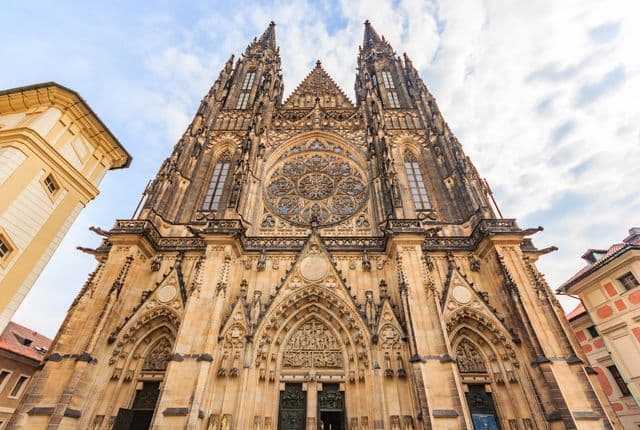
His grandson Václav (Wenceslas), who promoted Christianity and allied with the German kingdom, was murdered by his brother Boleslav in 935. He became the patron saint of the Czech nation — the "Good King Wenceslas" of the Christmas carol. His chapel in St. Vitus Cathedral, inlaid with semi-precious stones, remains the most sacred space in Czech Christianity.
The Přemyslids expanded Prague steadily. The Old Town (Staré Město) was formally chartered in the 13th century. The Lesser Town (Malá Strana) was founded in 1257 by Přemyslid King Otakar II for German colonists. The basic layout of Prague — Castle on the hill, town below, bridge across the river — was established under the Přemyslids and never fundamentally changed.
The dynasty ended in 1306 when the last male Přemyslid, Wenceslas III, was assassinated in Olomouc. Through marriage, the crown passed to the Luxembourg family — and Prague was about to enter its greatest era.
Charles IV and the Golden Age (1346-1378)
Charles IV — Holy Roman Emperor, King of Bohemia, and the most important figure in Prague's history — made this city the capital of an empire.
Born in 1316 as Václav, he took the name Charles at his French confirmation and was educated at the Parisian court. When he became king of Bohemia in 1346 and Holy Roman Emperor in 1355, he chose Prague as his seat of power. For the next three decades, he transformed a prosperous but provincial city into one of the great capitals of medieval Europe.
The list of what Charles IV built or founded in Prague reads like a guide to its major landmarks. He commissioned St. Vitus Cathedral (1344). He founded Charles University (1348) — the first university in Central Europe. He built the New Town (Nové Město), more than doubling Prague's area. He commissioned Charles Bridge (1357) to replace an earlier bridge swept away by floods. He expanded Prague Castle and established it as an imperial residence.
Under Charles, Prague's population reached approximately 40,000 — making it one of the largest cities in Europe, comparable to Paris and London. The city had a cosmopolitan character: Czech, German, Italian, and Jewish communities lived in distinct quarters but shared the same streets and markets.
You can spend an entire day in Prague visiting only what Charles IV built. On our All Prague in One Day tour, we trace his legacy through the castle, across the bridge, and into the university quarter — connecting the buildings to the man who imagined them.
The Hussite Wars (1419-1434)
The period of peace and prosperity didn't last. In 1415, the Czech religious reformer Jan Hus — a priest who challenged Church corruption and preached in Czech rather than Latin — was burned at the stake at the Council of Constance, despite holding a safe-conduct pass from the Emperor.
His execution ignited a revolution. In July 1419, a Hussite mob in Prague threw Catholic councillors from the window of the New Town Hall — the first Defenestration of Prague (Prague would develop a tradition of resolving political disputes by throwing people out of windows). The act triggered the Hussite Wars, a fifteen-year series of conflicts that pitted the Bohemian reformers against papal crusades.
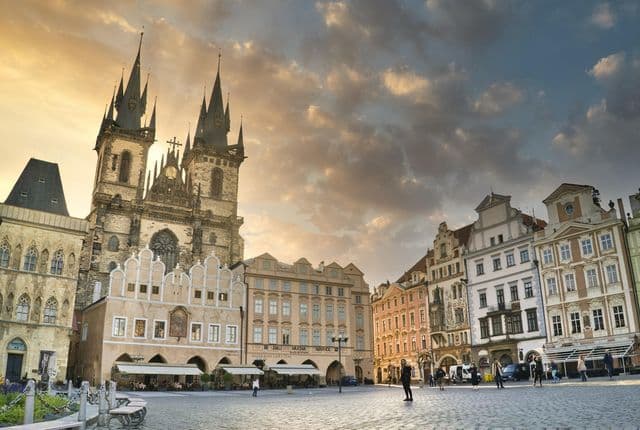
The wars devastated many monasteries and churches across Bohemia, but Prague survived largely intact. The Hussite legacy shaped Czech identity permanently: a suspicion of foreign religious authority, a tradition of intellectual independence, and a national memory of being punished for standing on principle. The statue of Jan Hus in the centre of Old Town Square, erected in 1915 on the 500th anniversary of his death, remains one of the most symbolically charged monuments in Prague.
The Habsburg Era (1526-1918)
In 1526, the Bohemian nobility elected the Habsburg Ferdinand I as king, beginning nearly 400 years of Habsburg rule. The relationship between Czech Bohemia and the Austrian-German Habsburgs would define — and torment — Prague for centuries.
The early Habsburg era brought the Renaissance to Prague. Rudolf II (reigned 1576-1612) moved the imperial court from Vienna to Prague, making the city once again an imperial capital. Rudolf was an eccentric patron of art, science, and the occult. He invited astronomers Tycho Brahe and Johannes Kepler to Prague, amassed one of the greatest art collections in Europe, and supported alchemists who worked in the Golden Lane (or so legend claims — the lane's tiny houses were actually built for castle guards).
The harmony shattered in 1618 with the Second Defenestration of Prague — Protestant nobles threw two Catholic governors from the windows of Prague Castle. This triggered the Thirty Years' War, the most destructive conflict in European history to that point.
The war's decisive battle happened just outside Prague. At the Battle of the White Mountain (Bílá Hora) in 1620, the Protestant Bohemian forces were crushed in less than two hours. The aftermath was devastating: 27 Czech Protestant leaders were executed in Old Town Square on June 21, 1621 (the crosses in the pavement mark the spot). The Czech language was suppressed. The Protestant nobility was dispossessed. A Catholic Counter-Reformation physically remade Prague's churches and palaces in the baroque style.
For the next two centuries, Prague became a provincial Habsburg city — culturally subordinate to Vienna, its Czech identity pushed underground. The baroque buildings that visitors admire today — St. Nicholas Church, the Klementinum, the grand palaces of Malá Strana — are the architectural legacy of this era of enforced Catholicism.
The National Revival (19th Century)
Czech national consciousness re-emerged in the 19th century through language, music, and literature. A movement of scholars, writers, and composers deliberately revived the Czech language (which had been marginalised in favour of German) and created a modern Czech cultural identity.
The National Theatre (Národní divadlo), opened in 1881, was built with donations from ordinary Czechs — a national project funded by the nation itself. When it burned down weeks after opening, it was rebuilt within two years with the same popular support. The motto above the stage reads "Národ sobě" — "The nation to itself."
Bedřich Smetana and Antonín Dvořák composed music that became inseparable from Czech identity. The National Museum at the top of Wenceslas Square, completed in 1891, was designed as a monument to Czech achievement within the Habsburg framework — a Renaissance palace dedicated not to imperial power, but to national culture.
By the turn of the 20th century, Prague had developed a distinct Czech identity alongside its German-speaking minority. The tension between the two communities — and the broader question of Czech autonomy within the Habsburg Empire — would be resolved by the cataclysm of World War I.
Independence and the First Republic (1918-1938)
On October 28, 1918, with the Habsburg Empire collapsing, Czechoslovakia declared independence. Tomáš Garrigue Masaryk — philosopher, professor, and democratic visionary — became the first president. Independence was proclaimed from the Municipal House (Obecní dům) on náměstí Republiky, and Wenceslas Square erupted in celebration.
The First Republic (1918-1938) was a period of optimism, democratic governance, and cultural flourishing. Prague became a modern European capital with a vibrant avant-garde scene. The architecture of this period — Functionalist villas, the Trade Fair Palace, and experimental Cubist buildings — reflected the confidence of a new nation.
These stories come alive when told by someone who knows them deeply. Our licensed guides share what the plaques don't say.
But the Republic was also fragile. The German-speaking Sudeten minority in the border regions became a lever for Hitler's expansionism.
Munich, Occupation, and World War II (1938-1945)
In September 1938, Britain and France signed the Munich Agreement, ceding Czechoslovakia's Sudeten border regions to Nazi Germany — without consulting Czechoslovakia. President Edvard Beneš famously said the country had been "betrayed" by its allies. The phrase "About us, without us" (O nás bez nás) entered Czech political vocabulary and remains resonant.
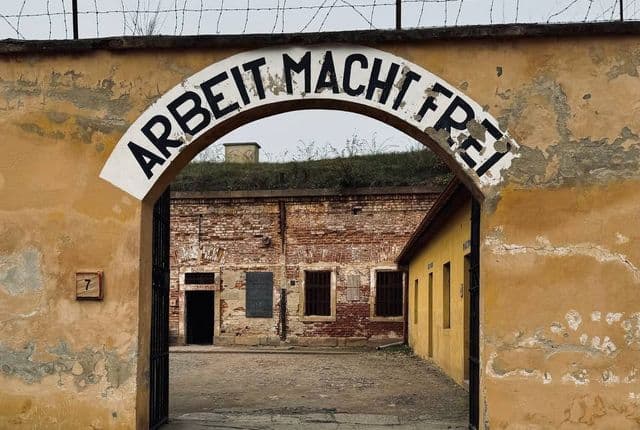
In March 1939, German troops occupied the remainder of the Czech lands, creating the Protectorate of Bohemia and Moravia. Prague spent six years under Nazi occupation. The Jewish population — roughly 45,000 in Prague — was systematically deported to Terezín and then to extermination camps. Of the approximately 80,000 Jews living in the Protectorate, fewer than 10,000 survived.
Prague itself was not heavily bombed — an accidental Allied raid in February 1945 caused damage in some areas, but the historic centre survived largely intact. On May 5, 1945, the Prague Uprising began, and on May 9, Soviet troops entered the city. The war was over, but the liberation would come at a different cost.
The Communist Takeover and Soviet Era (1948-1989)
In February 1948, the Communist Party of Czechoslovakia seized power in a coup d'etat. Democracy died quietly — the President, Beneš, signed the new government into power under pressure and died six months later. Foreign Minister Jan Masaryk (son of the first president) was found dead below a window of the Czernin Palace. The official ruling was suicide; many Czechs have always believed it was a third defenestration.
For 41 years, Czechoslovakia was a Soviet satellite state. The early 1950s were the most brutal — show trials, executions, forced collectivisation. The enormous Stalin monument that stood above Letná Park from 1955 to 1962 was the largest group statue in Europe, and its demolition (after Khrushchev's de-Stalinisation) became a symbol of the regime's contradictions.
In 1968, the Prague Spring — a period of political liberalisation under Alexander Dubček — attempted to create "socialism with a human face." On August 21, 1968, Warsaw Pact tanks rolled into Prague. The invasion was broadcast to the world. The bullet holes in the facade of the National Museum date from that night. Jan Palach, a student, set himself on fire on Wenceslas Square in January 1969 in protest — a memorial now marks the spot.
The following two decades of "normalisation" were characterised by repression, conformity, and a pervasive culture of surveillance. Dissident movements, led by figures like Václav Havel, kept resistance alive through underground publications and the 1977 Charter 77 manifesto.
The Velvet Revolution and Beyond (1989-Present)
On November 17, 1989, police brutally suppressed a student demonstration on Národní třída (National Street). A bronze plaque of hands reaching upward marks the spot where the beatings took place. The crackdown triggered the Velvet Revolution — ten days of peaceful mass protests that ended Communist rule.
Václav Havel, the playwright and dissident who had spent years in prison, became president on December 29, 1989. The transition from totalitarian state to parliamentary democracy happened without violence — "velvet" was the right word.
The country split peacefully into the Czech Republic and Slovakia on January 1, 1993 — the "Velvet Divorce." The Czech Republic joined NATO in 1999 and the European Union in 2004. Prague, which had been sealed behind the Iron Curtain for four decades, became one of Europe's most visited cities.
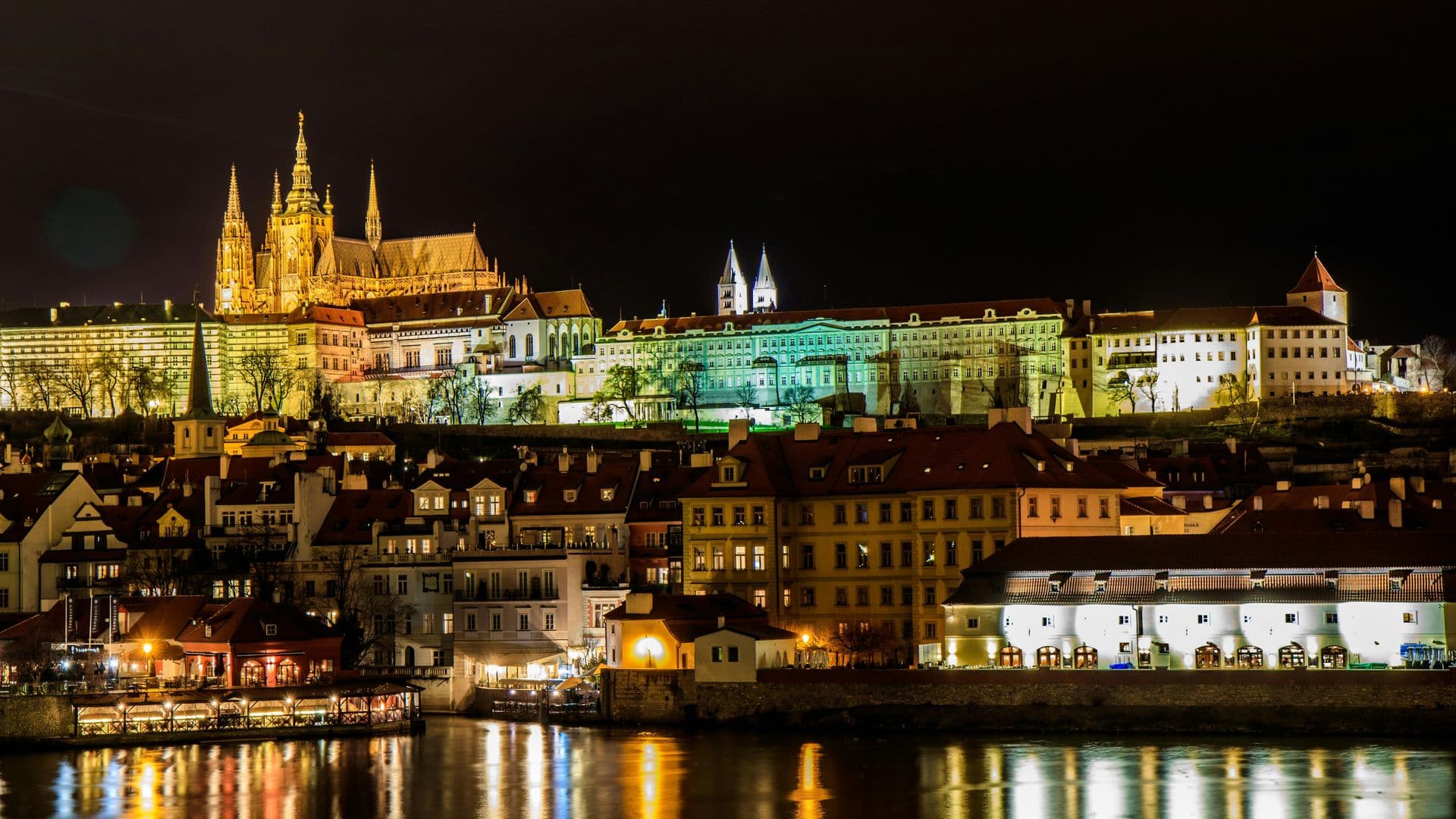
Today, walking through Prague means walking through every chapter of this history. The castle where Přemyslid princes ruled. The bridge Charles IV commissioned. The square where Protestant leaders were executed. The street where students were beaten in 1989. The buildings still stand. The streets still carry the same names. The history is not in a museum — it's underfoot.
Why Prague Is Called the City of a Hundred Spires
The nickname "City of a Hundred Spires" dates to the 19th century, when the mathematician and philosopher Bernard Bolzano reportedly counted the towers visible from a single vantage point. The actual count depends on what you include — church spires, bridge towers, gate towers, bell towers — but modern estimates put the number above 500.
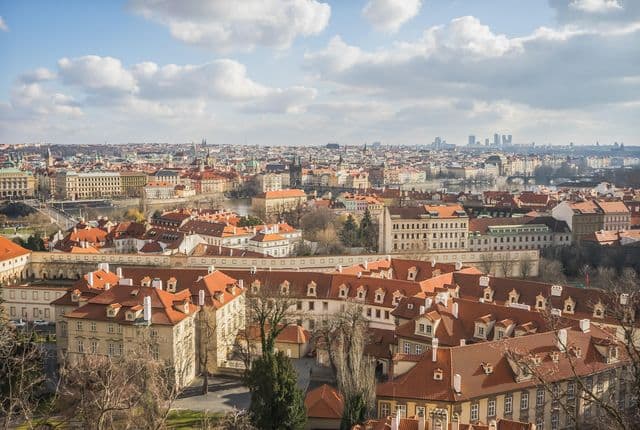
From Letná Park or Petřín Hill, the skyline effect is unmistakable. Gothic spires, Baroque domes, Renaissance gables, and Art Nouveau turrets layer on top of each other across the river. No two look the same. The density of vertical architecture is what makes Prague's silhouette different from any other European capital — and it survived largely intact because the city was never heavily bombed during World War II.
Experience It With a Private Guide
History in Prague is spatial — it lives in specific streets, squares, and buildings. On our All Prague in One Day tour, we walk through a thousand years of history, connecting each era to the places where it happened. Our Charles Bridge and Old Town tour focuses on the medieval and baroque layers — the bridge, the square, the churches.
For a visceral experience of medieval Prague, the Medieval Dinner Show at U Pavouka puts you in 15th-century vaulted cellars with period food, live swordplay, and an atmosphere that no museum can replicate.
Browse all our private tours in Prague.
Frequently Asked Questions
How old is Prague?
Prague has been continuously settled since at least the 9th century, when the Premyslid dynasty established a fortress on the site of today's Prague Castle around 880. Archaeological evidence of earlier Slavic settlement in the Vltava basin dates to the 6th century.
Who was the most important person in Prague's history?
Charles IV (1316-1378) had the greatest single impact on Prague. He made it the capital of the Holy Roman Empire, founded Central Europe's first university, commissioned Charles Bridge and St. Vitus Cathedral, and built the New Town, roughly doubling the city's size.
What happened in Prague in 1968?
On August 21, 1968, Warsaw Pact forces led by the Soviet Union invaded Czechoslovakia to suppress the Prague Spring, a period of political liberalisation. Tanks occupied the streets of Prague. Bullet holes from the invasion are still visible on the National Museum facade. In January 1969, student Jan Palach set himself on fire on Wenceslas Square in protest.
Why was Prague not destroyed in World War II?
Prague was largely spared from Allied bombing, though an accidental raid in February 1945 caused some damage. The historic centre survived intact, which is why Prague preserves architecture from so many centuries — a rare circumstance in Central European capitals.
What is the Velvet Revolution?
The Velvet Revolution was a peaceful transition from Communist to democratic rule in November 1989. Triggered by a police crackdown on a student demonstration on Narodni trida, it led to ten days of mass protests and the end of 41 years of Communist government. Vaclav Havel became president on December 29, 1989.
You May Also Like
Want to see Prague for yourself?
Discover Prague's underground tour