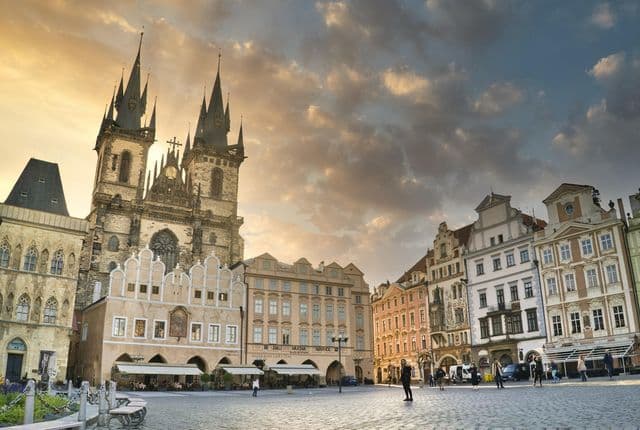
Prague Architecture — 1,000 Years of Building Styles in One City
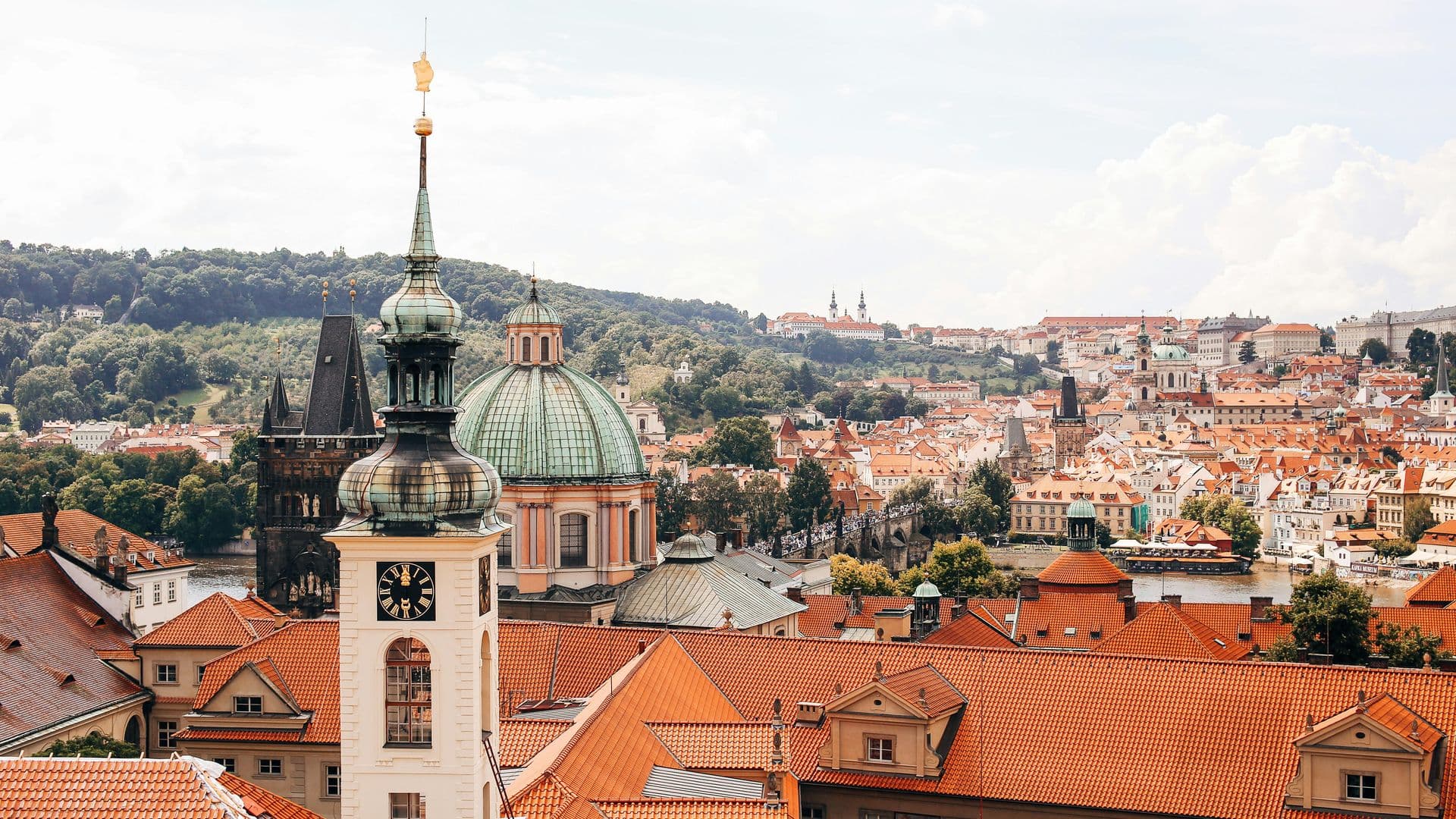
Most European cities lost their older layers to wars, fires, or modernisation. Prague didn't. This is a city where you can stand on a single street and see Romanesque foundations, a Gothic church, a Renaissance palace, a baroque facade, an Art Nouveau hotel, a Cubist lamppost, and a Communist-era tower block — all within a few hundred metres.
We walk past a thousand years of architecture in Prague every day with our guests, and the thing that surprises most people is how intact it all is. Prague was barely touched by bombing in World War II. The Communist regime neglected the historic centre but didn't demolish it. The result is a living architectural textbook, readable from the street.
Romanesque — The Foundations (11th-12th Century)
Prague's Romanesque layer is mostly underground. When the Old Town was raised by several metres in the 13th century to prevent flooding, the original Romanesque ground floors became basements. You can still see them if you know where to look.
The Romanesque cellars beneath buildings in the Old Town preserve the original street level. Several restaurants and shops occupy spaces that were once ground-floor rooms, with thick stone walls and rounded arches that date to the 11th and 12th centuries.
Above ground, three Romanesque rotundas survive — small round churches with simple semicircular apses. The Rotunda of the Holy Cross on Karoliny Světlé street is the most accessible, sitting in a small park surrounded by later buildings. The Rotunda of St. Martin at Vyšehrad is larger and better preserved, perched on the fortress ramparts above the river.
These are the oldest standing structures in Prague. Their thick walls, tiny windows, and blunt forms belong to an era when architecture was about shelter and survival, not beauty.
Gothic — The Defining Era (13th-15th Century)
If Prague has a single architectural identity, it's Gothic. The period under Charles IV (reigned 1346-1378) produced the buildings that still define the skyline.
Charles Bridge, commissioned in 1357 and completed in the early 15th century, is the most visible Gothic structure in Prague. Sixteen arches carry it across the Vltava, and the bridge towers at each end — particularly the Old Town Bridge Tower designed by Petr Parléř — are among the finest examples of Gothic civil architecture in Europe. The Old Town tower's facade is carved with royal symbols, saints, and a kingfisher — Charles IV's personal emblem.
The Church of Our Lady before Týn (Kostel Matky Boží před Týnem) dominates the Old Town Square with its twin spires. The interior is darker and more atmospheric than most Prague churches, and the tomb of the astronomer Tycho Brahe lies in the right aisle.
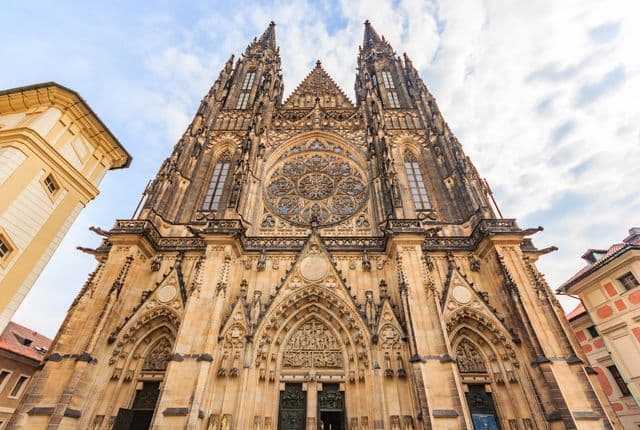
St. Vitus Cathedral is the supreme achievement — begun in 1344, completed in 1929, spanning Gothic and neo-Gothic across nearly six centuries. The work of Petr Parléř, who took over from the original French architect at age 23, gave the cathedral its innovative vault designs and the extraordinary St. Wenceslas Chapel.
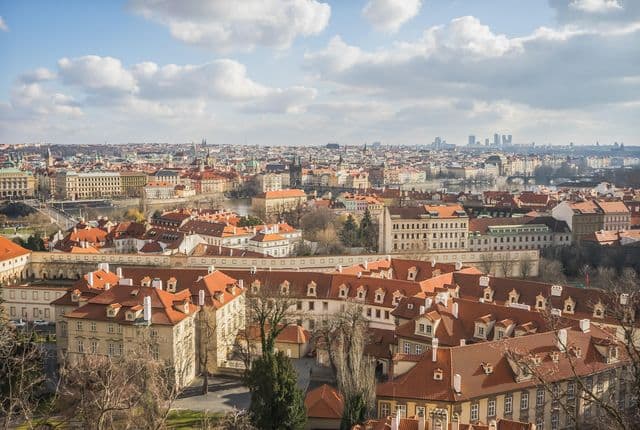
The Gothic era gave Prague its fundamental shape: the Castle above, the bridge across, the church spires below. Everything that came after was built around this framework.
Renaissance — The Italian Influence (16th Century)
The Renaissance arrived in Prague through Italian architects invited by the Habsburgs after they took the Bohemian throne in 1526. The style appears most clearly in a handful of buildings that contrast sharply with the surrounding Gothic fabric.
The Schwarzenberg Palace on Hradčanské náměstí (Castle Square) is the most striking example. Its facade is covered in sgraffito — a technique of scratching patterns through layers of coloured plaster to create geometric illusions. The black-and-white diamond pattern makes the flat wall appear three-dimensional. Visitors often stop to photograph it without knowing what period or style they're looking at.
The Belvedere (Royal Summer Palace) in the Prague Castle gardens is the purest Renaissance building in Prague — a long, elegant arcade with a copper roof shaped like an inverted ship's hull. Built between 1538 and 1563 for Queen Anne, it was designed by Italian architects and looks as if it were transported from Florence. The singing fountain in front of it produces a metallic ringing tone when water hits the bronze basin — you have to stand close and listen carefully.
Renaissance sgraffito appears on buildings throughout the Old Town and Malá Strana, often hidden behind later baroque additions. Look for geometric patterns on facades — diamonds, rectangles, and rustication effects — and you're seeing the 16th century beneath the surface.
Baroque — The Dramatic Transformation (17th-18th Century)
After the Battle of the White Mountain in 1620, the Habsburgs launched a Counter-Reformation that physically remade Prague. Catholic religious orders — Jesuits, Carmelites, Theatines — built churches and monasteries on an extraordinary scale, and the baroque style transformed entire districts.
See Prague through architectural eyes with our fully licensed Prague guides.
St. Nicholas Church (Kostel sv. Mikuláše) in Malá Strana is the masterpiece. Built by the Dientzenhofer father-and-son team between 1703 and 1755, its interior is one of the most overwhelming baroque spaces in Central Europe. The ceiling fresco by Johann Lukas Kracker covers over 1,500 square metres, and the painted architecture extends the real architecture seamlessly into an illusion of infinite sky.
The Klementinum — the massive Jesuit complex next to Charles Bridge — is the second-largest building in Prague after the Castle. Its baroque library hall, with its trompe-l'oeil ceiling and gilded wooden shelves, ranks among the most beautiful library rooms in Europe. The astronomical tower, still recording weather data as part of the longest continuous meteorological record in the world (since 1775), offers another panoramic viewpoint.
Baroque in Prague is not subtle. It was the architecture of power and persuasion — designed to overwhelm Protestants into submission and convert doubt into awe. Whether you admire the politics or not, the craftsmanship is staggering.
Art Nouveau — The National Awakening (1890s-1910s)
By the late 19th century, Czech identity was reasserting itself within the Austro-Hungarian Empire. Art Nouveau — called Secese in Czech — became the vehicle for a national cultural statement.
The Municipal House (Obecní dům) on náměstí Republiky is the crown jewel. Completed in 1912, every surface is decorated — the mosaic above the entrance by Karel Špillar, the Smetana Hall with its painted dome, the private rooms designed by Alfons Mucha. Czechoslovak independence was proclaimed from this building in 1918. The cafe and restaurant on the ground floor are open to the public and remain some of the most beautiful interior spaces in Prague.
The Hotel Evropa (now Hotel Evropa Palace) on Wenceslas Square shows Art Nouveau at a smaller scale — an ornate facade with gilded ironwork and stained glass that's been a landmark on the boulevard since 1906. The facade is the attraction; the building behind it has been under renovation for years.
Art Nouveau also shaped Prague's infrastructure. The Hlavní nádraží (Main Railway Station) has an Art Nouveau wing by Josef Fanta that most travellers rush through without seeing. And Čechův most (Čech Bridge), with its ornamental lamps and allegorical bronze figures, is perhaps the most beautiful bridge in Prague that nobody photographs.
Cubism — Prague's Unique Contribution (1911-1914)
This is where Prague architecture becomes globally unique. Cubist architecture exists almost nowhere else in the world. While Paris had Cubist painting and sculpture, only Prague applied Cubist principles to buildings — faceted surfaces, angular geometry, and crystalline forms translated into stone and concrete.
The House of the Black Madonna (Dům U Černé Matky Boží) on Ovocný trh, designed by Josef Gočár in 1912, is the most important example. The facade is built entirely of angled planes and faceted surfaces. Inside, the Grand Café Orient on the first floor has been restored as a Cubist cafe — even the furniture was designed with angular Cubist geometry.
These stories come alive when told by someone who knows them deeply. Our licensed guides share what the plaques don't say.
Below Vyšehrad, a cluster of apartment buildings by Josef Chochol on Neklanova and Rašínovo nábřeží shows Cubism applied to residential architecture. The facades ripple with triangular and diamond-shaped projections. The Cubist lamppost under Vyšehrad is one of the few Cubist objects of street furniture in existence.
We always point out Cubist buildings to our guests because the reaction is genuine surprise. People who've studied art history in school and know Picasso and Braque have never seen these principles applied to a building. It happened here, and only here.
Functionalism — The Interwar Vision (1920s-1930s)
After Czechoslovak independence in 1918, Prague embraced modernism. The new republic needed buildings that expressed democratic modernity, not imperial grandeur.
The Müller Villa (Vila Müllera) in Střešovice, designed by Adolf Loos in 1930, is one of the most important functionalist buildings in Europe. From outside it's a plain white cube. Inside, the Raumplan — Loos's concept of rooms at different levels connected by short staircases — creates a flowing interior of unexpected spatial complexity. Tours of the interior run on limited schedules and require advance booking.
The Veletržní palác (Trade Fair Palace) in Holešovice, now housing the National Gallery's modern art collection, was one of the largest functionalist buildings in the world when it opened in 1928. Its reinforced-concrete frame and glass curtain walls anticipated the International Style by decades.
Functionalism in Prague is easy to miss if you're focused on the medieval centre. But the residential districts of Dejvice, Bubeneč, and Střešovice are filled with interwar villas that represent some of the finest modernist domestic architecture in Central Europe.
Communist Era — Ideology in Concrete (1948-1989)
The Communist period left its architectural mark, though opinions vary on whether that mark has value.
The Žižkov Television Tower — 216 metres of concrete and steel rising from a residential neighbourhood — is the most visible and most polarising. Completed in 1992 (designed in the 1980s), it's regularly voted one of the ugliest buildings in Europe. But go up to the observation deck, and the view is undeniable. David Černý's crawling baby sculptures, added to the tower's exterior in 2000, turned a hated landmark into something stranger and more interesting.
Panelák housing estates ring the city's outskirts — prefabricated concrete apartment blocks built to house hundreds of thousands of workers. They're architecturally grim but sociologically fascinating. Over a third of Czech citizens still live in paneláky, and many have been renovated with colourful facades and modern insulation. They're an inescapable part of the Prague landscape that most tourist itineraries pretend doesn't exist.
The Hotel International in Dejvice (now Hotel Crowne Plaza) is the most ambitious Communist-era building — a Soviet-style wedding-cake tower with a spire and star, built in the 1950s as a replica of Moscow's Stalinist skyscrapers. The interior preserved much of its original Socialist Realist decoration.
Contemporary — The City Keeps Building
The most famous contemporary building in Prague is the Dancing House (Tančící dům), designed by Vlado Milunić and Frank Gehry in 1996. Its deconstructivist curves — meant to evoke a dancing couple — shocked Prague when it was built. Today it's accepted, photographed, and houses a rooftop restaurant with river views.
Contemporary Prague architecture is mostly happening outside the historic centre — in Karlín (once flooded in 2002, now Prague's most architecturally ambitious district), along the river in Holešovice, and in the developing areas south of the centre. The contrast between the medieval core and the modern periphery is itself a story about how cities grow.
Experience It With a Private Guide
A thousand years of architecture rewards explanation. The sgraffito on a Renaissance palace, the reason baroque churches feel overwhelming, the fact that Cubist architecture happened only in Prague — these are things you see differently with context. On our All Prague in One Day private walking tour, we walk chronologically through the city's building history.
Our Charles Bridge and Old Town tour concentrates on the Gothic and baroque layers in the oldest districts. And for architecture at its most atmospheric, the Medieval Dinner Show puts you inside 15th-century vaulted stone cellars with candlelight, live music, and food served on wooden boards.
Browse all our private tours in Prague.
Frequently Asked Questions
What architectural styles can you see in Prague?
Prague contains Romanesque (11th-12th century), Gothic (13th-15th), Renaissance (16th), Baroque (17th-18th), Art Nouveau (1890s-1910s), Cubist (1911-1914), Functionalist (1920s-1930s), Communist-era (1948-1989), and contemporary architecture. The concentration and preservation of all these layers in one city is globally unusual.
What is Cubist architecture and why is it only in Prague?
Cubist architecture applies the angular, faceted principles of Cubist painting to buildings — angled surfaces, crystalline geometry, diamond-shaped projections. A small group of Czech architects experimented with this style between 1911 and 1914. No other city applied Cubism to architecture on this scale, making Prague's Cubist buildings globally unique.
What is the Dancing House in Prague?
The Dancing House is a deconstructivist building designed by Vlado Milunic and Frank Gehry, completed in 1996. Its curved glass tower beside a straight concrete tower is meant to evoke a dancing couple. It houses offices and a rooftop restaurant with views of the river and castle.
Is Prague's architecture well preserved?
Exceptionally so. Prague suffered minimal bombing damage in World War II, and the Communist regime neglected but did not demolish the historic centre. The result is a city where buildings from ten centuries stand side by side in largely original condition.
You May Also Like
Want to see Prague for yourself?
Discover Prague's underground tour