Art Nouveau in Prague — Mucha, Architecture and Hidden Details
Prague is famous for its Gothic spires and Baroque facades, but the city's Art Nouveau layer — built in a burst of creative energy between roughly 1895 and 1914 — might be the most beautiful of all. It's also the most overlooked. Visitors walk past extraordinary facades every day without looking up.
We point out Art Nouveau details on almost every tour we lead, and the reaction is always the same: guests start noticing things they'd been passing for days. Floral reliefs above doorways, mosaic lunettes in building entrances, ironwork balconies with organic curves. Once you see the pattern, the whole city transforms. Here's where to look and what to look for.
Municipal House — The Masterpiece
Obecní dům (Municipal House) on Náměstí Republiky is the single most important Art Nouveau building in Prague — and arguably in Central Europe. It was built between 1905 and 1912 on the site of the former Royal Court, and every significant Czech artist of the period contributed to its decoration.
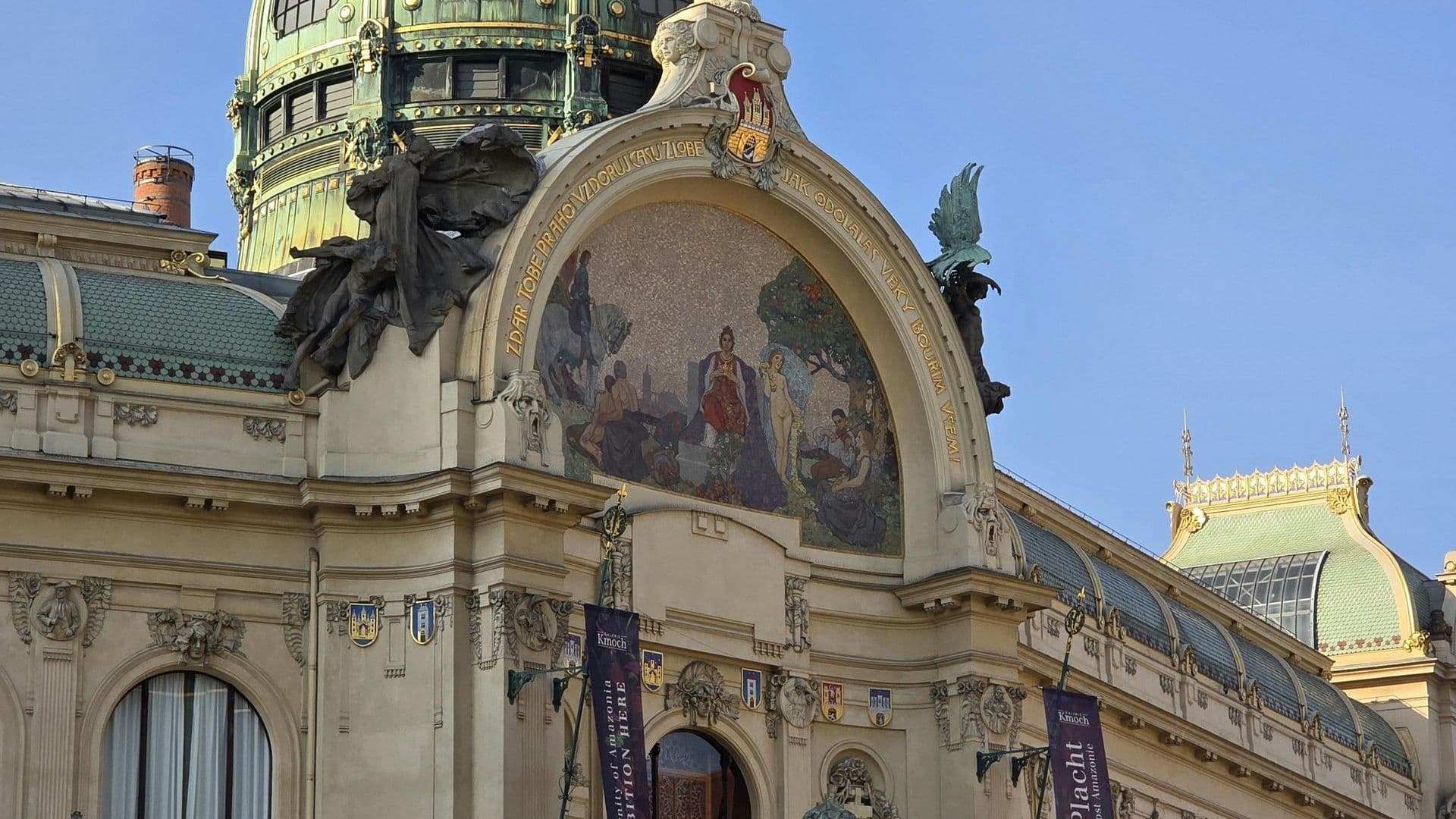
The exterior features a mosaic lunette by Karel Špillar titled *Homage to Prague* — a monumental semicircular panel above the main entrance showing allegorical figures celebrating the city. The colours are vivid even after more than a century, and the mosaic alone is worth the walk to Náměstí Republiky.
Inside, the building is astonishing. The Smetana Hall — the main concert venue — has painted ceilings, gilded columns, and stained glass that rival anything in Vienna or Paris. It's the home of the Prague Symphony Orchestra and the traditional venue for the opening concert of the Prague Spring music festival.
But the real treasure is the suite of rooms decorated by Alfons Mucha — the Mayor's Hall (*Primátorský sál*). Mucha painted the lunettes, pendentives, and curtain designs himself, creating an immersive space where Art Nouveau doesn't decorate the room but becomes it. The figures are unmistakably Mucha — Slavic women with flowing hair, surrounded by botanical motifs and interlocking geometric patterns. Guided tours of the interior run daily, and we recommend them to every guest.
One insider detail: the Kavárna Obecní dům (Municipal House Café) on the ground floor is one of the most beautiful café interiors in Prague. The ceiling, the light fixtures, the tile work — it's a functioning Art Nouveau total artwork, and you can sit there with a coffee and a cake for the price of a regular café. Most tourists line up outside and photograph the building without going in.
Hotel Evropa — Wenceslas Square's Faded Star
Hotel Evropa (originally Hotel Šroubek, later Grand Hotel Evropa) on Wenceslas Square is the most photographed Art Nouveau facade on Prague's main boulevard. The building dates from 1903-1905, designed by Alois Dryák and Bedřich Bendelmayer, and its facade is a textbook of the style — gilded lettering, floral balcony railings, carved female figures flanking the upper windows.
The hotel's Café Evropa was once a legendary meeting point — writers, artists, and politicians gathered here throughout the 20th century. The interior, with its original stained glass, marble columns, and ornate ceiling paintings, was one of the finest Art Nouveau café spaces in Europe.
The building has changed hands multiple times and undergone renovation under the W Hotel brand. The exterior remains largely intact, and standing on the west side of Wenceslas Square in the afternoon light — when the sun hits the gilded details — is still one of the great Art Nouveau moments in Prague.
Alfons Mucha — More Than Posters
Alfons Mucha is Prague's most famous Art Nouveau artist, and most visitors know him from the iconic poster designs — Sarah Bernhardt with flowing hair, surrounded by botanical halos and pastel curves. The posters made him famous in Paris in the 1890s, but Mucha considered them commercial work. His life's ambition was something much larger.
The Mucha Museum on Panská street (near Wenceslas Square) covers his career comprehensively — from the Paris posters through the decorative panels to the photography he used as reference material. It's a small, focused museum that takes about an hour. What most visitors don't expect is the range: Mucha designed jewellery, furniture, wallpaper, banknotes for the new Czechoslovak Republic, and even a stained-glass window in St. Vitus Cathedral — the one in the north aisle depicting Saints Cyril and Methodius, which is worth seeking out on any visit to Prague Castle.
His greatest work is the Slav Epic (*Slovanská epopej*) — a cycle of 20 monumental canvases (the largest measuring 6 by 8 metres) depicting the history and mythology of the Slavic peoples. Mucha spent 18 years painting them, from 1910 to 1928, and considered the cycle his defining achievement. The paintings are currently displayed at the Moravský Krumlov chateau in South Moravia, though their permanent home has been debated for decades. When exhibited in Prague (as they were at the Veletržní palác until 2023), the scale is overwhelming — these are room-sized paintings that immerse you in colour and narrative.
Prague Main Railway Station — The Hidden Gem
Praha hlavní nádraží (Prague Main Railway Station) is a place most visitors pass through without looking up. That's a mistake. The original station building — the Fantova budova, designed by Josef Fanta and completed in 1909 — is one of the finest Art Nouveau structures in Prague, hidden above the modern communist-era concourse.
The original entrance hall is on the upper level, accessible by escalator from the main platforms. It features arched windows, allegorical sculptures, ceramic tile panels depicting Prague and Bohemian landscapes, and a pair of grand staircases with ornate iron railings. The dome above the entrance is decorated with painted medallions and stucco work that rivals the Municipal House.
Most travellers arrive at the modern lower concourse — a brutalist concrete hall added in the 1970s — and never discover that the original building is directly above them. We always tell guests arriving by train to take the escalator up before leaving the station. The Fanta Café in the restored upper hall is a beautiful space with original detailing, and it's usually quiet.
Pařížská Street — The Art Nouveau Boulevard
Pařížská (Paris Street) was created during the demolition of the old Jewish Quarter in the 1890s-1900s, and the buildings that line it were designed to be Prague's answer to the Parisian boulevards. The result is the highest concentration of Art Nouveau facades in the city, stretching from Old Town Square down to the Čechův most bridge.
The irony is heavy — the street was built by destroying a historic Jewish neighbourhood and replacing it with luxury apartments for the Czech bourgeoisie. Today it's lined with high-end fashion boutiques, and most visitors come for the shop windows rather than the architecture above them.
Look up. The buildings on Pařížská feature carved masks, floral cartouches, wrought-iron balconies, ceramic tile panels, and sculptural groups that range from mythological figures to Art Nouveau maidens. Numbers 1, 7, and 17 are particularly rich in decoration. The corner building at Pařížská and Široká — near the entrance to the Old Jewish Cemetery — has some of the most elaborate facade work in Prague.
Masarykovo Nábřeží — The Riverside Facades
The embankment known as Masarykovo nábřeží (Masaryk Embankment), running along the Vltava south of the National Theatre, has a row of Art Nouveau apartment buildings whose facades face the river. Because visitors typically walk along the opposite bank or cross the bridges at either end, these buildings are seen from a distance but rarely examined up close.
Walk the embankment from Most Legií south toward Palackého most, and you'll find ornamental facades competing for attention — each building trying to outdo its neighbour with different tile patterns, sculptural ornament, and colour schemes. Number 32 (the Hlahol building, home of a Czech choral society) has a spectacular sgraffito facade by Mikoláš Aleš and Karel Klusáček, with scenes of Czech musical life.
The embankment also gives you an unobstructed view across the river to the Slavic Island (*Slovanský ostrov*) and Žofín Palace — another 19th-century venue that hosts concerts and events. The combination of river, facades, and castle in the background makes this one of the most photogenic walks in Prague, and one that almost no tourist takes.
Beyond the Famous Buildings — Details Everywhere
Art Nouveau in Prague isn't confined to landmarks. It's in the details of ordinary buildings across the city — apartment houses, shops, and commercial buildings that were decorated between 1900 and 1914 by architects and craftsmen working in the new style.
A few places to look:
- Vodičkova street — several commercial buildings with Art Nouveau shopfronts and entrance halls, including the Lucerna Palace passage (built by Václav Havel's grandfather)
- Celetná street — mixed Gothic and Art Nouveau facades leading from Old Town Square to the Powder Tower
- Na Příkopě — the pedestrian boulevard between Wenceslas Square and Náměstí Republiky has Art Nouveau bank buildings with elaborate interiors
- Čechův most (Čech Bridge) — the Art Nouveau bridge with ornate iron lampposts topped by winged figures holding golden torches, designed by Antonín Popp in 1908
The key is to look above street level. Prague's Art Nouveau treasures are at the second floor and above — where the landlords invested in decoration to attract tenants and show off their taste. Street level has been renovated many times; the upper floors often retain their original 1900s appearance.
Seeing Art Nouveau With a Private Guide
Art Nouveau rewards attention to detail, and a private guide who knows where to look changes the experience completely. The difference between walking past a building and understanding its facade — who designed it, what the symbols mean, how it fits into Prague's cultural moment — is the difference between seeing a city and reading it.
On our All Prague in One Day private tour, we cover the major Art Nouveau landmarks — Municipal House, Pařížská street, the Powder Tower area — alongside the Gothic, Baroque, and modern layers. On the Charles Bridge and Old Town tour, the route passes through the heart of the Art Nouveau district between Old Town Square and Náměstí Republiky. Exclusively yours, with your own guide. We adjust the focus to match your interests.
For an evening that takes you back to medieval Prague, a medieval dinner at U Pavouka is a short walk from the Art Nouveau quarter — and the contrast between the two eras is part of the fun.
Browse all our private tours in Prague.
Frequently Asked Questions
Where is the best Art Nouveau building in Prague?
The Municipal House (Obecní dům) on Náměstí Republiky is widely considered the finest. The Mucha-decorated Mayor's Hall and the Smetana Hall concert venue are extraordinary. Interior tours run daily.
Is the Mucha Museum worth visiting?
Yes — it's small, focused, and covers Mucha's full career from the Paris posters to the Slav Epic, including his photography and design work. Allow about one hour. It's on Panská street, a short walk from Wenceslas Square.
Where can I see the Slav Epic by Mucha?
The 20-canvas cycle is currently displayed at Moravský Krumlov chateau in South Moravia, about two hours from Prague. Its permanent Prague home remains under discussion. Check current exhibition status before planning a visit.
What is the best street for Art Nouveau in Prague?
Pařížská street in the Old Town has the densest concentration of Art Nouveau facades. For a longer walk, follow Masarykovo nábřeží along the Vltava — the riverside apartment buildings are spectacular and far less visited.
You May Also Like
Want to see Prague for yourself?
Discover Prague's underground tour