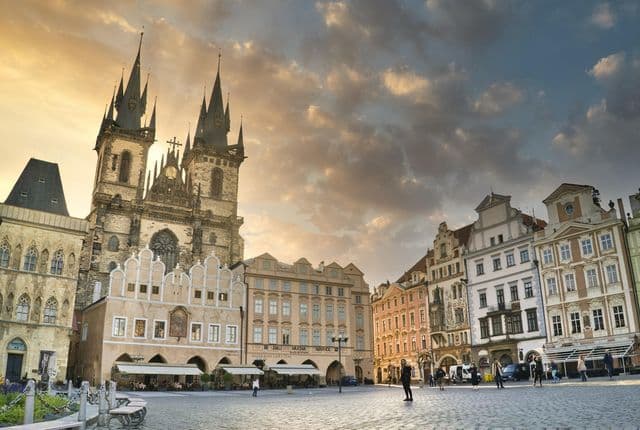
Communist Prague — What Remains and What It Means
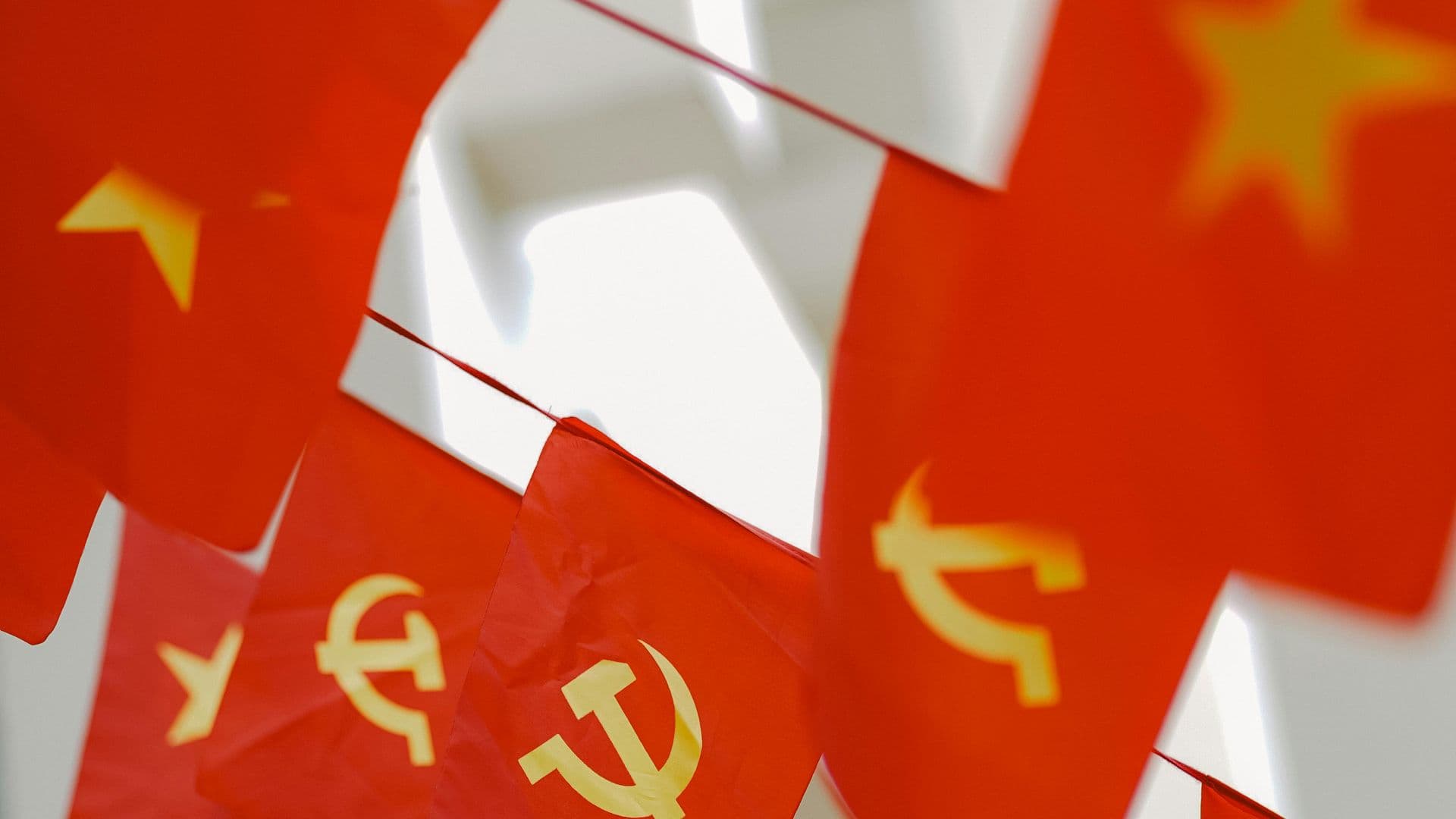
The hammer-and-sickle flags came down in 1989, but communist Prague didn't disappear — it just stopped announcing itself. Forty-one years of one-party rule reshaped the city's skyline, its public spaces, and the daily rhythms of its people. The traces are still everywhere, once you know where to look.
We walk guests through these layers regularly, and the conversations are always compelling. This isn't ancient history — Uliana grew up in the Soviet Union, and many of the Czechs you'll meet in Prague lived through normalization, stood on Wenceslas Square in November 1989, or grew up in the panelák housing estates that ring the city. Here's what remains and what it means.
The Coup That Changed Everything — February 1948
Czechoslovakia didn't fall to a Soviet invasion. The Communist Party took power through a political coup in February 1948, exploiting a cabinet crisis to force President Edvard Beneš into accepting an all-communist government. Within weeks, opposition politicians were fleeing the country, being arrested, or — in the case of Foreign Minister Jan Masaryk — found dead below a window at the Černín Palace.
Masaryk's death remains one of the great mysteries of Czech history. The official verdict was suicide; most Czechs have always believed he was thrown. A 2004 police investigation concluded it was murder, but the case has never been fully resolved. The Černín Palace still stands on Loretánské náměstí, and we often point it out — the window is visible from the street.
The speed of the takeover stunned Europe. Czechoslovakia had been the most democratic country in Central Europe, with a genuine multi-party system and free press. Within a year, all of that was gone. Show trials followed, modelled on Stalin's purges — the most notorious being the 1952 trial of Rudolf Slánský, the party's own general secretary, who was hanged along with ten others.
Normalization — The Long Grey Years
After the brief thaw of the Prague Spring in 1968 and the Soviet-led invasion that crushed it, Czechoslovakia entered what became known as *normalizace* — normalization. The term sounds benign. The reality was a systematic effort to eliminate dissent, remove reformers from public life, and ensure that nothing like 1968 could happen again.
For ordinary Czechs, normalization meant a bargain: stay quiet, don't challenge the party, and you could have a reasonable material life — a flat, a weekend cottage (*chalupa*), a Škoda car after a few years on the waiting list. Speak up, and you lost your job, your children's university places, your passport. Hundreds of thousands of people were vetted and found politically unreliable. Professors became window cleaners. Writers became stokers.
The physical legacy of normalization is the panelák — the prefabricated concrete housing block. Prague is ringed by vast panelák estates: Jižní Město, Háje, Černý Most, Prosek. These were built quickly and cheaply to house the urban workforce. From the outside, they're monotonous grey slabs. Inside, the flats are small but functional, and many have been renovated with colourful facades since the 1990s. About a third of Prague's residents still live in them.
Wenceslas Square — Where History Kept Happening
Václavské náměstí (Wenceslas Square) isn't really a square — it's a long boulevard stretching 750 metres from the National Museum down to Na Příkopě. And it has a habit of being the stage where Czechoslovak history plays out.
In August 1968, Soviet tanks rolled down Wenceslas Square. Praguers surrounded them, argued with the bewildered soldiers, and painted over street signs to confuse the occupiers. Photographs from those days — young people climbing on tanks, signs reading "Lenin, wake up, Brezhnev has gone mad" — remain some of the most powerful images of Cold War Europe.
On 16 January 1969, a 20-year-old student named Jan Palach set himself on fire on the steps of the National Museum to protest the Soviet occupation and the growing apathy of the Czech public. He died three days later. His funeral became a massive demonstration, and his name became a symbol of resistance that the regime could never fully suppress. The spot where he fell is now marked by a small memorial cross in the pavement — easy to miss unless someone points it out. We always do.
Twenty years later, in November 1989, the same square filled with hundreds of thousands of people during the Velvet Revolution. They jingled their keys — a gesture meaning "it's time to go home" — directed at the communist government. Within weeks, the regime collapsed. Václav Havel, a playwright who had spent years in prison, became president.
Jan Palach and Jan Zajíc — The Torches
Jan Palach's self-immolation is the act most visitors have heard of, but he wasn't alone. A month later, on 25 February 1969, Jan Zajíc — an 18-year-old student — set himself on fire at the same spot. A third person, Evžen Plocek, did the same in Jihlava in April.
The regime tried to erase Palach's memory. His grave at Olšany Cemetery became a site of pilgrimage, so in 1973 the authorities secretly exhumed his remains and had them cremated, then placed the urn in his mother's village. The original grave plot was given to a stranger. After 1989, the grave was restored, and it's now one of the most visited sites in the cemetery.
Palach Square (*Palachovo náměstí*) faces the Rudolfinum concert hall in the Old Town. The naming was one of the first symbolic acts after the revolution.
The Architecture — Brutalism, Social Realism and Concrete Dreams
Communist-era architecture in Prague ranges from ambitious to oppressive, and some of the most recognizable landmarks in the city date from this period.
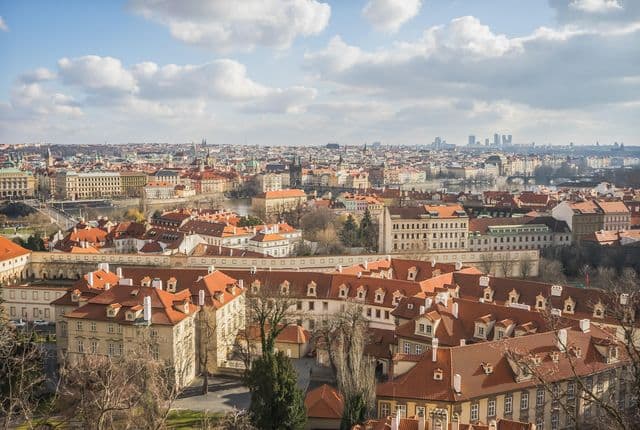
The Žižkov Television Tower is the most visible — a 216-metre structure bristling from the Žižkov hilltop like something from a science fiction film. Built between 1985 and 1992, it was designed to jam Western radio signals as well as to broadcast. Most Praguers hated it when it went up. Many still do. In 2000, the artist David Černý added ten giant crawling babies to the tower's pillars, which made it weirder but somehow more lovable. The observation deck at the top gives you the best panorama of Prague — including a clear view of the panelák estates spreading to the horizon.
Hotel International in Dejvice is a textbook example of Stalinist Social Realism — a socialist skyscraper modelled on the "Seven Sisters" towers in Moscow. It was built in the early 1950s, complete with a gilded five-pointed star on the spire (since removed), monumental reliefs of heroic workers, and an interior of marble, chandeliers, and Soviet grandeur. Today it operates as a hotel, and you can walk into the lobby to see the original decoration largely intact.
The National Memorial on Vítkov Hill — originally a monument to the Hussite commander Jan Žižka — was repurposed by the communists as a mausoleum. The body of Klement Gottwald, the first communist president, was embalmed and displayed here in imitation of Lenin. The embalming failed (Gottwald was a heavy drinker, which complicated the chemistry), and the body had to be cremated. The building is now a museum of 20th-century Czech history, and the equestrian statue of Žižka on top — the third-largest bronze equestrian statue in the world — is visible from much of the city.
Daily Life Under Communism — What Visitors Don't Expect
Visitors often imagine communist Czechoslovakia as uniformly grim. The reality was more complicated. Czechs developed a rich culture of quiet subversion — underground concerts, samizdat literature, private philosophy seminars held in boiler rooms. Václav Havel's plays were performed in living rooms. The Jazz Section of the Musicians' Union became a centre of cultural resistance, and its leaders were imprisoned for publishing books.
These stories come alive when told by someone who knows them deeply. Our licensed guides share what the plaques don't say.
The weekend cottage culture — chataření — became a defining Czech institution. Families retreated to small countryside cottages every Friday, where they could garden, drink beer, and speak freely away from workplace informers. This tradition survived communism and remains central to Czech life. If Prague seems empty on summer weekends, that's why.
Shopping meant queues. When bananas or oranges appeared at the state grocery, word spread instantly, and lines formed around the block. The Tuzex shops sold Western goods — jeans, whisky, electronics — but only for special vouchers (*bony*) that were technically illegal to trade on the black market, though everyone did. A pair of Levi's could cost a week's salary.
Where to See Communist History in Prague Today
The Museum of Communism on Na Příkopě (near Wenceslas Square) does a solid job of covering the era from 1948 to 1989 — propaganda posters, surveillance equipment, a reconstructed interrogation room, and footage of the Velvet Revolution. It takes about 90 minutes and provides essential context for understanding modern Prague.
The Nuclear Bunker under the Hotel Jalta on Wenceslas Square is an atmospheric Cold War relic — a fallout shelter built beneath a luxury hotel, designed to protect the party elite. Tours run by appointment.
Letná Park is where the world's largest statue of Stalin once stood — a 15-metre granite colossus overlooking the Vltava, completed in 1955 and blown up in 1962 after de-Stalinization made it embarrassing. The plinth remains, now occupied by a giant metronome. The views over the river are beautiful, and the spot carries a weight that photographs don't capture.
For a deeper look at how the era connects to Prague's longer story — from medieval power struggles to 20th-century revolutions — our All Prague in One Day private tour covers Wenceslas Square, the Old Town, and the broader arc of Czech history with a licensed guide who can put the pieces together.
Walking Communist Prague With a Private Guide
The communist period doesn't have a single museum or a single street. It's layered across the city — in the architecture, the street names, the stories that older Praguers tell when they trust you enough. Walking these sites with context is what transforms a grey tower block into a chapter of someone's life.
On our All Prague in One Day tour, we cover the communist era alongside medieval and Habsburg Prague — because the layers overlap, and one explains the other. Exclusively yours, with your own guide. We adjust the route to what interests you most.
To explore how Prague's deep past shaped the ground that communism was built on, pair this with a medieval dinner at U Pavouka — where the vaulted cellars predate every ideology by several centuries.
Browse all our private tours in Prague.
Cold War and Modern History
Prague's communist past left a deep mark on the city's architecture, culture, and collective memory. For four decades, daily life unfolded under state surveillance, censored media, and the constant presence of Soviet troops. The Cold War Museum brings this era to life through original artefacts, declassified documents, and carefully reconstructed scenes that reveal what ordinary Czechs experienced behind the Iron Curtain.
Frequently Asked Questions
Is there a communist museum in Prague?
Yes — the Museum of Communism on Na Příkopě, near Wenceslas Square, covers the period from 1948 to 1989 with original artefacts, propaganda, and film footage. Allow about 90 minutes for a thorough visit.
Where was the Stalin statue in Prague?
On the Letná Plain above the Vltava River. The statue stood from 1955 to 1962. The granite plinth remains, now topped by a large metronome. The site is a popular viewpoint in Letná Park.
Can you visit the panelák housing estates?
Yes — they're ordinary residential neighbourhoods, not restricted areas. Estates like Jižní Město and Černý Most are accessible by metro. There's nothing touristy about them, which is part of the interest — they're where a large portion of Prague actually lives.
What happened on Wenceslas Square in 1989?
Hundreds of thousands of Czechs gathered during the Velvet Revolution in November 1989, demanding the end of communist rule. The protests, combined with nationwide strikes, led to the resignation of the communist government and the election of Václav Havel as president within weeks.
You May Also Like
Want to see Prague for yourself?
Discover Prague's underground tour