Franz Kafka in Prague — The City That Shaped His World
Franz Kafka was born in Prague, lived almost his entire life in Prague, and hated that he couldn't leave Prague. The city held him in a grip he spent decades trying to articulate — in letters, diaries, and novels that turned the experience of being trapped in a beautiful, suffocating place into some of the most important literature of the 20th century.
We bring guests to Kafka's Prague regularly, and the experience is always layered. The city he knew is still here — the narrow streets, the looming facades, the sense that the buildings are watching. But Prague has also turned Kafka into a brand, and separating the real from the souvenir-shop version takes some local knowledge. Here's where to find the writer behind the t-shirts.
Born at the Edge of Old Town Square
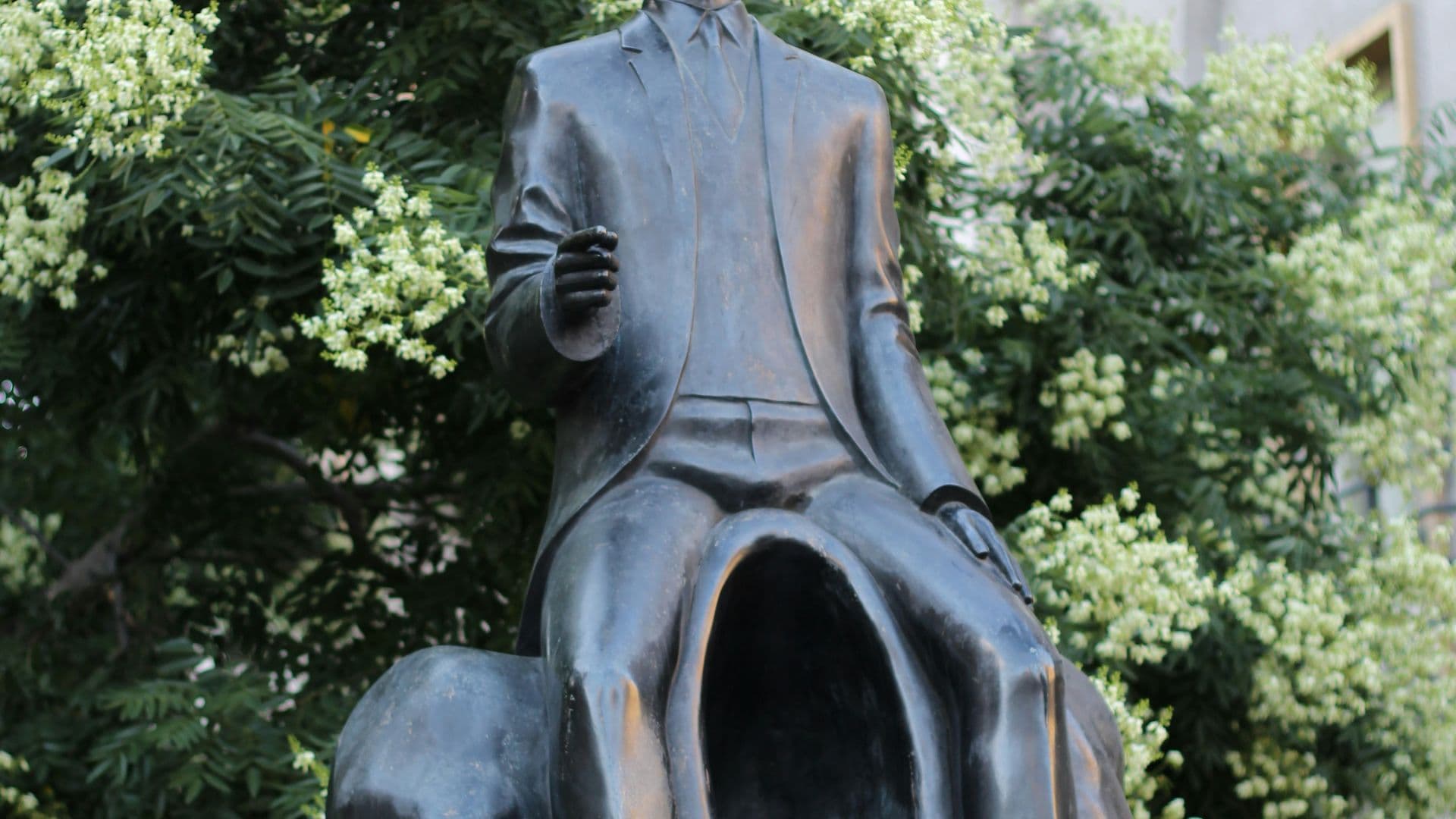
Kafka was born on 3 July 1883 in a house at the corner of Old Town Square and Maiselova Street — the border between the Old Town and the Jewish Quarter. The original building was destroyed by fire in 1897; a newer structure stands on the site now, marked by a bronze bust and a small plaque. Our Jewish Quarter walking tour starts at this corner and follows Kafka's Prague through Josefov.
The location matters. Kafka grew up at the intersection of Czech, German, and Jewish Prague — three communities that occupied the same streets but lived in largely separate worlds. His family was German-speaking and Jewish in a predominantly Czech city. He attended German schools, worked in German-speaking offices, and wrote in German. But the Czech world was always pressing in — the sounds, the politics, the growing nationalism that would eventually reshape Central Europe.
This in-between status — belonging everywhere and nowhere — runs through everything he wrote. Prague wasn't background for Kafka. It was the condition.
The Jewish Quarter — Kafka's Neighbourhood
The Josefov district — Prague's historic Jewish Quarter — was being demolished and rebuilt during Kafka's childhood. The medieval ghetto was razed between 1893 and 1913 in a massive urban renewal project called *asanace*. Kafka watched the narrow lanes, crumbling synagogues, and cramped courtyards of his ancestors disappear, replaced by the wide Pařížská Street and its Art Nouveau apartment blocks.
He wrote about it. In his diaries, the demolition appears as a recurring image — old structures being torn apart, new ones rising over the rubble, the sense that something essential is being lost and something hollow is replacing it.
Six synagogues survived the demolition and stand today as part of the Jewish Museum in Prague. The Old Jewish Cemetery, where headstones are stacked twelve layers deep because the community was never given more burial space, is one of the most haunting sites in the city. Kafka's grave isn't here — he's buried in the New Jewish Cemetery in Žižkov — but the atmosphere of the Old Cemetery captures something of his world better than almost any other place in Prague.
Golden Lane — The Writer's Retreat
Zlatá ulička (Golden Lane) is a row of tiny, colourful houses built into the northern wall of Prague Castle. In 1916, Kafka's sister Ottla rented number 22 — a miniature house barely large enough for a desk and a chair — and Kafka used it as a writing studio for several months.
The house is now a bookshop selling Kafka editions, which feels appropriate and slightly absurd in equal measure. The lane itself is one of the most visited spots in the castle complex. What most visitors don't know is that Kafka came here specifically to escape — from his father's apartment, from the noise of family life, from the insurance office where he spent his days.
He wrote parts of several stories in this room, including sections that would become *The Country Doctor* collection. The ceiling is low enough that Kafka — who was over 180 centimetres tall — would have had to duck through the doorway.
The Insurance Office — Where Kafka Spent His Days
Kafka's day job was at the Workers' Accident Insurance Institute (*Dělnická úrazová pojišťovna*), where he worked from 1908 until illness forced his retirement in 1922. The office was located on Na Poříčí street, in a building that still stands. There's no museum inside — it's an ordinary commercial building — but the facade is recognizable.
He was, by all accounts, a competent and valued employee. He investigated factory safety conditions, wrote reports on workplace injuries, and helped draft regulations. The work wasn't glamorous, but it gave him a detailed knowledge of bureaucratic machinery — the forms, the procedures, the way institutions process human beings — that fed directly into his fiction.
The insurance office in *The Trial*, the castle administration in *The Castle*, the penal colony's execution machine — these aren't abstract inventions. They're the daily reality of a man who spent his mornings handling claims and his evenings writing. Kafka's Prague was a city of offices, and his genius was understanding that the office is where modern life happens to most people.
Café Culture — Where Kafka Talked
Kafka wasn't a loner. He had a close circle of friends — Max Brod, Oskar Baum, Felix Weltsch, Franz Werfel — and they met regularly in Prague's cafés. The German-speaking literary circle gathered at places like Café Louvre on Národní třída, Café Arco on Hybernská street (which Czech nationalist critics mockingly called the "Arco-nauts"), and Café Savoy in Josefov.
Café Louvre still operates today and looks much as it did in Kafka's time — high ceilings, marble tables, the sound of billiard balls from the back room. It's where Einstein also lectured during his Prague years (1911-1912), though whether Kafka attended is uncertain. The café is on the first floor above street level, which means most tourists walk past the entrance without noticing it.
Café Arco was demolished and rebuilt, but Café Savoy — on Vítězná street, near the Legii Bridge — has been restored and serves as a working café-restaurant. Sitting in these spaces doesn't bring Kafka closer exactly, but it puts you in the same proportions — the same ceiling height, the same light through tall windows, the same relationship between the individual and the room.
The Kafka Head — Černý's Kinetic Sculpture
The most photographed Kafka memorial in Prague isn't the modest bust at his birthplace. It's David Černý's rotating head of Franz Kafka — a 10-metre, 45-tonne kinetic sculpture installed in 2014 outside the Quadrio shopping centre on Národní třída.
The sculpture consists of 42 independently rotating stainless-steel plates that align to form Kafka's face, then dissolve into abstract motion. It's mesmerizing, unsettling, and perfectly Kafkaesque — the face assembles and disassembles endlessly, never stable, never quite resolved. Černý, Prague's most provocative artist, has said it reflects Kafka's relationship with identity and Prague itself.
These stories come alive when told by someone who knows them deeply. Our licensed guides share what the plaques don't say.
The placement is deliberate. The sculpture sits near the site of the former Lazarská street apartment where Kafka lived with his parents. It's also directly above a metro station, which means the giant mechanical head gazes down at commuters — another Kafka-worthy detail that most visitors don't catch.
Why Prague Felt Like a Prison
Kafka described Prague in terms that sound extreme until you've walked the streets at night. "This little mother has claws," he wrote. "Prague doesn't let go. Either of us. This old crone has claws. One has to yield, or else."
He tried to leave repeatedly — to Berlin, to Vienna, to Palestine. He managed short stays elsewhere but always returned. Part of it was practical: his job was in Prague, his family was in Prague, his health was fragile. But part of it was psychological. Prague held him because it was the only city whose proportions matched his inner landscape — narrow, vertical, pressing in from all sides, beautiful in ways that made the confinement worse.
The Old Town streets between Staroměstské náměstí and the river are the closest you'll come to experiencing Kafka's Prague physically. Walk them after dark, when the tourist crowds thin and the stone facades close in overhead. The alleys twist without logic. The buildings lean. The courtyards lead to other courtyards. It's easy to see how a man walking these streets every night would eventually write *The Trial*.
The Trial and The Castle as Prague
Kafka never names Prague in his novels — Josef K.'s city in *The Trial* is unnamed, as is the village beneath *The Castle*. But every reader who knows Prague recognizes it.
The labyrinthine courtrooms in *The Trial* — hidden in attic apartments, accessible through ordinary residential buildings — mirror the hidden courtyards and passageways of Prague's Old Town. The castle that K. can see but never reach has the same relationship to its village as Prague Castle has to the city below — always visible, always elevated, never quite accessible in the way you expect.
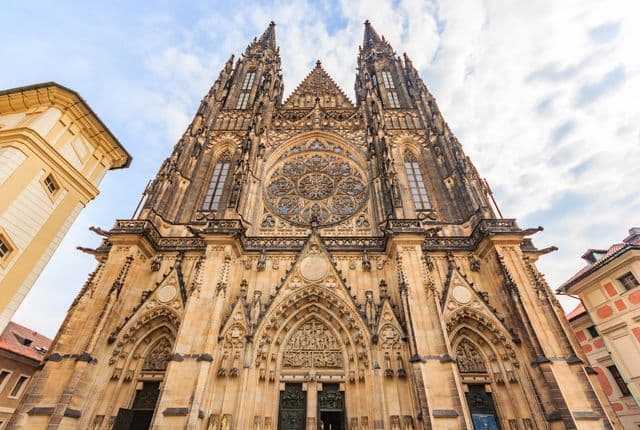
The cathedral in *The Trial*, where Josef K. meets the prison chaplain, is almost certainly St. Vitus Cathedral — the proportions, the darkness, the sense of overwhelming scale. On our Charles Bridge and Old Town private tour, we walk through the streets that Kafka walked, and the connections between the fiction and the city become almost unavoidable.
Walking Kafka's Prague With a Private Guide
Kafka's Prague isn't a museum trail with numbered stops. It's a mood — something you feel in the proportions of the streets, the weight of the buildings, the way the city opens and closes as you walk. A private guide who knows both the biography and the architecture can connect the two in ways that a guidebook can't.
On our Charles Bridge and Old Town tour, we pass Kafka's birthplace, the Jewish Quarter he grew up in, and the streets that shaped his fiction. On the All Prague in One Day tour, we add the castle district — including Golden Lane — and the broader context of the city Kafka couldn't escape. Exclusively yours, with your own guide. We follow whatever thread interests you most.
For an evening that takes you back even further than Kafka's Prague, a medieval dinner at U Pavouka puts you in vaulted cellars that have been here since the 15th century — the kind of underground space Kafka would have recognized.
Browse all our private tours in Prague.
Frequently Asked Questions
Where is Kafka's birthplace in Prague?
At the corner of Old Town Square and Maiselova Street, marked by a bronze bust and plaque. The original building was destroyed by fire in 1897; the current structure dates from the early 20th century.
Where is Kafka buried?
In the New Jewish Cemetery (*Nový židovský hřbitov*) in Prague's Žižkov district. The grave is shared with his parents, Hermann and Julie Kafka. The cemetery is accessible by metro (line A, Želivského station) and is open Sunday through Thursday.
What is the spinning Kafka head in Prague?
A kinetic sculpture by David Černý, installed in 2014 outside the Quadrio shopping centre on Národní třída. The 10-metre structure consists of 42 rotating steel plates that align to form Kafka's face and then break apart in continuous motion.
Can you visit Kafka's house on Golden Lane?
Yes — house number 22 on Zlatá ulička (Golden Lane) within Prague Castle is open to visitors and operates as a small bookshop. Golden Lane is included in the Prague Castle circuit ticket. Kafka used the house as a writing studio in 1916-1917.
The Jewish Quarter is one of Prague's most layered neighborhoods, and a knowledgeable guide makes the difference. See our private Jewish Quarter tour for details.
You May Also Like
Want to see Prague for yourself?
Discover Prague's underground tour