Famous People from Prague — Writers, Composers and Rebels
Prague has a habit of producing people who change things — writers who redefine what fiction can do, composers who create national identities through sound, politicians who reshape continents, and at least one astronomer who lost his nose in a duel. The city shaped them, and they shaped the city back. Most of their homes, workplaces, and favourite haunts are still standing.
We walk guests past these places regularly, and the stories are always better when you can point at the actual building. This is not a Wikipedia list — it's a guide to where these people lived, what they made, and what you can still find if you know where to look.
Franz Kafka (1883-1924) — The Writer Who Never Left
Kafka is the most famous person ever born in Prague, and he spent most of his 40 years trying to escape the city — without ever quite managing it. He was born at the edge of the Old Town Square, studied law at the Karolinum (Charles University), worked as an insurance clerk at the Workers' Accident Insurance Institute on Na Poříčí, and wrote most of his fiction in a series of cramped rented rooms scattered across the centre.
His birthplace is marked by a small bust at náměstí Franze Kafky 3, just off the Old Town Square. The house itself burned down and was rebuilt, but the location is original. His family moved frequently — to Celetná, Dlouhá, Pařížská — and Kafka knew every cobblestone of the Old Town and Josefov.
The single most atmospheric Kafka site is Zlatá ulička 22 (Golden Lane 22) at Prague Castle. His sister Ottla rented the tiny house in 1916, and Kafka used it as a writing studio. It's a miniature building — barely wide enough for a desk — and standing inside it you understand something about the claustrophobia that runs through his work. Golden Lane is included in the Prague Castle circuit ticket.
The Franz Kafka Museum at Cihelná 2b in Malá Strana is a thorough and well-designed exhibition. Outside stands David Černý's kinetic sculpture of two men urinating on a map of the Czech Republic — which is very much not what Kafka would have wanted, but very much what Prague does to its famous sons.
Antonín Dvořák (1841-1904) — The Butcher's Son Who Conquered Carnegie Hall
Dvořák grew up in Nelahozeves, a village 30 km north of Prague, where his father was a butcher and innkeeper. He studied at the Prague Organ School, played viola in the Provisional Theatre orchestra under Bedřich Smetana, and gradually became the most internationally celebrated Czech composer — the man whose Symphony No. 9 ("From the New World") premiered at Carnegie Hall in 1893.
In Prague, Dvořák lived for decades at Žitná 14 in the New Town. The building is now the Antonín Dvořák Museum (Muzeum Antonína Dvořáka), housed in a beautiful Baroque summer palace called Villa Amerika. The collection includes manuscripts, personal items, and his piano. It's a quiet museum with few visitors — one of Prague's genuine hidden spots.
His grave is at Vyšehrad Cemetery, alongside Smetana and dozens of other Czech cultural figures. The cemetery itself is worth visiting — small, peaceful, and filled with elaborate Art Nouveau tombstones. Dvořák's headstone is easy to find. Our Vyšehrad cemetery tour with a guide stops at the Slavín and the composers' graves with the full context.
Bedřich Smetana (1824-1884) — The Composer Who Went Deaf
Smetana is the founder of Czech national music. His cycle of symphonic poems *Má vlast* (My Homeland) — particularly *Vltava* (The Moldau) — is the unofficial national anthem, played every year to open the Prague Spring music festival. He composed the first Czech-language opera (*The Brandenburgers in Bohemia*) and the beloved comic opera *The Bartered Bride*.
Smetana went completely deaf in 1874 from syphilis. He continued composing for another decade, working in silence. His final years were spent in increasing mental disturbance, and he died in a psychiatric institution. His apartment on the Vltava embankment is now the Bedřich Smetana Museum at Novotného lávka 1 — a small building wedged between Charles Bridge and the Old Town waterfront. The views from here are stunning, and the museum holds manuscripts, instruments, and the hearing aids he used as his deafness progressed.
Like Dvořák, he is buried at Vyšehrad Cemetery. Their graves are a short walk apart.
Alfons Mucha (1860-1939) — Art Nouveau's Signature Artist
Mucha made his name in Paris with his poster for Sarah Bernhardt's play *Gismonda* in 1894 — an overnight sensation that launched the Art Nouveau style internationally. But he always intended to return to Prague, and he did, spending his later decades on the monumental *Slav Epic* — twenty enormous canvases depicting the history of the Slavic peoples.
The Mucha Museum at Panská 7 in the New Town covers his Paris poster period, his photography, and his decorative work. It's compact but well curated. For the *Slav Epic*, you need to visit the National Gallery's permanent display — the paintings are each several metres wide and demand a large space.
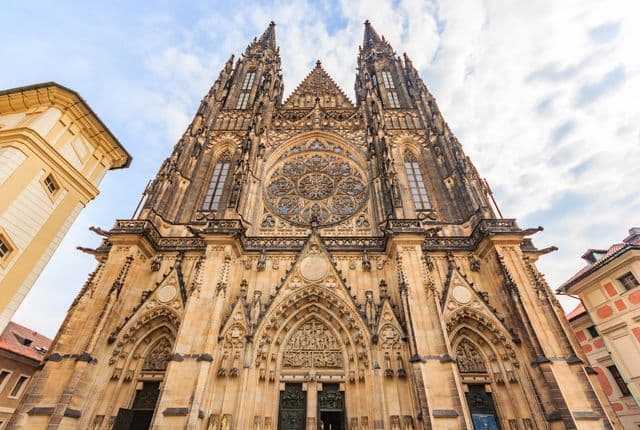
Mucha's most accessible work in Prague is hiding in plain sight: the stained glass windows at St. Vitus Cathedral inside Prague Castle. The window on the north side of the nave, depicting Saints Cyril and Methodius, was designed by Mucha and funded by Banka Slavie. It's the most photographed window in the cathedral, and most visitors don't realize it's by the same artist as the Parisian posters.
Václav Havel (1936-2011) — The Playwright President
Havel was born into a prominent Prague family — his father was a developer, his uncle owned the Barrandov film studios. The communist regime blocked him from higher education because of his bourgeois background, so he educated himself while working as a stagehand at the Divadlo Na zábradlí (Theatre on the Balustrade) on Anenské náměstí, where he eventually became resident playwright.
His absurdist plays — *The Garden Party*, *The Memorandum* — dissected bureaucratic language and totalitarian logic. After 1968, he was banned from the theatre. His essay "The Power of the Powerless" (1978) circulated as samizdat and became a foundational text for dissidents across Central Europe.
Havel's Prague is layered across the city. His apartment at Rašínovo nábřeží 78 overlooks the Vltava south of the National Theatre. The Knihovna Václava Havla (Václav Havel Library) at Ostrovní 13 hosts exhibitions and events. The theatre where he started is still operating on Anenské náměstí. And of course, Prague Castle itself — where he served as president from 1989 to 2003 — is the largest address on his CV.
Milan Kundera (1929-2023) — The Exile Who Never Came Back
Kundera was born in Brno, not Prague, but his literary career began here. He studied at the Film Academy (FAMU), taught at the Academy of Performing Arts, and was twice expelled from the Communist Party. After 1968, his books were banned. He emigrated to France in 1975 and never returned.
*The Unbearable Lightness of Being* (1984) is set partly in Prague during the Soviet invasion. *The Book of Laughter and Forgetting* (1979) dissects Czech life under normalization. Kundera refused to be called a "Czech writer," insisting he was French, and requested that his novels not be published in Czech during his lifetime.
There is no Kundera museum in Prague. His legacy is in the books, and the Prague he describes — the streets during the tanks, the private spaces where people tried to live honestly — still exists underneath the tourist surface.
These stories come alive when told by someone who knows them deeply. Our licensed guides share what the plaques don't say.
Jan Hus (c. 1370-1415) — The Reformer Who Preceded Luther
Hus was a theologian and preacher at Betlémská kaple (Bethlehem Chapel) in the Old Town, where he delivered sermons in Czech rather than Latin — a radical act in the early 15th century. He challenged the sale of indulgences, demanded church reform, and was summoned to the Council of Constance to defend his views. He was promised safe conduct by King Sigismund. The promise was broken, and Hus was burned at the stake on 6 July 1415.
His execution ignited the Hussite Wars (1419-1434), a series of conflicts that made Bohemia ungovernable for a generation and established Czech religious independence a full century before Martin Luther. Hus is arguably the most consequential person in Czech history.
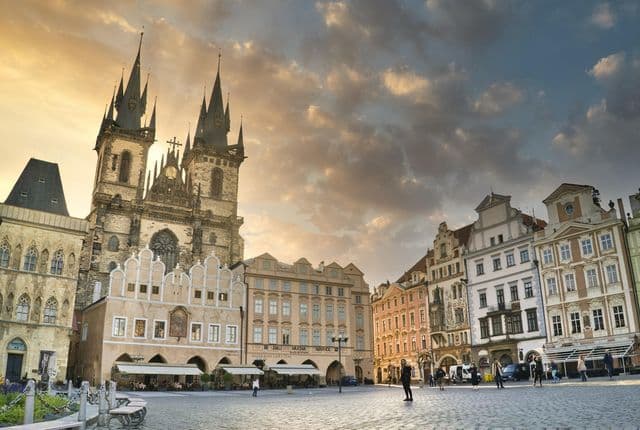
The Bethlehem Chapel was reconstructed in the 1950s on Betlémské náměstí — the original medieval walls still form part of the structure. The enormous Jan Hus Memorial on the Old Town Square, unveiled in 1915 on the 500th anniversary of his death, is the square's dominant sculpture. Most visitors photograph it without knowing who the figure represents. We always stop to explain.
Tycho Brahe (1546-1601) — The Astronomer With the Metal Nose
Brahe was Danish, not Czech, but he spent his final two years in Prague as Imperial Mathematician to Emperor Rudolf II — the eccentric Habsburg who turned Prague into the capital of European science and alchemy. Brahe lost part of his nose in a duel as a student and wore a prosthetic made of brass (or possibly gold and silver — accounts vary). He brought his instruments, his dwarf jester, and a tame elk to Prague.
He died in 1601, allegedly from a burst bladder after refusing to leave a banquet — a story that may or may not be true. His grave is in the Týn Church (Kostel Matky Boží před Týnem) on the Old Town Square, marked by a red marble slab. His successor, Johannes Kepler, used Brahe's meticulous observations to derive the laws of planetary motion.
Emmy Destinn (1878-1930) — The Opera Voice of a Nation
Emilie Pavlína Kittlová, known as Emmy Destinn, was one of the greatest sopranos of the early 20th century. She performed at the Metropolitan Opera in New York, Covent Garden in London, and the Bayreuth Festival. Puccini chose her for the world premiere of *La fanciulla del West* in 1910, opposite Enrico Caruso.
She was born in Prague and studied here before building an international career. During World War I, Austrian authorities confined her to her estate in south Bohemia for smuggling independence documents to Tomáš Masaryk abroad. She returned to performing after the war, but her voice had suffered from the years of forced silence.
Destinn appears on the Czech 2000 Kč banknote — the highest denomination. Her face is literally the most valuable in Czech currency. Her grave is at Vyšehrad Cemetery, near Dvořák and Smetana. She is less famous internationally than she deserves, partly because she died before the era of widespread studio recording.
Walking Prague Through Its Famous Residents
The people on this list lived within walking distance of each other — Kafka's Old Town, Dvořák's New Town, Havel's embankment, Hus's Bethlehem Chapel, Brahe's Týn Church. Prague is compact enough that a single day on foot can connect them all.
On our All Prague in One Day private tour, we pass the buildings where these people lived, worked, and changed history. Exclusively yours — and our licensed guides know which stories belong to which doorway.
For a deeper look at the medieval layer — Hus, Brahe, the Hussite legacy — pair it with a medieval dinner at U Pavouka, a 15th-century tavern in the Old Town. The building was standing when Hus was preaching at Bethlehem Chapel a few streets away.
The Charles Bridge and Old Town tour covers the heart of literary and musical Prague — Kafka's streets, the Karolinum, the Týn Church, and the Old Town Square where Hus's memorial dominates.
For more on Prague's Jewish heritage and Kafka's neighbourhood, see our guide to the Jewish Quarter (Josefov), or browse all our private tours in Prague.
Frequently Asked Questions
Was Kafka Czech or German?
Kafka was a German-speaking Jew born in Prague, which was then part of the Austro-Hungarian Empire. He wrote in German, spoke fluent Czech, and lived his entire life in Prague. He belongs to all three traditions and fits neatly into none of them.
Where are the most famous Czechs buried?
Vyšehrad Cemetery is the national burial ground for Czech cultural figures. Dvořák, Smetana, Mucha, Emmy Destinn, and dozens of other writers, composers, and artists are buried there. It is open to visitors and included in the Vyšehrad complex, which is free to enter.
Can you visit Kafka's house on Golden Lane?
Yes — Golden Lane (Zlatá ulička) at Prague Castle is open to visitors with a castle circuit ticket. Number 22, where Kafka wrote, is preserved as a small exhibition space. It is tiny — barely room for two visitors at once.
Is there a Václav Havel memorial in Prague?
There are several. The Václav Havel Library at Ostrovní 13 hosts exhibitions. A memorial bench sits near Žofín on Slovanský ostrov. His theatre, Divadlo Na zábradlí, still operates on Anenské náměstí. Prague Castle, where he served as president, is the largest memorial of all.
You May Also Like
Want to see Prague for yourself?
Discover Prague's underground tour