Wenceslas Square — More Than Just a Shopping Street
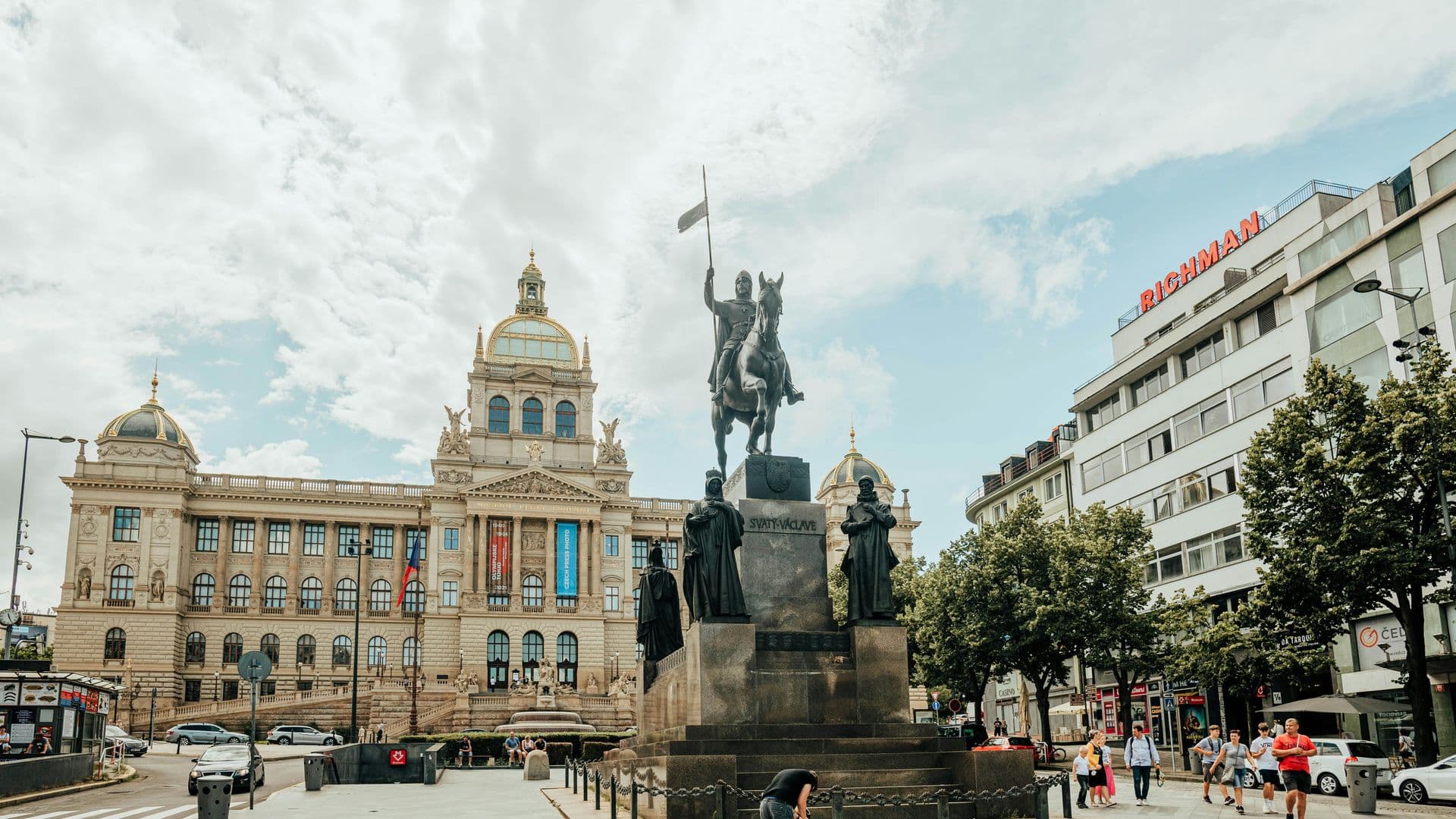
Stand at the top of Václavské náměstí near the National Museum and look down toward Na Příkopě. What stretches before you is not a square at all — it's a 750-metre boulevard, wider than the Champs-Élysées, built as a medieval horse market in 1348 by Charles IV. Six centuries of revolution, commerce, occupation, and liberation have played out along its length.
We walk this boulevard with our private tour guests because most visitors cross it quickly, dodging trams and heading for the Old Town. They miss the layers underneath — the Art Nouveau facades, the hidden passages, the balcony where a revolution was announced. Here's what's actually here and why it matters.
Not a Square — A Boulevard With a Horse Market Past
The confusion starts with the name. "Náměstí" translates as "square," but Wenceslas Square has the proportions of a Parisian boulevard — roughly 60 metres wide and 750 metres long. When Charles IV founded the New Town (Nové Město) in 1348, this space was designated as the Koňský trh (Horse Market). Livestock was traded here for centuries. The name changed to Wenceslas Square in 1848, during the nationalist fervor of the Spring of Nations, when Czechs wanted to reclaim their public spaces from German-language associations.
The shape explains the layout: no central green space, no fountain, just a long tree-lined promenade running down the middle with traffic on both sides. The buildings lining it are mostly late 19th and early 20th century — the medieval structures were gradually replaced as Prague modernized. What survived is not the architecture of the horse market but the dimensions.
The National Museum — The Anchor at the Top
The massive neo-Renaissance building closing off the upper end of the square is the Národní muzeum, completed in 1891 by the architect Josef Schulz. It was designed to make a statement: Czech culture is serious, substantial, and permanent. The building is 104 metres wide and sits on a raised terrace, deliberately dominating the view from below.
Look closely at the facade and you'll see bullet marks. Some date from the Warsaw Pact invasion of August 1968, when Soviet soldiers mistook the museum for the Czechoslovak parliament and fired on it. The marks were partially repaired but not erased — a deliberate choice. Others date from the fighting in May 1945.
The museum reopened in 2020 after a major renovation. The interior is worth seeing for the grand staircase and the Pantheon hall alone, even if natural history isn't your primary interest. A connecting underground passage links it to the former Federal Assembly building next door, now the New Building of the National Museum.
The Wenceslas Statue and What It Witnessed
The equestrian statue of Svatý Václav (Saint Wenceslas) at the top of the boulevard is the work of Josef Václav Myslbek, unveiled in 1912 after twenty years of development. Wenceslas — the 10th-century Duke of Bohemia, patron saint of the Czech state — sits on horseback surrounded by four other Czech patron saints: Ludmila, Prokop, Vojtěch (Adalbert), and Anežka (Agnes).
The statue has served as Prague's primary gathering point for over a century. People met here to celebrate the founding of Czechoslovakia in 1918, to protest the Nazi occupation, to mourn Jan Palach in 1969, and to jingle their keys during the Velvet Revolution in 1989. When something important happens in Prague, crowds gather at the Wenceslas statue. It's the default coordinates for collective emotion.
One detail that most visitors miss: the statue faces *down* the boulevard, toward Na Příkopě. Wenceslas looks away from the National Museum and toward the commercial heart of the city. The positioning was intentional — the saint faces the people, not the institution.
Hotel Evropa — Art Nouveau Trapped in Time
Roughly halfway down the left side of the square (coming from the museum), you'll find the Hotel Evropa at number 25. Its facade is one of the finest Art Nouveau compositions in Prague — ornate green and gold ironwork, decorative tiles, curved windows. The building was designed by Alois Dryák and Bedřich Bendelmayer and completed in 1906 as the Hotel Archduke Štěpán, later renamed.
For decades the Evropa was a fading beauty — the famous ground-floor cafe served mediocre coffee in a gorgeous room while the hotel rooms deteriorated. The building was purchased by the W Hotels group and underwent a long renovation. The restored interior preserves the original Art Nouveau detailing in the public spaces, though the room rates now reflect the luxury market rather than the backpacker circuit that kept it alive in the 1990s.
Even if you don't go inside, the facade repays a slow look. The ironwork canopy over the entrance, the ceramic tile panels, and the lettering are all original. Stand across the street to see the full composition — it's one of those buildings that rewards distance.
Lucerna Passage — The Palace Under the Boulevard
One of the best things about Wenceslas Square is invisible from the street. The Palác Lucerna at numbers 61-63 (entered from the square or from Štěpánská or Vodičkova streets) is an entertainment and shopping complex built between 1907 and 1921 by Václav Havel — grandfather of the future president. It was one of the first reinforced-concrete buildings in Prague.
Inside, the passage is a world of its own: a cinema (still operating), a concert hall, a cafe, a music bar, and a labyrinth of corridors connecting to adjacent buildings. The most photographed feature is David Černý's sculpture of Saint Wenceslas — a parody of the outdoor monument, showing the saint riding a dead horse hung upside down. It hangs from the ceiling of the main atrium. Černý installed it in 1999, and it remains one of his most effective provocations.
The Lucerna passage connects through to other passages — Rokoko, U Nováků, and ultimately to Vodičkova street. Walking through this network gives you a sense of how Prague's commercial life operated before shopping malls: indoor arcades with shops, theaters, and restaurants, linking streets through the middle of city blocks. This network is one of the insider details we point out on our private tours — few visitors realize it exists.
1989 — The Revolution's Stage
Wenceslas Square's most recent chapter of global significance was written in November 1989. During the Velvet Revolution, hundreds of thousands of people filled the boulevard every evening. They jingled keys — the sound that meant "it's time to go home," directed at the communist government.
The speeches were delivered from the balcony of the Melantrich building at number 36, about halfway down the square. Václav Havel spoke there, as did Alexander Dubček — the leader of the 1968 Prague Spring, making his first public appearance in twenty years. When Dubček appeared on November 24, the crowd erupted. The building still stands; the balcony is visible from the street. There is no plaque.
The spot has additional weight: in January 1969, the student Jan Palach set himself on fire near the Wenceslas statue to protest the Soviet-led invasion and the creeping normalization that followed. He died three days later. A small memorial cross marks the spot on the pavement. It's easy to step on without knowing — another case where the square's history is embedded in the ground rather than displayed on signs.
The Modern Boulevard — Shopping, Hotels, and Trams
Today, Wenceslas Square is Prague's main commercial corridor. International brands occupy the ground floors, hotels range from boutique to business-class, and fast-food chains compete for foot traffic at the lower end. The tram tracks that ran down the middle were removed in the early 1980s, though trams still cross the bottom of the square at the Můstek junction.
The square has been undergoing a long-planned redesign. The current project aims to return tram lines to the lower section, add more greenery, and reduce car traffic. Construction has been intermittent and controversial — Praguers argue about the design with the same intensity they bring to arguments about beer.
The best time to walk the square is early morning — before 8 a.m. — when the shops are closed and the boulevard is mostly empty. The proportions become apparent. You can see the full sweep from the museum to Na Příkopě without the visual clutter of crowds. The facades are better appreciated in low-angle light, when the ornamental details throw shadows.
The Side Streets and Hidden Courtyards
The streets branching off Wenceslas Square contain some of the New Town's best architecture. Jindřišská leads to the Jindřišská Tower — a Gothic bell tower with a modern interior that serves as a viewpoint and cultural space. Štěpánská is lined with Art Nouveau and functionalist buildings. Vodičkova connects to the passage network and leads toward Karlovo náměstí (Charles Square), Prague's largest square.
Many buildings on the square itself have interior courtyards that aren't visible from the street. The passage system — Lucerna, Světozor, Alfa — lets you explore some of these. Others are accessible only through residential entrances. The density of hidden space behind the commercial facades is one of the things that makes Prague's New Town more interesting than it appears at first glance.
Walking Wenceslas Square With a Private Guide
Most tour itineraries skip Wenceslas Square or cross it in transit. That's a mistake. The square holds six centuries of Czech history in a single boulevard — medieval origins, 19th-century national revival, Art Nouveau ambition, Nazi occupation, communist repression, revolution, and contemporary transformation. The stories are in the facades, the bullet holes, the passages, and the pavement memorials — but you need someone to point them out.
On our All Prague in One Day private tour, we walk the full length of the square and explain the layers — from the horse market to the Velvet Revolution. Exclusively yours, with your own guide, at a pace that lets you stop when something catches your eye.
For an evening that takes you even deeper into Prague's past, continue with a medieval dinner at U Pavouka Tavern — fire dancers, roasted meats, and unlimited mead in a Gothic cellar that predates the square itself.
Browse all our private tours in Prague.
The Saint Wenceslas Statue — More Than a Meeting Point
The equestrian statue of Saint Wenceslas dominates the upper end of the square, and most visitors use it as a meeting point without looking closely. Sculptor Josef Václav Myslbek worked on it for nearly 30 years before its unveiling in 1912. The horse alone weighs over 5 tonnes.
Look at the base. Four smaller figures represent the patron saints of Bohemia — Saint Ludmila, Saint Prokop, Saint Adalbert, and Saint Agnes. Each is positioned at a corner, facing outward as if guarding the square.
The memorial plaques at the foot of the statue are more recent and more somber. This is where Jan Palach set himself on fire in January 1969 to protest the Soviet occupation, and where Jan Zajíc did the same a month later. The small shrine with flowers and candles is maintained year-round. We always pause here with our guests — the contrast between the medieval saint above and the modern martyrs below captures something essential about Prague.
Frequently Asked Questions
Is Wenceslas Square actually a square?
No — it's a 750-metre boulevard, roughly 60 metres wide, with the proportions of a Parisian avenue. It was laid out as a horse market in 1348 and only renamed Wenceslas Square in 1848. The "square" label is traditional but misleading.
What is there to see on Wenceslas Square?
The National Museum at the top, the Wenceslas equestrian statue, the Art Nouveau Hotel Evropa, the Lucerna Passage with David Černý's inverted horse sculpture, the Melantrich balcony where Havel spoke during the 1989 revolution, and the Jan Palach memorial cross in the pavement. The side passages connecting through to adjacent streets are worth exploring.
Is Wenceslas Square safe at night?
The upper half of the square (near the museum) and the passage areas are generally fine. The lower half near Můstek can attract persistent street touts and currency-exchange scams after dark. Standard city awareness applies — keep valuables secure and avoid unofficial money changers.
How long should I spend at Wenceslas Square?
A quick walk takes fifteen minutes. With stops at the museum facade, the Wenceslas statue, the Palach memorial, Hotel Evropa, and the Lucerna Passage, budget an hour. With a guide who can explain the historical layers, ninety minutes is ideal.
You May Also Like
Want to see Prague for yourself?
Take our flagship Prague tour-6-640x430.jpg&w=3840&q=75)