Tyn Church Prague — The Old Town's Most Iconic Silhouette
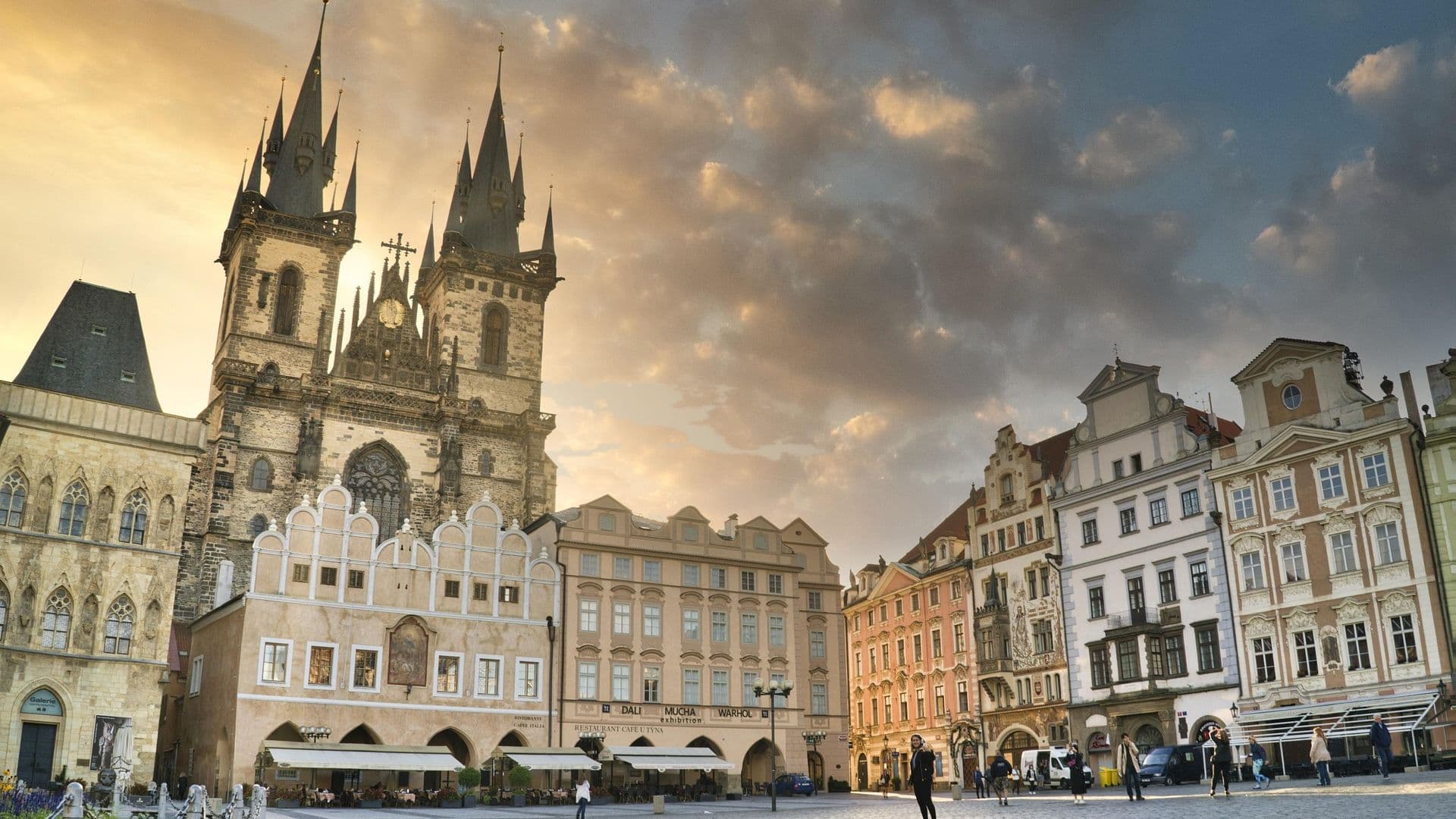
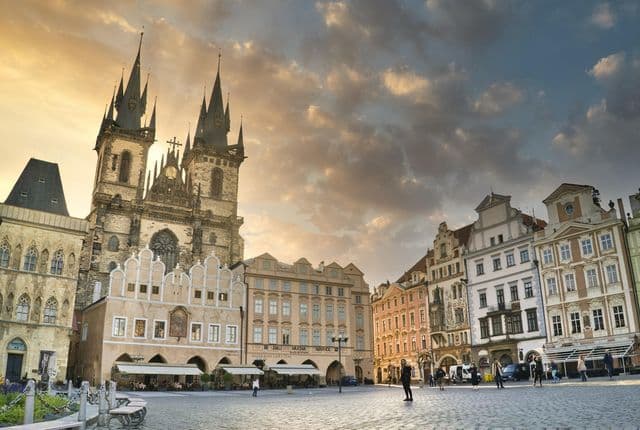
The twin spires of the Kostel Matky Boží před Týnem — the Church of Our Lady before Týn — define the Old Town skyline. They rise 80 metres above Staroměstské náměstí, dark and pointed, visible from half the viewpoints in Prague. The silhouette is on postcards, in photographs, and in the memory of anyone who has stood in the Old Town Square after dark, when the spires are lit against the sky. It is, along with Prague Castle and Charles Bridge, one of the three images that say "Prague" without explanation.
We walk past the Týn Church with every private tour that visits the Old Town Square, and the first thing we point out is something most people don't notice until it's mentioned: the two spires are not the same height.
The Asymmetric Spires
Look carefully at the twin towers. The north tower (on the left as you face the church from the square) is slightly taller and wider than the south tower. The difference is subtle — roughly a metre — but once you see it, you can't unsee it.
The reason for the asymmetry has generated folklore: one tower represents the masculine side, the other the feminine; one is Adam, the other Eve. The more prosaic explanation is that the towers were built at different times. The north tower was completed first, in the mid-15th century. The south tower was finished decades later, and the builders either couldn't or didn't try to match the dimensions precisely. Medieval construction was an imperfect art, and perfect symmetry was neither expected nor prioritized.
The spires themselves — the pointed caps with their corner turrets — are late additions, from the second half of the 15th century. They replaced earlier, simpler rooflines. The current profile, with its distinctive bristling silhouette, dates to this period and has been maintained through subsequent restorations.
Hidden in Plain Sight — The Entrance
The Týn Church has no direct entrance from the Old Town Square. This surprises virtually every visitor who assumes they can walk straight in from the open square. Instead, the church is hidden behind a row of medieval houses built in front of it, and the entrance is through a narrow passage under the arcaded house at Celetná 5 (or through the Týn School courtyard at Staroměstské náměstí 14).
This arrangement is not accidental. The houses in front of the church predate its current Gothic form. When the church was expanded in the 14th century, the existing buildings were not demolished — the church was built behind and above them, rising over the roofline but leaving the houses in place. The result is that the most famous church in the Old Town is entered through an arcade passage that feels more like a back door than a main entrance.
The hidden entrance is one of those Prague details that rewards a guide. Many visitors walk around the church looking for a door, assume it's closed, and leave. It isn't closed — it's just not where you expect it.
The Hussite Church — The Gold Chalice on the Facade
Look at the space between the two towers, above the gabled roof of the nave. In the triangular pediment, you can see a gold image — today it is a statue of the Madonna, placed there after the Counter-Reformation. But before 1620, that space held a large gold chalice (kalich) — the symbol of the Hussite movement.
The Týn Church was the main Hussite church in Prague from the early 15th century through the Battle of White Mountain in 1620. Jan Hus's reform movement, which demanded that laypeople receive communion in both bread and wine (the "chalice" symbolizing the wine offered to all, not just the clergy), made this church its principal place of worship. The great Hussite leader Jiří z Poděbrad (George of Poděbrady), who ruled Bohemia from 1458 to 1471, worshipped here and contributed to the church's construction.
After the Catholic Habsburg victory at the Battle of White Mountain in 1620, the Týn Church was recatholicized. The gold chalice was removed from the facade and melted down. According to tradition, the gold was used to create the Madonna and the halo that now occupy the same spot. The story is almost too symbolic to be true — the Hussite chalice literally melted into a Catholic icon — but it has persisted in Prague's oral history for four centuries.
Inside — Gothic Space and Tycho Brahe's Tomb
The interior of the Týn Church is a tall, three-aisled Gothic hall — simpler than St. Vitus Cathedral but impressive in its vertical proportions and the quality of light that enters through the pointed windows. The furnishings are a mix of Gothic, Renaissance, and Baroque, reflecting the church's religious transformations.
The most notable tomb belongs to Tycho Brahe (1546-1601), the Danish astronomer who spent the last years of his life in Prague under the patronage of Emperor Rudolf II. Brahe's grave is marked by a red marble tombstone near the main altar, with a carved portrait showing him in armor and a Latin inscription. He died under mysterious circumstances — for centuries, the cause was debated (murder by jealous rivals, mercury poisoning, or simply a burst bladder from refusing to leave a banquet). Modern forensic analysis in 2010 concluded that the mercury levels in his remains were not sufficient to cause death, leaving the question partly open.
Other notable features include the oldest baptismal font in Prague (a tin font from 1414), a remarkable early Baroque altarpiece by Karel Škréta, and several Gothic stone carvings that survived the Counter-Reformation renovations. The pulpit, in carved stone, is one of the finest in Prague.
The atmosphere inside is significantly quieter than the square outside. The thick walls muffle the noise of the crowds, and on a weekday morning you may find yourself nearly alone in the nave — a rare experience in central Prague.
Limited Opening Hours — Plan Ahead
The Týn Church keeps restricted visiting hours compared to other Prague churches. It is not a museum and does not charge admission — it is a functioning parish church — but its hours for tourist visits are limited, typically a few hours in the late morning and early afternoon on weekdays, with different hours on weekends.
The exact schedule changes seasonally. The church is closed to visitors during services and on some religious holidays. This catches many visitors off guard, particularly those who arrive at the Old Town Square in the late afternoon expecting to walk in. Check the posted hours at the entrance or ask your guide to confirm the current schedule.
When the church is closed, you can still appreciate the exterior — and the exterior is, in many ways, the main event. The twin spires seen from the square, the hidden entrance, the gold Madonna (or former chalice), and the relationship between the church and the houses built against its front are all visible without going inside.
The Týn Courtyard — Ungelt
Behind the church lies the Týnský dvůr (Týn Courtyard), also called Ungelt — a medieval merchants' courtyard that served as Prague's international trading center from the 11th century. Foreign merchants arriving in Prague were required to stay here, pay customs duties (the name "Ungelt" derives from the German for the customs fee), and display their goods.
The courtyard has been restored and now contains restaurants, shops, and a hotel. The architecture is a mix of Romanesque foundations, Gothic cellars, and Renaissance upper stories. It's a quiet, enclosed space that feels removed from the crowds on the square, even though it's less than fifty metres away. The contrast between the noise of the square and the calm of the Ungelt is one of those Prague micro-experiences that a guide can reveal.
Seeing the Týn Church With a Private Guide
The Týn Church is a building that needs narration. The asymmetric spires, the hidden entrance, the melted chalice, Brahe's tomb, the Hussite connection — these details transform a beautiful silhouette into a story that spans six centuries of Prague's religious, political, and scientific history.
On our All Prague in One Day private tour, we cover the Týn Church as part of the Old Town Square and explain its role in the Hussite wars, the Counter-Reformation, and Prague's astronomical heritage. On our Charles Bridge and Old Town tour, we go deeper into the Gothic and medieval layers. Exclusively yours, with your own guide.
For an evening after exploring the Old Town, try a medieval dinner at U Pavouka Tavern — fire dancers, spit-roasted meats, and unlimited mead in a vaulted cellar that matches the Týn Church's medieval atmosphere.
Browse all our private tours in Prague.
Frequently Asked Questions
Where is the entrance to the Týn Church?
The church has no entrance from the Old Town Square itself. The main entrance is through a narrow passage under the arcaded house at Celetna 5, or through the Tyn School courtyard at Staromestske namesti 14. The hidden entrance is one of the church's most unexpected features.
Why are the two spires of the Týn Church different heights?
The north tower is slightly taller and wider than the south tower. The towers were built at different times — the north tower was completed first in the mid-15th century, and the south tower was finished decades later without precisely matching its dimensions.
Is Tycho Brahe really buried in the Týn Church?
Yes — the Danish astronomer Tycho Brahe is buried near the main altar, marked by a red marble tombstone with a carved portrait. He died in Prague in 1601 while serving as imperial astronomer to Emperor Rudolf II.
What are the Týn Church opening hours?
The church keeps restricted visiting hours, typically a few hours in the late morning and early afternoon. Hours change seasonally and the church is closed during services. Check the posted schedule at the entrance or confirm with your guide — many visitors arrive to find the church closed.
You May Also Like
Want to see Prague for yourself?
Discover Prague's underground tour