Karlštejn Castle: The Complete Guide to the Most Famous Castle in Bohemia
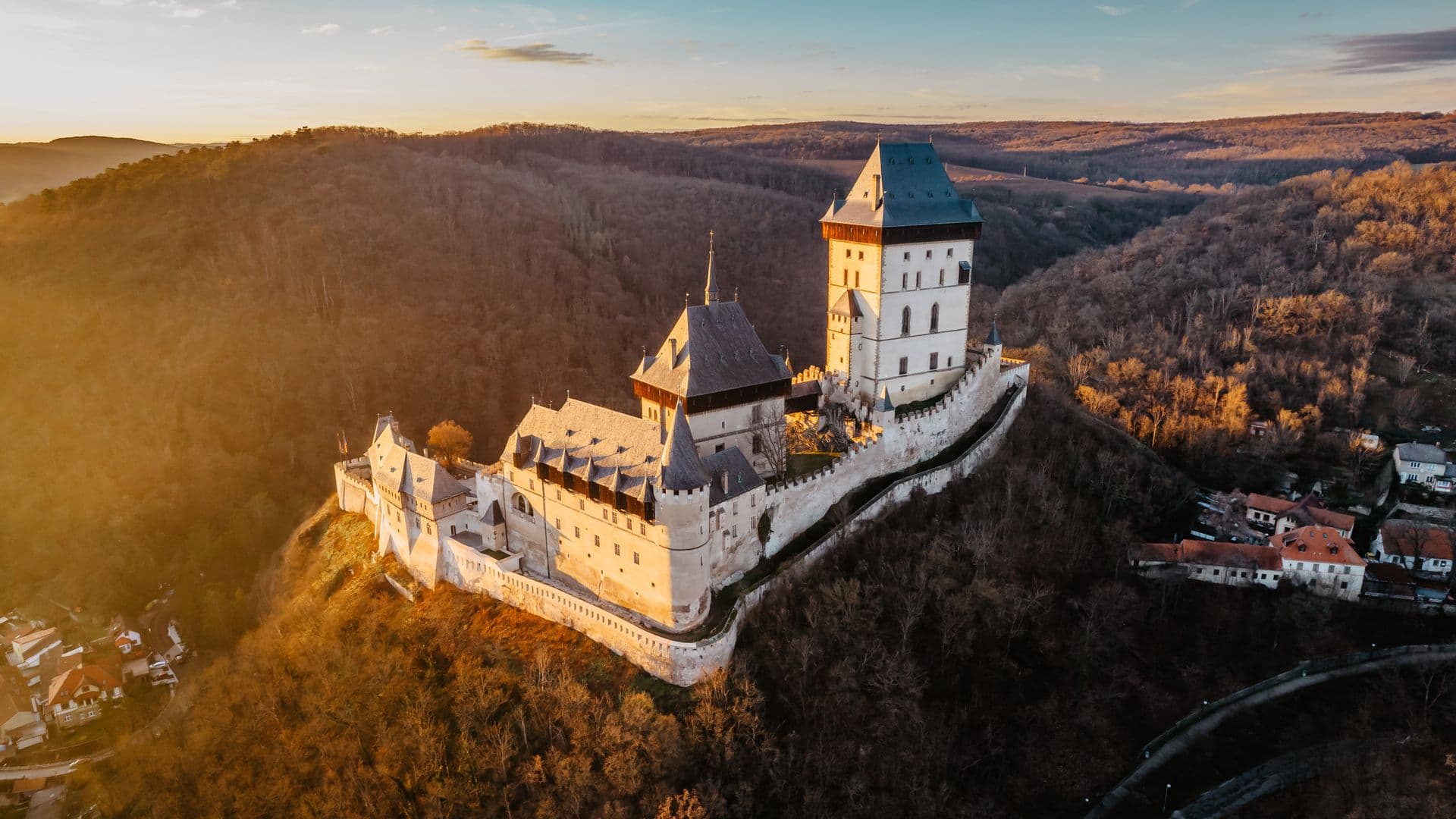
A Karlštejn Castle day trip from Prague is one of the most rewarding half-days in Bohemia — and one of the easiest. Thirty kilometres southwest of the city, the castle appears suddenly above the trees: a dramatic Gothic silhouette on a limestone cliff above the Berounka River, looking exactly as a medieval imperial fortress should look.
But Karlštejn is more than a beautiful castle. It was built to house the most precious objects in the Holy Roman Empire — the Crown Jewels, the Imperial Regalia, and Emperor Charles IV's extraordinary private collection of holy relics. Understanding what was kept here, and why, transforms a visit from a pleasant excursion into something genuinely memorable.
Here is everything you need to know before you go.
Why Charles IV built Karlštejn
The castle was founded on 10 June 1348 by Charles IV — King of Bohemia and Holy Roman Emperor — and the name says everything: Karlstein means "Charles's Stone" in German. Construction was completed in 1365. Charles personally supervised every detail of the interior decoration, treating the castle not as a residence but as a sacred repository for the most precious objects in his empire.
What was so precious? The Imperial Regalia of the Holy Roman Empire. The Bohemian Crown Jewels. And Charles's extraordinary private collection of holy relics — pieces of the True Cross, fragments of saints, sacred objects from across Christendom that he had spent a lifetime assembling.
To house the most sacred of these, he built the Chapel of the Holy Cross inside the Great Tower — a room secured behind multiple iron doors and locks, its walls lined with 129 panel paintings by Master Theodoric, court painter of Charles IV. This is the largest collection of medieval panel paintings in the world, and one of the greatest achievements of Gothic art in Central Europe.
The castle that held for seven months
Karlštejn was built to be impregnable — and it proved it. The castle's stepped layout reflects the medieval hierarchy of power and holiness: three levels rising one above the other, each more sacred and more secure than the last. The Imperial Palace at the base. The Marian Tower with the Church of the Virgin Mary and the Chapel of St. Catherine. And at the very summit, the Great Tower with the Chapel of the Holy Cross at its heart.
During the Hussite Wars of the 1420s, the castle withstood a siege that lasted more than seven months. Hussite attackers even resorted to catapulting dead bodies over the walls in an attempt to spread disease. The castle held. The Bohemian Crown Jewels remained safe within its walls for nearly 200 years.
After 1619, when the Bohemian Crown Jewels were permanently moved to Prague, the castle gradually lost its significance and fell into disrepair. The Gothic Revival restoration carried out by architect Josef Mocker between 1887 and 1899 gave the castle its current appearance — the dramatic, fairy-tale silhouette that makes Karlštejn one of the most photographed places in Bohemia.
The village and the walk
Part of what makes a Karlštejn Castle day trip from Prague so satisfying is the approach. The village of Karlštejn stretches along the road that climbs toward the castle gates — cobblestone streets, small shops, local restaurants and the castle looming larger with every step. The walk up takes around 20 minutes and the views back over the valley grow more remarkable with every turn.
The village also has an unexpected story. After the castle's significance faded, the surrounding area was known for its vineyards — a tradition that goes back to Charles IV himself, who ordered vines planted on the slopes around Karlštejn. Local wine is still produced here and available in the village restaurants.
The legend of the women's ban
One of Karlštejn's most enduring legends concerns Emperor Charles IV and the Chapel of the Holy Cross. According to the story, Charles issued a decree banning women from entering the Great Tower and the chapel — either to preserve the sacred atmosphere, or because he simply wanted a space of his own, free from the imperial court.
This day trip is best with a guide who handles the logistics and storytelling. Meet our team.
Whether historically accurate or not, the legend inspired one of the most beloved Czech theatrical comedies: Night at Karlštejn by the poet Jaroslav Vrchlický, in which the empress disguises herself as a page to sneak into the forbidden castle. The play has been staged regularly since its premiere in 1884 and remains a staple of Czech theatre.
Practical information
Getting there: Karlštejn — also spelled Karlstejn — is approximately 30 kilometres from Prague, around 40 minutes by private car. By train around 30 to 40 minutes — trains depart from both the main station (Hlavní nádraží) and Smíchov station. From the train station it is a 20-minute walk uphill to the castle.
The castle tour: Karlštejn can only be visited on a guided tour. Several tour circuits are available, covering different parts of the castle. The most comprehensive includes the Imperial Palace, the Marian Tower and the Chapel of the Holy Cross — book this in advance as it has limited capacity.
Opening hours: The castle is open Tuesday to Sunday, with reduced hours in winter. It is closed on Mondays and in January and February. Check current opening times before you visit.
How long do you need? A half-day is sufficient for the castle itself — around 3 to 4 hours including the walk up and down and the guided tour. Combined with Český Šternberk Castle, a short drive away, it makes a full and rewarding day from Prague.
Why go with a private guide
The castle exterior is spectacular — and even most visitors who arrive independently agree on that. What they miss is everything else. Who was Charles IV and why did he care so much about holy relics? What were the Imperial Regalia and why did they need to be kept behind multiple iron doors? What do 129 medieval panel paintings actually look like, and why does the Chapel of the Holy Cross have no equivalent anywhere in the world?
A private guide answers all of this before you even arrive — so that when you stand in the courtyard looking up at the Great Tower, you already know what you are looking at and why it matters.
Our private Karlštejn Castle day trip from Prague includes door-to-door transport from your hotel, a licensed guide for the full visit and everything at your own pace. The trip pairs naturally with Český Šternberk Castle for a complete day of Bohemian castle history.
Frequently asked questions
How far is Karlštejn from Prague? Approximately 30 kilometres — around 40 minutes by private car. Our private day trip includes hotel pickup and drop-off, so there is nothing to arrange on your end.
Can you visit Karlštejn Castle independently? Yes — but the castle can only be seen on a guided tour, and the most interesting circuit including the Chapel of the Holy Cross must be booked in advance. A private guide adds the historical context that makes the visit genuinely meaningful rather than just visually impressive.
Is Karlštejn open year-round? The castle is open Tuesday to Sunday from March to November, with reduced hours in winter. It is closed on Mondays and in January and February. Check current opening hours before you visit.
What is the Chapel of the Holy Cross? The Chapel of the Holy Cross is the innermost sanctuary of Karlštejn — located in the Great Tower and secured behind multiple iron doors and locks. Its walls are lined with 129 panel paintings by Master Theodoric, the largest collection of medieval panel paintings in the world.
What else can be combined with a Karlštejn visit? Český Šternberk Castle is a short drive away — one of the oldest continuously inhabited castles in Central Europe, home to the same family since 1241. The two castles make for a perfect full day from Prague.
Planning your trip? See our day trips from Prague for details.
Planning your trip? See our Prague tour prices for details.
Want to see Prague for yourself?
Visit Karlštejn Castle on our tour