Prague Astronomical Clock & Old Town Square: A Local Guide
There is a moment that happens to almost every visitor to Old Town Square in Prague. They arrive, they look up at the Astronomical Clock, they wait for the hour to strike, they watch the mechanical show — the apostles, the skeleton, the golden rooster — and then they look at each other and say: is that it?
It is not that. It is never just that. The problem is not the clock. The problem is the missing context.
The Prague Astronomical Clock — known in Czech as the Orloj — is one of the most sophisticated mechanical instruments of the medieval world, still functioning after more than 600 years. Old Town Square around it is one of the most historically layered public spaces in Central Europe, where the fate of Bohemia has been decided, announced and mourned for eight centuries. None of that is visible on the surface. All of it is available — if you know where to look.
This guide is built on what we tell our tour guests in 2026: the things that are not on the information boards, the stories behind the stones, and the reason Old Town Square is one of the most extraordinary places in Europe rather than just one of the most photographed.
The Prague Astronomical Clock: What It Actually Does (and Why It Matters)
Most visitors assume the Astronomical Clock is a decorative feature of the Old Town Hall — a beautiful old clock that tells the time. It is significantly more than that.
The Orloj was installed in 1410, making it the third-oldest astronomical clock in the world and the oldest one still in operation. It was designed by clockmaker Mikuláš of Kadaň and astronomer Jan Šindel — and what they built was not a clock in the modern sense. It is a mechanical model of the universe as it was understood in the 15th century, showing simultaneously: the position of the sun and moon in the sky, the current time in multiple systems (Bohemian time, Old Czech time, Babylonian time, and Central European time), the phase of the moon, the sign of the zodiac, and the position of the stars. All of this from a single mechanical instrument, built before the printing press, before Copernicus, before the scientific revolution.
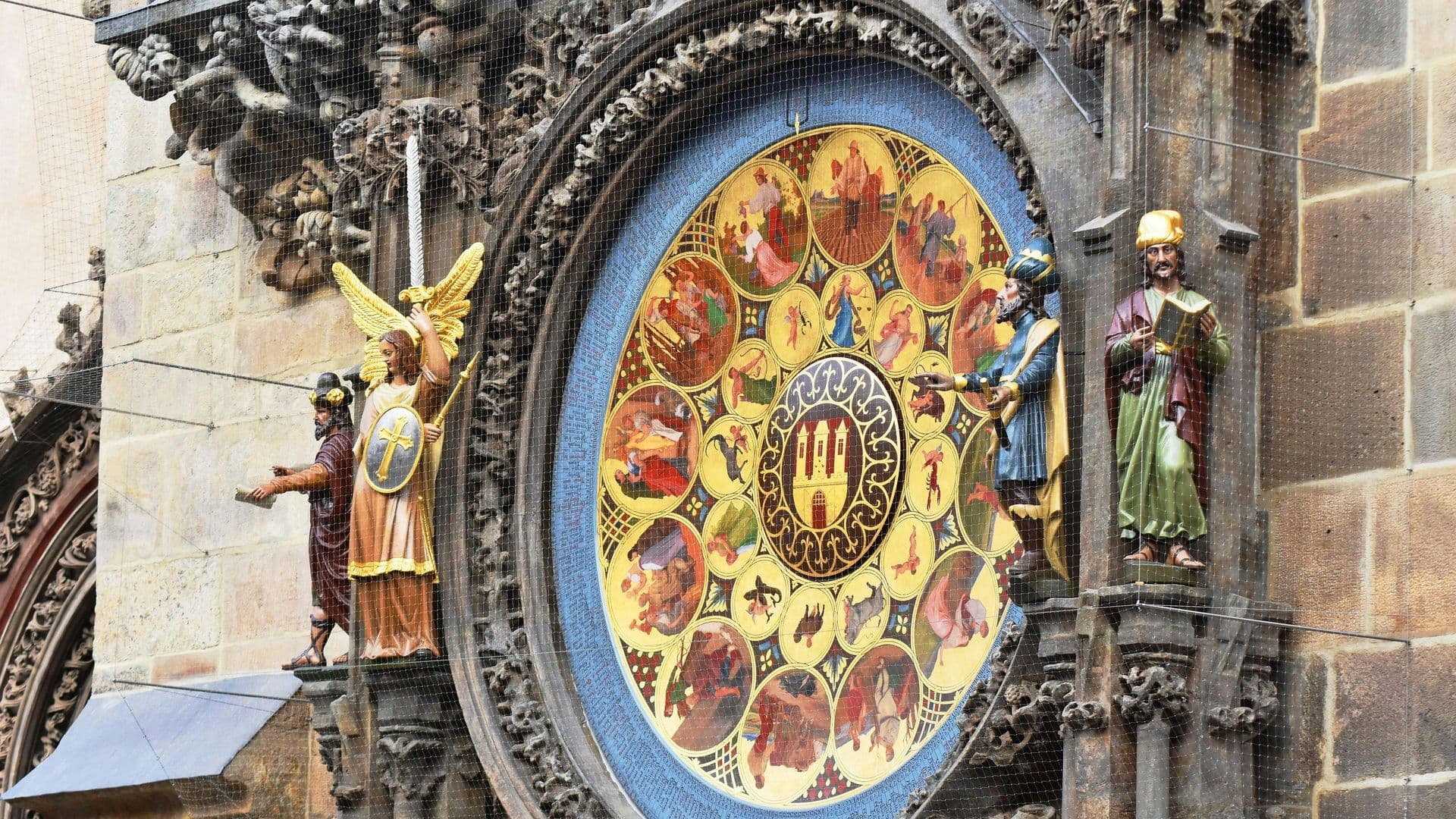
The Orloj has four distinct parts. The astronomical dial — the large circular face — shows the movement of the sun and moon against the backdrop of the universe. The calendar dial below it displays the months of the year with scenes from Bohemian rural life, painted by Josef Mánes in the 19th century (the originals are in the City Museum; what you see on the clock face is a replica). On either side of the clock face stand four figures: Vanity, Greed, Death and a Turk representing Pagan Invasion — the four things medieval Praguers feared most. And every hour on the hour from 8am to 11pm, the mechanical procession: Death rings his bell, the twelve apostles rotate through the windows above, the golden rooster crows, and the show ends.
The whole performance takes about 45 seconds. Without context it is charming. With context it is extraordinary.
The legend of the clockmaker: According to Prague legend, the city councillors were so proud of the Orloj that they ordered the clockmaker Hanuš — in some versions the original maker, in others the man who later maintained it — to be blinded after its completion, so that he could never build another clock as magnificent anywhere else. Before he died, Hanuš allegedly reached into the mechanism and stopped it. Whether the legend is true is beside the point: it tells you exactly how Praguers felt about this clock in the centuries after it was built.
Prague Old Town Square History: Eight Centuries in One Place
The Prague Astronomical Clock is remarkable. But Old Town Square around it is a complete history of Bohemia compressed into a single space.
The square has been the centre of Prague's public life since the 12th century. Markets were held here. Executions were carried out here. Royal processions passed through here. And on a single morning in June 1621 — one of the darkest moments in Czech history — 27 leaders of the Bohemian Protestant uprising were executed here on orders of the Habsburg Emperor, following the Battle of White Mountain. Their names are marked on the pavement of the square in 27 white crosses. Most visitors walk over them without noticing.
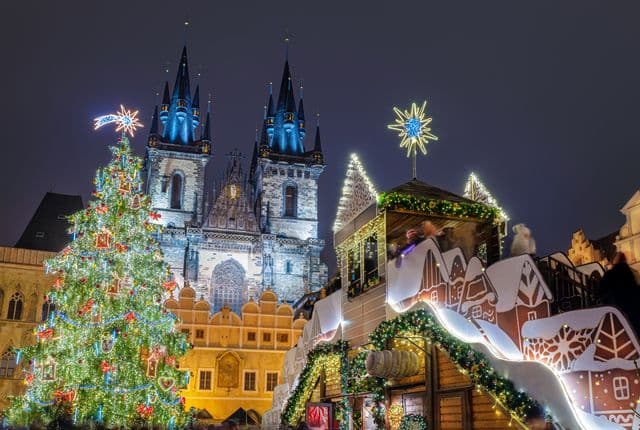
The Church of Our Lady before Týn dominates the eastern side of the square — its twin Gothic towers rising 80 metres above the roofline, topped with gold. Construction of the present Gothic church began in the mid-14th century under Emperor Charles IV. Inside: the tomb of Tycho Brahe, the Danish astronomer who served at the court of Emperor Rudolf II, and whose meticulous observations of Mars later enabled Johannes Kepler to formulate the laws of planetary motion. The connection between the church on this square and the scientific revolution is direct — and almost nobody who visits Týn knows it.
The Jan Hus Monument at the centre of the square commemorates the Czech religious reformer burned at the stake in 1415 for heresy — a full century before Martin Luther began the Reformation. Hus is one of the most important figures in Czech history and one of the least known outside it. The monument was unveiled on 6 July 1915, exactly 500 years after his death.
The Old Town Hall Tower is the building to which the Astronomical Clock is attached — and it offers one of the best views over Prague from its observation deck. The queue moves quickly and the view is worth it: Old Town Square below you, the spires of Týn ahead, Prague Castle on the hill across the river.
What most visitors miss: The Jewish Quarter — Josefov — begins just north of Old Town Square, accessible in under two minutes on foot. Six synagogues, the oldest Jewish cemetery in Europe, and the most emotionally powerful neighbourhood in Prague. Most people who spend an hour on the square never make it there. It is one of the biggest missed opportunities in all of Prague tourism.
What to See in Prague Old Town: Beyond the Astronomical Clock
Old Town Square is the anchor. The streets radiating out from it in every direction are the reason to stay.
Celetná Street runs east from the square toward the Powder Tower — one of the original gates of the medieval city — and is lined with Baroque palaces built over Romanesque and Gothic foundations. Walk it slowly and look up at the facades. Most visitors use it as a corridor between the square and the main shopping street. It deserves better.
The streets behind Týn Church are where Prague's Old Town feels most like itself — narrow, quiet, with courtyard entrances and details that would take weeks to catalogue. The Church of St. James on Malá Štupartská contains one of the strangest objects in Prague: a mummified human forearm hanging above the entrance, placed there after a thief attempted to steal a jewel from the Virgin Mary statue in the 17th century. The arm has been there ever since.
Dlouhá Street and the streets north of the square lead quickly into the quieter, less-touristed parts of the Old Town — local restaurants, coffee shops without tourist pricing, and the feeling of a city that has residents rather than just visitors.
Our Charles Bridge & Old Town Walking Tour covers Old Town Square, the Astronomical Clock and the streets of the Old Town in full — with a private licensed guide who makes the history of every stone legible. The tour continues through the hidden network of Old Town streets and courtyards to Charles Bridge.
If you want to combine Old Town Square with Prague Castle and all the city's main sights in a single morning, our Best of Prague Car and Walking Tour does exactly that — private car, licensed guide, hotel pickup included.
When to Visit Old Town Square and the Astronomical Clock
Timing matters more here than almost anywhere else in Prague.
Best time: Before 9am or after 6pm. Old Town Square in the early morning — before the tour groups arrive — is one of the most beautiful places in Central Europe. The facades of the buildings catch the morning light, the square is quiet, and you can stand in front of the Astronomical Clock without fighting for space. After 6pm the groups thin out and the square takes on a different character entirely.
Worst time: Between 11am and 4pm in summer. This is when Old Town Square reaches its maximum density of visitors. The Astronomical Clock show at noon draws the largest crowds of the day. If this is your only option, arrive at the square early and leave before noon.
The hourly show: The mechanical procession of the apostles happens every hour from 8am to 11pm daily. The show is worth seeing at least once. What you experience at 8am and what you experience at 1pm in August are very different — same clock, very different crowd.
What NOT to Do at Prague Old Town Square
Don't eat on or immediately around the square. The restaurants facing Old Town Square are among the most expensive and least reliable in Prague. Two minutes' walk in any direction and the quality improves and the price drops significantly.
Don't only watch the clock from the front. The best view of the Astronomical Clock's mechanical procession is from the side — from beneath the Town Hall tower — where you can see the apostle figures moving in and out of the windows at eye level rather than craning your neck from directly below.
Don't skip the calendar dial. Most visitors focus entirely on the astronomical face and ignore the circular calendar dial below it. This is where the months of the Bohemian year are illustrated with scenes of peasant life — one of the most beautiful pieces of decorative art on the square, and almost universally overlooked.
Don't miss the 27 crosses. The white crosses embedded in the paving of the square mark the spot where 27 Czech Protestant leaders were executed in 1621. They are one of the most significant historical markers in the city and most visitors step over them without knowing what they are.
Don't rush. Old Town Square rewards time. Sit somewhere with a view of the whole square and simply watch it for twenty minutes. The architecture, the movement of light across the facades, the layers of history visible in the different building styles around you — it takes time to absorb, and it is worth absorbing.
What to Do in Prague Old Town: With or Without a Guide
Here is the honest version. You can visit Old Town Square entirely on your own. The Astronomical Clock is visible from 50 metres. Old Town Square is a public space. You do not need a guide to stand in it.
What a guide gives you is the difference between standing in a famous place and understanding why it is famous — and what happened there, and who walked across this square before you, and what the buildings are saying if you know how to read them. The 27 crosses in the pavement. The mummified arm in the church behind Týn. The connection between Tycho Brahe's tomb and the laws of planetary motion. The legend of the clockmaker's blinded eyes. The story of Jan Hus and why it still matters to Czechs six centuries later.
These are not details you find on information boards. They are the reason Old Town Square is extraordinary — and they require a guide to tell.
Our Charles Bridge & Old Town Walking Tour is a private tour — exclusively yours, with your own licensed guide. It covers Old Town Square, the Astronomical Clock, the hidden streets of the Old Town and the walk to Charles Bridge. Everything explained. Everything understood.
Frequently Asked Questions: Prague Astronomical Clock and Old Town Square
What is the Prague Astronomical Clock? The Prague Astronomical Clock — the Orloj — is a medieval mechanical instrument installed in 1410 on the Old Town Hall in Prague. It is the oldest functioning astronomical clock in the world and shows the position of the sun, moon and stars, the time in multiple systems, the phase of the moon and the zodiac sign. Every hour from 8am to 11pm it performs a mechanical procession of the twelve apostles.
How old is the Prague Astronomical Clock? The Orloj was installed in 1410, making it over 600 years old. It is the third-oldest astronomical clock in the world and the oldest still in operation.
What is there to do in Prague Old Town? Old Town is the historic heart of Prague — a compact neighbourhood you can walk across in fifteen minutes but which takes days to fully explore. The main highlights are Old Town Square and the Astronomical Clock, the Church of Our Lady before Týn, the Old Town Hall Tower with its observation deck, the Church of St. James with its mummified arm, and the Jewish Quarter — Josefov — just north of the square. The streets between and around these landmarks are as rewarding as the landmarks themselves.
What is the best time to see the Astronomical Clock in Prague? The best time is early morning — before 9am — when the square is quiet and the light is at its best. The noon show draws the largest crowds of the day. The mechanical procession happens every hour from 8am to 11pm; the experience varies significantly depending on how many other visitors are present.
What to see in Prague Old Town in one day? Start at Old Town Square before 9am — watch the clock show, find the 27 crosses in the pavement, go inside Týn Church. Then explore the streets behind Týn and on Celetná toward the Powder Tower. Allow time for the Jewish Quarter north of the square. Walk to Charles Bridge through the Old Town's hidden courtyards. If time allows, climb the Old Town Hall Tower for the view.
Is Old Town Square free to visit? The square itself is free and open at all times. The Old Town Hall Tower observation deck requires a ticket. The interiors of the Týn Church and the Church of St. James are free to enter during visiting hours.
How long should I spend at Old Town Square? Without a guide, allow at least 90 minutes to walk the square, watch the clock show, visit the Týn Church and explore the surrounding streets. On a guided tour, two to three hours covers Old Town Square and the walk to Charles Bridge properly.
Do I need a guide for Old Town Square and the Astronomical Clock? You do not need one — but you will benefit enormously from one. The history of Old Town Square spans eight centuries and involves the Bohemian Reformation, the Thirty Years' War, the Habsburg occupation, the Nazi occupation and the Velvet Revolution. A private guide makes all of it legible in two to three hours. Without one, you will see one of Europe's most beautiful squares. With one, you will understand it.
How do I book a private walking tour of Prague Old Town? Fill in the booking form on our Charles Bridge & Old Town Walking Tour page, tell us your preferred date and number of travellers, and we confirm within a few hours. Private tour, exclusively yours.
Want to see Prague for yourself?
Take our flagship Prague tour-6-640x430.jpg&w=3840&q=75)