Prague Castle — Everything You Need to Know Before Visiting
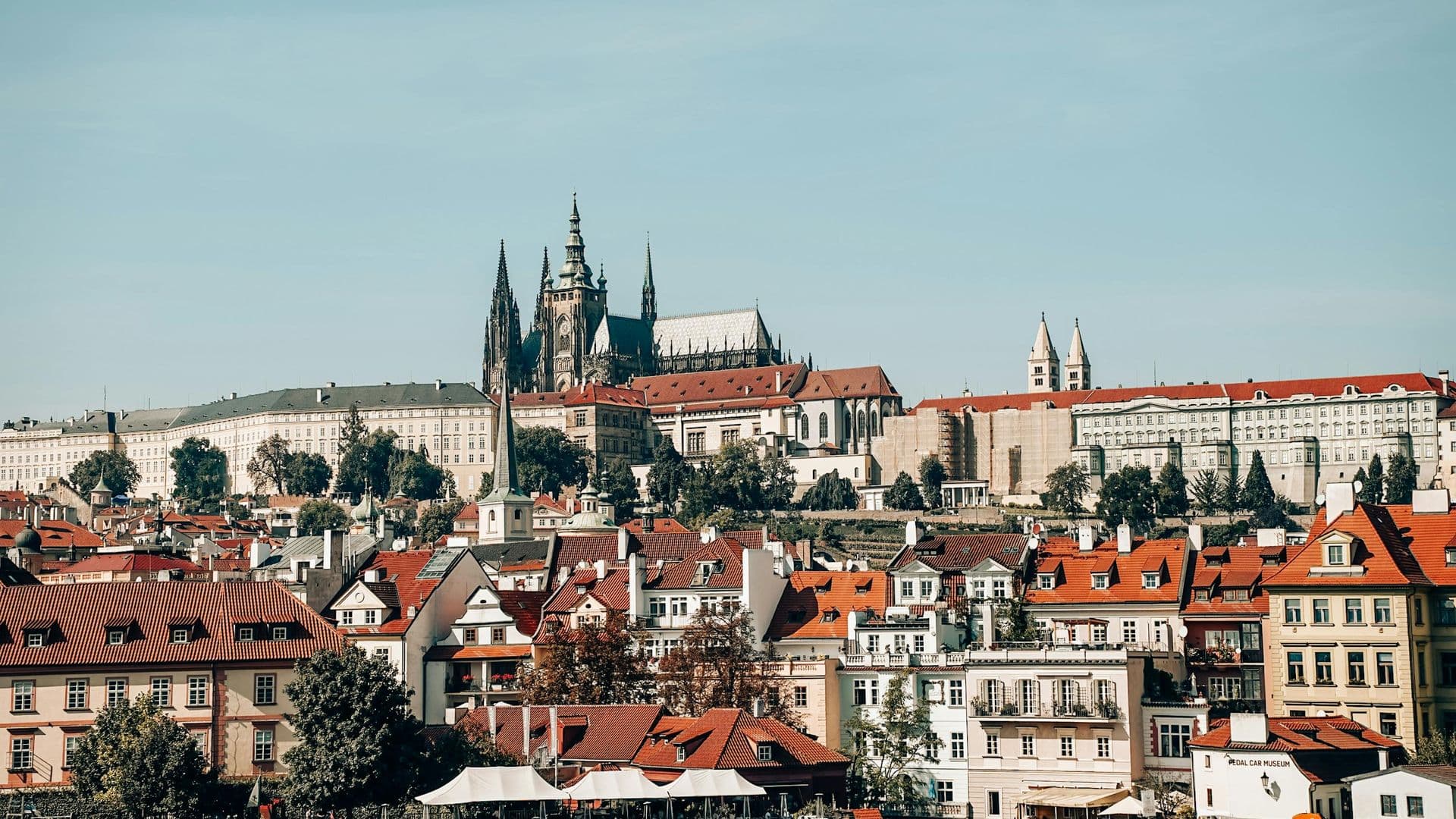
Prague Castle is the largest ancient castle complex in the world — not a single building but an entire district of palaces, churches, courtyards, gardens, and towers spread across 70,000 square metres on a ridge above the Vltava. Most visitors underestimate its scale and leave having seen only a fraction of what's here. This guide covers everything you need to plan a visit that actually does the place justice.
We've guided hundreds of private tours through the complex. What follows combines the practical logistics — tickets, timing, routes — with the insider details that turn a walk through old buildings into something you remember for years.
A Brief History — Why the Castle Is Here
The story begins around 880 AD, when Prince Bořivoj of the Přemyslid dynasty built a wooden fortification on this hilltop. The location was strategic: a limestone ridge overlooking a river crossing, defensible on three sides. Every Czech ruler since — Přemyslids, Luxembourgs, Habsburgs, and modern presidents — has governed from this spot.
The Castle grew through layers. The Romanesque basilica under the current cathedral dates from the 10th century. Charles IV, the Holy Roman Emperor who made Prague his capital in the 14th century, commissioned St. Vitus Cathedral and expanded the palace complex dramatically. The Renaissance additions came under the Habsburgs, and the baroque rebuilds under Maria Theresa in the 18th century gave the complex its current unified facade.
Today the Castle houses the Czech president's offices, the Prague Castle Picture Gallery, St. Vitus Cathedral, the Old Royal Palace, St. George's Basilica, the Golden Lane, and several gardens. It is both a working seat of government and the most visited site in the Czech Republic.
Which Prague Castle Ticket to Buy
This used to be the first decision that tripped people up. Since 1 March 2024 it is simpler: Prague Castle sells one Main Circuit, with the permanent exhibitions and the Great South Tower ticketed separately.
The Main Circuit includes St. Vitus Cathedral, the Old Royal Palace, St. George's Basilica, and the Golden Lane with Daliborka Tower. It covers the four principal interiors. The price is 450 CZK for adults, 300 CZK reduced, 950 CZK family.
The permanent exhibitions — the Story of Prague Castle, the Picture Gallery, Rožmberk Palace and the Castle Guard exhibition in the Powder Tower — are a separate ticket: 300 CZK adult, 200 CZK reduced, 700 CZK family. The Great South Tower is separate again: 200 CZK adult, 150 CZK reduced, 500 CZK family.
Prices effective 1 March 2024. Check the current price list on hrad.cz.
Our recommendation: the Main Circuit is enough for most visitors. The Picture Gallery is good but not essential unless you have a specific interest in Baroque painting (it holds works by Titian, Rubens, and Tintoretto). Save your time and energy for the sites that define the complex.
One insider note: the ticket office at the main entrance (Second Courtyard) often has the longest queues. Walk to the ticket office at the eastern end near the Golden Lane — it's the same tickets, fewer people. You can also buy online in advance, though the lines are manageable outside of July and August.
St. Vitus Cathedral — The Centre of Everything
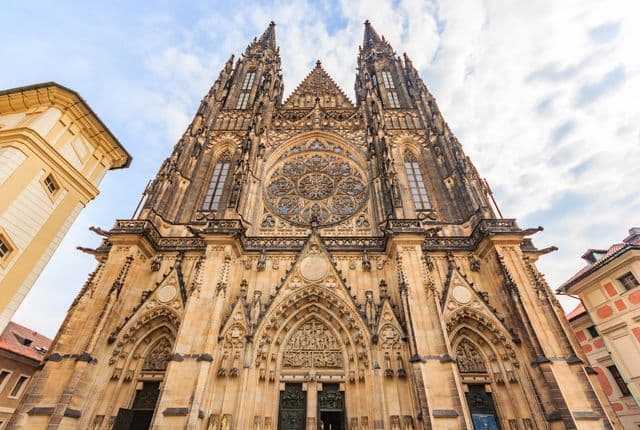
The cathedral dominates the skyline and the experience. Construction started in 1344 under Charles IV and wasn't completed until 1929 — nearly six centuries of building. The neo-Gothic western facade that faces you as you enter the Third Courtyard was finished in the early 20th century, which means the "oldest-looking" part of the cathedral is actually the newest.
Step inside and look up. The vaulted ceiling reaches 33 metres. The stained glass fills the nave with filtered colour, and the effect shifts dramatically with the time of day — morning light through the eastern windows is entirely different from afternoon light through Alfons Mucha's Art Nouveau window on the north side.
The Mucha window is the one most people photograph. It was created in 1931 by Alfons Mucha, who is better known for his Parisian Art Nouveau posters. The window depicts Saints Cyril and Methodius and was funded by an insurance company — a detail that always gets a smile from our guests. Look closely at the bottom panels; Mucha's style is unmistakable even in stained glass.
The Chapel of St. Wenceslas is the emotional heart of the cathedral. Its walls are covered with semi-precious stones — over 1,300 pieces of jasper, amethyst, and chrysoprase — and medieval frescoes depicting the life and murder of the patron saint of Bohemia. The chapel also guards the entrance to the Crown Chamber, where the Czech Crown Jewels are kept behind a door secured by seven locks held by seven separate keyholders, including the president and the archbishop.
Walk around the ambulatory to find the Royal Crypt below the main altar. Charles IV, Wenceslas IV, and Rudolf II are buried here. The crypt was rediscovered during renovations in the 1920s and opened to visitors. It's a quiet space — most tour groups skip it because it requires stepping down a narrow stairway.
The Old Royal Palace
The palace served as the seat of Bohemian kings until the Habsburgs moved to the more comfortable western wing. The highlight is the Vladislav Hall, a late Gothic hall with a vaulted ceiling so wide it seems impossible for its era. The hall was built by Benedikt Rejt between 1493 and 1502. Its ceiling ribs twist and interlace in a pattern that looks almost organic.
Vladislav Hall was used for jousting tournaments — on horseback, indoors. The wide, ramp-like stairway called the Riders' Staircase was built specifically so knights on horseback could ride directly into the hall. Stand at the top of that staircase and picture armoured riders coming up toward you. The scale suddenly makes sense.
From the hall, a door leads to the Bohemian Chancellery, the room where the Second Defenestration of Prague took place in 1618. Two Catholic governors were thrown from the window by Protestant nobles — an event that triggered the Thirty Years' War. The window is still there. It's smaller than you'd expect, and the drop is about 16 metres. The governors survived, which the Catholic side attributed to angelic intervention and the Protestant side to landing in a manure heap.
St. George's Basilica
This is the oldest surviving church building within the complex — the Romanesque core dates from 920 AD, with the current appearance largely from the 12th century. The facade is baroque (added in the 17th century), which misleads some visitors into thinking the whole church is baroque. Step inside and the difference is immediate: bare stone walls, rounded arches, and a simplicity that feels centuries removed from the cathedral.
The basilica currently houses a permanent exhibition of 19th-century Czech art from the National Gallery. But the building itself is the real exhibit. The Romanesque crypt below holds the tomb of St. Ludmila, grandmother of St. Wenceslas and the first Czech Christian martyr, who was strangled in 921 AD.
The Golden Lane
A row of tiny, colourful houses built into the fortification wall in the 16th century. They were originally constructed for Castle marksmen, later housed goldsmiths (hence the name), alchemists during Rudolf II's era, and eventually became a Prague slum before restoration.
House No. 22 is the most famous — Franz Kafka lived and wrote here during the winter of 1916-1917, staying with his sister Ottla. The house is barely larger than a closet. Today it's a bookshop selling Kafka editions, which feels appropriate.
All our castle tours are led by top-category licensed guides.
The lane is charming but tiny — you can walk its entire length in five minutes. What most visitors miss is the upper level of the fortification wall, accessible from the lane, which contains a small armoury and views down over the rooftops of Malá Strana. It's included in your ticket but easy to overlook.
After the interiors close — 17:00 from 1 April to 31 October, 16:00 from 1 November to 31 March — the Golden Lane is free to walk through, but the exhibitions in the houses are closed. The exteriors and the lane itself are still worth seeing, and the light is often better in the evening.
The Castle Gardens
The castle has several gardens, and most visitors walk right past them. The Royal Garden (Královská zahrada) on the north side was founded in 1534 and contains the Renaissance Ball Game Hall (Míčovna), one of the finest Renaissance buildings in Prague. The garden is open from April to October and is free.
The Gardens on the Ramparts (Zahrady na Valech) run along the southern face of the castle, offering views over Malá Strana, the red rooftops, and the river. There's a stairway connecting them directly down to Malá Strana, which makes for a far more interesting descent than the main road.
The South Gardens (Jižní zahrady) adjoin the rampart gardens and include the Bull Staircase designed by Josip Plečnik, the Slovenian architect who reshaped much of the castle complex in the 1920s under President Masaryk. Plečnik's work is everywhere at the castle — the granite obelisk in the Third Courtyard, the stairways, the retaining walls — but it's subtle enough that most visitors don't notice they're walking through one architect's unified vision.
The Changing of the Guard
The guard change happens every hour on the hour through the day, at the main gate in the First Courtyard (Hradčanské náměstí entrance). The full ceremony with the fanfare happens at noon — a brass ensemble plays from the first-floor window of the palace, and the flag is ceremonially exchanged.
If you care about the ceremony, be at the main gate by 11:45. The crowd builds fast. Stand to the side rather than directly in front of the gates — you'll see the soldiers more clearly and have a better angle for photos.
If you don't care about the ceremony, use noon as your signal to be somewhere else entirely. The main entrance area becomes a bottleneck. Head to St. Vitus Cathedral or the gardens while everyone else watches the guards.
When to Visit — Timing and Crowds
Prague Castle is open daily. Grounds are accessible from 6:00 to 22:00 year-round. Interior sites open from 9:00 to 17:00 (1 April to 31 October) and 9:00 to 16:00 (1 November to 31 March). Last entry to the cathedral is 16:40 in summer and 15:40 in winter. Always check the official Prague Castle website for current hours and closures.
Best times: Early morning — arrive at 8:45 before the ticket offices open at 9:00. You'll have 30 to 45 minutes of relative quiet before the first large tour groups arrive. Alternatively, after 15:00 in summer, when the coach tours start heading back to their hotels.
Worst times: 10:00 to 14:00, every day. This is peak tour group hours. St. Vitus Cathedral becomes standing-room-only, and the Golden Lane is shoulder-to-shoulder.
Day of the week: Tuesday through Thursday tend to be marginally less crowded than weekends. Monday can also be quieter. Fridays start picking up for the weekend.
The Castle is busiest from June through September and during the Christmas/New Year period. April, May, and October offer the best balance of decent weather and manageable crowds.
A private guide makes all the difference when exploring this part of Prague.
How to Get There
On foot from Malá Strana: Walk up Nerudova ulice (the historic route) — steep but atmospheric, lined with baroque house signs. Takes about 15 minutes from Malostranské náměstí.
Tram 22: One of the best tram rides in Europe. Take it to the Pražský hrad stop and enter through the Second Courtyard, or continue to Pohořelec and walk down through Hradčanské náměstí to enter from the west. The second option gives you the dramatic approach through the main gate.
From Old Town: Walk across Charles Bridge, through Malá Strana, and up. Allow 30 minutes. Or take tram 22 from Národní třída.
Avoid: the old castle steps (Staré zámecké schody) from Malostranská metro station if you have mobility issues — they're charming but long and uneven.
What Most People Miss
- The Powder Bridge view: The bridge connecting the Second Courtyard to the Royal Garden offers a view down into the Stag Moat (Jelení příkop) that almost nobody photographs. The moat is a deep ravine with mature trees, and it's an unexpected pocket of wilderness in the middle of the complex.
- The Third Courtyard pavement: Look down. The granite paving was designed by Plečnik, and the patterns shift subtly across the courtyard. Most people are looking up at the cathedral and miss the ground entirely.
- St. Vitus gargoyles from the south side: Walk around the south exterior of the cathedral (away from the main entrance) and look up at the flying buttresses. The gargoyles are remarkably detailed and individually carved. Bring binoculars or a zoom lens.
Best Entrance to Avoid Crowds — Pohořelec Gate
Most visitors approach Prague Castle from Hradčanské náměstí — the grand eastern entrance where the honour guard stands. It's iconic, but it's also where every tour bus unloads, where the security screening queue snakes across the courtyard, and where you'll spend 20-40 minutes in line during peak season (April-October, 10:00-13:00).
There's a better way. We route nearly all of our Prague Castle tours through the western gate at Pohořelec — and here's why.
How to do it: Take tram 22 to the Pohořelec stop. From there, walk east along the quiet lane past Strahov Monastery's baroque library (worth a 5-minute detour to peek inside the Theological Hall). Continue through the Pohořelec gateway — a passage most visitors never discover — and you'll enter the Castle complex at the second courtyard, bypassing the main gate entirely.
Why it works:
- Shorter security line. The western checkpoint handles a fraction of the foot traffic. On a July morning when the main entrance had a 30-minute wait, we've walked through the Pohořelec security in under 3 minutes.
- Better narrative flow. Entering from the west means you move through the Castle in chronological order — from the oldest fortifications to the Renaissance additions to St. Vitus Cathedral — rather than hitting the Cathedral first and working backwards.
- Strahov bonus. The approach takes you past one of Prague's finest monastery complexes. The Strahov Library (a separate ticket, about 150 CZK) houses 200,000 volumes in two spectacular halls that predate the Castle's current baroque form.
Timing tip: Arrive by 8:30 a.m. if visiting between June and September. The Castle grounds open at 6:00 but the interiors (Cathedral, Old Royal Palace, Golden Lane) open at 9:00. Being at the Pohořelec gate by 8:30 means you're inside when the doors open, ahead of the wave that arrives from the eastern side around 9:30.
One more insider detail: the stretch between Pohořelec and the Castle offers one of the best elevated views over Prague's red rooftops — a panorama that the main-entrance visitors miss completely because they arrive from below.
How to Get to Prague Castle from Old Town
There are three main approaches to the Castle from Old Town, and each one offers a different experience. We've walked all of them hundreds of times with guests, and our recommendation depends on your energy level and what you want to see along the way.
Option 1: Tram 22 to Pohořelec (our top pick) Catch tram 22 from Národní třída or Malostranská — it climbs the hill for you and drops you at Pohořelec, the western approach to the Castle. From the stop, it's a flat 5-minute walk past the Strahov Monastery to the Castle's second courtyard. This is how we start most of our Prague Castle & Lesser Town tours because it lets you enter through the quieter western gate and avoid the main-entrance queue entirely.
Option 2: Walk up Nerudova Street Cross the river via Charles Bridge (or Mánesův most if you want fewer crowds), head through Malostranské náměstí, and take Nerudova — the steep, beautiful street lined with baroque house signs. Look for the house "At the Two Suns" (U Dvou slunců) where Jan Neruda lived. The climb takes about 15 minutes and is steeper than it looks on a map. Reward: you arrive at the Castle's main gate (Hradčanské náměstí) with a sense of having earned the view.
Option 3: Funicular to Petřín + walk across Take the funicular (once reopened — check dpp.cz) from Újezd up to Petřín Hill, enjoy the gardens and tower, then walk north along the hillside paths to the Castle. This is the scenic detour — allow an extra 30-40 minutes — but it's spectacular in spring and autumn.
Important 2024 update: Trolleybus 59 replaced the former bus 119 on the airport-to-city route. Some older guides still reference bus 119 for Castle access — it no longer exists. For the Castle approach, tram 22 remains the most reliable option.
A Prague transport tip: buy a 24-hour pass (150 CZK paper, 140 CZK in the PID Lítačka app) if you plan to use trams and the funicular — it covers everything including the Petřín funicular. Seniors 65+ ride free with a passport.
Around Prague Castle
The castle complex and its surroundings are packed with landmarks that deserve their own visit. From the soaring Gothic cathedral to the ceremonial guard change and the peaceful gardens below, these guides cover what most visitors miss on a quick walk-through.
- St. Vitus Cathedral guide -- history, highlights, and visiting tips
- Hradcany Square -- the overlooked plaza at Prague Castle's gates
- Prague Castle change of guards -- schedule, best viewing spots, and what to expect
- Kinsky Garden -- a quiet escape on the castle's southern slope
The Castle complex is enormous, and even with a good map you can spend hours wandering without understanding what you are looking at. A ticket gets you through the door, but context is what turns St. Vitus Cathedral from a pretty church into a nine-hundred-year story. If you are wondering whether to visit with a guide, we compare both approaches side by side so you can choose the one that matches your schedule and curiosity.
Experience It With a Private Guide
We run a dedicated Prague Castle and Lesser Town private tour that takes the complexity of this place and turns it into a story. We know which doors to enter first, which rooms empty out at what times, and where the details hide that you'd walk past on your own. Exclusively yours, with your own guide.
If you want to combine the Castle with the rest of Prague's highlights in a single day, our All Prague in One Day tour covers the castle, Charles Bridge, Old Town, and more — carefully paced so you don't burn out.
And for an evening that matches the grandeur of your day, try a medieval dinner at U Pavouka Tavern. After six centuries of royal history, an evening of roast meats, fire dancers, and sword swallowers in a Gothic cellar feels like a fitting end.
Browse all our private tours from Prague.
Frequently Asked Questions
Do I need a ticket to enter Prague Castle?
The castle grounds, courtyards, and gardens are free to enter. You only need a ticket to go inside the buildings — St. Vitus Cathedral (beyond the free entrance zone), the Old Royal Palace, St. George's Basilica, the Golden Lane, and the other exhibition spaces.
How long should I spend at Prague Castle?
Two to three hours is the minimum for the main sights. A thorough visit with gardens and the picture gallery can take four to five hours. We recommend arriving early and allowing at least three hours.
Is Prague Castle accessible for wheelchairs and strollers?
The main courtyards and some buildings are accessible, but many sections involve steps, uneven cobblestones, and narrow passages. The Cathedral and Vladislav Hall are accessible via ramps. Contact the Castle information centre in advance for current accessibility details.
Can I visit Prague Castle in the rain?
Yes — most of the main attractions are indoors. The courtyards and gardens are less enjoyable in heavy rain, but the Cathedral, Old Royal Palace, St. George's Basilica, and Golden Lane all have roofs over your head. Bring good shoes for wet cobblestones.
When is the changing of the guard?
Every hour on the hour through the day, at the main gate. The noon change is the ceremonial one, with musical fanfare.
You May Also Like
Want to see Prague for yourself?
Visit Prague Castle on our tour-6-640x430.jpg&w=3840&q=75)