Prague Coworking Spaces — Where Digital Nomads and Travelers Work

Fast Wi-Fi, good coffee, fair day-pass prices, and a timezone that overlaps with both European and East Coast US business hours — Prague checks every box for remote workers.
Prague has become one of Europe's strongest magnets for digital nomads, remote workers, and traveling professionals. The cost of living is roughly half that of London or Amsterdam, the internet infrastructure is excellent, and the coworking scene has matured well beyond a few hipster spaces with beanbags. Whether you need a desk for an afternoon or a base for a month, the options here are serious.
We work in Prague every day, and we've watched the coworking scene grow from a handful of pioneering spaces to a city-wide network. Here's where to work, what it costs, and which neighborhoods make the best base.
Best Coworking Spaces
Prague's coworking scene is concentrated in a few neighborhoods, each with a different character. These are the spaces that have earned their reputations.
Locus Workspace — Located in Karlín, Locus is the space most frequently recommended by Prague's expat and nomad community. The interior is clean, modern, and designed for actual productivity — not for Instagram. The Wi-Fi is fast and reliable (100+ Mbps), there are private phone booths for calls, and the meeting rooms are bookable by the hour. The kitchen is well-stocked, and the coffee machine is above average. Day passes and flexible weekly options are available.
Node5 — Prague's original tech-focused coworking space, situated in Smíchov near Anděl metro station. Node5 doubles as a startup incubator, so the crowd skews toward tech founders and developers. The energy is productive and slightly more intense than a general coworking space. Events — meetups, pitch nights, workshops — happen regularly. The building itself is a converted industrial space with high ceilings and generous natural light.
Impact Hub Prague — Part of the global Impact Hub network, the Prague location occupies a beautifully renovated space near Florenc. The focus here is on social impact and sustainability, which shapes the community — you'll find NGO workers, social entrepreneurs, and freelancers with a mission-driven bent alongside traditional remote workers. The common areas are excellent, and the event calendar is one of Prague's most active.
Opero — A premium space in the heart of Prague 1, inside a renovated palazzo near the National Theatre. Opero attracts a more corporate crowd — consultants, lawyers, and established businesses alongside freelancers who want a polished environment. The location is unbeatable for central Prague access, the interiors are elegant, and the Wi-Fi and meeting room infrastructure are top-tier. Pricing reflects the premium positioning.
HubHub — Located in the Palác Ara building on Wenceslas Square, HubHub offers modern, spacious facilities with a corporate-grade fit-out. The views from the upper floors are excellent. Flex desks, dedicated desks, and private offices are all available. The community manager organizes regular networking events, and the space has a distinctly international feel.
Insider tip: Most Prague coworking spaces offer a free trial day or heavily discounted first visit. Email ahead or check their website — trying two or three spaces before committing to a weekly or monthly pass is standard practice and nobody will think it's unusual.
Work-Friendly Cafés
Not every work session needs a coworking space. Prague's café culture is strong, and several cafés actively welcome laptop workers with good Wi-Fi, accessible power outlets, and a tolerance for long stays.
Kavárna co hledá jméno (Stroupežnického, Smíchov) — The name translates to "The café looking for a name," and it's become a de facto coworking café. Generous table space, fast Wi-Fi, power outlets at most seats, and a quiet weekday atmosphere. The coffee is specialty-grade, and the lunch menu is solid.
Cafe Jedna (Holešovice) — Inside the National Gallery's Trade Fair Palace, this café combines good coffee with an inspiring setting. Quieter than most, with large tables and a relaxed attitude toward laptops. The gallery itself provides excellent walking-break material.
EMA Espresso Bar (multiple locations) — Czech specialty coffee chain with consistently fast Wi-Fi across all locations. The Florenc and Náměstí Míru branches have the most space and the best work-friendly seating. Expect to buy a drink every 90 minutes or so — it's an unwritten courtesy.
Můj šálek kávy (Křižíkova, Karlín) — One of Prague's third-wave coffee pioneers. Small but work-friendly, with a few dedicated tables near outlets. The pour-over coffee is among the city's best.
Insider tip: Czech cafés rarely ask you to leave or limit your stay. The culture here is more European than American — lingering is normal. But buying a drink every hour or so keeps the relationship healthy, and tipping 10% goes a long way.
Day Pass vs Weekly Rates
Coworking pricing in Prague is significantly lower than in Western European cities. Here's the general range:
Day passes: 250–500 CZK (roughly €10–20). Locus and Impact Hub sit in the lower range; Opero and HubHub are higher. Most day passes include Wi-Fi, printing, coffee/tea, and access to common areas.
Weekly passes: 800–1,500 CZK (roughly €32–60). This is where the value proposition gets strong — a full week of coworking for less than a single day in central London.
Monthly flex desks: 3,000–6,000 CZK (roughly €120–240). A fixed desk in a shared space, with full-month access and usually a locker or storage.
Monthly dedicated desks: 5,000–10,000 CZK (roughly €200–400). Your own desk, 24/7 access, and typically a more private setup.
For short stays (under a week), day passes and café-hopping are the most cost-effective approach. For anything longer, a monthly flex desk pays for itself quickly — especially compared to the cumulative cost of café coffees and meals.
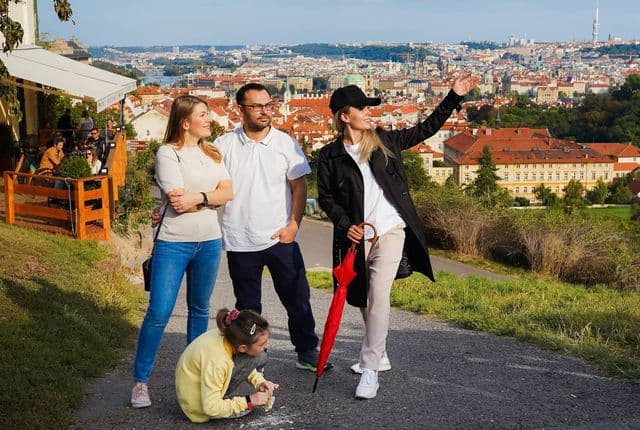
A private guide makes all the difference when exploring this part of Prague.
Insider tip: Some spaces offer evening and weekend rates that are cheaper than the standard day pass — useful if your remote work schedule aligns with a US timezone and you're working Prague evenings.
Neighborhoods for Digital Nomads
Two neighborhoods consistently top the list for remote workers settling into Prague life.
Karlín — Former industrial district, now Prague's most polished modern neighborhood. Clean streets, new apartment buildings with high-speed internet, excellent restaurants, and a 10-minute tram ride to the center. Locus Workspace is here, and so are dozens of cafés that welcome laptop workers. The Vítkov Hill park is a five-minute walk for midday breaks. Karlín attracts a slightly older, more established nomad crowd — people who've moved past the hostel-and-beer phase and want a functioning neighborhood base.
Vinohrady — Prague's most desirable residential neighborhood, centered around Náměstí Míru. Beautiful tree-lined streets, Art Nouveau architecture, wine bars, brunch cafés, and a strong community of expats and long-term residents. Vinohrady doesn't have a dedicated coworking space at its core, but EMA Espresso Bar and several other work-friendly cafés serve the need. The lifestyle here — morning run in Riegrovy sady park, coffee at a local roastery, afternoon work session, evening wine — is what draws people to stay for months rather than days.
Holešovice is a strong third option — more raw and creative than Karlín, with converted industrial spaces, galleries, and a craft beer scene. Impact Hub's proximity and the neighborhood's artistic energy appeal to creative freelancers.
Insider tip: Karlín and Vinohrady both have excellent Airbnb availability at prices that shock visitors from more expensive cities. A modern one-bedroom apartment with fast Wi-Fi runs 25,000–40,000 CZK per month (roughly €1,000–1,600) — half the price of a comparable flat in Amsterdam or Berlin.
Prague Digital Nomad Visa
The Czech Republic introduced a Digital Nomad Visa (officially the "visa for remote work") that allows non-EU nationals to live and work remotely from the country for up to one year. This is relevant for American, Canadian, British, and other non-EU remote workers who want to stay beyond the 90-day Schengen limit.
Key requirements:
- Proof of remote employment or freelance contracts with non-Czech clients
- Minimum monthly income (approximately €3,500 — check current requirements)
- Health insurance valid in the Czech Republic
- Clean criminal record
- Accommodation arranged in the Czech Republic
The application is submitted through Czech embassies or consulates in your home country. Processing times vary but typically run 60–90 days.
Insider tip: The visa is relatively new, and the bureaucratic process is still being refined. Online forums and Facebook groups for Prague digital nomads (search "Prague Digital Nomads" and "Expats in Prague") are the best sources for real-time application experiences and tips.
Between work sessions, Prague offers plenty of reasons to close the laptop. Our All Prague in One Day tour is a strong orientation for new arrivals — it covers the main landmarks and hidden details that help you understand the city you're living in. For something more unusual, our Hidden Prague tour takes you into underground spaces and alchemist workshops that most long-term residents never discover.
And for an evening that's the opposite of staring at a screen, our Medieval Dinner experience delivers fire shows, swordfighters, and a five-course feast in a Gothic cellar — the kind of offline experience that reminds you why you chose the nomad life.
Experience It With a Private Guide
Moving to a new city — even temporarily — is different from visiting as a tourist. Our private tours help remote workers and long-term visitors understand Prague on a deeper level: the history that shaped the neighborhoods, the cultural context behind daily life, and the insider details that make the difference between feeling like a visitor and feeling like a resident.
See our private tour options — exclusively yours, with your own guide — and let us help you feel at home.
FAQ
What does a coworking day pass cost in Prague? Day passes range from 250 to 500 CZK (roughly 10–20 EUR), depending on the space. Most include Wi-Fi, coffee, tea, and access to common areas. Weekly and monthly passes offer significantly better value for longer stays.
Which Prague neighborhood is best for digital nomads? Karlín and Vinohrady are the top choices. Karlín offers modern infrastructure, coworking spaces, and excellent restaurants. Vinohrady has beautiful streets, strong café culture, and a vibrant expat community. Both are well-connected to the center by tram and metro.
Do Prague cafés allow laptop working? Yes. Czech café culture is relaxed about lingering, and many cafés have good Wi-Fi and power outlets. Buying a drink every hour or so is the expected courtesy. Several cafés — like Kavárna co hledá jméno and EMA Espresso Bar — actively welcome remote workers.
You May Also Like
Want to see Prague for yourself?
Take our flagship Prague tour-6-640x430.jpg&w=3840&q=75)