Prague Municipal House — Art Nouveau at Its Finest
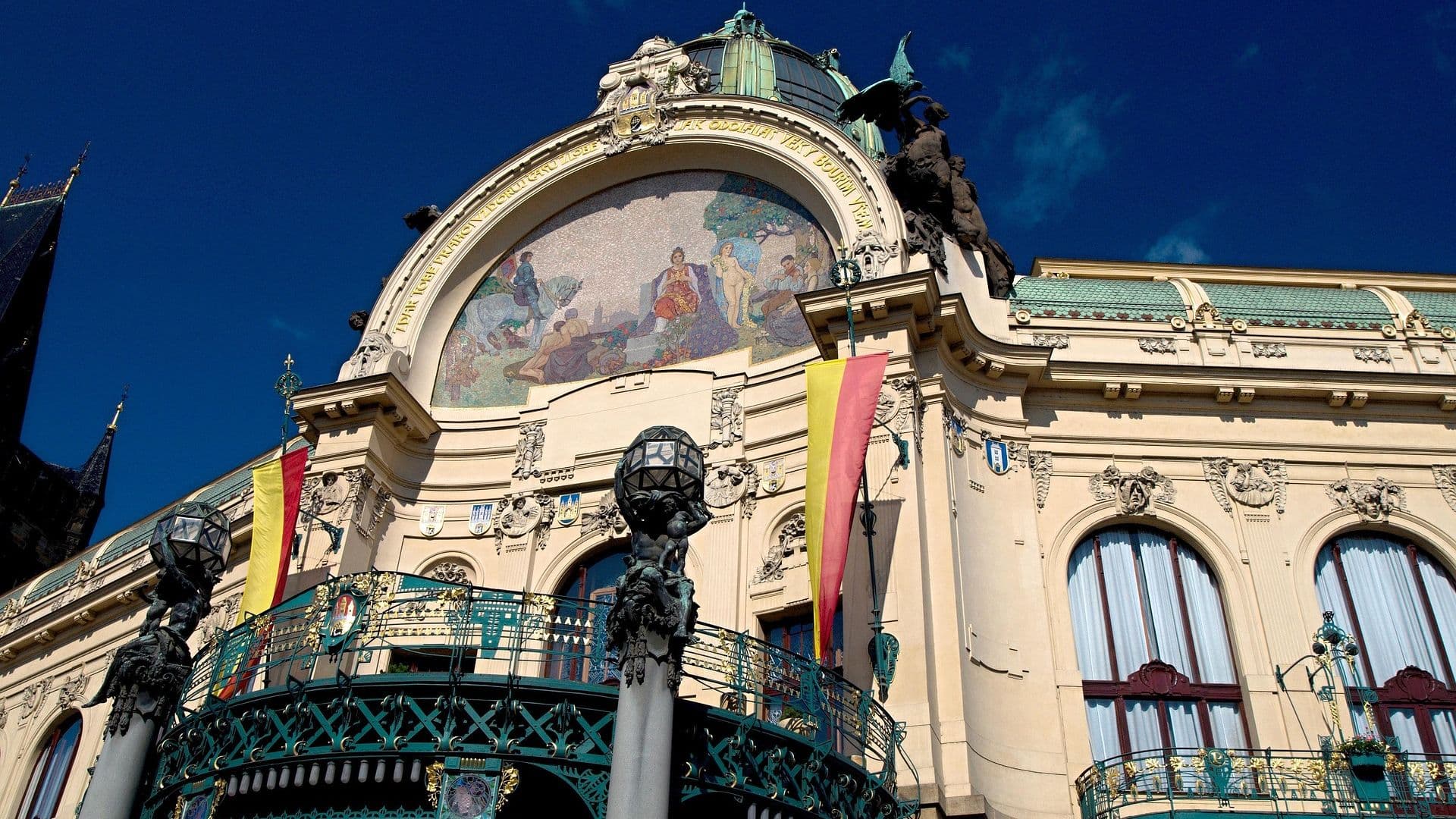
The Obecní dům stands at the corner of Náměstí Republiky and Na Příkopě, and it announces itself with a confidence that borders on extravagance. Mosaics, gilded ironwork, sculptural groups, stained glass — the facade alone contains more decorative detail than most buildings manage in their entirety. Step inside and the density increases. Every surface has been designed: walls, ceilings, door handles, light fixtures, floor tiles.
We bring our private tour guests past the Municipal House because it represents something specific in Prague's history — the moment when Czech national identity found its architectural voice. The building was designed to declare, in the most elaborate terms possible, that Czech culture was the equal of anything produced by Vienna or Paris. Here's the full story and what you can see today.
The Site — From Royal Court to Cultural Statement
The Municipal House occupies the site of the former Royal Court (Královský dvůr), which served as the Bohemian kings' residence from 1383 to 1485, when the court moved to Prague Castle. After the royal departure, the building served various functions — it housed a military seminary, a cadet school — and by the late 19th century it had deteriorated badly. It was demolished in 1903.
The city government decided to build a cultural center on the site. The competition was won by architects Antonín Balšánek and Osvald Polívka, and construction ran from 1905 to 1912. The project was explicitly national — every element was intended to celebrate Czech identity. The artists commissioned to decorate the interior were the leading Czech painters, sculptors, and craftspeople of the era.
This context matters. In 1905, Prague was part of the Austro-Hungarian Empire, and the Czech national movement was in full force. The Municipal House was not just a concert hall — it was a political statement in stone, glass, and gold.
Smetana Hall — Where Czech Music Lives
The centerpiece of the building is the Smetanův sál (Smetana Hall), the main concert auditorium. It seats approximately 1,200 people and is home to the Czech Philharmonic Orchestra's season-opening concert. The annual Prague Spring Festival (Pražské jaro) traditionally opens here on May 12 — the anniversary of Bedřich Smetana's death — with a performance of his symphonic poem *Má vlast* (My Homeland).
The hall's acoustics are good, though not in the top tier of European concert venues. What makes it extraordinary is the visual experience. The ceiling is decorated with an allegorical painting by Karel Špillar, the walls are lined with ornamental plasterwork and murals, and the stage is framed by sculptural groups. Attending a concert here is as much a visual event as a musical one.
If you visit Prague during the Spring Festival season (late May through early June), tickets to a Smetana Hall performance are worth pursuing. The combination of the music and the room is one of Prague's best cultural experiences.
Mucha's Mayor's Hall — The Room Everyone Wants to See
The most famous single room in the building is the Primátorský sál (Mayor's Hall), decorated entirely by Alfons Mucha between 1910 and 1911. Mucha — already internationally famous for his Parisian poster art — created a cycle of paintings that depict key moments in Czech and Slavic history. The central ceiling painting represents Slavic Concord; the wall panels show episodes from the Czech past — Hussite warriors, scenes of oppression and resilience.
The room is not large, which makes the intensity of the decoration almost overwhelming. Every surface — walls, ceiling, pendentives, lunettes — carries Mucha's distinctive style: flowing lines, muted earth tones punctuated by deep blues and golds, allegorical figures with a weight and seriousness that his better-known poster work often lacks. This is Mucha at his most ambitious, working on a monumental scale in a room that meant everything to him — he was a Czech patriot working on a Czech national building at a moment when Czech independence was still a dream.
The Mayor's Hall is only accessible via the building's guided tour — you cannot wander in independently. Tours run several times daily and cover the Mayor's Hall, the Smetana Hall, and several other decorated rooms. The tour lasts approximately one hour and is well worth the time.
The Kavárna — Coffee Under Art Nouveau Ceilings
The Kavárna Obecní dům (Municipal House Cafe) occupies the ground floor facing Náměstí Republiky. The interior is original Art Nouveau — ceramic pillars, ornate chandeliers, large windows, and a ceiling with decorative plasterwork. The cafe serves standard Central European fare: coffee, cakes, light meals.
The quality is honest rather than spectacular — this is not the city's best coffee, and the service can be slow when tour groups arrive. But the room itself is the reason to visit. Sitting under the original ceiling, surrounded by the 1912 decoration, with a view out to the Powder Tower, is an experience that the price of a coffee generously undervalues. Go mid-morning on a weekday for the best chance of a quiet table.
There is also a more formal restaurant — the Francouzská restaurace (French Restaurant) — on the same floor. Its interior is equally decorated, with painted ceilings and Art Nouveau furnishings. It operates at a higher price point and offers a more composed dining experience.
1918 — Where Czechoslovakia Was Declared
On 28 October 1918, the independent state of Czechoslovakia was formally declared. The Municipal House played a central role — it served as the meeting place for the Czech National Committee that proclaimed the new state. The declaration itself was issued from the building, and the negotiations that shaped the new government's first days took place in its halls.
This gives the building a double significance. It was designed as a celebration of Czech culture within the Habsburg Empire; seven years after completion, it became the birthplace of Czech statehood outside it. The architects who designed the Municipal House to assert Czech identity within an empire lived to see it used to dismantle that empire.
A small exhibition on the ground floor documents this history. It's easy to walk past — there's no prominent signage — but it provides valuable context for the building's political dimension.
The Powder Tower Connection
The Municipal House stands directly adjacent to the Prašná brána (Powder Tower), the Gothic gate that marks the boundary between the Old Town and the former royal district. The two buildings — one late Gothic, one Art Nouveau — create one of Prague's most striking architectural contrasts. They share a short covered passage at the base.
The juxtaposition is deliberate. The Municipal House was built to face the Powder Tower, and the architects incorporated the medieval gate into their visual composition. Standing in Náměstí Republiky, you see both buildings together: the dark Gothic stonework of the gate and the light, ornate Art Nouveau facade of the Municipal House. The five centuries between them are written in the materials and the styles.
Visiting the Municipal House
The guided tour is the best way to see the building's most important rooms, including Mucha's Mayor's Hall, which is otherwise closed to the public. Tours are available in several languages and run throughout the day. Booking in advance is recommended during peak season.
Without the tour, you can still experience the Kavárna, the French Restaurant, and the entrance halls with their mosaic floors and decorative ceilings. The ground floor areas are free to enter. The building also hosts concerts, balls, and exhibitions — check the current program for events in Smetana Hall or the smaller salons.
The Municipal House is directly adjacent to the Powder Tower and a two-minute walk from the Old Town Square. It sits at the junction of several major walking routes, making it easy to incorporate into any Prague itinerary.
See the Municipal House With a Private Guide
The Municipal House is one of those buildings where context transforms the experience. Understanding why it was built, who decorated it, and what happened here in 1918 turns a beautiful building into one of Prague's most important sites.
On our All Prague in One Day private tour, we stop at the Municipal House to explain its national significance and Art Nouveau decoration. On our Charles Bridge and Old Town tour, we pass it alongside the Powder Tower as part of the Old Town's architectural story. Exclusively yours, with your own guide.
For an evening that matches the Municipal House's theatrical spirit, continue with a medieval dinner at U Pavouka Tavern — fire dancers, spit-roasted meats, and mead in a Gothic cellar. From Art Nouveau elegance to medieval revelry in the same day.
Browse all our private tours in Prague.
Frequently Asked Questions
Can you visit the Municipal House without a guided tour?
Yes — the ground floor areas including the Kavárna, the French Restaurant, and the entrance halls are open to the public without a ticket. However, the most important rooms — including Mucha's Mayor's Hall and Smetana Hall — are only accessible via the guided tour.
How long is the Municipal House guided tour?
The tour lasts approximately one hour and covers the Mayor's Hall, Smetana Hall, and several other decorated salons. Tours run in multiple languages throughout the day. Booking in advance is recommended during summer months.
What is special about Mucha's Mayor's Hall?
Alfons Mucha decorated the entire room — ceiling, walls, pendentives, and lunettes — with a cycle of paintings depicting Czech and Slavic history. It is his most ambitious monumental work and shows a different side of his art from the famous Parisian posters.
Is there a connection between the Municipal House and the Powder Tower?
The two buildings stand side by side and share a short covered passage. The Municipal House was deliberately designed to face the Powder Tower, creating a striking contrast between late Gothic and Art Nouveau architecture spanning five centuries.
You May Also Like
Want to see Prague for yourself?
Discover Prague's underground tour