Prague National Museum — What to See and Is It Worth It?
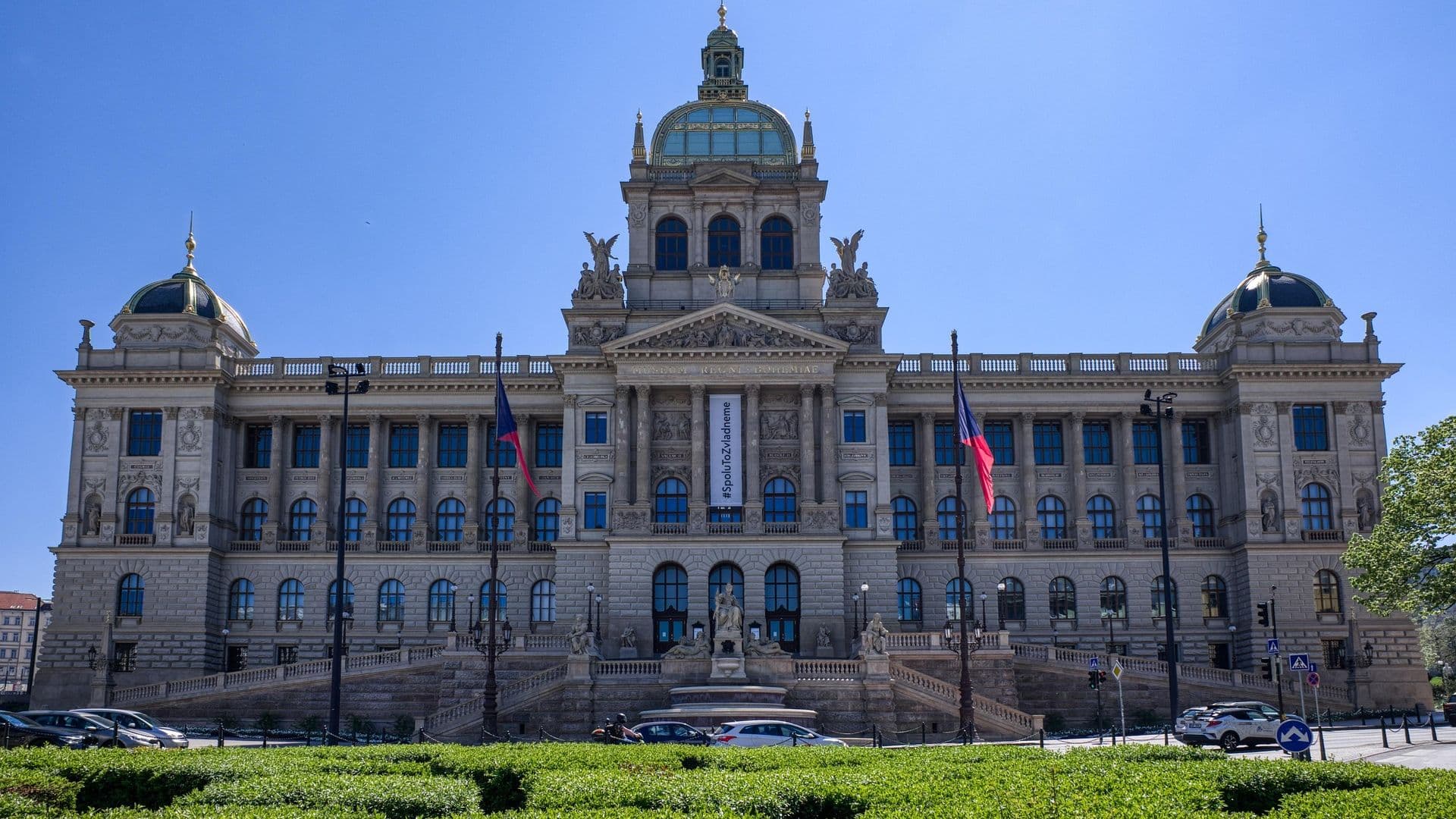
Yes, it's worth it — but mainly for the building itself. The National Museum reopened in 2020 after an eleven-year renovation that cost billions of crowns. The collections inside are decent. The building — the grand staircase, the Pantheon hall, the Wenceslas Square views — is extraordinary.
We walk past the National Museum several times a week with our guests. Most people photograph it from Wenceslas Square and keep walking. Those who go inside are usually glad they did, as long as they know what they're actually looking at.
The Building and Its History
The Národní muzeum sits at the top of Václavské náměstí (Wenceslas Square) like an exclamation point at the end of a sentence. Designed by Josef Schulz in neo-Renaissance style, it opened in 1891 and was intended to be a statement of Czech national identity during the Austro-Hungarian era.
The exterior is monumental — 104 metres wide, with a central dome that rises above the square. The facade features allegorical sculptures representing Bohemia, Moravia, and Silesia, along with the rivers Vltava and Labe. It was designed to say: we are a nation, we have a culture, and this building proves it.
During the renovation (2011-2020), workers restored the original colour scheme, repaired the dome's interior, and modernised the exhibition spaces while keeping the historical framework intact. The result is a building that looks better now than it has in a century.
The Pantheon Hall
If you see nothing else, see the Pantheon. This domed ceremonial hall on the first floor was designed as a secular temple to Czech achievement. Bronze busts and statues of figures from Czech history, science, and culture line the walls — Jan Hus, Bedřich Smetana, Antonín Dvořák, Jan Amos Komenský (Comenius), and dozens more.
The hall itself is the experience. The vaulted ceiling with painted lunettes, the marble columns, the mosaic floor — it's the kind of room that makes you stand still for a moment and take it in. The renovation restored the original polychrome decoration that had been covered up for decades.
Our guests often say the Pantheon reminds them of a European parliament chamber crossed with a cathedral. That's not far off — it was designed to inspire the same kind of reverence, but for national culture instead of religion.
The Collections
The permanent exhibitions cover natural history, archaeology, mineralogy, and Czech history and culture. The natural history floors include extensive mineral and gemstone collections — the Czech lands have been mined for centuries, and the specimens here reflect that.
The prehistoric and archaeological sections trace human settlement in Bohemia from the Paleolithic era through the early medieval period. The objects are well-presented, with clear labelling in Czech and English, but they're the kind of exhibits that reward genuine interest in the subject. If Bronze Age burial sites and Slavic pottery engage you, the collection delivers. If not, move through these floors at a pace that suits you.
The historical exhibitions on the upper floors cover Czech statehood — from the Přemyslid dynasty through the Habsburg era, the founding of Czechoslovakia in 1918, and the events of the 20th century. The 1968 section is particularly well done, with photographs and documents from the Soviet invasion that resonate differently when you know where you're standing.
The Bullet Holes from 1968
Walk outside after your visit and look at the facade columns near the main entrance. You'll see pockmarks in the stone — bullet holes from August 1968, when Warsaw Pact tanks rolled into Prague. Soviet soldiers fired on the building, either mistaking it for the parliament or deliberately targeting a national symbol.
The museum chose to leave the bullet damage unrepaired during the renovation. It's a deliberate decision — a reminder embedded in the stone. Most visitors walk past without noticing. Once you know what to look for, the small craters in the columns change your understanding of the entire building.
We always point these out to our guests. Standing in front of the museum, looking at bullet holes from tanks that parked on this very square, connects the 1968 invasion to a physical place in a way that reading about it never does.
The View from Inside
The upper windows of the National Museum face directly down Wenceslas Square — the full 750-metre length of the boulevard stretching toward the Old Town. This is the same view that appears in photographs of every major Czech political event: the 1918 independence declaration, the 1968 protests, the 1989 Velvet Revolution.
From the upper gallery, you can see the square as the stage it has always been. The slope is more apparent from above, and on clear days the view extends to the spires of the Old Town beyond the bottom of the square. It's one of the best perspectives in Prague, and you get it included with your museum ticket.
The New Building
Connected to the main building by an underground passage, the New Building (formerly the Federal Assembly) hosts temporary exhibitions and additional permanent collections. The architecture is 1960s Communist-era — angular, concrete, a deliberate contrast to the neo-Renaissance main building.
The temporary exhibitions here vary in quality and topic. Check what's showing before you visit. The ethnographic collection, when on display, includes folk costumes and craft objects from across the Czech lands that give a different perspective from the historical grandeur upstairs.
These stories come alive when told by someone who knows them deeply. Our licensed guides share what the plaques don't say.
The underground passage itself is worth noting — it runs beneath the busy road that separates the two buildings and includes a small exhibition space.
The Grand Staircase and Interior Architecture
Before reaching any exhibition, you walk up the grand staircase — a sweeping marble construction with bronze railings and painted ceilings that was designed to make visitors feel the weight of national achievement before they saw a single artefact. The staircase alone justified the renovation budget for many Praguers.
The hallways and landings between exhibition rooms are lined with historical paintings and decorative details that most visitors pass through without pausing. The ironwork, the mosaic floors, the carved stone balustrades — they reward attention. The museum was built as a Gesamtkunstwerk, a total work of art, and the corridors are part of the experience, not just passages between galleries.
We often tell our guests that the National Museum building is its own best exhibit. The collections give you a reason to walk through every room. The rooms themselves are the reward.
Practical Considerations
Allow one to two hours for the main building. If you're interested in the collections, three hours is comfortable. The Pantheon and the Wenceslas Square views take 30 minutes if you're focused on the highlights.
The museum is at the top of Wenceslas Square, which means it sits at the natural endpoint (or starting point) of any walk through the New Town. The location makes it easy to combine with a stroll down the square, which leads naturally toward the Old Town.
The building is fully accessible after the renovation, with lifts to all floors. The gift shop on the ground floor sells well-designed reproductions and books about Czech history — better quality than most museum shops in Prague.
Experience It With a Private Guide
The National Museum makes most sense in context. The bullet holes, the Pantheon busts, the view down Wenceslas Square — they connect to stories that span a thousand years of Czech history. On our All Prague in One Day private tour, we walk through Wenceslas Square and can include the museum when it fits your interests.
For an evening that takes you from 19th-century national revival to medieval spectacle, the Medieval Dinner Show at U Pavouka puts you in vaulted 15th-century cellars with live swordplay and period food.
Browse all our private tours in Prague.
Frequently Asked Questions
Is the National Museum in Prague worth visiting?
Yes, primarily for the building. The Pantheon hall, the grand staircase, and the views down Wenceslas Square from the upper windows are genuinely impressive. The collections are solid but secondary to the architectural experience. Allow at least an hour.
What are the bullet holes on the National Museum?
They are damage from gunfire during the Warsaw Pact invasion of August 1968. Soviet soldiers fired on the building's facade. The museum deliberately left the pockmarks unrepaired during the 2011-2020 renovation as a historical reminder.
How long does it take to visit the National Museum?
One to two hours covers the main building comfortably, including the Pantheon and the key exhibitions. If you want to include the New Building and temporary exhibitions, plan for three hours.
Is there an English audio guide at the National Museum?
The exhibition labels are in Czech and English. Audio guides are available. The building itself is largely self-explanatory — the Pantheon, the grand staircase, and the views need no translation.
You May Also Like
Want to see Prague for yourself?
Discover Prague's underground tour