Strahov Monastery and Library — Prague's Most Beautiful Interiors
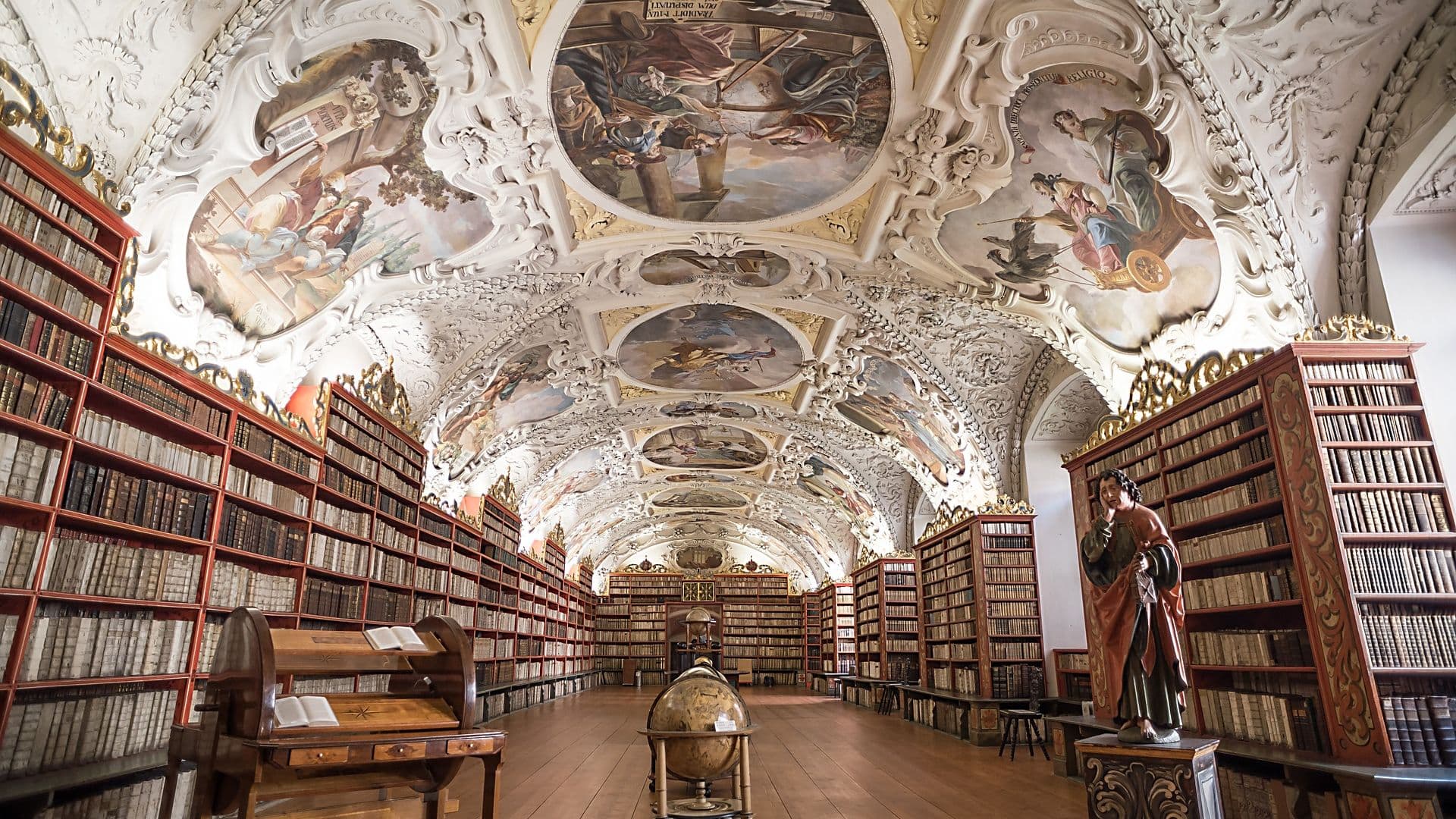
The two library halls at Strahovský klášter are among the most photographed interiors in Central Europe, and for good reason. Ceiling frescoes, floor-to-ceiling walnut shelving, centuries of leather-bound volumes, and the faint smell of old paper — the rooms look like something a set designer would create if budget were unlimited. Except they're real, they've been here since the 18th century, and the books on the shelves are not decorative props.
We bring our guests here on private tours because Strahov delivers something rare: genuine beauty that hasn't been diluted by over-restoration or commercialization. The monastery still functions. Premonstratensian canons have lived here continuously since 1143, making it one of the oldest active monasteries in Europe. Here's what you'll find and how to make the most of a visit.
The Theological Hall — Baroque Perfection
The Teologický sál (Theological Hall) was built between 1671 and 1679 by Giovanni Domenico Orsi. The ceiling frescoes, painted by a Strahov monk named Siard Nosecký between 1723 and 1727, depict scenes related to true wisdom and the pursuit of knowledge. The stucco cartouches contain inscriptions — proverbs and quotations about learning — that frame the painted scenes.
The room holds approximately 18,000 volumes, primarily theological works. The shelving is original — carved walnut, built to fit the room's dimensions precisely. The proportions are intimate compared to the grander Philosophical Hall: lower ceilings, warmer light, a sense of human scale. Many visitors prefer it for exactly that reason.
One detail worth noticing: the beautiful baroque globes positioned on the floor near the entrance. They're 17th-century Dutch-made, and the cartographic details are remarkable — coastlines drawn from explorers' accounts that hadn't yet been corrected, continents with speculative interiors. They're easy to overlook because the ceiling demands your attention, but they reward a close look.
The Philosophical Hall — Ambition on a Grand Scale
The Filosofický sál (Philosophical Hall) is the room that stops people mid-sentence. Built in 1794, it's significantly larger than the Theological Hall — the ceiling rises over 14 metres. The entire ceiling is covered by a single fresco painted by Franz Anton Maulbertsch in just six months, depicting the spiritual development of humanity through reason and revelation.
The walnut shelving in this hall has its own story. It was originally built for a monastery in Louka, Moravia, which was dissolved by Emperor Joseph II during his reforms in the 1780s. The Strahov abbot purchased the shelving and then designed the hall's dimensions around it — adjusting the architecture to fit the furniture rather than the other way around. The result is that the shelving fits the room perfectly, though the room was built for the shelving.
The collection includes approximately 42,000 volumes — philosophy, science, astronomy, mathematics. There are first editions, manuscripts, and incunabula (books printed before 1501) that would make any bibliophile's pulse quicken. Visitors view both halls from the doorway rather than walking among the shelves, which preserves the collections but also means you're looking at a composed scene — framing the room like a painting.
The Cabinet of Curiosities
Between the two library halls sits a corridor lined with display cases containing the monastery's Cabinet of Curiosities — a Wunderkammer assembled over centuries. This is where Strahov gets genuinely strange. Dried sea creatures, insect collections, mineral specimens, antique surgical instruments, and most memorably, two desiccated whale penises mounted on the wall.
The Cabinet of Curiosities reflects a pre-modern approach to knowledge — the idea that understanding the world meant collecting it, classifying it, displaying it. The monks who assembled this collection weren't eccentric hoarders; they were following the intellectual fashion of their era, when a monastery library was expected to represent all of creation, not just theology.
Most visitors glance at the corridor on the way between the two halls. Slow down. The cases repay attention — the mineral collection alone is extraordinary, and the illustrated botanical manuscripts in the lower cases are beautiful objects in their own right.
The Monastery Brewery — Sv. Norbert
Strahov has been brewing beer since the monastery's early centuries, and the modern Klášterní pivovar Strahov (Strahov Monastery Brewery) continues the tradition. The brewery operates under the name Sv. Norbert — after the founder of the Premonstratensian order — and produces several distinctive beers that you won't find elsewhere in Prague.
The amber lager and the IPA are consistently good. The seasonal specials rotate through the year and are worth trying if they're available. The brewery restaurant occupies a vaulted space adjacent to the monastery grounds, and the terrace has partial views toward Petřín Hill.
This is one of the insider stops we recommend to guests who want a break from the standard tourist beer halls. The quality is genuine, the setting is unusual, and because it's uphill from the main tourist routes, it's less crowded than comparable places in the Old Town or Malá Strana.
The Viewpoint — Prague Spread Below
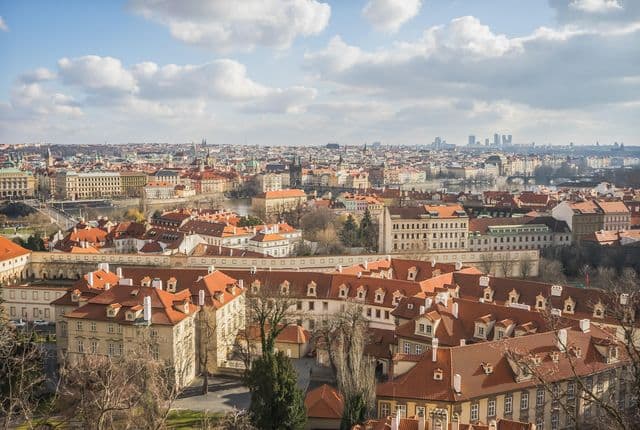
The terrace in front of the monastery offers one of the best panoramic views of Prague — and it's significantly less crowded than the viewpoints at Prague Castle or Petřín Tower. From here, you look east across the red rooftops of Malá Strana toward the Old Town, with the Vltava River curving through the middle distance and the towers of the Old Town rising above the treeline.
The view is particularly good in the early morning or late afternoon, when the low-angle light picks out the individual buildings and the river catches reflections. Photographers who know Prague often come here rather than the castle esplanade precisely because the angle includes both the castle complex (slightly to the right) and the full sweep of the city below.
Bring the moment together with a beer from the monastery brewery, and you have one of the most satisfying half-hours available in Prague — beautiful library, unusual beer, world-class view, all within a working monastery that's been here for nearly nine centuries.
Practical Access and What to Know
Strahov sits at the western end of the Pohořelec street, uphill from Prague Castle. The walk from the castle takes about ten minutes along Úvoz or through the Strahov Garden. From the city centre, tram 22 to Pohořelec is the most efficient approach — the stop is a three-minute walk from the monastery gate.
The library halls are open daily, and admission is by ticket purchased at the entrance. Photography is permitted in both halls for an additional fee — a separate ticket or added charge. The halls are viewed from the doorway, not entered, so visits are relatively quick: twenty to thirty minutes covers both halls and the Cabinet of Curiosities thoroughly. There are no guided tours of the library — you view independently, though the information panels provide context.
The Strahov Picture Gallery (Strahovská obrazárna) in the monastery's upper floors holds a collection of Gothic, Renaissance, and Baroque paintings that is undervisited relative to its quality. If you have an extra thirty minutes, it's worth the ticket.
The monastery grounds are free to walk through and are open to visitors outside of service hours. The basilica — Basilica of the Assumption of Our Lady — is occasionally accessible but primarily used for religious services. The Romanesque foundations are visible in places, reminding you that this community has been here since the 12th century.
See Strahov With a Private Guide
Strahov works best when someone tells you what you're looking at. The ceiling frescoes have specific iconographic programs, the books on the shelves have stories, and the Cabinet of Curiosities makes more sense in the context of 18th-century intellectual life. That's what a private guide provides — narrative, not just access.
We include Strahov on our Prague Castle and Lesser Town private tour, combining the monastery with the castle complex and a walk down through Malá Strana. On our All Prague in One Day tour, we fit Strahov into the full panorama of Prague's history. Exclusively yours, with your own guide.
For an evening that matches the monastery's medieval atmosphere, continue with a medieval dinner at U Pavouka Tavern — fire dancers, spit-roasted meats, and unlimited mead in a Gothic cellar. The contrast between Strahov's scholarly calm and the tavern's raucous energy is exactly the kind of range that makes a day in Prague memorable.
Browse all our private tours in Prague.
Frequently Asked Questions
Can you go inside the Strahov Library?
You view both library halls from the doorway — visitors do not walk among the shelves. The perspective is excellent and the rooms are well lit, but you are looking into the halls rather than standing inside them. Photography is permitted for an additional fee.
How do I get to Strahov Monastery?
The easiest approach is tram 22 to the Pohořelec stop, then a three-minute walk. From Prague Castle, walk west along Úvoz for about ten minutes. From Malá Strana, walk uphill through the Strahov Garden or along Úvoz. There is limited parking nearby.
Is the Strahov Monastery Brewery good?
Yes — it produces distinctive beers under the Sv. Norbert label that are not available elsewhere in Prague. The amber lager and seasonal specials are particularly good. The brewery restaurant has a vaulted interior and a terrace with views toward Petřín Hill.
How long should I spend at Strahov?
Budget thirty minutes for both library halls and the Cabinet of Curiosities. Add twenty minutes for the picture gallery, fifteen for a beer at the brewery, and ten for the viewpoint. A thorough visit takes about ninety minutes.
You May Also Like
Want to see Prague for yourself?
Discover Prague's underground tour