Dresden Day Trip from Prague — Baroque Beauty Across the Border
Dresden is two hours north of Prague, just across the German border, and the connection between the two cities is older and deeper than most visitors realise. For centuries, the Elbe River served as a trade highway linking Bohemia to Saxony. The same river that flows through Prague's centre passes through Dresden 150 kilometres downstream. Kings, merchants, artists, and armies moved along this corridor for a thousand years, and the architectural wealth of both cities reflects that shared history.
What makes Dresden remarkable as a day trip from Prague is the story visible in its buildings. This was one of the most beautiful Baroque cities in Europe. Then, on the night of 13 February 1945, Allied bombing destroyed nearly the entire historic centre in a firestorm that killed an estimated 25,000 people. What you see today is one of the great reconstruction projects of the modern era — a city rebuilt from its own rubble, stone by stone, with a commitment to historical accuracy that borders on obsessive. The contrast between original blackened sandstone and new cream-coloured blocks on the same facade tells the whole story without a word.
Getting There — Easier Than You'd Think
By train: RegioJet and Deutsche Bahn operate direct trains from Praha hlavní nádraží to Dresden Hauptbahnhof. The journey takes approximately 2 hours and 15 minutes. Trains run multiple times daily, and the route follows the Elbe valley through some of the prettiest scenery on either side of the border — sandstone formations, river bends, and the forests of both Bohemian and Saxon Switzerland.
By car: The drive takes about 1.5 hours via the D8 motorway north to the border, then the A17 autobahn into Dresden. The road passes through the Czech-German border in the Krušné hory (Ore Mountains) region. Both countries are in the Schengen Area — there are no passport checks, no border stops. You'll know you've crossed because the road signs switch from Czech to German and the speed limits change.
Practical note: If you're driving, German autobahn speed limits apply once you cross the border, and Dresden's city centre has a low-emission zone (Umweltzone) requiring a green sticker on your windshield. Rental cars from the Czech Republic may not have one. If in doubt, park outside the zone and use the tram.
The Zwinger — Baroque Architecture at Its Peak
The Zwinger is where you start, and it may stop you in your tracks. This palatial complex of pavilions, galleries, and courtyards was built between 1710 and 1728 by architect Matthäus Daniel Pöppelmann for Augustus the Strong, Elector of Saxony and King of Poland — a ruler whose appetite for art, architecture, and display was extraordinary even by Baroque standards.
The Zwinger wasn't a residence. It was designed as an orangery and festival ground — a place for court celebrations, exhibitions, and the display of Augustus's vast collections. The Kronentor (Crown Gate) is the most photographed element: a gateway topped with four Polish eagles supporting a gilded crown, flanked by nymphs, satyrs, and cascading stone drapery. The level of sculptural detail on every surface is relentless.
Inside the Zwinger complex, three museums are worth knowing about:
The Old Masters Picture Gallery (Gemäldegalerie Alte Meister) contains one of Europe's finest collections of Renaissance and Baroque painting. Raphael's Sistine Madonna — the one with the two bored cherubs at the bottom that you've seen on a thousand postcards — hangs here. Vermeer, Rembrandt, Titian, Cranach, and Canaletto are all represented. If you visit one museum in Dresden, make it this one.
The Porcelain Collection houses Augustus's obsession with Chinese and Japanese porcelain, along with early pieces from the Meissen manufactory, which Augustus established in 1710 after his alchemist, Johann Friedrich Böttger, cracked the secret of porcelain production. Meissen was the first European porcelain, and the collection here is staggering in scale.
The Mathematics-Physics Salon contains historical scientific instruments — astrolabes, globes, clocks, and early calculating machines. Smaller and quieter than the other two museums, it's a good choice if you have limited time and want something unusual.
Insider detail: The Zwinger was almost completely destroyed in the 1945 bombing. What you see today is a meticulous reconstruction completed in stages between 1951 and 1963 — during the East German (DDR) period. The Communist government invested heavily in rebuilding the Zwinger as a matter of national prestige, which is ironic given that the building celebrates exactly the kind of aristocratic excess that Marxist ideology condemned.
The Frauenkirche — Destroyed and Reborn
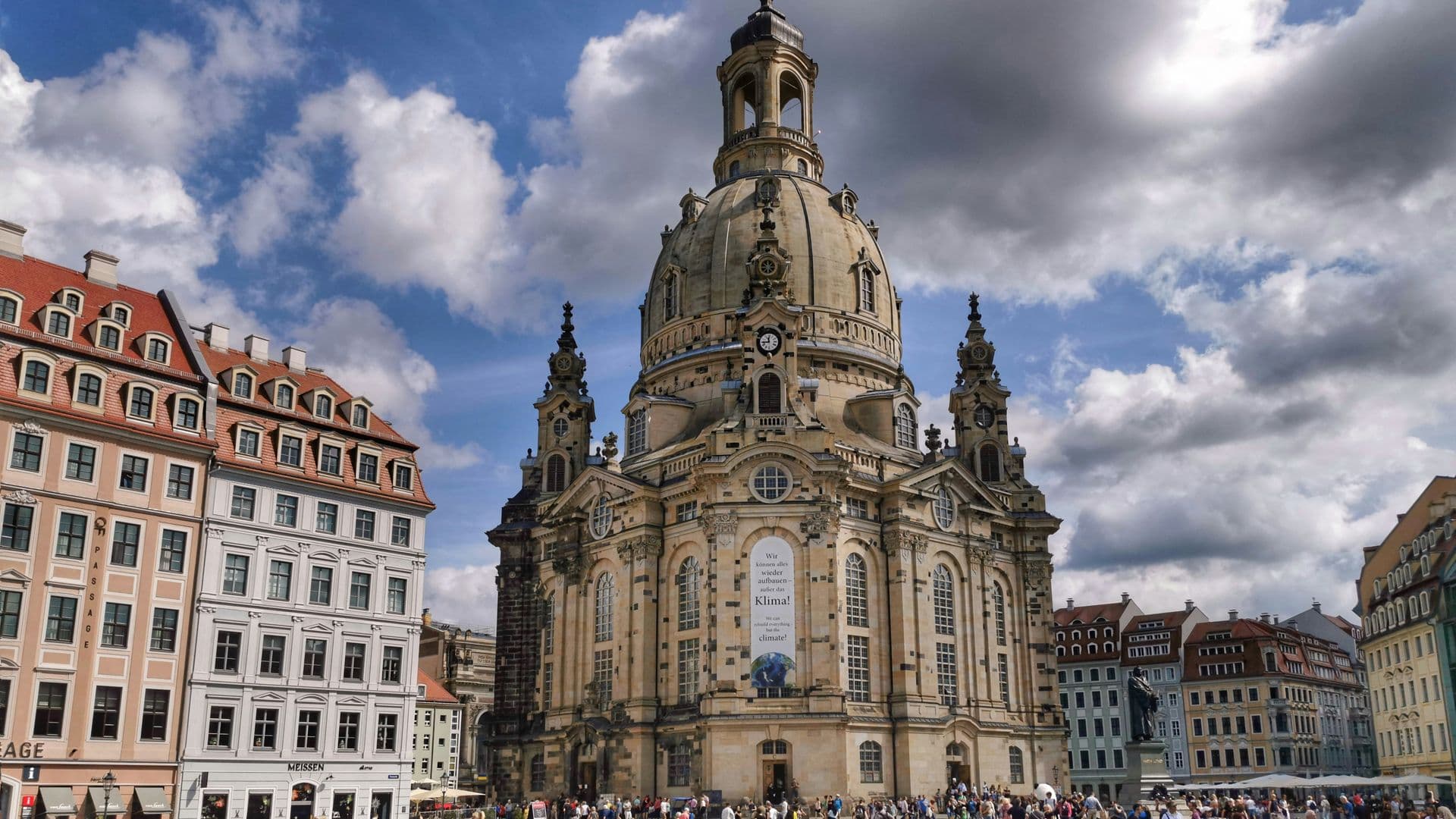
The Frauenkirche (Church of Our Lady) is the most powerful symbol of Dresden's destruction and reconstruction. The original church, a Lutheran Baroque masterpiece designed by George Bähr and completed in 1743, featured a massive stone dome that was an engineering marvel of its era — the largest stone dome north of the Alps.
On 15 February 1945, two days after the main bombing raid, the damaged dome collapsed. The ruins were left standing as a war memorial throughout the entire East German period — a deliberate pile of blackened rubble in the centre of the city, undisturbed for 45 years. After German reunification, a citizens' initiative raised funds to rebuild the church using as much original material as possible.
The reconstruction took from 1994 to 2005. Workers catalogued thousands of original stones from the rubble pile, numbering each one and fitting it back into its original position like a three-dimensional jigsaw puzzle. The result is extraordinary: the exterior is a patchwork of dark original stones and lighter new sandstone, creating a visual map of destruction and recovery. Over time, the new stones will darken to match the originals, and the distinction will disappear — but for now, the building wears its history on its surface.
Insider detail: The gold cross on top of the dome was funded by the British people — specifically by the "Dresden Trust" established in the UK. It was crafted by Alan Smith, a British silversmith whose father had been one of the bomber pilots in the 1945 raid. The gesture of reconciliation is genuine and moving, and it's a detail that guides mention but plaques don't adequately convey.
Brühl's Terrace — The Balcony of Europe
Brühl's Terrace (Brühlsche Terrasse) is an elevated promenade along the south bank of the Elbe, originally part of the city's fortifications and later converted into a private garden by Count Heinrich von Brühl, the chief minister to Augustus III. Goethe called it "the Balcony of Europe," and the name stuck.
The terrace offers a panoramic view across the Elbe to the Neustadt (New Town) on the opposite bank. Walking along it, you pass the Academy of Fine Arts with its distinctive glass dome (locals call it "the lemon squeezer"), the Albertinum art museum, and a row of stately buildings that survived or were rebuilt after the war.
The staircase descending from the terrace to the riverbank passes through the Kasematten — the original fortification tunnels from the 16th century, which are open as a small museum. The contrast between the elegant promenade above and the military architecture below captures Dresden's layered identity.
The Semperoper — One of Europe's Great Opera Houses
The Semperoper (Semper Opera House) sits at the edge of the Theaterplatz, facing the Zwinger. Designed by Gottfried Semper and completed in 1878 (after an earlier version burned), it's one of the most prestigious opera houses in Europe, home to the Sächsische Staatsoper (Saxon State Opera) and the Staatskapelle Dresden, one of the oldest orchestras in the world, founded in 1548.
The exterior is Italian Renaissance in style; the interior is lavish — gilded balconies, painted ceilings, and acoustic engineering that still impresses sound engineers today. Guided tours run daily when no rehearsals are in progress. If you happen to be in Dresden on an evening when a performance is scheduled, tickets are worth pursuing — the experience of hearing opera or symphony in this room is different in kind from most concert halls.
The Green Vault — Augustus's Treasury
The Grünes Gewölbe (Green Vault) is Augustus the Strong's treasury collection, housed in the Residenzschloss (Royal Palace). It's divided into two sections:
The Historic Green Vault displays objects in their original Baroque room settings — no glass cases, no labels, just room after room of gold, silver, jewels, ivory, and amber arranged as Augustus intended. The centrepiece is the Court of the Grand Mughal of Delhi, a table-sized sculptural scene made from 5,223 individual pieces, including 4,909 diamonds, by court jeweller Johann Melchior Dinglinger. It took seven years to complete.
The New Green Vault presents individual masterpieces in modern museum cases with detailed explanations. The star piece is the Dresden Green Diamond, a 41-carat natural green diamond that is one of the rarest gemstones in the world.
Timed entry tickets for the Historic Green Vault sell out days or weeks in advance. If this interests you, book online well before your trip. The New Green Vault is easier to access but still busy on weekends.
Insider detail: In November 2019, thieves broke into the Historic Green Vault and stole 21 items of jewellery, including diamond-encrusted epaulettes and a sword hilt with 770 diamonds. It was one of the most brazen art thefts in European history. Most of the stolen pieces were recovered in 2022 after the suspects — members of a Berlin crime clan — were arrested. The recovered items are being restored and gradually returned to display.
The Neustadt — Dresden's Other Side
Cross the Augustusbrücke (Augustus Bridge) and you're in the Neustadt (New Town), which despite its name contains some of Dresden's oldest surviving buildings — the Baroque core here actually survived the 1945 bombing better than the Altstadt.
The Outer Neustadt (Äußere Neustadt) is Dresden's creative quarter — independent shops, cafés, street art, and a nightlife scene that rivals much larger cities. The contrast with the Baroque grandeur across the river is stark and deliberate. If you have time for lunch and want something less formal than the Altstadt tourist restaurants, the Neustadt is where locals eat.
Look for the Kunsthofpassage — a series of interconnected courtyards where the buildings are decorated with whimsical art installations. One building has a rain-activated musical facade: when it rains, water flows through a system of gutters and funnels that plays music. It's the kind of detail that doesn't appear in most guidebooks.
WWII — The Bombing and Its Legacy
The bombing of Dresden on 13-15 February 1945 remains one of the most debated events of the war. British and American bombers launched a series of raids that created a firestorm in the city centre, destroying approximately 1,600 acres of the historic core. The stated military objective was to disrupt communications and logistics supporting the Eastern Front — Dresden was a major rail junction and industrial centre. The civilian death toll, long disputed, is now estimated by historians at approximately 22,700-25,000.
The ethical debate hasn't ended. Was the bombing militarily justified, or was it disproportionate destruction of a cultural centre with diminishing strategic value in the final months of the war? Dresden's reconstruction answers the question differently than words could — by rebuilding exactly what was lost, the city makes its own argument about what was destroyed.
Walking through the Altstadt, the mix of dark and light stone on every major building is a constant, quiet reminder. The city doesn't hide its scars. It incorporates them.
A Suggested Day in Dresden
For a day trip from Prague, here's a realistic itinerary:
8:00 AM: Depart Prague (train or car) 10:00-10:15 AM: Arrive in Dresden. Walk from Hauptbahnhof to the Altstadt (15 minutes) 10:30 AM: The Zwinger — courtyards, Kronentor, and the Old Masters Gallery (1.5-2 hours) 12:30 PM: Lunch in the Altstadt or cross to the Neustadt for something less touristy 1:30 PM: Frauenkirche — exterior, interior, and the panoramic view from the dome (45 minutes) 2:30 PM: Brühl's Terrace and a walk along the Elbe 3:15 PM: Residenzschloss — Green Vault if you have advance tickets, or the Semperoper guided tour 5:00 PM: Neustadt — Kunsthofpassage and coffee 6:00-6:30 PM: Depart Dresden 8:15-8:30 PM: Arrive back in Prague
This is a full day but entirely manageable. The key sights are clustered within a 15-minute walk of each other in the Altstadt.
Dresden Day Trip — Let Us Handle the Logistics
Dresden pairs naturally with Prague — the two cities share a river, a border, and centuries of intertwined history. A day in Dresden adds a German perspective to your Central European trip without the complexity of a separate booking.
Contact us to arrange a custom private day trip to Dresden from Prague. We handle transport (private car or first-class rail), coordinate museum entries, and provide local context that connects Dresden's story to what you've seen in Prague. Exclusively yours, with your own guide.
Before or after your Dresden day, our All Prague in One Day private tour covers Prague's essential landmarks in a single walk. And for an evening that's unlike anything in Dresden — a medieval dinner at U Pavouka Tavern in Prague, with fire dancers, sword fights, and a feast eaten with your hands — it's the perfect counterpoint to a day of Baroque refinement.
Browse all our private tours from Prague.
Frequently Asked Questions
How long does it take to get from Prague to Dresden?
About 2 hours 15 minutes by direct train, or approximately 1.5 hours by car via the D8/A17 motorway. Both routes follow the Elbe valley through attractive scenery. Both countries are in the Schengen Area, so there are no border stops or passport checks.
Is Dresden worth a day trip from Prague?
If you have any interest in Baroque architecture, art galleries, or WWII history, absolutely. The Zwinger, Frauenkirche, and Green Vault are world-class attractions, and the story of the city's destruction and reconstruction is genuinely moving. You can see the essential sights in 6-7 hours on the ground.
Do I need euros in Dresden?
Yes — Germany uses the euro, not Czech crowns. ATMs are widely available at Dresden Hauptbahnhof and throughout the Altstadt. Credit cards are accepted at museums, restaurants, and most shops, though some smaller German establishments still prefer cash. See our day trips guide for more border-crossing tips.
Do I need a passport for Prague to Dresden?
Technically yes — you should carry valid ID when crossing an international border, even within the Schengen Area. In practice, there are no border checkpoints on the Prague-Dresden route. Police can conduct random checks, but this is rare. Carry your passport or national ID card.
What is the best museum in Dresden?
The Old Masters Picture Gallery in the Zwinger is the single strongest museum — Raphael's Sistine Madonna, Vermeer, Rembrandt, and Titian in a magnificent Baroque setting. If you prefer decorative arts, the Historic Green Vault in the Residenzschloss is extraordinary, but requires advance-booked timed entry tickets.
You May Also Like
Want to see Prague for yourself?
Experience Český Krumlov on our day trip