Křivoklát Castle — A Gothic Fortress in Bohemia's Ancient Forests
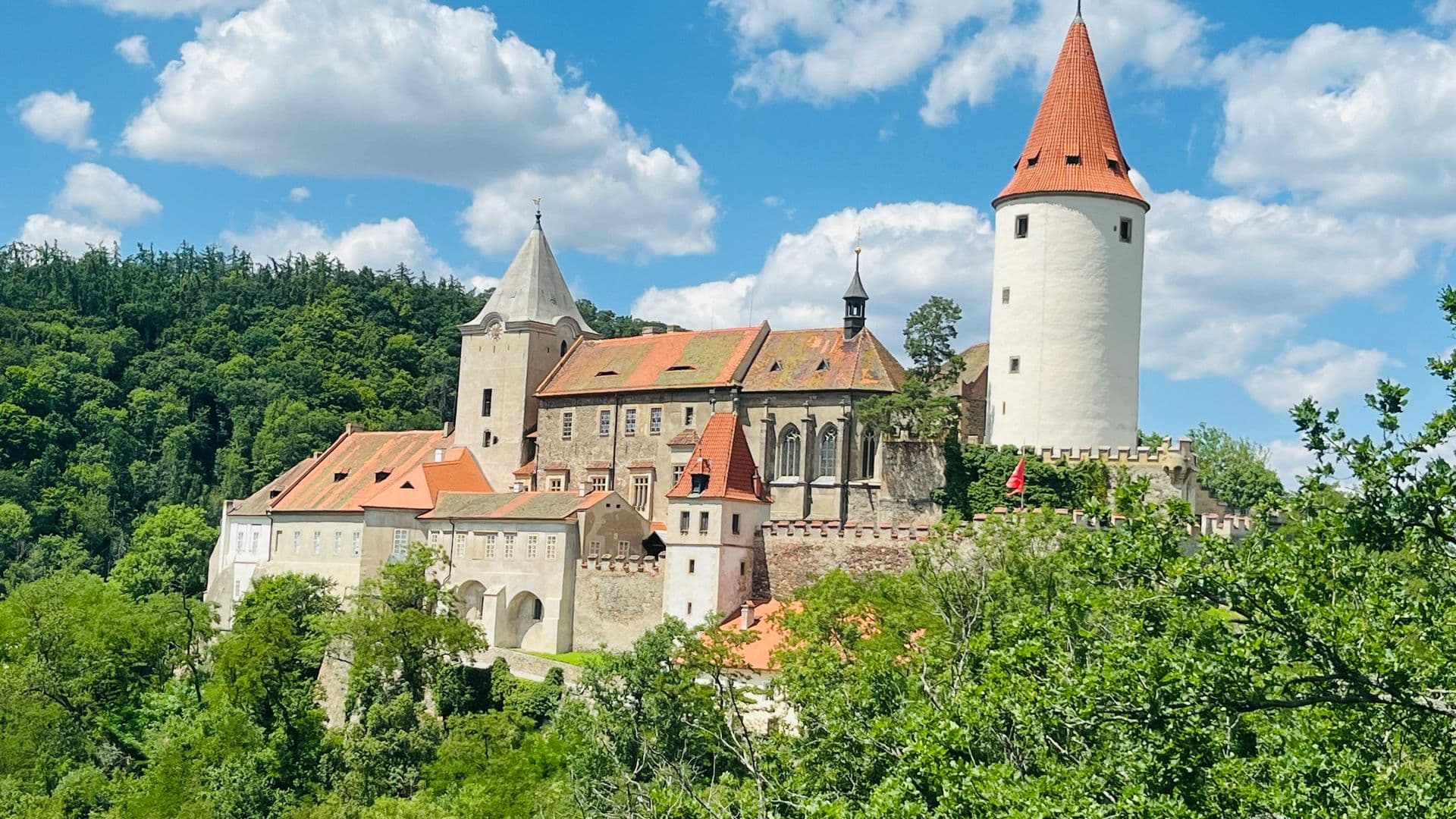
Křivoklát Castle sits on a rocky promontory above the Rakovnický potok stream, surrounded by some of the oldest continuous woodland in Central Europe. The forests around it are not a backdrop — they are the reason the castle exists. Czech kings chose this site in the 12th century precisely because the deep woods west of Prague were their best hunting grounds, and Křivoklát began as a royal hunting lodge before growing into one of the most significant Gothic castles in Bohemia. It stands about 60 kilometres west of Prague, roughly a 90-minute drive through rolling countryside that looks nothing like the rest of the tourist circuit.
We recommend Křivoklát to guests who've already seen Karlštejn and want something different. Where Karlštejn is compact and vertical — a treasury fortress designed to protect crown jewels — Křivoklát sprawls across its hilltop like a place where people actually lived, hunted, and held court for centuries. The castle is less polished, less visited, and more atmospheric. On a weekday morning, you might be one of a handful of visitors walking the Great Tower's spiral staircase, and the surrounding forest trails are quieter still.
From Hunting Lodge to Royal Seat
The earliest fortification on the Křivoklát site dates to the 12th century, when the Přemyslid dynasty established a network of royal castles in the Central Bohemian woodlands. The original structure was timber and stone, modest by later standards. It was King Přemysl Otakar II who began expanding it in the mid-13th century into something more substantial — stone walls, a great hall, and the beginnings of the massive round tower that still dominates the complex.
The castle's golden age came under the Jagellonian kings in the late 15th and early 16th centuries. King Vladislav II Jagello invested heavily in renovations, adding the Late Gothic chapel (one of the finest in the Czech Republic), the Great Hall with its elaborate rib-vaulted ceiling, and the castle's most striking architectural details. The chapel contains a carved wooden altarpiece and stone tracery that would be the centerpiece of any Prague church. Here, it sits in relative obscurity, seen by a fraction of the visitors who crowd St. Vitus Cathedral.
Fire damaged Křivoklát severely in 1643, and the castle passed through various hands — the Fürstenberg family owned it for much of the 18th and 19th centuries and kept it from total ruin. A restoration programme beginning in the late 19th century stabilized the structures, and the castle became state property after World War II. Today, it operates as a museum and is open to the public from spring through autumn.
One dark chapter: Křivoklát served as a prison at various points in its history. The round tower's lower levels held cells where political prisoners and accused heretics were confined. The prison exhibition in the tower includes original instruments of punishment — a sobering contrast to the elegant chapel and great hall above.
The Castle Interior — What You See Inside
A guided tour of Křivoklát typically covers the Great Hall, the Royal Chapel, the castle library, the prison tower, and the hunting gallery. The experience is markedly different from Prague's more manicured castle interiors.
The Great Hall is the largest secular Gothic hall in the Czech Republic outside Prague. The rib-vaulted ceiling spans an impressive width, supported by columns that have stood since the Jagellonian renovation. The hall was used for royal audiences, banquets, and occasionally as a courtroom. Today, the walls display hunting trophies and period weapons, reinforcing the castle's identity as a seat of royal hunts.
The Royal Chapel is Křivoklát's jewel. The Late Gothic stone tracery, the carved altarpiece, and the delicate painted ceiling create an interior of real beauty. If you appreciate Gothic architecture, this chapel alone justifies the trip. The quality of the stonework is extraordinary — the window tracery has a lightness that seems to defy the heavy stone walls around it.
The Great Round Tower served multiple purposes over the centuries — watchtower, prison, storehouse. The lower levels now house the prison exhibition, while the upper galleries contain the castle's hunting collection. The climb to the top offers views over the surrounding forests that stretch unbroken to the horizon.
The Library holds a significant collection of early printed books and manuscripts. The room itself — wood-paneled, intimate, with reading desks that look as though someone just stepped away — conveys the intellectual side of castle life that's easy to forget when surrounded by armor and antlers.
The Forests Around Křivoklát — UNESCO Biosphere Reserve
The landscape surrounding Křivoklát Castle is the Křivoklátsko Protected Landscape Area, covering roughly 628 square kilometres of forests, river valleys, and limestone cliffs in Central Bohemia. Křivoklátsko has been a UNESCO Biosphere Reserve since 1977, and the designation recognizes the area's exceptional biodiversity — the mix of beech, oak, and fir forests supports plant and animal species found nowhere else in the Czech Republic in such concentration.
This is not manicured parkland. The forests are dense, old, and wild by Central European standards. Hiking trails wind through valleys where the Berounka River and its tributaries have carved deep gorges into the limestone bedrock. In spring, the forest floor erupts with wildflowers — hepatica, primrose, and several orchid species that thrive in the alkaline soils. In autumn, the beech forests turn copper and gold in a display that rivals any in the country.
Several marked hiking trails begin directly from the castle or the nearby town of Křivoklát. The most popular follows the Rakovnický potok valley downstream to the village of Roztoky, about 7 kilometres through forest with almost no elevation change — an easy walk suitable for families. A more challenging route follows the ridge above the Berounka River to the ruins of Jenčov Castle, offering views down into the river gorge. Allow three to four hours for this circuit.
The forests are home to red deer, wild boar, European badger, and a variety of raptors including the black stork. Birdwatchers visit Křivoklátsko specifically for species that have disappeared from more developed parts of the country. The quieter you are and the earlier you walk, the more you'll see.
The Town of Křivoklát
The small town below the castle has a handful of restaurants, a few pensions, and the kind of unhurried pace that larger tourist destinations lost decades ago. This is not Český Krumlov — there are no crowds, no souvenir shops lining every street, no tour buses idling in parking lots. Křivoklát feels like a place that exists for the people who live there, with the castle as a natural focal point rather than a commercial attraction.
For lunch, the restaurant U Jelena (or similar establishments near the castle entrance) serves straightforward Czech food — roast duck, svíčková, grilled trout from the local streams. Portions are generous, prices are well below Prague levels, and the beer is likely from a regional Bohemian brewery rather than a global brand. On a warm day, sitting on a terrace with the castle tower above and the forest beyond is the kind of quiet pleasure that a packed Prague beer garden can't offer.
The Křivoklát train station sits in the valley below the town, connected by a steep but short walk. The journey by train from Prague passes through the Berounka valley — one of the prettiest rail routes in the Czech Republic, following the river through gorges and past small villages that seem untouched by the 21st century.
Insider Details Worth Knowing
The castle hosts medieval festivals. Several times a year, Křivoklát holds themed events — medieval markets, falconry displays, night tours by torchlight. The largest is usually in June or September. These events draw Czech families and history enthusiasts but remain far smaller than Prague's tourist events. Check the castle's website for the current schedule.
The acoustics in the Royal Chapel are extraordinary. The vaulted stone space was designed for liturgical chanting, and it amplifies sound in a way that modern rooms cannot replicate. Occasionally, the castle hosts small concerts in the chapel. If one coincides with your visit, it's worth rearranging your schedule.
The prison exhibition is graphic but historically important. The instruments of punishment on display are original, and the exhibition doesn't soften the reality of medieval justice. If you're visiting with young children, use your judgment — some of the displays are vivid.
Spring and autumn are the best times to visit. Summer weekends bring Czech day-trippers, though the crowds are modest by Karlštejn standards. May and September offer warm weather, fewer visitors, and the forests at their most beautiful — spring wildflowers or autumn color, depending on the month.
The combination of castle and forest makes Křivoklát a genuine full-day trip. Unlike Karlštejn, where you can see the castle and be back in Prague by lunch, Křivoklát rewards a slower pace. Tour the castle in the morning, eat in the town, walk a forest trail in the afternoon. This is a gothic castle near Prague that earns its full day.
Getting to Křivoklát from Prague
By car: Take the D5 motorway toward Plzeň, exit toward Beroun, then follow road 116 northwest through the Berounka valley. The drive takes about 90 minutes depending on traffic. Parking is available in the town below the castle.
By train: Trains run from Praha hlavní nádraží (Prague main station) to Beroun, where you change for a local train to Křivoklát station. The total journey takes roughly 90 minutes to two hours. The second leg — the Beroun-to-Křivoklát section — follows the Berounka River through forested gorges and is one of the most scenic short rail journeys in Bohemia. From the station, it's a 15-minute uphill walk to the castle.
By private transfer: For most of our guests, a comfortable car with your licensed guide is the most comfortable option. We handle the logistics, the vehicle waits while you explore, and you have the flexibility to stop at points of interest along the route — the Berounka valley viewpoints, the village of Nižbor with its traditional glass workshop, or a riverside lunch spot.
Experience It With a Private Guide
Křivoklát is not a standard tour we list on our website — it's a custom day trip that we arrange for guests who want to go beyond Prague's usual circuit. Contact us to plan a private day trip to Křivoklát, and we'll build an itinerary that matches your interests — castle history, forest hiking, river valley scenery, or all three. Exclusively yours, with your own guide, and a day outside Prague that shows you a completely different side of Bohemia.
If you've already visited Karlštejn Castle and Konopiště Castle, Křivoklát is the natural next step — less visited, more atmospheric, and set in a landscape that makes the other two seem almost suburban by comparison.
Back in Prague, continue the medieval theme with the Medieval Dinner Show at U Pavouka Tavern — a candlelit feast with fire dancers, sword acts, and food served the way a Bohemian banquet would have been in the castle's heyday.
For more ideas beyond the city, see our complete guide to day trips from Prague.
Frequently Asked Questions
How far is Křivoklát Castle from Prague?
About 60 kilometres west of Prague, roughly 90 minutes by car or train. The castle sits in the Křivoklátsko Protected Landscape Area in Central Bohemia — not to be confused with the Šumava (Bohemian Forest) region, which is 200 kilometres further southwest.
Is Křivoklát Castle worth visiting?
If you appreciate Gothic architecture, medieval history, or forest landscapes, yes. Křivoklát is less polished than Karlštejn but more atmospheric — a royal castle that feels genuinely old, set in ancient woodland rather than a tourist village. The Royal Chapel alone is one of the finest Late Gothic interiors in the Czech Republic.
When is Křivoklát Castle open?
The castle is open from April through October, with the fullest schedule from May through September. Shoulder months have reduced hours and fewer guided tour times. The castle is closed Mondays except in July and August. Winter visits are possible only on select dates or by special arrangement.
Can I combine Křivoklát with hiking?
Absolutely. The Křivoklátsko Protected Landscape Area offers well-marked trails ranging from easy riverside walks to full-day ridge hikes. The most accessible trail follows the Rakovnický potok valley from the castle to Roztoky (about 7 km, flat terrain). For a castle-plus-hike day, plan to arrive in the morning, tour the castle, eat lunch in town, and hike in the afternoon.
How does Křivoklát compare to Karlštejn?
Karlštejn is a compact fortress built to store crown jewels — vertical, dramatic, heavily restored. Křivoklát is a sprawling royal hunting castle — horizontal, atmospheric, with more original fabric intact. Karlštejn is closer to Prague (30 km vs 60 km) and far busier. Křivoklát rewards visitors who want depth over convenience. Both are worth seeing, ideally on separate days.
You May Also Like
Want to see Prague for yourself?
Visit Prague Castle on our tour