Visiting Terezín Memorial — What to Expect and How to Prepare
The drive from Prague to Terezín takes about an hour. For most of that hour, the landscape is ordinary — fields, petrol stations, the flat stretch of Bohemia north toward the Ústí nad Labem region. Then you arrive, and the scale of the fortress walls becomes visible from the road.
Our guests often go quiet at this point. That shift — from the casual rhythm of a day trip to the weight of what you're about to see — is something worth acknowledging before you go.
Terezín Memorial is one of the most important Holocaust remembrance sites in Central Europe, and visiting it well requires some preparation. This guide covers what Terezín actually was, what you'll see at each part of the memorial, and how to plan a visit that gives you enough time and emotional space to absorb it properly.
What Terezín Was — and What It Was Not
Terezín was not a death camp. Understanding this distinction matters, because the reality of what happened here is its own kind of horror — different from Auschwitz, but no less significant.
The fortress town was built in the 1780s by Emperor Joseph II as a military fortification, named after his mother, Empress Maria Theresa. It consists of two parts: the Main Fortress (Hlavní pevnost), which is the walled town itself, and the Small Fortress (Malá pevnost), a separate compound across the river.
In November 1941, the Nazis repurposed the Main Fortress as a transit ghetto — officially called Theresienstadt. The existing Czech population was expelled, and over the next three and a half years, more than 150,000 Jews from Czechoslovakia, Germany, Austria, the Netherlands, and Denmark were transported here. The town, built for a garrison of a few thousand, held up to 58,000 people at its peak. Around 33,000 died in the ghetto itself — from disease, starvation, and the conditions of extreme overcrowding.
But the most insidious aspect of Terezín was its propaganda function. The Nazis presented it to the outside world as a "model Jewish settlement" — a place where Jews supposedly lived in relative comfort. In 1944, they produced a propaganda film and staged a visit by the International Red Cross, with inmates forced to participate in the deception. Shops, cafes, and cultural events were arranged for the cameras.
Weeks after filming ended, transports to Auschwitz resumed. Of the roughly 87,000 people deported east from Terezín, fewer than 4,000 survived.
The Small Fortress
Most visitors begin at the Small Fortress, which served as a Gestapo prison from 1940 onward. This is the part of Terezín that leaves the strongest immediate impression.
You enter through the infamous gate bearing the words "Arbeit macht frei" — the same cynical slogan used at Auschwitz. Inside, the complex is a maze of courtyards, cell blocks, dormitories, and isolation cells. The corridors are narrow and damp. Even on a warm day, the stone walls hold a chill that visitors notice immediately.
The solitary confinement cells are particularly difficult to stand in. Some are barely wide enough for one person to lie down. The execution grounds at the rear of the fortress are marked, and the swimming pool built for SS guards sits just metres from the prisoners' quarters — a detail that tends to stop people in their tracks.
We walk through the Small Fortress slowly with our guests. The audio guide is well-produced, but having a guide who can answer questions and provide context in the moment makes a real difference here. Guests often need to pause, and that should be completely fine.
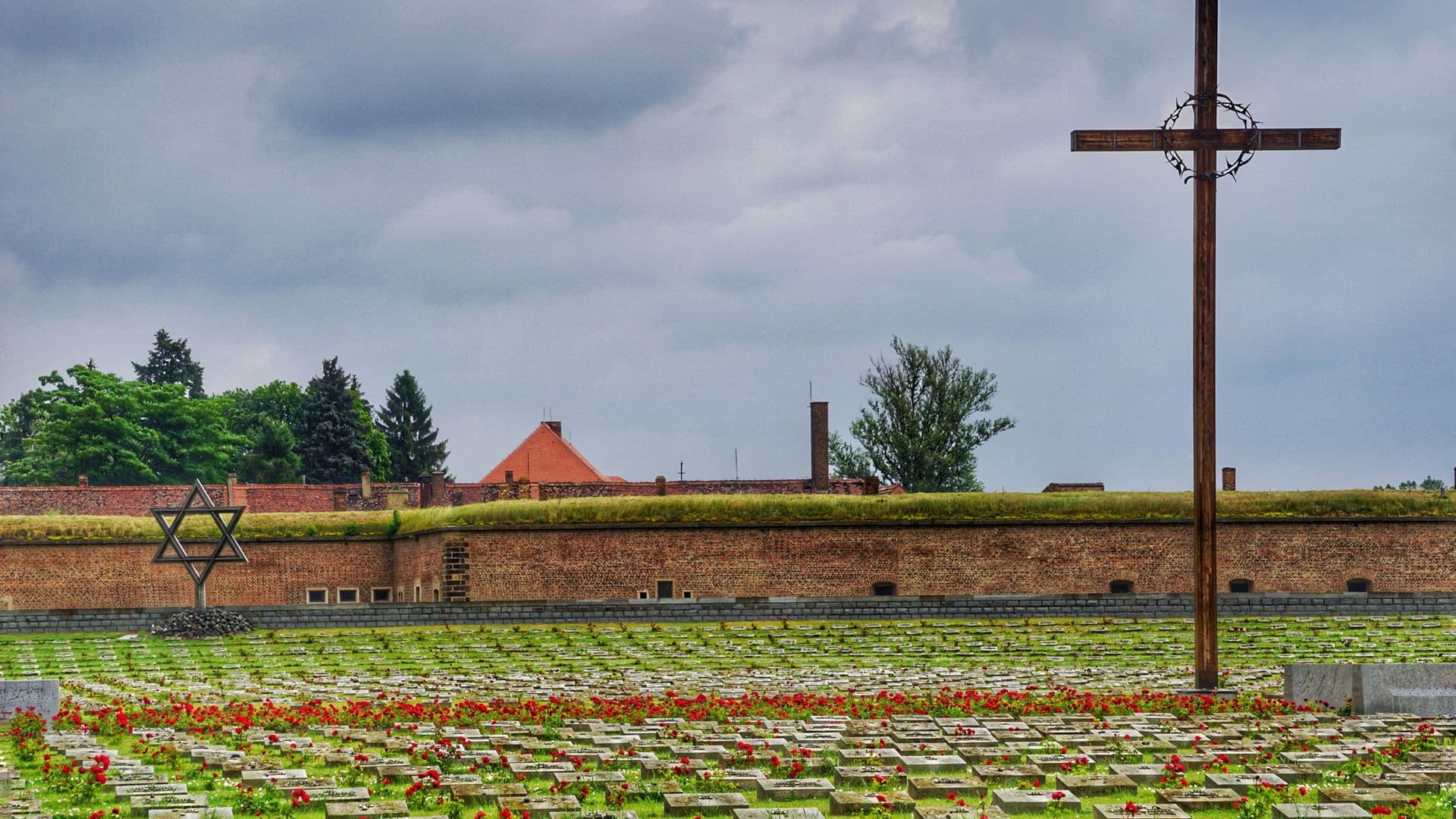
The National Cemetery sits in front of the Small Fortress, established after liberation in 1945. Rows of graves stretch across a grass field, many marked only with the Star of David. It's the first thing you see when arriving and often the last image visitors carry home.
The Ghetto Museum
The Ghetto Museum occupies a former school building in the Main Fortress area — the walled town itself. The permanent exhibition traces the full history of Terezín as a ghetto: the transports, daily life, the self-governance structure the Nazis imposed on inmates, and the cultural life that persisted despite everything.
What strikes most visitors is the artwork. Imprisoned artists documented conditions secretly, at enormous personal risk. Drawings by Bedřich Fritta, Leo Haas, and others survived the war hidden in walls and buried underground. These are not abstract expressions — they show emaciated figures, crowded barracks, funeral carts.
When the Nazis discovered some of this work, several artists were sent to Auschwitz.
The children's drawings are in a separate section. Over 15,000 children passed through Terezín. Educators organized clandestine lessons and encouraged the children to draw. Around 4,500 of these drawings survived.
The contrast between the bright colours of a child's painting and the subject matter — trains, barbed wire, people being counted — is one of the most emotionally difficult experiences in any European museum.
Allow at least 45 minutes for the Ghetto Museum. Visitors who move through quickly tend to regret it afterward. The material asks for slow reading.
The Magdeburg Barracks
Across the town square from the Ghetto Museum, the Magdeburg Barracks hold a separate exhibition focused on the cultural and intellectual life inside the ghetto. This is where the story becomes almost paradoxically complex.
Despite the conditions, Terezín had an extraordinary cultural scene. Composers wrote operas and chamber music. Poets gave readings. Lecturers organized talks on philosophy, science, and literature.
The children's opera Brundibár, composed by Hans Krása, was performed 55 times inside the ghetto. Krása was later murdered at Auschwitz.
The Magdeburg Barracks recreate a dormitory room to show living conditions — triple-stacked bunks, a few square metres per person, minimal possessions. Upstairs, the exhibition includes manuscripts, theatre programmes, and musical scores. The quality of the cultural work is remarkable, and the fact that it was produced under those circumstances raises questions about human resilience that don't have easy answers.
Our guests who are musicians or artists tend to spend the longest time here. The room with the musical scores is small and easy to overlook, but it contains some of the most powerful material in the entire memorial.
The Columbarium and Crematorium
South of the town centre, set slightly apart, is the Columbarium — a former military storage space used to hold urns of the dead. At one point it contained thousands of urns. In November 1944, the Nazis dumped the ashes into the Ohře River to destroy evidence of the death toll. The space is now empty, and that emptiness is the point.
Nearby stands the Crematorium, built in 1942 when the original burial capacity was overwhelmed. The ovens are preserved. Visiting this space is optional — the memorial clearly signposts it — and some visitors choose to skip it.
That's a reasonable choice. For those who enter, the room is small, clinical, and very quiet.
This day trip is best with a guide who handles the logistics and storytelling. Meet our team.
A Jewish cemetery is also located in this area, one of the few in the Czech Republic established during the war. The headstones are modest, and the ground is uneven. It receives fewer visitors than the Small Fortress, which means you'll likely be there alone.
Practical Information
How long to allow: Plan for four to five hours. This gives you enough time to visit the Small Fortress, the Ghetto Museum, the Magdeburg Barracks, and the Columbarium without feeling rushed. Visitors who try to compress it into two hours leave feeling they missed important parts.
Getting there: Terezín is roughly 60 kilometres north of Prague, near the town of Litoměřice. The drive takes about one hour. Public buses run from Prague's Holešovice station, but the schedule is limited and the walk from the bus stop to the memorial sites covers some distance. A private transfer gives you control over timing and the ability to pause between sites.
What to bring: Comfortable shoes — you'll walk several kilometres across cobblestones, gravel, and grass. Water and a light snack, as the café options inside Terezín are limited. A jacket even in summer — the Small Fortress interior stays cool.
Photography: Allowed in most outdoor areas and some interior spaces. The Ghetto Museum and Magdeburg Barracks have specific sections where photography is restricted. Signs are posted clearly. We recommend putting the phone away for portions of the visit and simply being present.
With children: Families do visit Terezín, and the children's art exhibition in the Ghetto Museum can be a meaningful starting point for conversations about history. For children under ten, the Small Fortress cells and crematorium may be overwhelming. Parents know their children best, but it's worth thinking through in advance.
Emotional preparation: This is not a day trip that ends with a cheerful lunch. Some of our guests have family connections to the Holocaust. Others come with no personal link but want to understand this chapter of European history. Either way, the visit asks something of you.
We've found that guests who read a little about Terezín beforehand — even a few pages — feel more grounded during the visit. The memorial's own website is a good starting point.
The Town Itself
Between the memorial sites, you'll walk through the streets of Terezín as it exists today. The town is still inhabited, with a population of around 2,800. The contrast between ordinary daily life — people walking dogs, children on bicycles — and the memorial plaques on nearly every building is disorienting in a way that feels important.
The town square is large and mostly empty. The buildings are pastel-coloured, Habsburg-era military architecture. On a quiet weekday morning, you can stand in the centre of the square and see almost no one. It's easy to imagine the same space filled with tens of thousands of people, and that's precisely what the memorial invites you to do.
There is a small information centre near the main square, and a few modest restaurants in Litoměřice, the neighbouring town just a few minutes north. Litoměřice itself is a pleasant Baroque town on the Elbe River, and stopping there for lunch after your visit provides a natural transition.
Experience It With a Private Guide
Terezín is the kind of place where context changes everything. The memorial sites are well-documented, but walking through them with someone who can explain the layers — the Habsburg military history, the Nazi propaganda strategy, the individual stories behind the artwork — gives the visit a depth that self-guided tours rarely achieve.
On our private Terezín Memorial tour, we handle transport from your Prague hotel and guide you through the full memorial at a pace that respects both the subject and you. Exclusively yours. The drive back to Prague gives you time to process what you've seen, and our guides are comfortable with silence when that's what's needed.
If you're building a longer Prague itinerary, our All Prague in One Day private tour covers the city's major landmarks on a separate day. For a lighter evening after a heavy day, a medieval dinner at U Pavouka Tavern offers something entirely different — fire shows, swordplay, and a feast served without cutlery.
Browse all our private tours from Prague.
Frequently Asked Questions
Is Terezín the same as a concentration camp?
Terezín functioned primarily as a transit ghetto and holding camp, not an extermination camp like Auschwitz or Treblinka. The Small Fortress was a Gestapo prison. Tens of thousands died here from disease and starvation, and approximately 87,000 were deported to death camps in the east. The distinction matters historically, though the suffering was immense in both contexts.
How long does a visit to Terezín take?
Allow four to five hours to see the main sites — the Small Fortress, Ghetto Museum, Magdeburg Barracks, and Columbarium. Visitors who rush through in two hours often feel they missed important parts of the story. A full half-day from Prague, including travel, is realistic.
How do I get to Terezín from Prague?
Terezín is about 60 kilometres north of Prague, roughly one hour by car. Public buses depart from Prague's Holešovice station, but service is infrequent and the walk between memorial sites adds distance. A private transfer or guided tour gives you the most flexibility.
Is Terezín appropriate for children?
Families do visit, and the children's art exhibition in the Ghetto Museum can be a meaningful educational experience. For younger children, the Small Fortress isolation cells and the crematorium may be difficult. Consider your child's age and sensitivity, and prepare them with a conversation beforehand.
Do you need a guide to visit Terezín?
You can visit independently — the memorial sites are well-signposted and an audio guide is available at the Small Fortress. However, having a knowledgeable guide adds significant context, particularly around the propaganda history and the stories behind individual artworks in the museum.
You May Also Like
Want to see Prague for yourself?
Visit Terezín Memorial with our guide