Hradčany Square — What to See Before You Enter Prague Castle
Almost every visitor to Prague Castle walks across Hradčanské náměstí without stopping. They pass through the honour guard at the gate, snap a photo of the first courtyard, and head straight inside. What they miss is one of the most architecturally complete squares in Central Europe — three palaces, a baroque plague column, and a view back toward Old Town that rivals anything inside the castle walls.
We start our private castle tours on this square for a reason. The buildings here tell the story of who held power in Prague — the Church, the Habsburgs, the Italian nobility — and how they competed to build the grandest facades. Spending fifteen minutes on Hradčany Square before entering the castle gives everything inside it more context.
The Square — What You Are Looking At
Hradčanské náměstí is a wide, sloping plaza directly in front of the main castle entrance. It was the centre of Hradčany, which was originally a separate town founded in 1320 and not incorporated into Prague until 1784. The square functioned as a marketplace and gathering point for the castle's surrounding community.
At its centre stands the Marian Plague Column, erected between 1724 and 1736 to give thanks for the end of the devastating bubonic plague of 1713-1714. The column is topped with a statue of the Virgin Mary and flanked by figures of eight saints, including St. Wenceslas, St. Jan Nepomucký, and St. Vojtěch. Open-air prayers were held on this exact spot during the epidemic, and the column marks where the altar stood.
The square is ringed by three major palaces — Schwarzenberg, the Archbishop's Palace, and Tuscany Palace — each representing a different era and patron. Together, they form an ensemble that most visitors photograph but few can explain. We can.
Schwarzenberg Palace — The Sgraffito Facade
The Schwarzenberg Palace dominates the southern side of the square with a facade unlike anything else in Prague. Every surface is covered in sgraffito — a Renaissance decorative technique where a dark base layer of plaster is coated with a lighter top layer, then the top is scratched away to reveal geometric patterns beneath. The effect creates an optical illusion of three-dimensional diamond-shaped stone blocks across the entire wall.
The palace was built between 1545 and 1576 for the Lobkowicz family, designed by Italian master builder Agostino Galli. The sgraffito was completed in 1567, and while it has been restored multiple times, the original patterns remain faithful to the 16th-century design. The style is distinctly North Italian and Venetian — a reminder that Prague's Renaissance architecture was shaped by Italian builders and craftsmen who migrated north.
Today the palace houses a branch of the National Gallery Prague, with a collection focused on Bohemian Baroque art and Old Masters. Inside you will find works by Rembrandt, Rubens, El Greco, and the Bohemian painter Petr Brandl. The collection is smaller and less crowded than the main National Gallery venues, which makes it a more rewarding visit for anyone who prefers looking at paintings without a tour group blocking the view.
Insider tip: the sgraffito catches the morning light best. If you arrive before 10 AM, the low sun rakes across the facade and the carved patterns cast tiny shadows that make the three-dimensional illusion far more dramatic. By midday, the flat overhead light flattens everything. Photographers — come early.
For more on Prague's architectural heritage, see our complete guide to Prague Castle.
Archbishop's Palace — The Rococo Facade You Cannot Enter
Directly opposite the castle entrance, the Archbishop's Palace presents an elegant rococo facade in pale cream and white. It has served as the seat of Prague's Catholic archbishops since 1562 and remains a working ecclesiastical residence — which means it is closed to the public nearly every day of the year.
The one exception is Maundy Thursday, the Thursday before Easter. On this single day, the palace opens its doors and visitors can see the Archbishop's private chapel, its 16th-century wall paintings, and a dramatic painting of the Crucifixion that hangs as the chapel's centrepiece. The Chapel of St. John the Baptist, with original stucco work, is the highlight. If your visit falls near Easter, it is worth adjusting your schedule for this rare opportunity.
The current rococo facade dates from a renovation in the 1760s by architect Jan Josef Wirch, replacing an earlier Renaissance exterior. The result is one of Prague's finest rococo compositions — soft curves, pastel tones, and decorative plasterwork that contrasts sharply with the Schwarzenberg Palace's hard-edged sgraffito across the square.
Insider tip: even when you cannot go inside, pause at the main portal. The wrought-iron gate is 18th-century work, and through it you can glimpse the interior courtyard. The palace is also one of the best backdrops for photographs of the castle guard — the soldiers stand directly in front of it.
Tuscany Palace — The Italian Corner
On the western side of the square, the Tuscany Palace (Toskánský palác) completes the architectural ensemble. Built around 1690 for Michael Oswald, Count Thun, it was later acquired by the Grand Duchess of Tuscany — hence the name. The design is attributed to French architect Jean Baptiste Mathey, with contributions from Italian builder Giacomo Antonio Canevalle.
The palace is early Baroque, with a more restrained facade than its neighbours. Its most distinctive features are two pavilions flanking the main entrance, rising above the roofline and connected by a terrace — an Italianate detail that gives the building a southern European character unusual for Prague. Along the roofline, seven statues by Jan Brokoff represent the Liberal Arts.
The Tuscany Palace now serves as the seat of the Czech Ministry of Foreign Affairs and is not open for regular public visits, though the ground floor occasionally hosts exhibitions and cultural events.
A private guide makes all the difference when exploring this part of Prague.
The View Looking Back
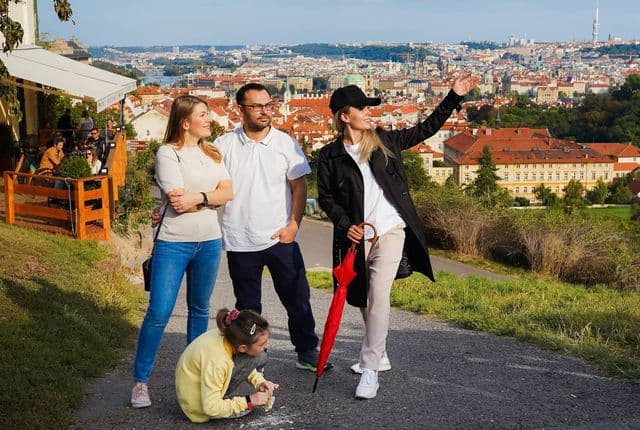
Before you walk through the castle gate, turn around. From the eastern edge of the square, you look down a long slope that descends through Nerudova street toward Malá Strana and the river. On clear days, you can see the Old Town skyline and the Žižkov Television Tower in the distance. This view is one of the reasons Hradčany was chosen as the seat of power — it commands the entire city.
The view also helps you understand Prague's geography. The castle sits on a long ridge above the Vltava, and everything below it — the Lesser Town, the bridges, the Old Town — spread out in layers. This perspective is something you lose once you enter the castle complex, where walls and courtyards close in around you.
Insider tip: the square is largely empty before 9 AM. The first large tour groups arrive around 9:30, and by 10 AM the space in front of the castle gate becomes crowded. If you want to experience the square in relative quiet, arrive early and take your time with the facades before heading inside.
Learn more about the monastery and library just a short walk from this square in our Strahov Monastery guide.
Experience It With a Private Guide
This square is where our private castle tour begins. Your guide meets you here on Hradčanské náměstí and walks you through everything — from the plague column's history to the sgraffito technique on the Schwarzenberg facade to the stories behind each palace. Then we walk through the castle gate together, past the honour guard, and into the courtyards and interiors that most visitors rush through without understanding.
Our All Prague in One Day tour covers the castle district, the Lesser Town, Charles Bridge, and the Old Town — and it starts right here. Exclusively yours, and a guide who has spent 17 years learning which details make this city unforgettable.
After a full day of walking, end the evening with our Medieval Dinner in Prague — a candlelit feast in a historic tavern with period entertainment, swordplay, and Czech cuisine rooted in centuries-old recipes. It is the best way to close a day that began on a square built by Renaissance counts and Baroque archbishops.
FAQ
Is Hradčany Square free to visit?
Yes. The square is a public open space and there is no admission fee. The palaces that line the square have their own hours and fees — the Schwarzenberg Palace (National Gallery) charges admission, the Archbishop's Palace is open only on Maundy Thursday, and the Tuscany Palace is not regularly open to visitors.
What time does the Prague Castle honour guard change?
The guard changes every hour on the hour at the castle gate facing the square. The most elaborate ceremony, with a full fanfare and flag exchange, takes place at noon. Arrive by 11:45 to secure a good viewing position.
How do I get to Hradčany Square?
Tram 22 to Pražský hrad stop puts you within a three-minute walk. Alternatively, take the metro to Malostranská and walk uphill through the castle gardens (about 15 minutes). The walk up Nerudova street from Malostranská is steep but scenic.
Can I visit Schwarzenberg Palace with children?
Yes. The National Gallery collection inside is manageable in size — about 45-60 minutes for a thorough visit — and the sgraffito facade itself is a conversation starter for older children. The square has open space for younger children to move around.
You May Also Like
Want to see Prague for yourself?
Take our flagship Prague tour-6-640x430.jpg&w=3840&q=75)