Letná Park — The Hilltop Beer Garden Locals Love Most
The first time we bring guests to Letná Park, they almost always say the same thing: "Why isn't this in every guidebook?" The answer is that it is — but buried under a line or two, never given the space it deserves. Letná sits on a long plateau above the Vltava River on Prague's left bank, stretching from the Čechův Bridge all the way to the Stromovka royal game reserve. It is one of the largest green spaces in Prague's center, and on a warm evening, it feels like the entire city has gathered on the grass.
We walk through Letná Park regularly on our tours, and what strikes us every time is how the energy shifts depending on where you are. The western end is quiet — old trees, winding paths, parents with strollers. The eastern end, near the Metronome and the beer garden, buzzes with skateboarders, joggers, and locals settling in for a cold Pilsner with a view. Both sides belong to the same park, but they feel like different places entirely.
How Letná Park Became What It Is Today
The plateau where Letná Park sits has been open land for centuries. In the Middle Ages, it served as a military staging ground — armies camped here before sieges of the city below. The name "Letná" likely derives from the Czech word for summer ("léto"), which fits a place that comes alive most vividly in the warmer months.
The park as a landscaped public space dates to the mid-19th century, when Prague's city planners began converting the open plain into a proper urban park. Tree-lined promenades were laid out, paths were graded, and the plateau transformed from scrubby grassland into one of Prague's most important green lungs. The park covers roughly 25 hectares, and its elevation — about 40 metres above the river — gives it a natural advantage that no other Prague park can match.
During the communist era, the park's eastern end became a site of political spectacle. In 1955, the government erected a colossal granite statue of Joseph Stalin on the bluff overlooking the river — the largest Stalin monument in Europe at the time. It stood for seven years before being demolished in 1962, during the wave of de-Stalinization. What remains today is the massive concrete pedestal, and on top of it, something nobody in 1955 could have predicted.
The Metronome — Prague's Strangest Landmark
Where Stalin once loomed, a giant mechanical metronome now ticks back and forth above the city. Installed in 1991 by artist Vratislav Karel Novák, the Metronome stands on the same pedestal that held the dictator's likeness. The symbolism is hard to miss — time moves on, regimes fall, and the empty pedestal itself has become the monument.
The Metronome is 25 metres tall and visible from much of the Old Town across the river. It does not keep a consistent tempo — it speeds up and slows down, sometimes stopping entirely. Whether this is intentional art or mechanical aging is a question locals enjoy debating. What's certain is that the structure has become one of Prague's most recognizable and most photographed silhouettes, especially at sunset when it's backlit against the western sky.
The concrete platform beneath the Metronome has taken on a life of its own. Since the 1990s, it has been Prague's most popular skateboarding spot. On any dry afternoon, you'll find skateboarders grinding along the ledges and rails of what was once a totalitarian monument. Nobody organized this — it happened organically, and the city has largely let it be. The smooth concrete, the open space, and the views of Prague bridges below make it a natural gathering point. Graffiti tags appear and disappear across the surface. It is chaotic and alive in a way that feels genuinely Prague.
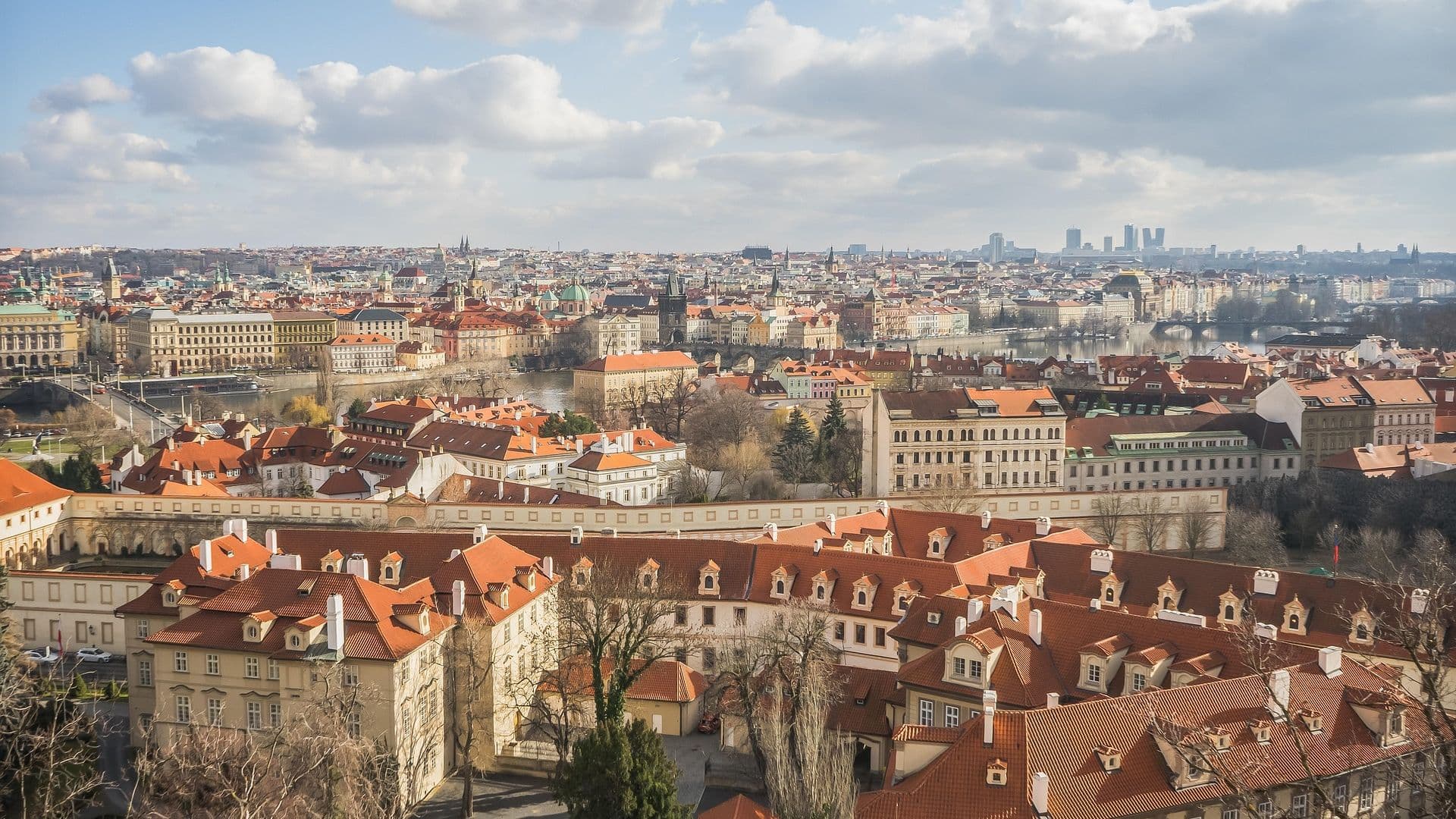
Walk to the very edge of the platform and look down. From here, you can count at least seven of Prague's bridges stretching across the Vltava — from the Štefánikův most directly below to Charles Bridge and beyond. On clear days, the panorama extends from Prague Castle on the left to the towers of Vyšehrad in the far distance. This is one of the finest views of Prague bridges anywhere in the city, and unlike the viewpoints on the castle side, there's no entrance fee and no queue.
The Beer Garden with the Best View in Prague
If you ask a Prague local where to have a beer on a summer evening, roughly half of them will say "Letná." They don't mean a specific pub — they mean the open-air beer garden on the park's eastern edge, perched directly above the Čechův Bridge with an unobstructed panorama of the Old Town, the river, and the bridges.
The Letná beer garden (Letenský zámeček area) operates seasonally, typically opening in April and running through October, weather permitting. The setup is deliberately unfussy — plastic chairs, wooden benches, a serving counter, and a view that restaurants charge ten times as much for and still can't match. A half-litre of draught lager costs around 60-70 CZK (as of 2026). You carry your own beer to your seat, find a spot on the terrace or the grass, and settle in.
The best seats are the benches closest to the railing on the park's edge, where the terrain drops steeply toward the river. From here, the rooftops of Josefov and Staré Město spread out below you in a jumble of red tiles and green copper. The National Theatre's gold roof catches the late sun. Boats slide under the bridges. It is the kind of view that makes conversation stop.
Timing matters. On weekday evenings from about 17:00 onward, the garden fills with locals leaving work — this is when the atmosphere is best. Weekend afternoons draw families and tourists, which is pleasant but busier. If you want one of the prime railing benches, arrive before 17:30 on a weekday or accept that the grass nearby is almost as good. The garden stays open until around 23:00 on warm nights, and the view after dark — when the bridges and castle are lit up — is equally striking.
Hanavský Pavilion — Art Nouveau Above the River
Near the beer garden, closer to the Čechův Bridge staircase, sits the Hanavský Pavilion (Hanavský pavilon) — an ornate cast-iron structure that looks like it belongs in a Belle Époque postcard. Originally built for the 1891 Jubilee Exhibition, the pavilion was designed in a florid neo-Baroque and Art Nouveau style and was later relocated to this spot on the Letná bluff.
Today, the Hanavský Pavilion houses a restaurant. The building itself is the attraction — the ironwork is intricate, with curved balconies and decorative details that reward a close look. Even if you don't dine here, walk around the exterior. The pavilion sits at the top of a monumental staircase descending toward the river, and the combined view of the structure against the Prague skyline is one of the park's best photo opportunities.
The Letná Plain — Where Prague Plays
The central section of Letná Park is dominated by a large open plain — the Letenská pláň — that serves as Prague's most informal sports ground. On any given afternoon, you'll see football matches, frisbee games, joggers circling the perimeter, and groups doing yoga or calisthenics on the grass.
In summer, the plain occasionally hosts food festivals, open-air markets, and cultural events. The annual Prague Metronome festival and various food truck gatherings set up here, turning the flat expanse into a temporary fairground. But on ordinary days, the plain belongs to locals exercising, dogs chasing balls, and children running in the kind of wide-open space that's rare in a dense European city center.
Along the northern edge of the park, several tennis courts and a small football pitch offer more structured recreation. These facilities are well-maintained and used heavily by neighborhood residents. The paths that ring the plain are popular with runners — a full loop is roughly 2 kilometres, flat and shaded, with occasional glimpses of the castle through the trees.
Walking Through Letná — What Most Visitors Miss
Most tourists who visit Letná go straight to the Metronome, take a photo, grab a beer, and leave. That's a reasonable visit, but the park rewards a longer walk. From the Metronome, head west along the main promenade that runs the length of the plateau. The path is lined with mature chestnut and plane trees, and in autumn, the canopy turns gold in a way that rivals any park in the city.
About halfway along the promenade, you'll pass a small carousel and a playground — unremarkable on their own, but a sign that you've entered the quieter residential section of the park. Keep walking and you'll reach the edges of Stromovka, the former royal hunting ground that connects to Letná's western boundary. The two parks blend into each other without a clear border, and together they form a continuous green corridor that stretches several kilometres.
Our guides know the best local spots — far from the tourist traps. Learn more about our team.
One bench we always point out to guests sits on the southern edge of the path, roughly midway between the Metronome and the Letenský zámeček restaurant. It faces south over the river with a slightly angled view that captures both Prague Castle to the left and the Old Town bridge towers to the right. It's not marked or famous — just a public bench in the right spot. On a quiet morning, it's one of the most peaceful places in Prague.
Practical Information
Getting there: The easiest approach from the city center is to climb the staircase from the Čechův Bridge (tram stop Čechův most, lines 12, 17, 53). The stairs are steep but the climb takes only about five minutes. Alternatively, tram lines 1, 12, 25, and 56 stop at Letenské náměstí on the park's northern side, which is a flat walk to the Metronome area. Metro station Hradčanská (line A) is a 10-minute walk from the park's western end.
When to go: The park is open year-round, but the beer garden operates seasonally (roughly April through October). For the best experience, visit on a weekday evening in summer — the light, the atmosphere, and the crowd are all at their peak between 17:00 and sunset. Spring and autumn mornings offer quieter walks with fewer people.
How long to spend: A quick visit to the Metronome and beer garden takes about an hour. A full walk from the eastern bluff through to Stromovka, with stops, takes two to three hours. Most of our guests spend about 90 minutes, which covers the Metronome, the view, a beer, and a stroll along the promenade.
Accessibility: The main promenade and the beer garden area are flat and accessible. The Metronome platform requires a short climb up steps. The Čechův Bridge staircase from the river is not wheelchair-accessible — use the tram to Letenské náměstí for a level approach.
Experience Letná on Your Prague Trip
Letná Park is one of those places you can explore perfectly well on your own — a cold beer, a sunset, and a view that does the talking. But for the parts of Prague where a local guide transforms the experience — the castle's hidden courtyards, the stories behind the Jewish Quarter's synagogues, the details etched into Charles Bridge's statues — that's where our full-day private walking tour comes in. Exclusively yours, and a guide who knows where to look.
If you're planning an evening after your day of exploring, the Medieval Dinner Show at U Pavouka Tavern is a different kind of Prague night — fire dancers, sword swallowers, and a multi-course feast served the way taverns did it five centuries ago. After a sunset beer on the Letná bluff, heading into a candlelit medieval banquet makes for a memorable contrast.
Browse all our private tours of Prague to find the right fit for your trip.
More Prague Parks and Viewpoints
Prague is greener than most visitors expect. Beyond Letna, the city offers hilltop beer gardens with skyline views, a miniature Eiffel Tower surrounded by orchards, and one of Central Europe's largest historic cemeteries -- all reachable by tram in minutes.
- Riegrovy Sady -- the beer garden with the best castle panorama in Prague
- Petrin Tower lookout -- how to visit Prague's hilltop observation tower
- Olsany Cemetery -- a peaceful walk through Prague's largest burial ground
Frequently Asked Questions
Is Letná Park free to enter?
Yes, completely free and open 24 hours. The park is public land with no fences or gates. The beer garden charges for drinks but there's no entry fee — you can sit on the grass nearby with your own refreshments if you prefer.
How do I get to the Letná beer garden?
The most direct route is up the staircase from the Čechův Bridge (tram stop Čechův most). Climb the stairs, turn right, and the beer garden is about a five-minute walk along the bluff. If you want to avoid stairs, take tram 1 or 12 to Letenské náměstí and walk south through the park.
What is the Metronome in Letná Park?
A 25-metre kinetic sculpture by Vratislav Karel Novák, installed in 1991 on the concrete pedestal that once supported the largest Stalin statue in Europe. The statue was demolished in 1962. The Metronome now ticks above the city as a symbol of time and change — and the platform below it has become Prague's most popular skateboarding spot.
When does the Letná beer garden open?
The beer garden operates seasonally, typically from April through October. Exact opening depends on weather — a warm March might see it open early, while a cold, rainy spring could delay things. Hours are generally 11:00 to 23:00 in high season. There is no fixed published calendar, so check locally or simply walk up and see.
Can I see Prague Castle from Letná Park?
Yes. From the Metronome platform and the beer garden area, Prague Castle is clearly visible to the west, sitting on its ridge across the river. The view from Letná is one of the few in Prague where you can see the castle, the bridges, and the Old Town skyline in a single panorama.
You May Also Like
Want to see Prague for yourself?
Try our medieval dinner experience