Petřín Lookout Tower — Prague's Mini Eiffel with the Best Views
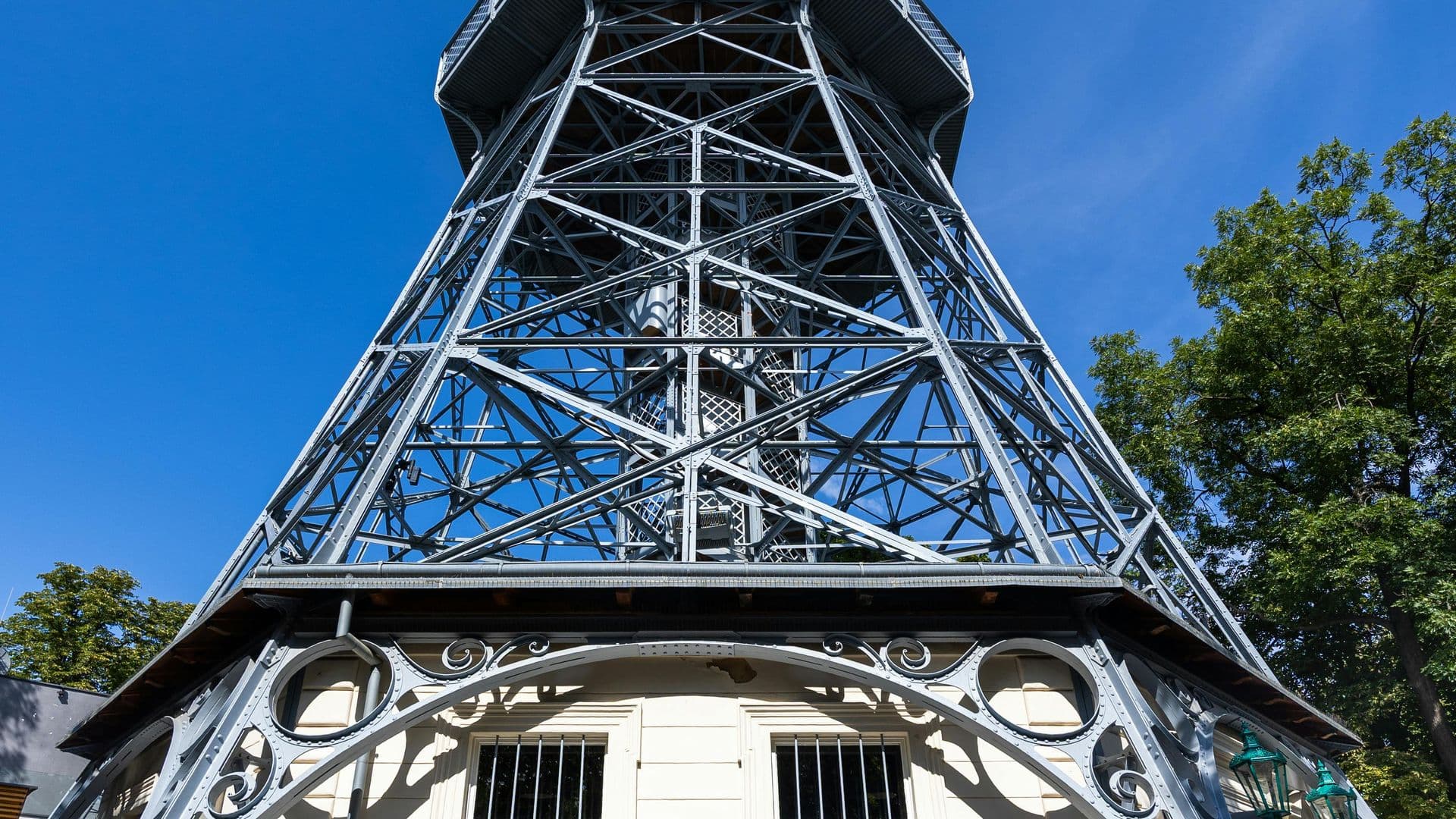
In 1891, a group of Czech tourists visited the Paris World Exhibition, saw the Eiffel Tower, and came home determined to build their own. The result stands on Petřín Hill today — a 63.5-metre iron lattice tower that is sometimes called an Eiffel Tower replica Prague never expected to love this much. It is shorter than the original by a wide margin (the Eiffel stands at 330 metres), but because Petřín Hill itself rises 327 metres above sea level, the observation deck of the Petřín Lookout Tower actually sits higher than the top of the Eiffel Tower above the streets of Paris. Prague's version wins on a technicality, and locals enjoy pointing this out.
We take guests up the tower regularly, and the view from the top is one of the most comprehensive in the city. On clear days, the panorama stretches beyond Prague's borders entirely — you can see the ridgeline of the Bohemian highlands to the north and the rolling farmland of Central Bohemia to the south. Below, the rooftops of Malá Strana, the spires of the Old Town, the bends of the Vltava, and Prague Castle on its ridge all unfold in a single sweeping circle. No other viewpoint in Prague offers this combination of height, centrality, and 360-degree exposure.
The Tower's History — Built for a Jubilee, Kept Forever
The Petřín Lookout Tower was built for the 1891 General Land Centennial Exhibition, a celebration of Czech industry, culture, and national identity held in Prague. The tower was designed by architect Vratislav Pasovský and engineer Julius Soukup, and it went up remarkably fast — construction took just four months. The design borrows the Eiffel Tower's lattice-iron concept but scales it down and adapts it to the hilltop site. The octagonal base and the tapering profile are distinctly its own.
Originally, the tower was intended to be temporary — a jubilee attraction that would be dismantled after the exhibition ended. But Praguers liked it too much. It became a permanent fixture on the Petřín skyline, and in the decades since, it has survived two world wars, four decades of communist rule, and multiple rounds of renovation. The most recent restoration, completed in 2002, reinforced the ironwork and updated the observation platforms while preserving the original 1891 appearance.
The tower served a practical function during the 20th century as well. A television transmitter was installed in the 1950s, and Petřín briefly became Prague's primary broadcast tower. That role has long since been taken over by the Žižkov Television Tower on the other side of the city, but the transmitter equipment remained until recent renovations.
The Climb — 299 Steps to the Top
There is no elevator. Reaching the observation deck at the top of the Petřín Tower means climbing 299 steps up a double-helix iron staircase that spirals inside the lattice structure. The staircase is open — you can see through the ironwork to the ground below and to the city beyond — which gives the climb a particular intensity for anyone uneasy with heights.
The ascent takes most people 10 to 15 minutes at a comfortable pace, with stops to catch your breath and look out through the lattice. The steps are metal grating, solid underfoot but with gaps you can see through. The staircase is wide enough for two people to pass, though on busy days the single-direction flow (up on one spiral, down on the other) keeps things moving. Children generally handle the climb well — they tend to be more excited than afraid.
At the top, the observation deck wraps around the tower's crown with views in every direction. On the clearest days, visibility can extend 100 kilometres or more. The interpretive panels on the deck identify landmarks in each direction — you can pick out Karlštejn Castle to the southwest, the Říp mountain to the north (the legendary landing place of the forefather Čech), and the cooling towers of the Mělník power station along the Vltava to the north.
The best time for the climb is early morning or late afternoon. Midday in summer brings crowds and heat — the metal staircase absorbs sun, and the enclosed space can feel warm. An hour before sunset, the light turns golden, the shadows lengthen across the city, and the observation deck is at its most photogenic.
What You See from the Top
The 360-degree panorama from the Petřín Lookout Tower divides naturally into quadrants, each with its own character.
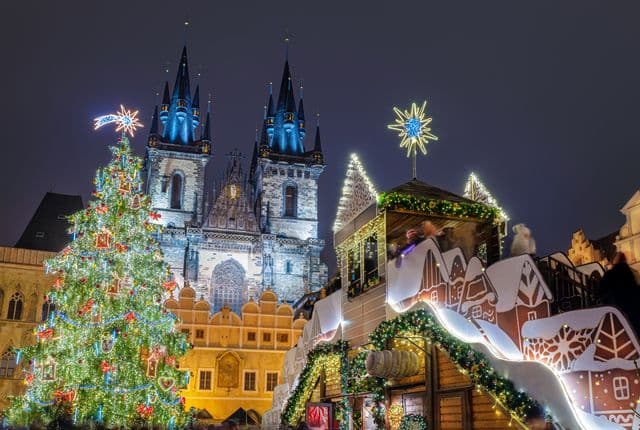
Looking east gives you the classic Prague postcard — the red rooftops of Malá Strana tumbling down to the Vltava, the bridges marching across the river, and the towers of the Old Town rising beyond. Charles Bridge is clearly visible, and on summer days you can see the crowds moving across it. The twin spires of Týn Church, the green dome of St. Nicholas in the Old Town, and the dark mass of the Powder Tower are all identifiable without binoculars.
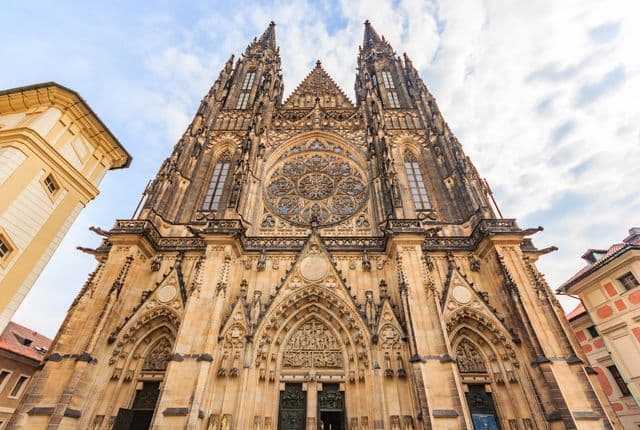
Looking north takes in Prague Castle, which sits on a ridge roughly level with the tower. St. Vitus Cathedral's Gothic spires, the long facade of the Royal Palace, and the terraced gardens below the castle are all spread out in profile. Beyond the castle, the residential districts of Dejvice and Bubeneč stretch toward the horizon.
Looking south, the view opens into a gentler landscape — the wooded slopes of Petřín Hill itself fall away below, and beyond them the residential neighborhoods of Smíchov and Barrandov extend along the river. On clear days, you can trace the Vltava valley as it curves southwest toward Slapy and Orlík.
Looking west, the terrain is green — the orchards, gardens, and paths of Petřín Hill dominate the foreground, with the Strahov Monastery and its white towers visible on the adjacent ridge. The suburbs of Prague 5 and Prague 13 spread beyond.
The Mirror Maze Next Door
Steps from the base of the tower stands the Petřín Mirror Maze (Zrcadlové bludiště), built in the same year — 1891 — for the same jubilee exhibition. The building itself looks like a miniature Gothic castle, with crenellated walls and a pointed entrance arch. Inside, the experience splits into two parts.
The first section is a traditional mirror labyrinth — a winding corridor of angled mirrors that creates an endlessly repeating illusion of space. It takes about five to ten minutes to navigate, depending on how lost you get. The mirrors are old-fashioned silvered glass, and the effect is disorienting in a pleasantly low-tech way. Children love it; adults walk into the glass more often than they'd like to admit.
The second section is a diorama — a large curved painting depicting a scene from the 1648 Swedish siege of Prague on Charles Bridge. The painting wraps around the viewer and uses mirror tricks to create a sense of depth and immersion. It is a 19th-century version of virtual reality, charmingly earnest in its execution.
The Mirror Maze is a quick visit — 15 to 20 minutes at most — and pairs naturally with the tower. Most visitors do both together. Tickets can be purchased separately or as a combined tower-plus-maze deal. On busy days, the line for the maze is usually shorter than the line for the tower.
How to Get Up — The Funicular and Walking Routes
Petřín Hill rises steeply from the Malá Strana quarter, and there are several ways to reach the tower at the top.
The Petřín Funicular (lanová dráha) first carried passengers up the hill in 1891 — the same year as the tower and the maze. It is currently closed for reconstruction. When operating, it departs from Újezd street at the base of the hill and climbs to the summit in about four minutes, with one intermediate stop at Nebozízek (where a restaurant with a terrace view sits). A 30- or 90-minute transit ticket is not valid on the funicular — you need a 24-hour or 72-hour Prague transport ticket, or a separate funicular ticket.
Walking up is the alternative, and many visitors prefer it. Several paths wind up through the hillside gardens and orchards. The most popular route starts at the Újezd funicular station and follows a paved path that zigzags up through the Petřín Gardens (Petřínské sady). The walk takes 20 to 30 minutes depending on your pace and fitness. The gradient is steady but not brutal — benches along the way offer rest stops with improving views.
A second walking route approaches from the south, through the lower slopes of Petřín Hill via the Hunger Wall (Hladová zeď), a 14th-century fortification wall built by Charles IV. Walking along the wall is a route in itself — the stonework is original in places, and the path offers views over the Malá Strana rooftops.
A third route comes from the west, descending from Strahov Monastery through orchards and connecting paths. This approach works well if you're combining the tower with a visit to the Strahov Library or the brewery.
Štefánik Observatory
On the summit of Petřín Hill, a short walk from the tower, sits the Štefánik Observatory (Štefánikova hvězdárna) — a public astronomical observatory that has been operating since 1928. Named after Milan Rastislav Štefánik, a Slovak astronomer, pilot, and co-founder of Czechoslovakia, the observatory opens its telescopes to the public on clear evenings.
During daytime visits, the observatory offers solar observation through filtered telescopes — you can see sunspots and solar flares in real time. In the evening, depending on the season and sky conditions, the observatory's main telescope is pointed at whatever is most interesting that night: the Moon, planets, star clusters, or galaxies. Admission is modest, and the experience of looking through a proper telescope from a hilltop in the middle of Prague is unexpectedly moving.
The observatory is small and can get busy on clear nights, especially during astronomical events. Check their schedule in advance — opening hours vary by season and are weather-dependent. It's a worthwhile stop for anyone with even a passing interest in the sky.
A private guide makes all the difference when exploring this part of Prague.
The Eiffel Connection — How Prague's Tower Compares
The comparison between the Petřín Lookout Tower and the Eiffel Tower is inevitable, so it's worth addressing directly. The Petřín tower is roughly one-fifth the height of the Eiffel (63.5 metres versus 330 metres). Its design uses the same basic principle — an iron lattice structure with a tapering profile — but the proportions, detailing, and engineering are entirely different. The Eiffel Tower was a feat of structural engineering at an unprecedented scale. The Petřín tower is a charming adaptation of that idea, scaled to fit a hilltop park.
What Prague's tower lacks in size, it compensates for in setting. The Eiffel Tower rises from flat ground in a dense urban district. The Petřín tower rises from a forested hilltop above a river valley, with a medieval city spread below. The experience of climbing it is more intimate — 299 steps versus the Eiffel's 674 (to the second floor) — and the reward at the top is a view that tells the whole story of Prague in a single sweep.
The tower is not a copy. It is an homage — built by Czech enthusiasts who admired French engineering and wanted to prove they could create their own version, adapted to their own landscape. That spirit of creative response rather than imitation is very Prague.
Insider Details Worth Knowing
The tower closes in high winds. The iron structure sways slightly in strong gusts, and the city closes the observation deck when conditions are unsafe. This happens most commonly in winter and early spring. If the weather looks marginal, check before making the climb up the hill.
The staircase has two spirals for a reason. One is for ascending, one for descending. On busy days, this one-way system keeps traffic flowing. On quiet mornings, you may have a spiral entirely to yourself — the sound of your footsteps on the metal grating, the wind through the lattice, and the city slowly expanding below.
The best photography spot isn't the very top. The observation deck has protective mesh and glass that can interfere with photos. About two-thirds of the way up, several of the staircase landings have open gaps in the lattice that offer unobstructed shots of the city. Pause on the way up and frame your photos through these openings.
Combine the tower with the Rose Garden. Just below the tower, the Petřín Rose Garden (Růžový sad) blooms from late May through September. It's a small, formal garden with several hundred rose varieties. After the climb down, the garden is a quiet place to sit and decompress. Most tower visitors walk right past it.
The ticket office sometimes has long lines; the climb rarely does. The bottleneck is buying tickets, not the staircase itself. If you can buy a combined ticket online or at a less busy window, the wait drops significantly.
Practical Information
Opening hours: The tower is open daily, year-round. Summer hours (April-September) are typically 10:00 to 22:00. Winter hours (October-March) are shorter, usually 10:00 to 18:00 or 20:00. Hours may vary — check before visiting.
Tickets: Adult admission is approximately 150 CZK for the tower alone; a combined tower-plus-maze ticket is around 200 CZK (as of 2026). Children and students receive reduced rates.
Getting there: Funicular from Újezd (when operating), or walk up from Újezd, Malá Strana, or Strahov. Tram lines 6, 9, 12, 20, 22, and 23 stop at Újezd, which is the most common starting point.
Time needed: Allow about 90 minutes to two hours for the tower climb, the view, and the Mirror Maze. Add 20-30 minutes for the walk up from Újezd if you're not taking the funicular.
Experience Petřín With a Private Guide
Petřín Hill and the lookout tower are places you can enjoy independently — the climb is straightforward, the view speaks for itself, and the Mirror Maze needs no narration. But Prague's deeper layers — the stories behind the castle walls, the significance of the bridge statues, the history embedded in the Old Town's facades — reward having a guide who knows what to point out and when. Our All Prague in One Day private tour covers the major landmarks in a single walk, and your guide can help you plan a Petřín visit for the same afternoon. Exclusively yours, and a day that covers more ground than you'd manage alone.
After a day of exploring hilltops and towers, the Medieval Dinner Show at U Pavouka Tavern offers a completely different kind of evening — torchlit halls, period costumes, and a feast that pairs spectacle with surprisingly good food. Descend from the hill and step into the 15th century.
Browse all our private Prague tours to plan your visit.
Frequently Asked Questions
How many steps are in the Petřín Tower?
There are 299 steps from the base to the observation deck. The double-helix iron staircase spirals inside the lattice structure, with one spiral for going up and one for coming down. The climb takes 10 to 15 minutes at a steady pace.
Is there an elevator in the Petřín Tower?
No. The only way to reach the observation deck is by climbing the 299 steps. The staircase is open (you can see through the ironwork), which can be challenging for people uncomfortable with heights. There is no accessibility alternative to reach the top.
Is the Petřín funicular running?
The Petřín funicular is closed for reconstruction. When operating, it runs from Újezd to the summit of Petřín Hill in about four minutes. A 30- or 90-minute transit ticket is not valid on it — you need a 24-hour or 72-hour Prague transport ticket, or a separate funicular ticket. Walking up from Újezd takes 20 to 30 minutes as an alternative.
What can you see from the top of the Petřín Tower?
On clear days, visibility extends over 100 kilometres. The 360-degree view includes Prague Castle, Charles Bridge, the Old Town skyline, the Vltava River, and the hills of Central Bohemia. Interpretive panels on the deck identify major landmarks in each direction.
Is the Petřín Tower the same as the Eiffel Tower?
No — it's an independent design inspired by the Eiffel Tower. Built in 1891 by Czech architects for Prague's jubilee exhibition, the Petřín tower uses a similar iron lattice concept but is roughly one-fifth the height (63.5 metres versus 330 metres). Because Petřín Hill is 327 metres above sea level, the tower's observation deck actually sits higher above sea level than the top of the Eiffel Tower.
You May Also Like
Want to see Prague for yourself?
Take our flagship Prague tour-6-640x430.jpg&w=3840&q=75)