Prague Photography Guide — Best Sunrise Spots and Camera Tips
Prague before dawn is a different city. The crowds vanish, fog drifts along the Vltava, and the Gothic skyline turns into something that belongs in a fine-art portfolio — if you know where to stand and when to press the shutter.
We guide photographers through Prague regularly, and the difference between a good photo and an extraordinary one almost always comes down to timing and position. This is not a list of "Instagrammable" spots for phone snapshots — this is a working guide for photographers who carry tripods, understand aperture, and are willing to set an alarm for 4:30 AM.
Best Sunrise Spots in Prague
Charles Bridge — The Classic Shot, Earned at Dawn
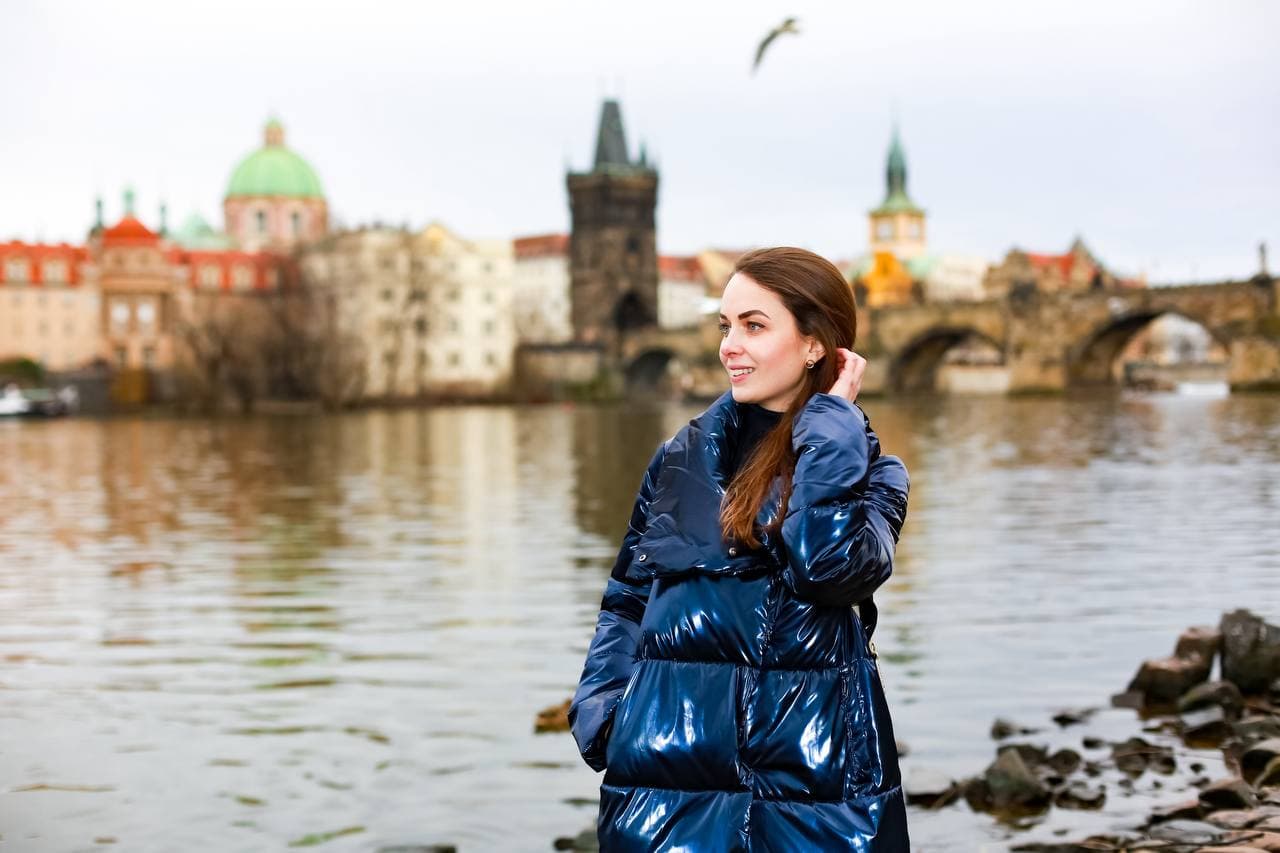
Charles Bridge photographed at sunrise, with empty arches stretching toward the Castle, is one of the most published images in European travel photography. Getting this shot requires arriving 40–50 minutes before official sunrise — by the time the sun clears the horizon, other early risers will have appeared.
The strongest compositions come from the Old Town side, shooting west toward the Lesser Town Bridge Towers and Prague Castle. The bridge's slight curve creates natural leading lines, and the Baroque statues become silhouettes against the warming sky. In summer, the sun rises to the northeast, so direct light hits the Castle façade while the bridge remains in soft shadow — ideal contrast.
Insider detail: The lamp posts along the bridge are gas-powered originals, and they stay lit until shortly after dawn. If you arrive early enough, you can capture the warm glow of the gas flames against the blue-hour sky — a detail that disappears by 6 AM.
Petřín Hill — Elevated Panorama Across the Entire Skyline
The upper slopes of Petřín Hill offer an unobstructed east-facing view over Prague — meaning the sunrise light comes directly toward your lens. The observation tower (a miniature Eiffel Tower, built in 1891) opens at 10 AM, but the hillside itself is accessible around the clock.
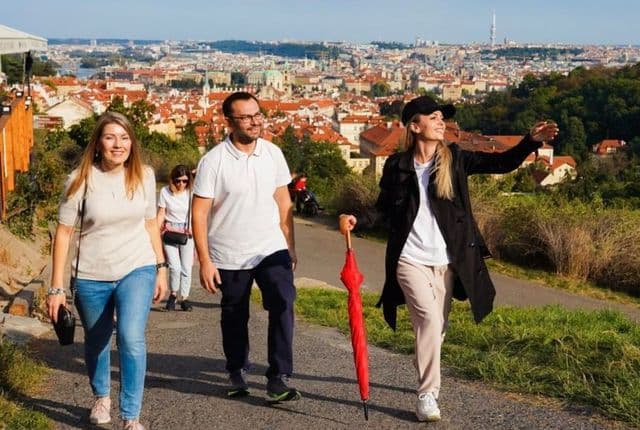
The best position is the stone terrace near the Hunger Wall, roughly two-thirds of the way up. From here, you get the Old Town skyline, the Vltava's bends, and the Žižkov Television Tower all in a single wide frame. For telephoto work, the terrace near the rose garden compresses Prague Castle against the dawn sky beautifully.
Insider detail: Plan a 15–20 minute walk uphill from Újezd — the funicular does not run before dawn even when operating. The path through the orchard (Petřínské sady) is unlit but safe, and the exercise warms you up for the cold wait at the top.
Letná Park — Where Fog Settles Over the Bridges
The Letná plateau sits north of the river, directly above a bend in the Vltava. The elevated promenade near the Hanavský Pavilon provides a sweeping view of five bridges, the Old Town waterfront, and the National Theatre dome. This is the spot where river fog concentrates most reliably — cold air pools in the river valley below while you stand above it.
The Metronome platform (the former Stalin monument site) is 200 metres east and offers a more central perspective, with Charles Bridge framed between the hillside and the Old Town Bridge Tower. Both locations are excellent; Letná's advantage over other spots is the elevated angle that separates the bridges into distinct layers.
Insider detail: On autumn mornings with temperatures near freezing, fog forms over the Vltava around 90% of the time. The fog usually lifts within 60–90 minutes of sunrise. If you arrive too late, you get a clear panorama — still beautiful, but missing the atmospheric drama that makes Letná images distinctive.
Vyšehrad — The Fortress Nobody Photographs at Dawn
Vyšehrad fortress, south of the city centre, is one of the most underused sunrise locations in Prague. The ramparts face north toward the city, and the view includes the Vltava, the Nusle Bridge (the large concrete viaduct), the Castle in the distance, and a foreground of historic fortification walls.
The churchyard of the Basilica of St. Peter and St. Paul is atmospheric at any hour, but at dawn the tombstones of Dvořák, Smetana, and other Czech luminaries catch the first light through old linden trees. This is a contemplative, quieter kind of Prague photography — less skyline spectacle, more mood.
Insider detail: The Tábor Gate entrance on the south side is unlocked 24 hours. Enter from there and walk through the casemated tunnel to emerge on the northern ramparts just as the sky begins to colour. Our Vyšehrad walking tour from Prague covers the ramparts and the basilica.
Metronome Platform — Clean Geometry and Leading Lines
The Metronome itself — a giant kinetic sculpture that replaced the demolished Stalin monument — provides strong geometric foreground interest for wide-angle compositions. The platform's clean lines and the sweeping staircase below create compositions that feel modern against Prague's medieval backdrop.
Shooting from the western edge of the platform, you can align Charles Bridge with the Metronome's arm for a graphic, contemporary image that stands apart from traditional Prague photography. The platform is concrete and exposed, so wind can be an issue for long exposures.
Golden Hour Timing by Season
Prague sits at roughly 50°N latitude, which means dramatic variation in daylight hours across the year. Sunrise times shift by nearly four hours between winter and summer — and so does the quality and direction of the golden light.
Season | Sunrise (approx.) | Best arrival | Golden hour duration | Sun direction
Winter (Dec–Jan) | 7:45–8:00 AM | 7:00 AM | 35–45 min | Southeast
Spring (Mar–Apr) | 5:45–6:30 AM | 5:00 AM | 25–35 min | East
Summer (Jun–Jul) | 4:50–5:10 AM | 4:00 AM | 20–25 min | Northeast
Autumn (Sep–Oct) | 6:15–7:00 AM | 5:30 AM | 30–40 min | East-southeast
Key insight: Winter golden hours last longer because the sun rises at a lower angle, staying close to the horizon for an extended period. Summer sunrises are faster and more dramatic — the light changes rapidly, and you have a narrower window to capture the warm tones before the sun climbs above the atmospheric haze.
Insider detail: The two weeks around the autumn equinox (late September) produce the most reliably photogenic sunrises. The sun rises almost due east, golden hour lasts a comfortable 30 minutes, and the probability of mist along the Vltava is at its seasonal peak.
Camera Settings for Prague Architecture
Prague's architecture rewards precision. Gothic spires, Baroque curves, and Art Nouveau details all demand sharp rendering — but the low-light conditions at dawn mean compromises are inevitable.
Aperture: f/8 to f/11 for most cityscape work. This range delivers peak sharpness on most lenses while maintaining enough depth of field for foreground-to-infinity compositions. For isolated details (statues, ornamental façades), open up to f/4 or f/5.6 to separate the subject from background clutter.
ISO: Start at ISO 100 or 200 and increase only as needed. Modern full-frame sensors handle ISO 800–1600 well, but noise in shadow areas becomes visible in large prints. If you are on a tripod, keep ISO as low as possible and extend the shutter speed instead.
Shutter speed: This depends entirely on whether you want motion blur. For mirror-smooth Vltava reflections, 2–8 seconds at low ISO produces silky water. For crisp dawn light on static architecture, 1/60 to 1/250 is sufficient once the sun clears the horizon.
White balance: Auto white balance often neutralises the warm tones that make golden hour special. Set a manual colour temperature of 5500–6000K for dawn shooting to preserve the natural warmth without over-saturating. Shoot RAW and fine-tune later if unsure.
Focus: Manual focus at the hyperfocal distance, or autofocus on a high-contrast edge one-third into the scene. For telephoto compression shots of spires and domes, focus directly on the subject and let the background fall slightly soft — the eye will not notice at normal viewing distances.
Tripod-Friendly Locations
Not every great viewpoint in Prague welcomes tripods. Some spots are too crowded, others have uneven surfaces, and a few have explicit restrictions.
A private guide makes all the difference when exploring this part of Prague.
Fully tripod-friendly:
- Letná promenade — wide paved surface, minimal foot traffic at dawn, no restrictions
- Vyšehrad ramparts — stone surfaces, empty in the morning, plenty of room
- Petřín hillside terraces — stable ground, no guards or restrictions
- Metronome platform — concrete, flat, wind-exposed but stable
Tripod possible with care:
- Charles Bridge — technically no restrictions, but the bridge narrows and early joggers will bump your setup. Use a compact tripod and stay close to the railing. By 7 AM in summer, the bridge is too crowded for comfortable tripod use.
- Old Town Bridge Tower — the top platform is narrow. A tabletop tripod or beanbag works; a full-size tripod blocks other visitors.
Tripod restricted or impractical:
- Prague Castle courtyards — security staff may ask you to collapse tripods during opening hours. Before opening, the courtyards are closed.
- Inside churches — tripods generally prohibited. Monopods sometimes tolerated.
Insider detail: The paving stones on Charles Bridge are uneven and slightly convex. Rubber-tipped tripod feet slip on them when wet. If you shoot on the bridge regularly, carry spiked feet or a heavy bag to hang from the centre column for stability.
Fog and Mist — When to Expect It
Fog is the single most transformative element in Prague photography. It turns a familiar skyline into something mysterious and layered, isolates spires against blank white backgrounds, and gives Charles Bridge the atmosphere of a 19th-century painting.
When fog forms: Prague fog is almost always radiation fog — it forms on clear, calm nights when the ground cools rapidly and moisture in the air condenses near the surface. The Vltava valley acts as a natural channel, concentrating fog along the river.
Best conditions:
- Clear sky the night before (allows ground to radiate heat)
- Low wind (below 5 km/h)
- Temperature drop overnight to near dew point
- High relative humidity (above 85%)
Peak fog months: October, November, and March. December and January can produce fog, but persistent cloud cover often prevents the clear-sky cooling needed for radiation fog. February is statistically the driest winter month and less reliable.
Insider detail: Check the weather forecast for the temperature-dew point spread the evening before your shoot. When the gap narrows to 2°C or less, fog is highly likely by dawn. The Czech Meteorological Institute (ČHMÚ) publishes hourly dew point data for Prague — it is the single most useful tool for fog prediction.
Where fog concentrates: The densest fog sits along the river between Vyšehrad and Letná. Charles Bridge is almost always in the fog zone. Higher ground — Petřín, Letná, Vyšehrad — often sits above the fog layer, giving you the extraordinary experience of photographing spires emerging from a white sea below.
Blue Hour Spots
Blue hour — the 20–30 minutes after sunset or before sunrise when the sky turns deep cobalt — is where Prague's artificial lighting meets natural atmosphere. Street lamps, illuminated monuments, and the warm glow from restaurant windows create a colour palette that no amount of post-processing can replicate.
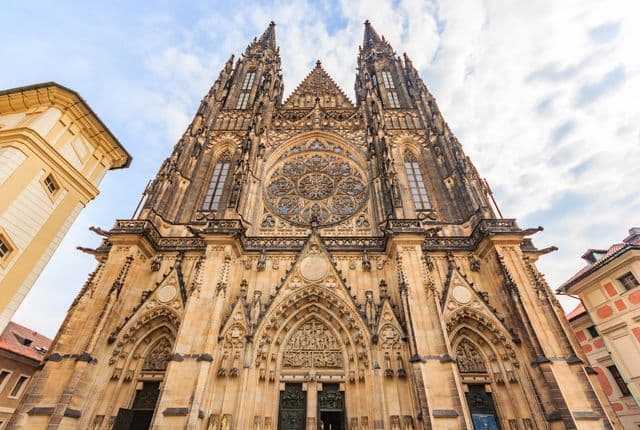
Prague Castle from Mánesův Bridge: The Castle's floodlights illuminate the complex in warm amber. Shot from Mánesův Bridge (one bridge north of Charles Bridge), the Castle, St. Vitus Cathedral, and the river reflections compose a powerful blue-hour image. The bridge itself sees less foot traffic than Charles Bridge, giving you room to work.
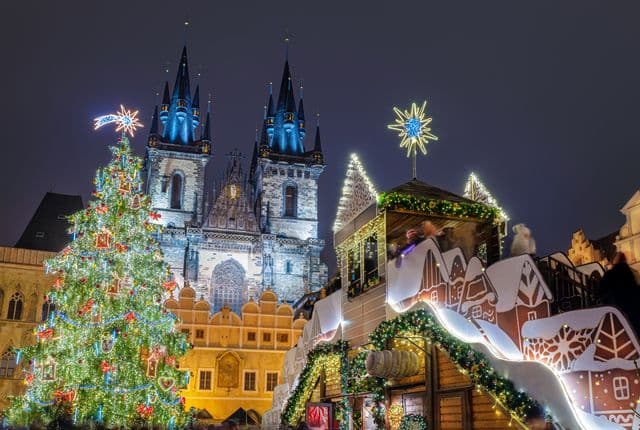
Old Town Square: The Astronomical Clock and Týn Church are both illuminated after dark. During blue hour, the sky provides a deep blue backdrop that separates the spires from what would otherwise be a black void. Shoot from the northwest corner of the square for the strongest composition.
Náplavka riverbank: The river walk along Náplavka (the embankment south of the National Theatre) offers a low-angle view north toward the illuminated bridges. The water reflections stretch the city lights into long vertical streaks — especially effective with a 2–4 second exposure.
Insider detail: Prague's municipal floodlights switch on at a fixed time that shifts with sunset — usually within 10 minutes of official sunset. In the transition period when natural light still fills the sky but the monuments are already illuminated, you get the richest blue-hour colour. This window lasts roughly 15 minutes. Miss it, and the sky goes black.
Experience It With a Private Guide
Photographing Prague seriously means navigating the city in the dark, finding unmarked viewpoints, and making split-second decisions about where to stand when the light shifts. Our guides know these locations intimately — not just where they are, but how the light behaves at each one across the seasons.
On our All Prague in One Day private tour, we can adjust the route to start at dawn if photography is your priority — hitting Charles Bridge and the Castle before the crowds arrive.
For something unexpected, our Hidden Prague Underground and Alchemy tour takes you into locations that most photographers never see — underground chambers, alchemist workshops, and passages beneath the Old Town.
And if you want to end a long day of shooting with something memorable, our medieval dinner at a candlelit Prague tavern is the kind of scene that deserves a few frames of its own — fire shows, heavy oak tables, and mead by torchlight.
Browse all our private tours — exclusively yours, with your own guide.
Frequently Asked Questions
Do I need a permit to photograph in Prague with a tripod?
No permit is needed for personal or editorial photography on public streets, bridges, and parks. Commercial shoots (advertising, branded content) in certain locations — particularly Prague Castle courtyards and some churches — may require advance permission from the property administrator.
What is the best month for Prague photography?
October offers the strongest combination of factors: reliable fog along the Vltava, warm autumn light, moderate golden hour duration, and significantly fewer tourists than summer. Late September and early November are close runners-up.
Can I fly a drone in Prague for photography?
Drone regulations in Czechia are governed by EU rules (EASA). Flying over the Prague historic centre is effectively prohibited — it is a densely populated area and falls within the restricted zone around Ruzyně Airport. Some locations outside the centre (Divoká Šárka, for example) may be feasible with proper registration, but always check current EASA and Czech CAA rules before flying.
Is Prague safe for photographers walking alone before dawn?
Prague is one of the safest capital cities in Europe, and walking with camera gear before dawn is routine for local and visiting photographers. Exercise normal precautions — keep your bag zipped, stay aware of your surroundings — but violent crime against tourists is extremely rare.
What lens focal length works best for Prague architecture?
A 24–70mm covers 80% of situations. Wide-angle (16–24mm) is essential for interiors and tight streets. A 70–200mm is valuable for compressing the skyline — isolating the Castle against distant hills, or pulling bridge arches together into a dense graphic composition.
You May Also Like
Want to see Prague for yourself?
Take our flagship Prague tour-6-640x430.jpg&w=3840&q=75)