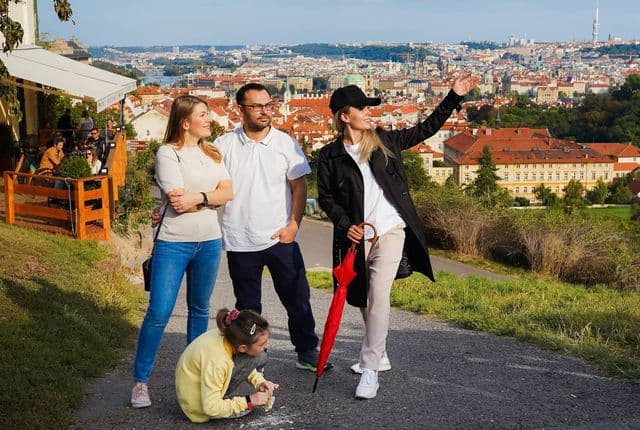
Prague in 2 Days — The Perfect Itinerary
Two days in Prague is the minimum to see both sides of the river properly. Day one covers Old Town, the Jewish Quarter, and Charles Bridge. Day two takes you uphill to Prague Castle, through Malá Strana, up Petřín hill, and into an evening you'll remember. With roughly 14 kilometres of total walking across both days, this itinerary covers every essential sight without the frantic pace of a single-day sprint. A private Jewish Quarter tour from Prague can replace the museum-hopping with a guided narrative of Josefov.
We designed this route around a simple principle: keep the river between your two days. Day one stays on the east bank — flat ground, dense with landmarks, and walkable in a logical loop. Day two crosses to the west bank — the castle, the hill, the quieter streets — and finishes with elevation and views that reward the climb. Each day has its own rhythm, and neither feels rushed.
Day 1: Old Town, Jewish Quarter, and Charles Bridge
Morning (8:30–12:00)
8:30 — Old Town Square (Staroměstské náměstí)
Start your first morning in the heart of Prague. Old Town Square is quieter before 9 AM than at any other hour — vendors are setting up, the cafes are just opening, and the square feels like it belongs to the city rather than to tourism.
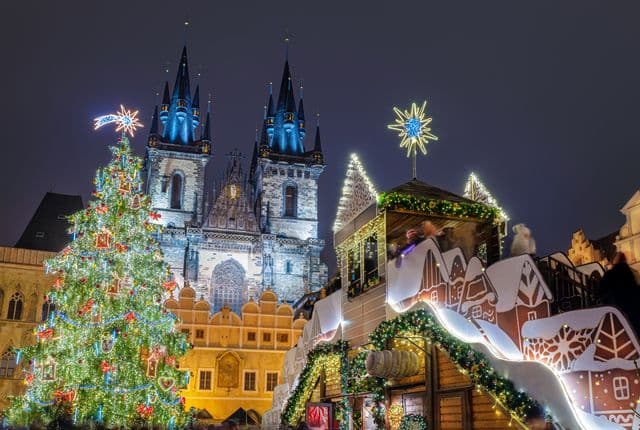
The key landmarks around the square: Týn Church (Kostel Matky Boží před Týnem) with its asymmetric Gothic spires, the Old Town Hall with the Astronomical Clock, the Church of St. Nicholas, and a row of baroque and Gothic facades that span five centuries.
Walk to the Astronomical Clock (Orloj) and look at it before the hourly show draws a crowd. The clock face itself is more interesting than the mechanical parade — it displays standard time, Old Czech time, a zodiac ring, and astronomical positions, and it's been operating since 1410. The apostle figures appear at the top of every hour, but the real value is in the dial itself.
Insider tip: On the south wall of the Old Town Hall, 27 white crosses are embedded in the pavement. They mark where 27 Czech Protestant leaders were executed on June 21, 1621, after the Battle of White Mountain. A small plaque tells the story, but most visitors walk right over the crosses without noticing. This single event shaped Czech identity for the next 400 years.
*Walking time to next stop: 5 minutes north along Pařížská.*
9:15 — Jewish Quarter (Josefov)
Walk north along Pařížská — Prague's luxury shopping street, lined with Art Nouveau buildings — into Josefov, the historic Jewish ghetto.
The Jewish Museum complex includes six synagogues, the Old Jewish Cemetery, and the Jewish Town Hall. A combined ticket covers the main sites. The two essential stops are the Pinkas Synagogue and the Old Jewish Cemetery.
The Pinkas Synagogue is a memorial — the names of 77,297 Czech and Moravian Holocaust victims are hand-written on the walls, floor to ceiling, room after room. It is one of the most powerful memorial spaces anywhere in Europe, and it requires no explanation or audio guide. Just stand and read the names.
The Old Jewish Cemetery (Starý židovský hřbitov) has roughly 12,000 tombstones crowded into a small area, with bodies buried in layers up to twelve deep. The cemetery was in use from the 15th to the 18th century, and the tilted, mossy stones stacked against each other give it an atmosphere that photographs never quite capture.
If time allows, the Spanish Synagogue is worth the extra 20 minutes — the interior is Moorish Revival with gold stucco and coloured arabesques, and it catches most visitors completely off guard. It looks nothing like what you'd expect from the outside.
The Old-New Synagogue (Staronová synagoga) requires a separate ticket but has been in continuous use since 1270. The steep Gothic gable and the five-ribbed vault inside are architecturally unique — legend says the extra rib was added to avoid forming a cross.
Insider tip: Visit the Pinkas Synagogue first thing. It's smaller, and once school groups arrive around 10 AM, the atmosphere changes. Early morning, it's just you and the names.
Allow 90 minutes to two hours for Josefov. Then walk south toward the river.
*Walking time to next stop: 8 minutes south to the Clementinum area.*
11:00 — Clementinum and Karlova Street
Walk south from Josefov through the narrow streets to Karlova — the medieval route connecting Old Town Square to Charles Bridge. The street is narrow, winding, and crowded by midday, but interesting for its building facades and hidden courtyards.
The Clementinum (Klementinum) on your left is the largest complex of buildings in Prague after Prague Castle. Originally a Jesuit college, it now houses the National Library. The Baroque Library Hall and Astronomical Tower can be visited on a short guided tour — the library ceiling fresco and the 360-degree view from the tower are both worth it, and the tour takes about 45 minutes.
Insider tip: The Clementinum's Meridian Hall contains a line on the floor used to determine solar noon — astronomers tracked it from the 18th century. It's one of those details that's easy to miss on a quick tour, but it connects the building to Prague's scientific history as much as its religious past.
*Walking time to next stop: 3 minutes west to Charles Bridge.*
Lunch (12:00–13:00)
Before crossing Charles Bridge, eat lunch in the side streets south of Karlova — Husova, Betlémská, or Bartolomějská. These streets have restaurants serving daily lunch specials (polední menu) with soup and a main course at local prices. One block off the tourist drag, the food improves and the prices drop. Avoid anything on Karlova or facing Old Town Square.
Afternoon (13:00–17:00)
13:00 — Charles Bridge (Karlův most)
After lunch, walk onto Charles Bridge from the Old Town side. The bridge is 516 metres long, lined with 30 baroque statues, and was commissioned in 1357 — construction continued into the early 15th century.
Early afternoon is busy, but the bridge is one of those places you simply have to walk. Move at your own pace and stop at the statues that interest you. The St. John of Nepomuk statue has the shiniest bronze relief — tourists touch it for good luck. Nepomuk himself was tortured and thrown from this bridge in 1393 on the orders of King Wenceslas IV.
Walk the full length to the Lesser Town Bridge Tower, but don't enter Malá Strana — that's tomorrow. Instead, turn around and walk back, this time on the downstream side. The views are different in each direction, and the return walk with the castle ahead of you is the better photo angle.
Insider tip: Look at the bridge piers carefully. Several of them have high-water marks from the 2002 flood, when the Vltava rose to levels not seen in 500 years. The bridge survived — but the water came within a metre of the deck in places.
*Walking time to next stop: 10 minutes east from the Old Town Bridge Tower.*
14:00 — Estates Theatre and Powder Gate
Walk east from Charles Bridge through Ovocný trh to the Estates Theatre (Stavovské divadlo) — the theatre where Mozart himself conducted the world premiere of Don Giovanni on October 29, 1787. The neoclassical exterior is handsome, and if you can catch an evening performance later in your trip, the interior is beautifully preserved.
Continue east to the Powder Gate (Prašná brána) — a Gothic tower that was once part of Prague's medieval fortifications. You can climb it for a view down Celetná street to Old Town Square. Next to it, the Municipal House (Obecní dům) is Prague's most important Art Nouveau building. The Kavárna Obecní dům cafe inside is ornate enough to be worth a stop — every surface was designed by the leading Czech artists of the early 1900s.
*Walking time to next stop: 10 minutes south.*
15:00 — Wenceslas Square (Václavské náměstí)
Walk south to Wenceslas Square — more boulevard than square, stretching 750 metres from the National Museum at the top to Na Příkopě at the bottom. The square has been the stage for Czech history's biggest moments: the declaration of independence in 1918, the Prague Spring of 1968, Jan Palach's self-immolation in 1969, and the Velvet Revolution in 1989.
Walk the full length and look at the architecture — it spans Art Nouveau, functionalism, socialist realism, and contemporary glass. The Lucerna Passage on the left side (heading downhill) has David Černý's inverted horse sculpture — a deliberate satire of the Wenceslas statue at the top of the square.
At the top of the square, the National Museum occupies a neo-Renaissance building that anchors the entire boulevard. Even if you don't go inside, the building's scale sets the tone for everything below it.
16:00 — Free Time / Riverside Walk
Spend the last daylight hours walking along the Smetanovo nábřeží (Smetana Embankment) south toward the National Theatre. The views across the river toward Malá Strana and Petřín hill are best in late afternoon light. Střelecký ostrov (Shooters' Island) is accessible via a footbridge and has a calm park with direct views of the theatre and the river.
Evening
Option A: Medieval Dinner Show
End day one underground. The medieval dinner show at U Pavouka Tavern is a two-and-a-half-hour evening in a 15th-century vaulted cellar on Celetná street — roasted meats, unlimited beer and mead, fire dancers, sword fights, and drums that echo off the stone walls. The evening show starts at 20:00. Book ahead — it fills up, especially on weekends.
Option B: Old Town Evening Walk
Old Town after dark has a different atmosphere. The crowds thin, the facades light up, and streets like Celetná and Dlouhá reveal details — carved portals, painted house signs, iron lanterns — that disappear in daytime foot traffic. Walk without a plan and let the streets guide you.
Day 2: Prague Castle, Malá Strana, and Petřín
Morning (8:00–12:00)
8:00 — Prague Castle (Pražský hrad)
Your second morning starts across the river. Take public transport or walk to Prague Castle — the courtyards open at 6 AM, and the interior buildings open at 9 AM. Being here early is essential. By 10 AM, the castle complex is packed.
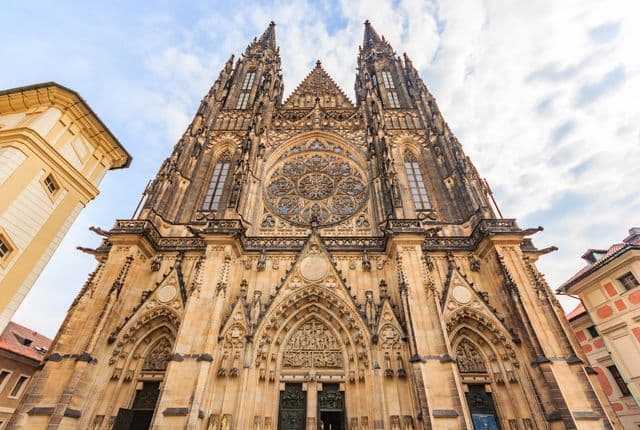
Enter from the western side at Hradčanské náměstí. Walk through the first and second courtyards to reach the third courtyard and St. Vitus Cathedral — the Gothic centrepiece of the entire complex. Inside, the Alfons Mucha stained glass window is on the left as you enter, and the morning light through it is at its best between 9 and 10 AM.
After the cathedral, continue to the Old Royal Palace with its Vladislav Hall — a space large enough for indoor jousting. The riders' staircase was built wide enough for horses carrying armoured knights. Then walk to St. George's Basilica, the oldest Romanesque building in the complex — stark, simple, and a striking contrast to the cathedral's Gothic excess.
Finish with Golden Lane (Zlatá ulička) — a row of tiny painted houses built into the castle wall. Franz Kafka lived at number 22. Visit before 10 AM to avoid the worst congestion, and don't skip the upstairs armour exhibition that most visitors walk past.
Insider tip: Before leaving the castle, walk along the southern ramparts. The view down over Malá Strana's red rooftops, the river, and the Old Town skyline is one of the best panoramas in Prague, and most visitors exit without seeing it. It adds only five minutes.
For the full castle story, see our Prague Castle guide.
*Walking time to next stop: 15 minutes downhill via the Old Castle Steps.*
10:30 — Malá Strana (Lesser Town)
Descend from the castle using the Old Castle Steps (Staré zámecké schody) — a steep, cobblestoned stairway dropping directly into Malá Strana. The steps are uneven, so take them at a steady pace.
At the bottom, walk to Malostranské náměstí — the main square of the Lesser Town. The Church of St. Nicholas (Kostel sv. Mikuláše) dominates the square. This is Prague's most important baroque church — the ceiling fresco by Johann Lucas Kracker covers over 1,500 square metres, and the nave is so ornamented that first-time visitors tend to stand still for a full minute just looking up.
From the square, walk south along Karmelitská to the Church of Our Lady Victorious, where the Infant Jesus of Prague (Pražské Jezulátko) has been venerated since 1628. Continue to the John Lennon Wall — continuously repainted since the 1980s, different every few weeks. The small square in front has a waterwheel on the Čertovka canal and a quieter atmosphere than anything north of the river.
Insider tip: From the Lennon Wall, slip through the gate into the garden of the Knights of Malta. It's not well signed, but it's public. The garden is usually empty and gives you a view of the Church of Our Lady Under the Chain that's impossible from the street.
Explore the side streets of Malá Strana — Vlašská, Tržiště, Nerudova. These streets have embassies in baroque palaces, small galleries, and a quiet residential feel that contrasts sharply with Old Town. Nerudova street climbs steeply toward the castle and is lined with historic house signs — two suns, a golden key, three violins — from the era before street numbers existed.
Lunch (12:00–13:00)
Eat in Malá Strana. The streets around Malostranské náměstí and along the Čertovka canal have several good restaurants. This neighbourhood is calmer for lunch than Old Town, and the quality of food tends to be higher because fewer places survive on tourist traffic alone. Look for daily menu boards — soup plus main course, same format as everywhere in Prague.
Afternoon (13:00–17:30)
13:00 — Petřín Hill (Petřínské sady)
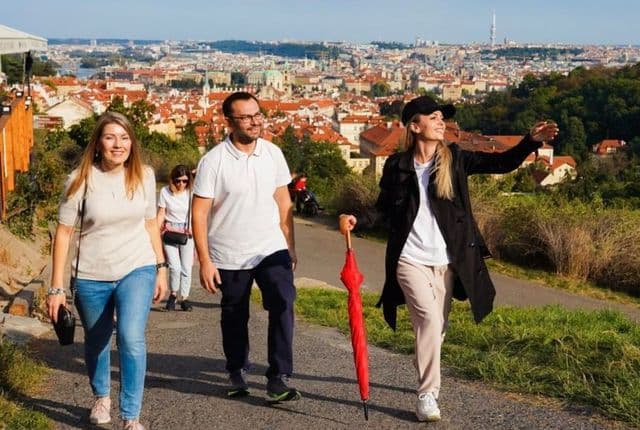
After lunch, walk south through Malá Strana to Petřín hill — Prague's green lung on the west bank. You can walk up (a steady 20-minute climb through orchards and gardens) or take the Petřín funicular from Újezd. A 30- or 90-minute transit ticket is not valid on the funicular — you need a 24-hour or 72-hour Prague transport ticket, or a separate funicular ticket.
At the top, the Petřín Lookout Tower (Petřínská rozhledna) is a 63.5-metre structure loosely modelled on the Eiffel Tower, built for the 1891 Prague Jubilee Exhibition. The 299 steps to the top are worth climbing — the view extends across the entire city, and on clear days you can see 100 kilometres into the Czech countryside. It's a view that puts everything you've seen over two days into geographic context.
Near the tower, the Strahov Monastery (Strahovský klášter) has two baroque library halls — the Theological Hall and the Philosophical Hall — with original ceiling frescoes and floor-to-ceiling books from the 17th and 18th centuries. You view from the doorways rather than entering the halls, but the sight is striking enough that it stays with you.
The monastery also has a small brewery on its grounds, where you can try sv. Norbert beer. The shift from 300-year-old manuscripts to a cold Czech lager is uniquely Prague.
Insider tip: Walk the path along the south side of Petřín hill through the orchards. In spring, the fruit trees bloom and the hillside turns white and pink. Even outside bloom season, this path is almost always quiet and gives you a forested walk minutes from the city centre. Most visitors take the funicular up and down without exploring the hill itself.
*Walking time to next stop: 20 minutes downhill to the river.*
15:30 — Kampa Island and the Čertovka Canal
Walk downhill from Petřín through the gardens to Kampa Island — technically a sliver of land separated from Malá Strana by the narrow Čertovka canal (Devil's Channel). The canal has a small waterwheel, painted buildings leaning over the water, and an atmosphere that feels more like a village than a European capital.
Kampa Island has a park at its southern end with direct views of the Vltava and Old Town on the opposite bank. The Museum Kampa displays modern Central European art, and the David Černý baby sculptures crawling up the lawn outside are a Prague landmark of a very different kind.
Walk along the river through Kampa Park. This is one of the quietest stretches in central Prague, especially in late afternoon. The views north toward Charles Bridge, with Petřín hill behind you, are among the most photographed in the city.
16:30 — Cross Charles Bridge at Sunset
Your second day gives you the bridge at a different time. Cross Charles Bridge from the Malá Strana side heading east toward Old Town. Late afternoon and early sunset light hits the bridge from the west, illuminating the Old Town Bridge Tower and casting long shadows from the statues. It's the best light for photos and a fitting way to close out your Prague visit.
Evening
Option A: Dinner Along the River
After crossing the bridge, walk south along the east-bank embankment. The stretch between Křížovnické náměstí and Národní divadlo (National Theatre) has several good restaurants. Sit by the window or on a terrace if the weather allows — the river view at night, with the castle illuminated above and the bridges reflected below, is Prague at its most atmospheric.
Option B: Medieval Dinner (If Not Done on Day 1)
If you saved the medieval dinner show for your last evening, tonight is ideal. The tavern is on Celetná street, a short walk from Old Town Square, and the 20:00 show runs about two and a half hours. Ending your Prague visit underground, in a candle-lit stone cellar with mead and drums, is the kind of finale that makes a city trip memorable.
Practical Tips for This Itinerary
Total walking distance: roughly 14 kilometres across two days — about 7 kilometres each day.
What to wear: comfortable shoes with grip for cobblestones and the Petřín hill climb. Layers are smart — mornings at the castle can be cool even when afternoons in Old Town are warm.
Day order: This itinerary starts with Old Town on Day 1 and the castle on Day 2. You can reverse it, but we find this order works better — Day 1 on flat ground gives your legs a warm-up before the castle hill and Petřín on Day 2.
If it rains: Day 1 works well in rain — the Jewish Quarter, churches, and covered passages all function indoors. On Day 2, the castle interiors are excellent in wet weather, but the Petřín hill climb is slippery — consider the funicular and focus on Strahov Monastery and the castle.
Skip if needed: If two days feel ambitious, shorten Day 1 by skipping Wenceslas Square, and shorten Day 2 by choosing either Petřín or the castle's full circuit (not both at maximum depth).
Is Prague Worth Visiting for Just 2 Days?
Yes — absolutely. Two days in Prague is enough to experience the city's most extraordinary landmarks, eat remarkably well, and leave with a genuine sense of the place. We say this not as a travel cliche but because Prague's historic core is compact enough that you can walk from the Castle to Old Town Square in under 25 minutes.
In two focused days, you can realistically cover: Prague Castle and St. Vitus Cathedral, the panoramic walk down through Malá Strana, Charles Bridge (ideally early morning or evening), Old Town Square with the Astronomical Clock, the Jewish Quarter, and still have time for a proper Czech dinner with dark lager. That's not rushing — that's smart routing.
The key is quality over quantity. Rather than ticking off a checklist of 20 attractions at speed, two well-planned days let you actually stand inside the Cathedral and absorb the Mucha window, linger on Charles Bridge without feeling the clock ticking, and sit down for svíčková at a real neighbourhood restaurant instead of grabbing a trdelník on the run.
What makes the difference is structure. A guided tour on day one — something like our All Prague in One Day walk — gives you the historical backbone and practical orientation so that day two becomes effortless exploration on your own. You'll know which lanes to wander, which viewpoints to revisit at sunset, and where to find coffee that locals actually drink.
Two days won't exhaust Prague — you won't get to Vyšehrad, or the Vítkov monument, or a day trip to Kutná Hora. But that's not a failure. That's a reason to come back. And most of our two-day visitors do.
Browse our full tour selection to see how we help you make every hour count.
Experience It With a Private Guide
Two days is where private guiding shines. Day one can be our Charles Bridge and Old Town walking tour — the bridge, Old Town Square, the Jewish Quarter, and the stories that make each stop make sense. Day two fits our Prague Castle and Lesser Town private tour, which covers the castle complex, Malá Strana, and everything in between.
Both tours are private — exclusively yours, with your own guide. We adjust the route and pace to your interests, skip queues where possible, and fill in the context that turns old buildings into living history. And with two days, there's room to go deeper into the places that resonate most with you.
If you're looking for a single tour that covers both sides of the river in one day, our All Prague in One Day tour is an intensive option for guests who want it all.
See all our private Prague tours and find the right combination for your stay.
Frequently Asked Questions
Is 2 days enough for Prague?
Two days is enough to see both sides of the river — Old Town, the Jewish Quarter, Charles Bridge, Prague Castle, Malá Strana, and Petřín hill. You'll have time for proper exploration at each stop rather than rushing through. For deeper museum visits or day trips, three days is ideal.
What should I see on my first day in Prague?
Start with Old Town Square and the Astronomical Clock, then explore the Jewish Quarter, walk Charles Bridge, and spend the afternoon around Wenceslas Square. See our detailed one-day Prague itinerary for the hour-by-hour version.
Should I visit Prague Castle on Day 1 or Day 2?
Day 2 works better for most visitors. Day 1 on the flat east bank warms up your walking legs, and saving the castle and Petřín for Day 2 means you end your trip with the best panoramic views rather than starting with them.
How much walking is involved in two days in Prague?
Roughly 14 kilometres total — about 7 each day. Most of the terrain is flat or downhill, except for the climb to Prague Castle (which you can do by tram) and Petřín hill (funicular — once reopened). Comfortable shoes with grip for cobblestones are essential.
Can I do a day trip from Prague with only 2 days?
With only two days, we recommend staying in Prague. Day trips to Český Krumlov, Kutná Hora, or Karlovy Vary each take a full day and are better suited to a three-day or longer visit. Use both days to explore the city at a pace that lets you actually enjoy it.
Planning to visit the Jewish Quarter on your trip? A private Jewish Quarter tour takes you through all six monuments with a licensed guide who answers your questions as you walk.
You May Also Like
- What to See in Prague in One Day — A Local Guide's Itinerary
- 3 Days in Prague — How to Make the Most of Your Visit
- Prague Castle Guide — What to Know Before You Go
Planning your trip? See our Prague tour guide for details.
Planning your trip? See our day trips from Prague for details.
Want to see Prague for yourself?
Take our flagship Prague tour-6-640x430.jpg&w=3840&q=75)