3 Days in Prague — How to Make the Most of Your Visit
Three days is the sweet spot for Prague. Two days cover the essential landmarks on both sides of the river. The third day opens up the parts of the city that most visitors never reach — the ancient fortress at Vyšehrad, the leafy residential streets of Vinohrady, and the offbeat towers and pubs of Žižkov. This itinerary covers roughly 22 kilometres total across three days, with the intensity front-loaded so your final day feels like a reward rather than a march.
We use this three-day structure with guests regularly. Days one and two follow a proven route through the historic core. Day three is deliberately different — less monumental, more local, with the kind of places that make you understand why people live in Prague and not just visit it.
Day 1: Old Town, Jewish Quarter, and Charles Bridge
Morning (8:30–12:00)
8:30 — Old Town Square (Staroměstské náměstí)
Start in the centre. Old Town Square before 9 AM is quieter than any other time of day — street vendors are setting up, the cafe terraces are just starting to fill, and the square belongs to the city rather than to tourism.
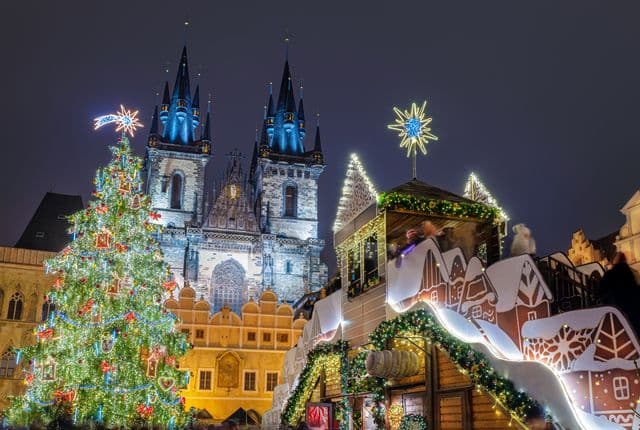
Take in the landmarks around the square: Týn Church (Kostel Matky Boží před Týnem) with its twin Gothic spires, the Old Town Hall and its Astronomical Clock, the Church of St. Nicholas, and the mix of baroque and Gothic facades lining the perimeter. The Astronomical Clock face is worth studying before the hourly parade draws a crowd — it displays multiple time systems simultaneously and has been operating since 1410.
Insider tip: On the south side of the Old Town Hall, 27 crosses are embedded in the pavement — marking the spot where 27 Czech Protestant leaders were executed on June 21, 1621. The crosses are easy to walk over without noticing, but this single event reshaped Czech national identity for centuries.
*Walking time to next stop: 5 minutes north along Pařížská.*
9:15 — Jewish Quarter (Josefov)
Walk north along Pařížská into Josefov. The district holds six synagogues, the Old Jewish Cemetery, and the Jewish Town Hall. Hiring a private guide for Josefov turns the museum circuit into a connected story.
The Pinkas Synagogue is the essential stop — 77,297 names of Czech and Moravian Holocaust victims written on the walls. Visit it first, before school groups arrive around 10 AM. The silence in the early morning, with just you and the names, is an experience that stays.
The Old Jewish Cemetery packs roughly 12,000 tombstones into a small area, bodies buried in layers up to twelve deep over four centuries. The tilted, moss-covered stones pressed together create an atmosphere that no photograph quite captures.
If time allows, the Spanish Synagogue has a Moorish Revival interior with gold stucco and coloured arabesques that surprises nearly everyone who enters. The Old-New Synagogue (Staronová synagoga), in continuous use since 1270, is included in the single Jewish Museum ticket and takes only ten minutes.
Allow 90 minutes to two hours for the quarter.
*Walking time to next stop: 8 minutes south.*
11:00 — Clementinum
Walk south to the Clementinum (Klementinum) — the largest building complex in Prague after the castle. The Baroque Library Hall and Astronomical Tower are accessible on a short guided tour. The library ceiling fresco is exquisite, and the tower view gives you a 360-degree panorama from the centre of Old Town.
Lunch (12:00–13:00)
Eat in the side streets south of Karlova — Husova, Betlémská, or Bartolomějská. Local restaurants here serve daily specials (polední menu) at a fraction of tourist-zone dinner prices. One block off the main route, the food quality jumps and the cost drops.
Afternoon (13:00–17:00)
13:00 — Charles Bridge (Karlův most)
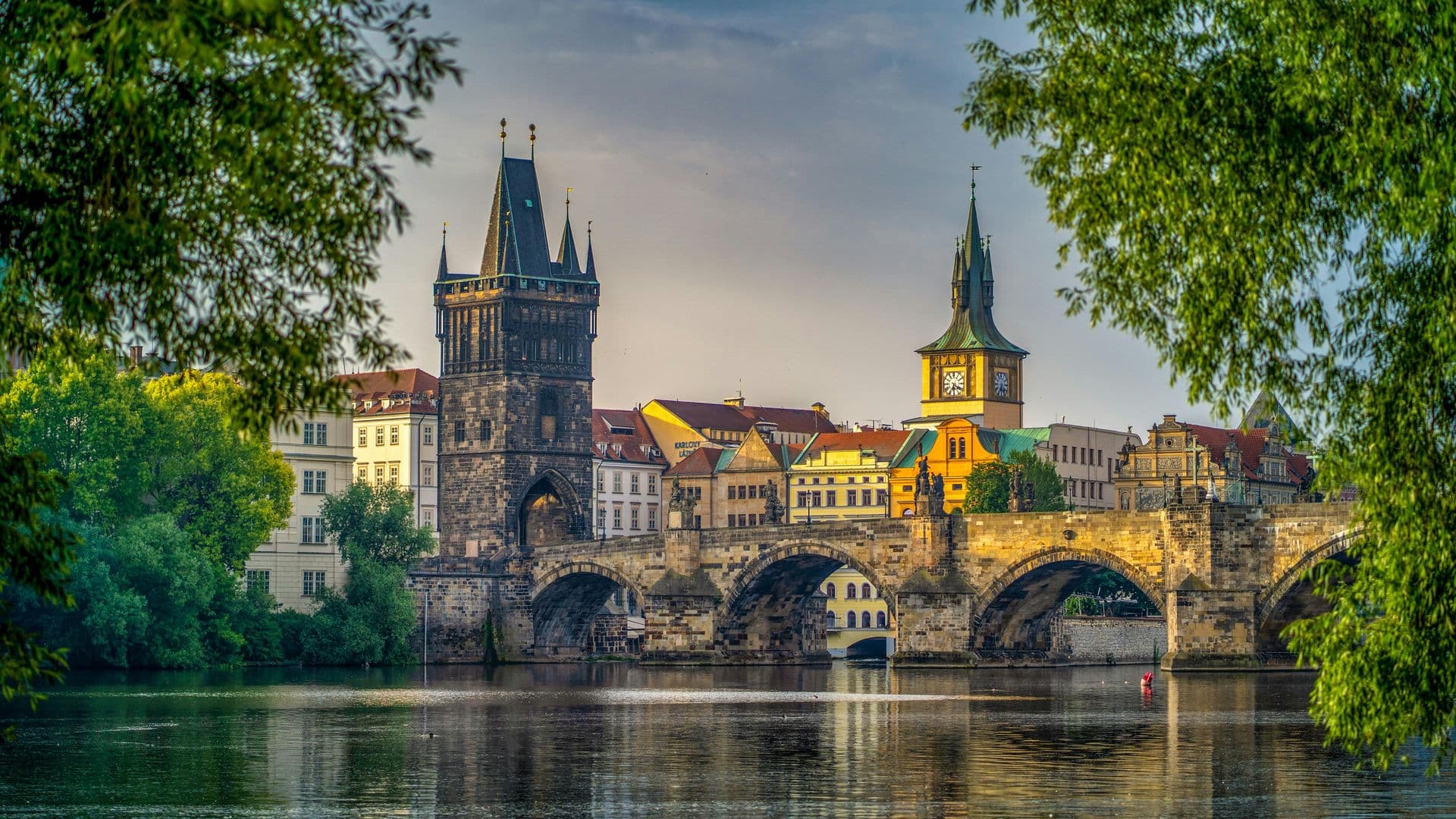
Cross Charles Bridge from Old Town heading west. The bridge is 516 metres long with 30 baroque statues, commissioned in 1357 and completed in the early 15th century. Walk on the upstream side for the best castle views behind you, and stop at the St. John of Nepomuk statue — the one with the shiny bronze relief. Nepomuk was thrown from this bridge in 1393.
Walk to the Lesser Town end, take in the view, then turn back. Today you stay on the east bank — Malá Strana is for tomorrow.
Insider tip: Look at the bridge piers for high-water marks from the 2002 flood. The Vltava rose to levels not seen in 500 years, and the water came within a metre of the bridge deck. The bridge held — but the marks are a sobering reminder of how powerful the river can be.
*Walking time to next stop: 12 minutes east.*
14:00 — Powder Gate, Municipal House, and the Estates Theatre
Walk east through Ovocný trh past the Estates Theatre — where Mozart premiered Don Giovanni in 1787 — to the Powder Gate (Prašná brána), a Gothic tower from Prague's medieval fortifications.
Next door, the Municipal House (Obecní dům) is Prague's premier Art Nouveau building. The Kavárna Obecní dům cafe inside is worth a stop — every surface designed by the leading Czech artists of the early 1900s, including Alfons Mucha.
15:00 — Wenceslas Square (Václavské náměstí)
Walk south to Wenceslas Square — 750 metres of boulevard stretching from the National Museum to Na Příkopě. This is where Czech independence was declared in 1918, where Jan Palach set himself on fire in 1969, and where the Velvet Revolution gathered a million people in 1989.
Walk the full length. The Lucerna Passage halfway down has David Černý's inverted horse sculpture. The architecture along the square spans 120 years of styles — Art Nouveau, functionalism, socialist realism, and modern glass.
16:00 — Riverside Walk
Head west to the Vltava and walk along the embankment south. The late-afternoon light on the river, with Malá Strana and Petřín hill across the water, is one of Prague's best visual moments. Střelecký ostrov is accessible via a footbridge for a quiet park stop.
Evening
End the day with the medieval dinner show at U Pavouka Tavern — a two-and-a-half-hour feast in a 15th-century cellar on Celetná street. Roasted meats, unlimited mead and beer, fire dancers, sword fights, and drums that bounce off the vaulted stone. The evening show starts at 20:00. It's the best first-evening experience in Prague and worth booking in advance.
Day 2: Prague Castle, Malá Strana, and Petřín
Morning (8:00–12:00)
8:00 — Prague Castle (Pražský hrad)
Arrive at Prague Castle before the buildings open at 9 AM. The courtyards open at 6 AM and are nearly empty at 8. Start from the western entrance at Hradčanské náměstí.
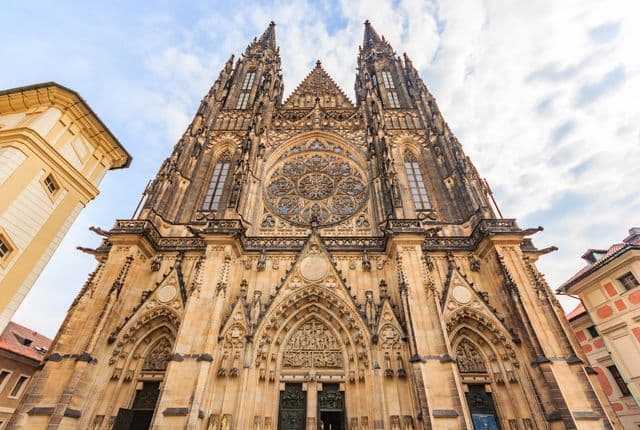
Walk through the courtyards to St. Vitus Cathedral — Prague's Gothic masterpiece. The Alfons Mucha stained glass window (left side as you enter) catches the best light between 9 and 10 AM. The ceiling vaults rise 33 metres, and the interior atmosphere shifts completely once you step inside.
Continue to the Old Royal Palace and its Vladislav Hall — large enough for indoor jousting tournaments, with a riders' staircase built for armoured knights on horseback. Then St. George's Basilica — Romanesque and austere, the oldest church building in the complex.
Finish with Golden Lane (Zlatá ulička). Kafka lived at number 22. Go before 10 AM and check the upstairs armour exhibition most visitors skip.
Insider tip: Walk the southern ramparts before leaving the castle. The panoramic view over Malá Strana's rooftops, the river, and Old Town is the best photo angle from the castle grounds, and most visitors exit without seeing it.
For more detail, see our full Prague Castle guide.
*Walking time to next stop: 15 minutes downhill.*
10:30 — Malá Strana (Lesser Town)
Descend via the Old Castle Steps into the heart of Malá Strana. Walk to Malostranské náměstí and enter the Church of St. Nicholas — Prague's finest baroque interior, with a ceiling fresco covering over 1,500 square metres.
Continue south to the John Lennon Wall, repainted continuously since the 1980s. The small square nearby has a canal waterwheel and a calmer atmosphere than anything across the river.
Explore the side streets — Nerudova, Vlašská, Tržiště. These have embassies in baroque palaces, small galleries, and a residential calm. Nerudova climbs toward the castle and is lined with historic house signs — two suns, a golden key, three violins — from before street numbers.
Insider tip: From the Lennon Wall, walk through the gate into the garden of the Knights of Malta. It's public but not well signed. Usually empty, with a view of the Church of Our Lady Under the Chain you can't get from the street.
Lunch (12:00–13:00)
Eat in Malá Strana around Malostranské náměstí or along the Čertovka canal. The neighbourhood supports better-quality restaurants than Old Town because fewer places survive on tourist traffic alone.
Afternoon (13:00–17:30)
13:00 — Petřín Hill (Petřínské sady)
Walk to Petřín hill and either hike up through orchards (20 minutes) or take the Petřín funicular from Újezd (once reopened — check dpp.cz). At the top, the Petřín Lookout Tower (63.5 metres, 299 steps) gives you a panoramic view that puts the whole city into context.
Near the tower, the Strahov Monastery has two baroque library halls — the Theological Hall and the Philosophical Hall — with original ceiling frescoes and 17th-18th century books. You view from the doorways, but the sight is unforgettable. The monastery brewery serves sv. Norbert beer, and the transition from baroque manuscripts to a cold lager is distinctly Prague.
Insider tip: Walk the southern path through Petřín's orchards. In spring, the fruit trees bloom white and pink. Even outside season, this path is nearly always quiet — a forested walk minutes from the centre. Most visitors just ride the funicular up and down.
*Walking time to next stop: 20 minutes downhill.*
15:30 — Kampa Island
Walk downhill to Kampa Island, separated from Malá Strana by the narrow Čertovka canal. The canal has a waterwheel, painted buildings leaning over the water, and a village atmosphere. The park at the island's southern end has direct river views and Old Town on the opposite bank.
16:30 — Cross Charles Bridge
Cross Charles Bridge at golden hour. Late-afternoon light hits the bridge from the west, illuminating the Old Town Bridge Tower and casting long shadows from the statues. It's the best light for photography and a different experience from your Day 1 crossing.
Evening
Free evening in Old Town. After two full days, you know the geography — pick a neighbourhood restaurant in the side streets, sit in a beer garden if the weather's good, and let the city slow down. Tomorrow is different.
Day 3: Vyšehrad, Vinohrady, and Žižkov
Day three takes you beyond the tourist core. No castle, no square, no bridge — just the parts of Prague where residents actually live, plus an ancient fortress most visitors never see.
Morning (9:00–12:30)
9:00 — Vyšehrad
Take the metro to Vyšehrad station (red line C) and walk five minutes through the park to the fortress gate. Vyšehrad is Prague's other hilltop fortress — older than Prague Castle in legend, quieter in reality, and atmospheric in a way that the castle complex no longer is.
Start with the Basilica of St. Peter and St. Paul (Bazilika sv. Petra a Pavla) — twin neo-Gothic spires visible from across the city. The interior has Art Nouveau frescoes that surprise visitors expecting a medieval church. The painted ceiling is detailed and vivid, unlike anything in Old Town.
Walk to the Slavín Cemetery — the national cemetery where Czech composers, writers, artists, and scientists are buried. Antonín Dvořák, Bedřich Smetana, Alfons Mucha, and Karel Čapek all rest here. The cemetery is well-maintained and quiet, with ornate graves and a central monument that overlooks the river valley.
Explore the casemates — underground tunnels and halls within the fortress walls. The Gorlice Hall stores the original baroque statues from Charles Bridge (the ones on the bridge today are copies). Standing next to these 300-year-old figures, indoors and at eye level rather than high overhead, gives you a completely different sense of their scale and detail.
Walk the ramparts around the fortress perimeter. The views from the northern rampart — looking across the river to the city centre and Prague Castle in the distance — rival anything from Petřín. From the southern rampart, you see the Vltava valley stretching south and the suburban hills beyond.
Insider tip: Vyšehrad has a subterranean passage that contains one of the few surviving Romanesque rotundas in Prague — the Rotunda of St. Martin (Rotunda sv. Martina), visible from outside the casemate circuit. It dates to the 11th century and is one of the oldest standing structures in Prague. Most visitors walk past it because it's small and unsigned.
For a deeper look, see our Vyšehrad guide.
*Walking time to next stop: 20 minutes northeast.*
Lunch (12:30–13:30)
Walk northeast from Vyšehrad into Vinohrady for lunch. The streets around Náměstí Míru (Peace Square) have a dense concentration of good restaurants, wine bars, and cafes. This is where Prague residents eat, and the quality reflects it. Czech cuisine, Vietnamese pho, Italian trattorias, Georgian khinkali — Vinohrady is one of the most culinarily diverse neighbourhoods in the city.
Afternoon (13:30–17:30)
13:30 — Vinohrady
After lunch, explore Vinohrady — Prague's most liveable neighbourhood and the area we most often recommend to visitors looking for a place to stay. The streets are lined with Art Nouveau and neo-Renaissance apartment buildings, many with ornate facades, balconies, and decorative details that rival anything in the tourist centre.
Walk to Náměstí Míru and the Church of St. Ludmila (Kostel sv. Ludmily) — a neo-Gothic church that anchors the square. The surrounding streets — Mánesova, Slezská, Korunní — have independent bookshops, wine bars, artisan bakeries, and a neighbourhood pace that feels completely different from Old Town.
Riegrovy sady (Rieger Park) is Vinohrady's main green space. Walk to the western edge of the park for a view of Prague Castle across the city. There's a beer garden here in summer that locals use as their living room. On warm evenings, the benches along the western slope fill with people watching the sunset behind the castle — no tourists, no admission fee, just Prague doing what Prague does.
Insider tip: The side streets of Vinohrady between Mánesova and Moravská have some of Prague's best-preserved Art Nouveau facades. Look up — the ceramic tile decorations, sculptural faces, and wrought-iron balconies above the first floor are easy to miss at street level. This neighbourhood was built during Prague's architectural golden age and it shows on almost every block.
*Walking time to next stop: 15 minutes east.*
15:30 — Žižkov
Walk east from Vinohrady into Žižkov — a traditionally working-class neighbourhood named after the Hussite military commander Jan Žižka. Žižkov has more pubs per capita than any other district in Prague, a reputation for bohemian independence, and the city's most eccentric landmark.
The Žižkov Television Tower (Žižkovský vysílač) is 216 metres tall and visible from nearly everywhere in Prague. It's brutalist, divisive, and impossible to ignore. Ten crawling baby sculptures by David Černý cling to the tower's pillars — visible from the ground as dark shapes inching upward. You can go up to the viewing platform at 93 metres for a panorama that includes the castle, Vyšehrad, Petřín, and the surrounding countryside.
Near the tower, the Olšany Cemetery (Olšanské hřbitovy) is Prague's largest burial ground — a sprawling, overgrown space with graves from the 18th century onward. It's atmospheric, slightly wild, and a stark contrast to the manicured Slavín Cemetery at Vyšehrad. Franz Kafka is buried in the smaller New Jewish Cemetery (Nový židovský hřbitov) adjacent to Olšany — the grave is modest and clearly marked.
Insider tip: After the tower, walk into the Žižkov side streets. The bars here are unpretentious and cheap — proper neighbourhood pubs where a half-litre of beer costs what a small coffee costs in Old Town. This is where Prague drinks after work, and the atmosphere is authentic in a way that tourist-friendly "Czech beer experiences" in the centre can't replicate.
17:00 — Return to Centre
Walk or take a tram back toward the centre. Žižkov and Vinohrady are both well-connected to Old Town — ten to fifteen minutes by tram, or a 25-minute walk downhill.
Evening
Your last evening in Prague. Options:
Dinner in Vinohrady or Karlín — both neighbourhoods have better dining than Old Town at lower prices. Walk the side streets and pick somewhere that looks good.
One final Charles Bridge walk — crossing the bridge at night, with the castle illuminated above and the river reflecting the city lights below, is a different experience from your daytime crossings. The bridge is quietest after 22:00.
Medieval dinner show — if you haven't done it yet, the evening show at U Pavouka is a memorable way to close three days in Prague.
Day 3 Alternative: Day Trip
If you've already explored Vinohrady and Žižkov (or you prefer leaving the city), Day 3 is the right day for a trip outside Prague. The best options:
Český Krumlov — a medieval town 170 km south, with a castle, a winding river, and a UNESCO-listed old town that feels like it was preserved in amber. It's a long day (about 2.5 hours each way by car, or 3 by bus), but it's the most beautiful small town in the Czech Republic. See our day trips guide for logistics.
Kutná Hora — 70 km east, famous for the Sedlec Ossuary (Bone Church) and the Gothic cathedral of St. Barbara. An easier day trip — about 1 hour by train, and you can be back in Prague by mid-afternoon.
Karlštejn Castle — 30 km southwest, built by Emperor Charles IV to house the Crown Jewels. The closest major castle to Prague, reachable in about 40 minutes by train.
Practical Tips for This Itinerary
Total walking distance: approximately 22 kilometres across three days — about 7 km on Days 1 and 2, and 8 km on Day 3 (or less if you take public transport between Vyšehrad, Vinohrady, and Žižkov).
What to wear: comfortable walking shoes with grip. Day 3 involves less cobblestone than Days 1-2 but includes park paths and cemetery gravel. Layers remain useful — the Žižkov Tower platform is exposed to wind.
Public transport on Day 3: Vinohrady and Žižkov are well served by trams. If you want to save energy, tram between Vyšehrad, Náměstí Míru, and Žižkov rather than walking.
When to schedule Day 3: This itinerary puts the local neighbourhoods on Day 3 deliberately. By then you've seen the landmarks, your sense of the city's geography is solid, and you're ready for places that reward curiosity over checklists.
Prague Card: Over three days, if you plan to enter Prague Castle interiors, the Jewish Museum, and several other paid attractions, a multi-day Prague Card may save money. Check current inclusions before purchasing.
Experience It With a Private Guide
Three days is where we can build something truly personal. Day one fits our Charles Bridge and Old Town private walk — the bridge, Old Town Square, the Jewish Quarter, and the stories behind each stop. Day two works as our Prague Castle and Lesser Town tour — castle interiors, Malá Strana's baroque streets, and the context that makes 600 years of architecture make sense.
Day three is where private guiding gets interesting. We can build a custom route through Vyšehrad, Vinohrady, and Žižkov, or combine the city walk with a day trip to Český Krumlov or Kutná Hora. With our All Prague in One Day tour, we can even compress the essentials into Day 1 and free up Days 2-3 for deeper exploration.
Every tour is private — exclusively yours, with your own guide. We adjust routes, pace, and depth to match your interests.
Browse all our private Prague tours and build the right combination for three days.
Want to see the Prague castle without the tourist crush? Book our private Vyšehrad Fortress tour — exclusively yours, with your own licensed guide, and Prague's most photographed skyline view from the hill the founding myth set the city on.
Frequently Asked Questions
Is 3 days enough for Prague?
Three days is the ideal length for a first visit. You'll cover both sides of the historic centre, visit Prague Castle and Charles Bridge properly, explore at least one residential neighbourhood, and still have time for a museum or a day trip. Most guests who spend three days say it felt like the right amount.
What should I do on Day 3 in Prague?
Day 3 is best spent outside the tourist centre. Visit Vysehrad fortress, explore Vinohrady (Prague's best residential neighbourhood), and walk through Zizkov for the TV Tower and authentic neighbourhood pubs. Alternatively, take a day trip to Cesky Krumlov, Kutna Hora, or Karlstejn Castle.
Is Prague better than Vienna for a 3-day trip?
They're different cities. Prague is more compact, more affordable, and easier to explore on foot. Vienna has larger museums and grander imperial architecture. Prague's medieval core and its neighbourhood diversity give it an edge for visitors who want to go beyond landmarks.
How much does 3 days in Prague cost?
Prague is affordable by Western European standards. Budget roughly 50-80 EUR per person per day for mid-range accommodation, meals, and attraction entry. Public transport is cheap and covers the whole city. The biggest variable is accommodation — staying in Vinohrady or Karlin saves money compared to Old Town.
Should I buy a Prague Card for 3 days?
It depends on your plans. If you'll enter Prague Castle interiors, the Jewish Museum, and at least two other paid attractions, the card may save money. If your third day is a neighbourhood walk or a day trip, individual tickets are usually cheaper. Check current inclusions before deciding.
For a deeper, expert-led visit, consider a private Jewish Quarter tour from Prague — fully customized to your interests.
You May Also Like
- Prague in 2 Days — The Perfect Itinerary
- Vyšehrad — Prague's Other Castle That Most Visitors Skip
- Best Day Trips from Prague
Planning your trip? See our Prague tour guide for details.
Planning your trip? See our day trips from Prague for details.
Want to see Prague for yourself?
Take our flagship Prague tour-6-640x430.jpg&w=3840&q=75)