Prague Astronomical Clock — How It Works and What to Look For
Every hour, a crowd gathers in front of the Old Town Hall, phones raised, watching a 600-year-old machine perform a show that lasts about 40 seconds. Most people in that crowd have no idea what they're looking at. They see the skeleton ring the bell, the apostles parade past the windows, the rooster crow — and then it's over, and they walk away having witnessed something without understanding it.
The Prague Astronomical Clock (Orloj) is the oldest working astronomical clock in the world, installed in 1410 by clockmaker Mikuláš of Kadaň and mathematician Jan Šindel. It has been running, with interruptions and repairs, for over six centuries. This guide explains its three components, how to read the dials, and what details reward a closer look.
The Three Components
The clock has three distinct parts stacked vertically on the south wall of the Old Town Hall tower. Each does something different, and understanding them separately is the key to understanding the whole.
1. The Astronomical Dial (Upper Dial)
The large circular dial is the heart of the clock, and it is far more than a timepiece. It shows the position of the sun and moon relative to the Earth, in the geocentric model that was standard in 1410. Yes — the clock depicts the Earth at the centre, with the sun and moon orbiting around it. This is not an error; it was the accepted model when the clock was built, and changing it would mean rebuilding the entire mechanism.
The dial has several concentric rings, each carrying different information:
The outer ring shows Old Czech time (sometimes called Italian time or Bohemian time), which divided the day into 24 hours starting at sunset. The golden numbers on the black outer ring shift throughout the year as sunset changes — a feature that baffles most visitors until it's explained.
The blue and brown background represents the sky. The blue upper portion is the sky above the horizon — daytime. The brown-red lower portion is below the horizon — night. The orange strips between them represent dawn and dusk. As the sun hand moves through these zones, you can see at a glance whether it's day, twilight, or night.
The golden sun on a moveable arm tracks the position of the sun through the zodiac signs (the inner ring of zodiac symbols) and through the hours (marked in Roman numerals on the gold ring). The position of the sun hand tells you the current time in three different systems simultaneously: modern 24-hour time, Old Czech time, and the unequal "planetary hours" used in medieval astrology.
The moon is a smaller sphere that tracks the lunar phases. Half the sphere is dark and half is silver — it rotates as the moon waxes and wanes, showing the current phase. The moon hand moves through the zodiac independently of the sun, and the position of both tells you where the sun and moon are in the sky relative to each other.
Insider detail: The blue disc at the very centre, showing a small Earth, has three curved lines that most people overlook. These mark the Tropic of Cancer, the celestial equator, and the Tropic of Capricorn. The sun hand's position relative to these lines tells you the season and the length of the current day. When the sun is above the equator line (northern summer), days are long; when below (winter), days are short. The entire annual cycle of daylight is encoded in this single dial.
2. The Calendar Dial (Lower Dial)
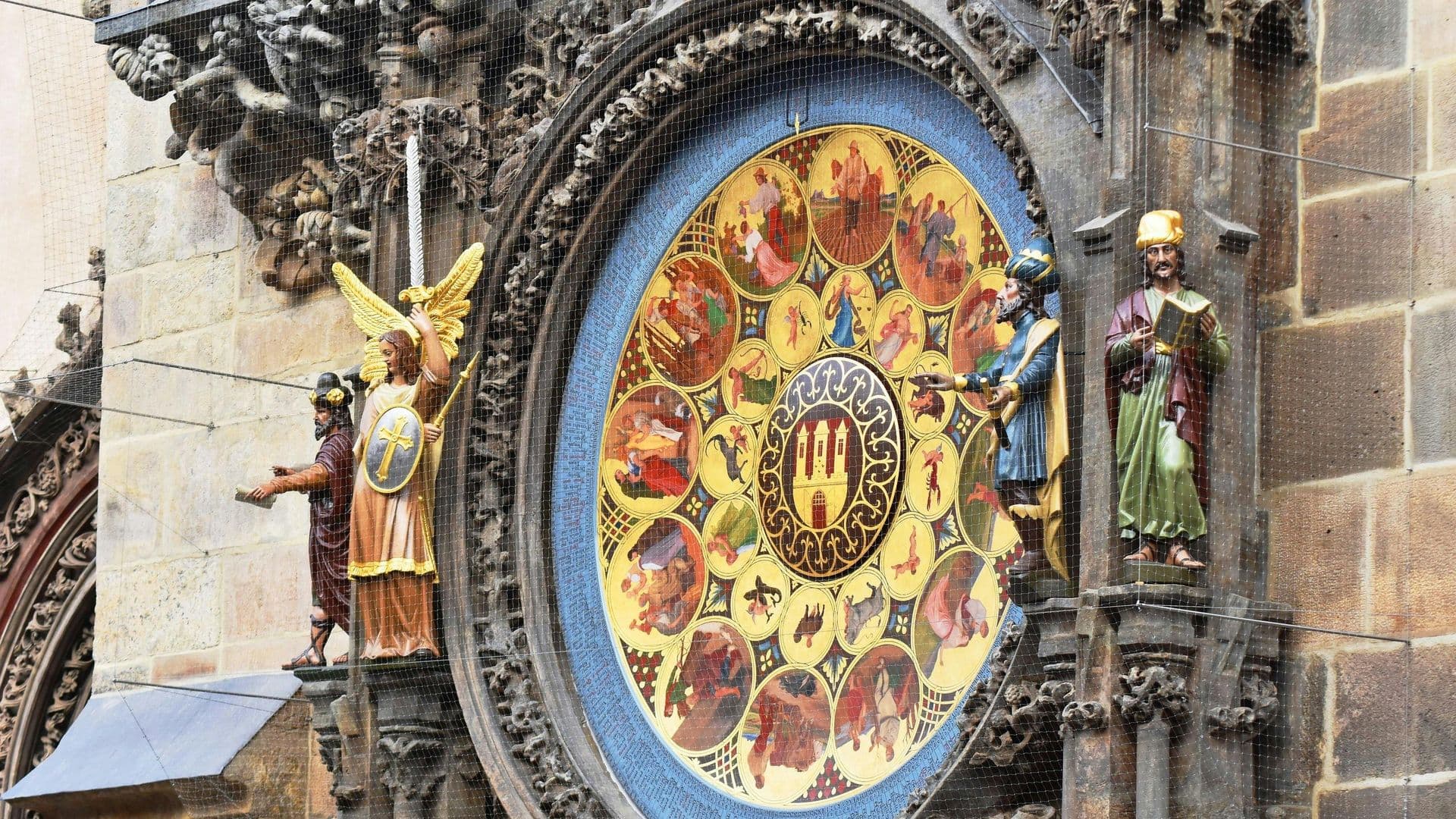
Below the astronomical dial sits a circular calendar with 365 positions, one for each day. The calendar was painted by Josef Mánes in 1865 and shows twelve medallions representing the months through scenes of Bohemian rural life — harvesting, plowing, feasting, slaughtering pigs in December. The original Mánes panels are now preserved in the Prague City Museum; the dial on the clock is a replica by Bohumír Číla.
Around the rim of the calendar, the names of saints are listed for each day — the Czech name-day calendar. The small pointer at the top indicates today's date and corresponding saint. Czechs still celebrate name days (jmeniny), so this part of the clock remains functionally relevant in daily life.
The four figures flanking the calendar dial represent Philosophy (holding a book), Astronomy (with a telescope, though this figure was added after Galileo's time), Rhetoric (a figure speaking), and History (looking back at a mirror). These don't move — they're static sculptures representing the medieval liberal arts.
3. The Hourly Show (Apostles)
This is the part that draws the crowds. At the top of the clock, two small windows open on the hour (from 9:00 to 23:00), and twelve apostle figures rotate past in sequence. Each apostle carries an attribute — Peter with keys, Paul with a sword, Matthew with an axe. The figures are small, and from street level you'll need binoculars or a zoom lens to see the details clearly.
The apostle mechanism was added during a major reconstruction in 1865–1866 and updated several times since. The current figures date from a restoration after World War II, when retreating German forces set fire to the Old Town Hall in May 1945, severely damaging the clock. Master clockmaker Hanuš Bursa led the postwar repair, and the clock resumed operation on 1 July 1948.
But the real show is in the side figures. On the hour, the sequence goes:
- Death (the skeleton on the right) rings a bell and inverts the hourglass.
- The skeleton pulls a cord that opens the windows above.
- The apostles parade past.
- Vanity (a figure admiring itself in a mirror) and Greed (a moneylender shaking a purse) both shake their heads — declining Death's invitation.
- The Turk (a figure with a turban) shakes his head.
- A rooster at the very top crows.
- The clock strikes the hour.
The whole sequence takes about 40 seconds. It's remarkably brief given how long people wait for it.
The Legend of the Clockmaker's Blinding
The most famous story about the clock is grim. According to legend, the Prague city councillors, fearing that clockmaker Master Hanuš would build a similar clock for another city, had him blinded so he could never replicate his work. In revenge, Hanuš reached into the clockwork and stopped the mechanism, which (the legend says) could not be repaired for decades.
This is a legend, not documented fact. It was popularized by the Czech writer Alois Jirásek in his 1894 collection Staré pověsti české (Old Czech Legends). The historical record is complicated: the clockmaker Mikuláš of Kadaň and the astronomer Jan Šindel are credited with the 1410 construction. A later clockmaker named Jan Hanuš (also called Master Hanuš) made repairs and improvements in 1490. The blinding story is attached to his name but has no contemporary documentary evidence.
We always tell our guests: the legend is worth knowing — it captures something real about how Prague guarded its treasures — but it should be held as a story, not a historical event.
How to Read the Time
Here's the practical version, for visitors who want to test themselves at the clock.
Stand facing the clock. Find the golden sun on the astronomical dial. Follow its position to the gold Roman numeral ring — that number is the current hour in modern 12-hour time (I through XII, repeated twice around the dial). Now check where the sun sits against the blue/brown background — if it's in the blue zone, it's daytime; in the brown zone, nighttime; in the orange strips, dawn or dusk.
For Old Czech time, find the sun against the black outer ring with golden Arabic numerals. This system counted 24 hours from sunset, so the numbers won't match your watch. The fact that this ring moves throughout the year (recalibrating for the shifting time of sunset) is one of the clock's most impressive mechanical features.
A private guide makes all the difference when exploring this part of Prague.
For the zodiac sign, note which sign the sun hand crosses on the inner zodiac ring. In April, the sun is in Aries; by July, it's in Cancer. This tells you the sun's position on the ecliptic — essentially, the time of year encoded in astronomical terms.
Best Viewing Position and Timing
Position: Stand about 10 to 15 metres back from the clock, slightly to the right of centre (as you face it). This angle lets you see both the astronomical dial and the apostle windows without craning your neck straight up. If you stand directly beneath the clock, you'll miss the apostle figures entirely.
Best time to watch the show: The first show of the day at 9:00 draws the smallest crowd. By noon, the square is packed. Late shows (20:00, 21:00) are good in summer when it's still light enough to see the figures and the crowds have thinned.
Best time for the dial: Overcast days produce even light on the clock face and reduce glare on the gold rings. Early morning sun (before 10:00) hits the clock face directly. Afternoon sun comes from behind you if you're facing the clock — good for photography.
Crowds: Summer midday is the worst. Arrive 10 minutes before the hour to secure your position. Be aware of pickpockets in the crowd — the moment when everyone looks up is when bags get opened.
After the Show — What Else to See
Don't leave immediately after the hourly show. Take time to examine the astronomical dial up close — the level of detail in the zodiac ring, the sun and moon mechanisms, and the painted calendar is remarkable and can't be appreciated from 15 metres away during the crowd surge.
Walk around to the eastern side of the Old Town Hall and look up at the Gothic oriel window and chapel. This part of the building is genuinely medieval and often ignored.
Climb the Old Town Hall Tower for a view directly down onto the clock mechanism from above. The tower also gives you the best elevated view of Old Town Square, with Týn Church, St. Nicholas Church, and the Jan Hus Memorial spread below you.
Experience It With a Private Guide
The Astronomical Clock is one of those landmarks that transforms completely when someone explains it. We stand with our guests, point out the sun and moon hands, explain the three time systems, identify the apostle figures, and tell the blinding legend with the appropriate caveats. By the time the show is over, you're not just watching — you're reading. Exclusively yours, with your own guide.
The clock is a core stop on our All Prague in One Day tour, where it fits into a full-day walk through Prague's major landmarks including the Castle, Charles Bridge, and Josefov.
Our Charles Bridge and Old Town private tour gives even more time at the square, with deeper coverage of the Old Town Hall, Týn Church, and the hidden details in the surrounding streets.
And when you want your evening to match the medieval atmosphere of a 600-year-old clock, a medieval dinner at U Pavouka Tavern puts you in a Gothic cellar with fire dancers, sword performers, and period food — the kind of evening the clock's original builders might have recognized.
Browse all our private tours from Prague.
Frequently Asked Questions
How old is the Prague Astronomical Clock?
The clock was installed in 1410, making it over 600 years old. It is the oldest working astronomical clock in the world. The apostle figures were added in the 1860s, and the clock has been repaired and restored multiple times, most significantly after World War II damage in 1945.
What time does the Astronomical Clock show run?
The apostle parade and Death figure show runs every hour on the hour from 9:00 to 23:00. Each show lasts about 40 seconds.
Is the Astronomical Clock free to see?
Yes. Watching the hourly show and examining the clock face is free — you're standing in a public square. Climbing the Old Town Hall Tower for an elevated view requires a small admission fee.
Can I see the clock mechanism inside?
The interior clock mechanism is occasionally open during special guided tours organized by the Prague City Museum. These are not regularly scheduled, so check the museum's website for availability. The tower climb does not include access to the mechanism.
Is the clockmaker blinding story true?
It is a legend, not a documented historical event. The story was popularized by the writer Alois Jirasek in the 1890s. The actual construction is attributed to clockmaker Mikulas of Kadan and astronomer Jan Sindel in 1410. A later clockmaker, Master Hanus, made repairs in 1490 — the blinding story is attached to his name but lacks contemporary evidence.
You May Also Like
Want to see Prague for yourself?
Take our flagship Prague tour-6-640x430.jpg&w=3840&q=75)