Prague Old Town Square — What to See and Hidden Details
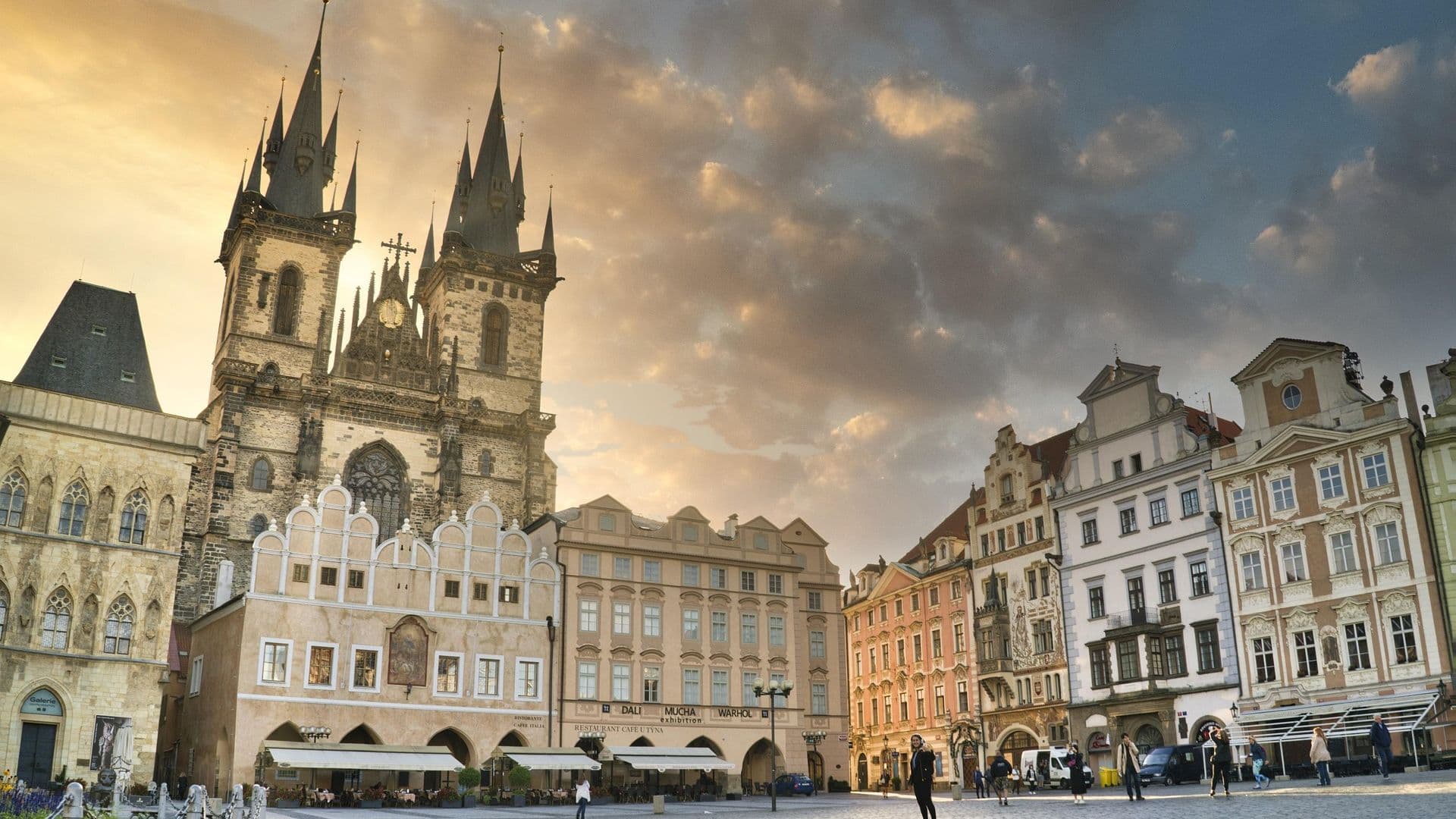
Old Town Square (Staroměstské náměstí) has been the centre of Prague life since the 12th century. Markets were held here, executions took place here, political revolutions were announced here, and today it's where almost every visitor to Prague ends up standing, slowly rotating, trying to take in the Astronomical Clock, the twin spires of Týn Church, the pastel baroque facades, and the sheer density of history packed into one public space.
Most people see the square in passing — they watch the clock strike the hour, take a photo, and move on. That's a mistake. The square rewards attention, and this guide covers the landmarks, the hidden details, and the stories that make it one of the great urban spaces in Europe.
The Astronomical Clock (Orloj)
The clock is the first thing most visitors look for, and it deserves its own section — we've written a dedicated guide to the Prague Astronomical Clock that covers the mechanics, the figures, and the legends in detail. Here's the summary.
The Prague Orloj has been running since 1410, making it the oldest working astronomical clock in the world. It has three components: the astronomical dial (showing the position of the sun and moon), the calendar dial below (with medallions representing the months), and the hourly show at the top (the parade of the Twelve Apostles that draws the crowds every hour).
The figure of Death — a skeleton holding an hourglass on the right side of the clock — rings a bell and inverts the hourglass on the hour, triggering the parade. The other figures flanking the clock represent Vanity (a figure with a mirror), Greed (a moneylender), and the Turk (shaking his head). These figures move, which is the part that makes the crowd gasp.
The best position to watch the hourly show is slightly to the right of centre as you face the clock, about 10-15 metres back. Don't stand directly beneath — you'll strain your neck and miss the apostle figures in the upper windows. Arrive 10 minutes before the hour to secure a spot.
For the full story — how to read the dials, the clockmaker blinding legend, and why the apostles replaced earlier figures — see our complete Astronomical Clock guide.
Church of Our Lady Before Týn (Týnský chrám)
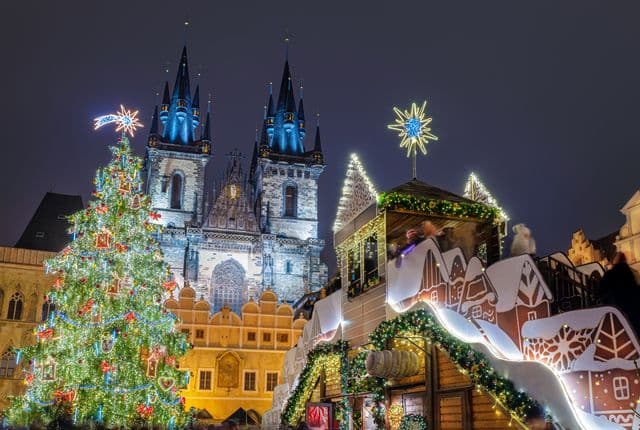
The twin Gothic spires of Týn Church define the Prague skyline from almost every angle. They rise 80 metres above the square, and their slightly asymmetrical silhouette — the northern tower is wider than the southern one — gives the church a character that perfectly symmetrical buildings lack. Some locals say the towers represent Adam and Eve.
The church was built between the mid-14th century and the early 16th century, making it contemporary with Charles Bridge and St. Vitus Cathedral. The main entrance is hidden behind a row of houses — you enter through an arcade passage, which means many visitors don't realize the church is open to the public at all.
Step inside and the contrast with the Gothic exterior is immediate. The interior is baroque, redecorated after a fire in 1679. The altarpiece by Karel Škréta and the oldest baptismal font in Prague (from 1414) are worth finding. But the most significant tomb belongs to Tycho Brahe, the Danish astronomer who served Emperor Rudolf II. He died in Prague in 1601, and his grave marker in the nave is easy to miss unless you know to look for it. The popular story that Brahe died from refusing to leave a royal banquet to use the bathroom has been revised — recent analysis of his remains suggests mercury poisoning.
Insider detail: Look at the northern tympanum above the main entrance from the square. The gold chalice that once topped the gable was a Hussite symbol — after the Catholics took control, it was melted down and replaced with a statue of the Virgin Mary. The outline of the original chalice shape is still faintly visible in the stonework if you know where to look.
Old Town Hall and the Tower
The Old Town Hall (Staroměstská radnice) is not a single building but a row of medieval houses gradually merged and adapted over centuries. The clock tower was added in 1364, and the building grew organically by annexing neighbouring houses one at a time.
The most visible scar is on the northern side. A neo-Gothic wing was destroyed by Nazi troops on 8 May 1945, during the Prague Uprising in the final days of World War II. The rubble was cleared, and the site was never rebuilt — a deliberate choice to preserve the wound as a memorial. A small park now occupies the space, and a plaque marks what happened. Most visitors walk past without knowing why the building seems to end abruptly.
Climb the tower (by stairs or lift — one of the few Prague towers with a lift) for a 360-degree view of the square and the Old Town rooftops. On a clear day, you can see Prague Castle, Petřín Hill, and the Žižkov Television Tower. The view is particularly good at sunset, when the square below fills with warm light and the long shadows of the church spires stretch across the cobblestones.
The Gothic chapel inside the hall, with its 14th-century oriel window, is often overlooked. The window faces the square and is one of the prettiest architectural details on the building, but visitors tend to bypass the interior on their way to the tower.
Jan Hus Memorial
The large monument in the centre of the square depicts Jan Hus, the Czech religious reformer who was burned at the stake in Constance in 1415 for challenging the Catholic Church. The memorial was unveiled on 6 July 1915 — the 500th anniversary of his death — and its installation was itself a political act during the Austro-Hungarian era, a statement of Czech national identity under Habsburg rule.
The sculpture by Ladislav Šaloun shows Hus standing tall among groups of Hussite warriors and Protestant exiles. The figures at the base represent the different phases of the reform movement — the fighters, the faithful, and the mothers who raised children into exile. A young mother with her child, positioned at the back of the monument, is the quietest figure and, for many visitors, the most moving.
The inscription reads: "Pravda vítězí" — Truth Prevails — which became the national motto of Czechoslovakia and remains the motto of the Czech Republic. The phrase appears on the presidential standard that flies above Prague Castle when the president is in residence.
Kinsky Palace (Palác Kinských)
The ornate rococo facade on the eastern side of the square belongs to the Kinsky Palace, built in the 1760s. It's one of the finest rococo buildings in Prague, and it now houses a branch of the National Gallery.
Two stories converge here. Franz Kafka's father, Hermann, ran a haberdashery shop on the ground floor — the same building where young Franz attended the Kinsky Palace German-language grammar school upstairs. The family business and the school occupied the same structure, which captures something about the compressed geography of Kafka's Prague.
The second story is political. In February 1948, Klement Gottwald stood on the balcony of the Kinsky Palace and declared the Communist takeover of Czechoslovakia to a crowd gathered in the square below. A photograph of that moment — Gottwald on the balcony with his comrades — became one of the most famous (and later most famously altered) images in Czech history, as figures were airbrushed out as they fell from political favour.
Franz Kafka's Birthplace
On the corner of the square closest to St. Nicholas Church, a small bust of Franz Kafka marks the site of his birth. Kafka was born on 3 July 1883 in a building that stood at the edge of what was then the Jewish ghetto. The original building was destroyed by fire; the current structure dates from the early 20th century.
The bust is modest and easy to miss — it's mounted on the corner of the building at about eye level. Most visitors walk past it without noticing, which feels oddly appropriate for a writer who spent much of his life feeling invisible in his own city.
For more on Kafka's Prague, see our Franz Kafka in Prague guide.
A private guide makes all the difference when exploring this part of Prague.
Hidden Details Most People Walk Past
- The meridian line: A brass strip is embedded in the cobblestones near the Marian Column site, marking the Prague Meridian. Before standardized time zones, this line was used to set noon — when the shadow of the (now-removed) column fell along the strip, it was twelve o'clock. The strip is still there but almost nobody notices it underfoot.
- The 27 crosses: In the pavement in front of Old Town Hall, 27 white crosses are embedded in the cobblestones. They mark the spot where 27 Czech Protestant leaders were executed on 21 June 1621, after the Battle of White Mountain. The executions were a brutal display of Habsburg Catholic authority and effectively ended Czech independence for nearly 300 years. Most visitors step on the crosses without looking down.
- The house signs: Before Prague had street numbers (which came under Habsburg reforms in the 18th century), buildings were identified by signs. Around the square and on adjacent streets, look for carved and painted signs — the House at the Stone Ram, the House at the Stone Bell, the House at the Golden Unicorn. These are medieval addresses, and some are remarkably well preserved.
- The House at the Stone Bell (Dům U Kamenného zvonu) on the eastern side of the square hides a Gothic facade behind later additions. Restoration in the 1980s uncovered the original 14th-century stonework, and today the building is split — the Gothic front is partially exposed beside the baroque plasterwork. It's a timeline in a single wall.
Practical Information
Old Town Square is open 24 hours and free to walk through — it's a public space. The Astronomical Clock hourly show runs from 9:00 to 23:00. The Old Town Hall tower is open daily (hours vary seasonally; typically 9:00–21:00 in summer, shorter in winter). Týn Church is open to visitors on certain hours (check posted signs at the entrance — hours shift frequently).
The square is busiest from 10:00 to 18:00, especially in summer and during Christmas and Easter markets. Early morning (before 9:00) and late evening (after 21:00) are the best times for a quieter experience and better photographs.
Landmarks Near Old Town Square
Old Town Square sits at the heart of Prague's historic core, surrounded by architectural gems that reward a closer look. Step a few streets in any direction and you will find Gothic towers, Baroque libraries, and one of the city's most photographed modern buildings.
- Church of Our Lady before Tyn -- the twin-spired icon of Old Town
- Powder Tower -- climb a medieval gate for panoramic views
- Klementinum -- Prague's stunning Baroque library and astronomical tower
- Dancing House -- the story behind Prague's most unusual building
Old Town Square is stunning on its own, but most visitors leave after watching the Astronomical Clock and snapping a few photos without realizing they missed the best parts. Hidden courtyards, underground cellars, and stories that no plaque will ever tell you are all within a few steps of where you are standing. Curious about what a private guide shows you beyond the square? Our dedicated Old Town tour article maps out everything a guided walk uncovers.
Experience It With a Private Guide
Old Town Square is where we spend some of our best time with guests, because the layers don't reveal themselves without context. We stand where the executions happened and explain why. We point out the crosses in the pavement, the house signs, and the meridian line. We tell the Kinsky Palace stories — Kafka and Gottwald — in the same breath, because that's what Prague does: it stacks centuries on top of each other and asks you to sort them out. Exclusively yours, with your own guide.
Our All Prague in One Day tour includes the square as a core stop, integrated with Prague Castle, Charles Bridge, and the other landmarks in a route that makes the city's geography and chronology click.
The Charles Bridge and Old Town private tour gives the square even more time, with a deeper dive into the side streets, the Jewish Quarter, and the details of the buildings.
And for an evening that matches the medieval energy of the square, a medieval dinner at U Pavouka Tavern takes you into a Gothic cellar with fire performers, roast meats, and music — the kind of evening you'll remember alongside the clock.
Browse all our private tours from Prague.
Frequently Asked Questions
Is Old Town Square free to visit?
Yes. The square is a public space open at all times. The Astronomical Clock hourly show is free to watch. Climbing the Old Town Hall tower and entering some buildings require a small admission fee.
How long should I spend at Old Town Square?
At least 30 to 45 minutes to see the main landmarks and watch the clock show. With a guide covering the hidden details and interior visits, plan for 60 to 90 minutes. The square is also a natural place to pause for coffee and people-watching.
When is the best time to visit Old Town Square?
Early morning (before 9:00) for quiet and good photography light. Late evening (after 21:00) for atmosphere and fewer crowds. Midday is the busiest period year-round.
Can I go inside Tyn Church?
Yes, but hours are limited and variable. The church opens for tourist visits on certain hours (typically 10:00-13:00 and 15:00-17:00, but this shifts). Check the signs at the entrance. Services are open to anyone, but tourist photography during services is not appropriate.
Where is the nearest metro station?
Staromestska station (Line A, green) is a five-minute walk north of the square. Mustek station (Lines A and B) is a five-minute walk south, at the top of Wenceslas Square.
You May Also Like
Want to see Prague for yourself?
Take our flagship Prague tour-6-640x430.jpg&w=3840&q=75)