Blatná Water Castle — Bohemia's Most Underrated Fairy Tale
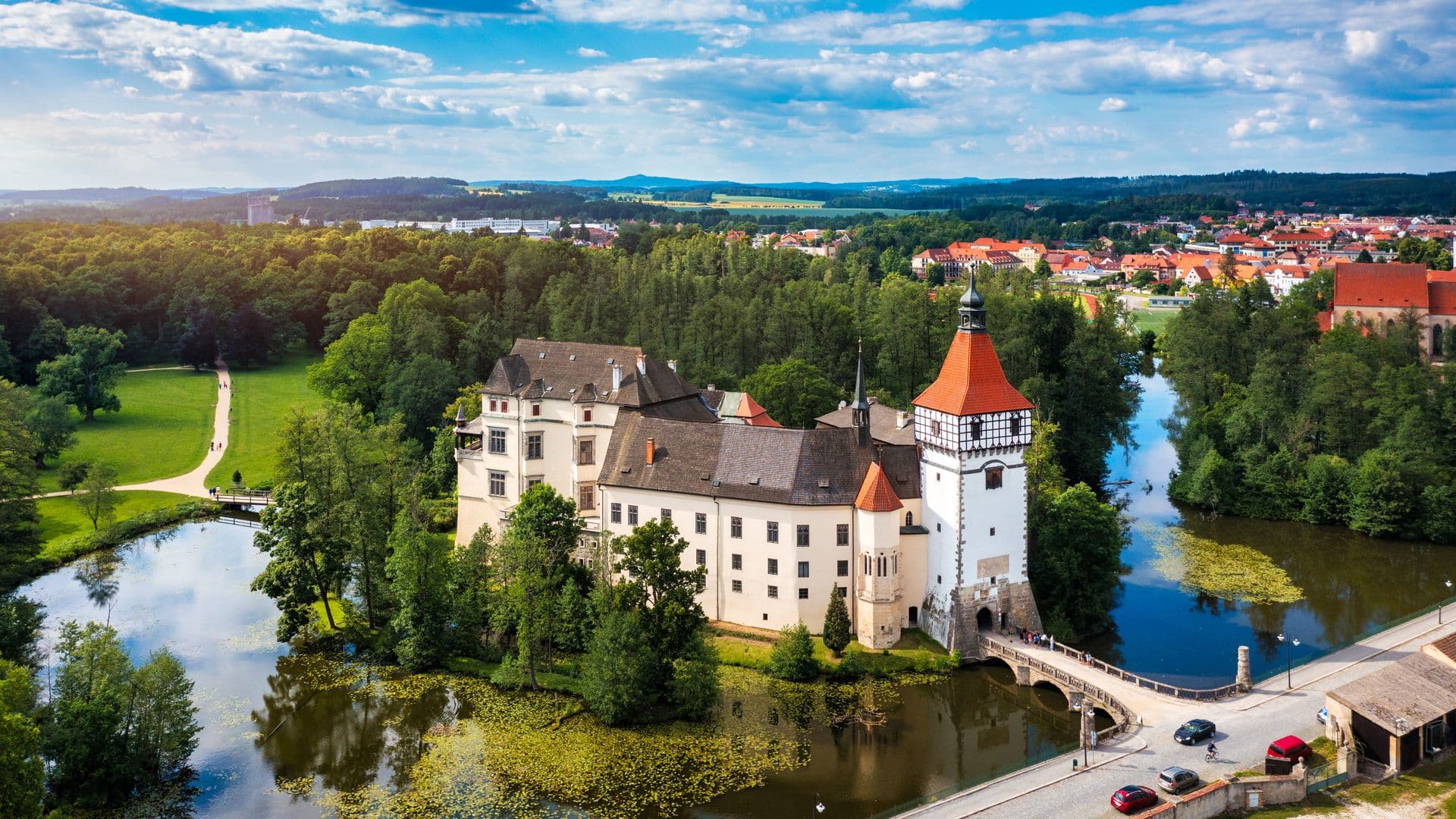
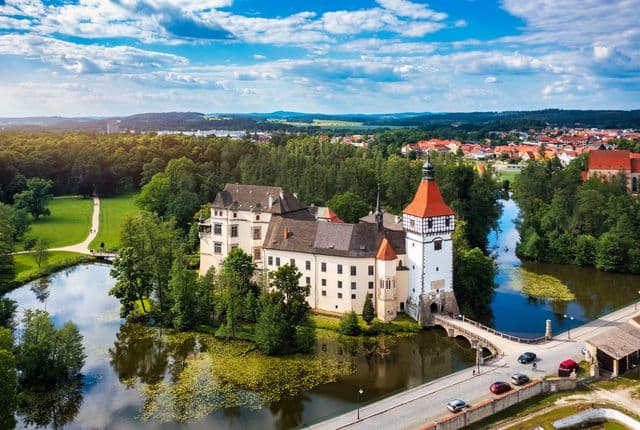
Blatná Castle is a moated "water castle" in South Bohemia, roughly 100 km southwest of Prague — one of only three preserved Czech water castles, alongside Švihov and Červená Lhota. First recorded in 1235, it has been home to the Hildprandt family since 1798 and is still privately owned by their descendant today. The big draw is the 42-hectare English park, open year-round, where a herd of tame fallow deer graze close enough to hand-feed. Castle interiors are shown on guided tours mainly from April to October; the park is open all year. By car it's about about 1.5 hours via the D4; by public transport it's slower and more involved. A private day trip to Blatná Castle turns a tricky journey into a door-to-door story — castle, family history and deer park in one unhurried day.
Most visitors come to the Czech Republic for Prague, Český Krumlov and a castle or two near the capital. Blatná is the one almost nobody has on the list — and it's the one our guests tend to talk about on the drive home. It is not the biggest castle in Bohemia, nor the most famous. What it has instead is rarer: water on all sides, a Gothic tower reflected in a still pond, a family that has lived through eight centuries of Czech history, and a park full of deer that will eat out of your hand.
We bring travellers here as an unhurried day trip, and the reaction is almost always the same — surprise that something this lovely is this quiet. Here is what makes Blatná worth the drive, the history behind the walls, and exactly how to visit Blatná Castle from Prague.
What Is a Water Castle — and Why Blatná Is Special
A water castle is exactly what it sounds like: a fortress built on an island or a knoll in the marshes, defended by water instead of a hilltop. The Czech Republic has thousands of castles, but only three water castles survive in good condition — Blatná, Švihov in the Plzeň region, and Červená Lhota near Jindřichův Hradec. Blatná is widely considered the best-preserved all-rounder of the three.
The name says everything about the setting. "Blatná" comes from blata, the Czech word for marshes — the boggy ground that made the moat possible in the first place. Approach the castle on a calm morning and the white Gothic tower doubles itself perfectly in the surrounding pond. It is the kind of view that needs no explanation.
Blatná Castle History — Eight Centuries on One Island
Blatná's story begins in 1235, when the site is first mentioned in writing as the seat of a minor nobleman named Vyšemír. By 1241 it had the formal status of a castle, linked to knightly orders that protected pilgrims bound for the Holy Land. The early stone work, the Romanesque chapel and the moat are all credited to the Bavors of Strakonice, who held Blatná until their male line died out in 1403.
The estate then passed to the Rožmitál family, and this is where Blatná briefly stepped onto the European stage. Jaroslav Lev of Rožmitál led a remarkable diplomatic mission between 1465 and 1467 — a delegation of forty Bohemian lords and knights that travelled across the courts of Western Europe to promote peace. He came home full of architectural ideas and poured them into Blatná, adding the Gothic entrance tower and chapel. His sister, Johanna of Rožmitál, did even better: she became Queen of Bohemia in 1458 as the wife of King George of Poděbrady — the only Czech queen drawn from the domestic nobility.
The castle's architectural high point came soon after, when the royal architect Benedikt Rejt built its Gothic-Renaissance palace (1523–1530). Rejt is no minor name — he is the master builder behind Vladislav Hall at Prague Castle (1493–1502), the largest secular medieval room in the city. To stand inside Blatná is to stand inside the work of the same hand that shaped Prague Castle itself.
After the Rožmitáls came the Rozdražov family, then the Hungarian-rooted Serényi family from 1695, who gave the castle a Baroque layer. Then, in 1798, Václav Karel Hildprandt of Ottenhausen — a noble family originally from Tyrol — bought Blatná. With one brutal interruption, the Hildprandts have held it ever since.
The Hildprandts — A Family That Came Back
If you visit one castle near Prague for its human story rather than its furniture, make it this one. The Hildprandt family's twentieth century reads like a novel.
After the Communist coup, the estate was confiscated in 1948, and in 1952 the family was forcibly evicted — banned, by the order of the day, from living closer than 11 kilometres to their own home. Baron Bedřich Hildprandt, his wife Cornelia ("Nella") and their two daughters were pushed out into ordinary working life.
Then came one of the strangest rescues in Czech history. When the Ethiopian Emperor Haile Selassie made a state visit to Czechoslovakia in July 1959, he personally asked President Novotný to let the Hildprandts emigrate. The connection ran through Cornelia's father, the diplomat Ferdinand Veverka — whose own castle at Dolní Lukavice had also been confiscated, and who, after reaching Ethiopia himself, drew the Emperor's attention to the fate of his daughter and her family. The Hildprandts were allowed to leave for Ethiopia, where Bedřich was entrusted with the supervision of the imperial stud farm and Cornelia worked as an interpreter at the local UN headquarters.
When Selassie was deposed, the family moved on again — first to the Balearic Islands, then to Germany, where Bedřich died in 1981. He never saw Blatná again. But in 1992, after the Velvet Revolution, Cornelia returned with her daughter Jana and Jana's Greek husband, the architect Spyridon Germenis. The castle was theirs again.
Who Owns Blatná Castle Today
Blatná is still a private family home. The current owner is Stephanos Germenis-Hildprandt, born in Athens in 1981, a former London banker who took over the running of the estate in 2014. He represents the line that fled to Ethiopia and came home — and he treats the castle, in his own words, as something to hand on in better shape than he found it.
One detail charms every visitor: the family does not actually live in the castle. They live in a smaller Empire-style house in the park — warmer, easier to heat, and a good deal more comfortable than a damp medieval palace surrounded by water.
What Is Blatná Famous For — The Deer Park
For most visitors, the answer to "what is Blatná famous for" is simple: the deer. The castle sits inside a 42-hectare English landscape park — created by Franz Hildprandt in the 19th century — with streams, bridges, ancient oaks and winding paths. It is open year-round, and it is genuinely lovely in any season.
What makes it unforgettable is the resident herd of fallow deer. Jana Germenis, showing a Radio Prague International journalist around her family's park, put the number plainly: there are some 60 fallow deer here. The herd has been self-sustainable and flourishing ever since her forebears introduced it. They are remarkably tame and used to people. Deer feed is sold in small portions at the gate, and you can hand-feed them — the single best reason to bring children. Peacocks wander the grounds too, sometimes showing off from the rooftops.
One word of caution we always pass on: during the autumn rut, roughly October to December, the bucks are not pets. Keep your distance, keep children close, and admire them from a respectful few metres. The rest of the year, they are as gentle as the setting.
The Town of Blatná — Roses and Electric Guitars
The town wrapped around the castle is small — about 6,700 inhabitants in the South Bohemian Region — but it punches above its weight in trivia. Blatná is known as a "city of roses," thanks to the rose grower Jan Böhm, and, more surprisingly, as the birthplace of the Resonet electric guitar, made here in the 1950s. There is a granite plaque at the courtyard entrance commemorating the scientist Jan Evangelista Purkyně, who tutored the Hildprandt children at the castle from 1810 to 1813 before going on to a career that put his name on cells in the human brain and heart.
The castle's present neo-Gothic look, incidentally, comes from renovations carried out between 1850 and 1856 by the Munich architect Bernard Grüber — the romantic silhouette you photograph today.
How to Visit Blatná Castle From Prague
Blatná lies about 100 km southwest of Prague, and getting there is the one real catch. Here are your options.
By car is easiest — roughly about 1.5 hours via the D4 motorway and Route 4. This is the option we recommend for anyone who values their time, and it's how our private Blatná water castle tour runs: door to door, no changes, no waiting on a rural platform.
By bus, there is a direct service from Prague's Smíchov bus station that takes around 1.5 hours, but departures are limited to a few a day, so the timetable dictates your whole trip.
By train is the scenic-but-slow choice: expect 2.5 hours or more with at least one change, on regional branch lines. Beautiful if you have the day to spare, frustrating if you don't.
Whichever way you arrive, note that the bus and train stations sit about 1.5 km from the castle gate — a flat, pleasant walk through town.
When Is Blatná Castle Open
The park is open year-round, daily, and is the main event for many visitors — you can walk the grounds and meet the deer in any season. The castle interiors are shown on guided tours mainly from April to October, on a seasonal calendar that expands to daily tours in July and August and narrows to weekends and holidays in the shoulder months. Tours run in Czech with English available, and English-language slots can fill up, so it's worth planning ahead. Because the schedule shifts month to month, we always confirm current tour times before a visit — one of the quiet advantages of going with a guide who makes the call for you.
Blatná, Švihov and Červená Lhota — The Three Water Castles Compared
If you fall for water castles, here is how the trio compares. Blatná is the all-rounder — a layered Gothic-to-Renaissance complex with the unbeatable bonus of the deer park. Švihov is the stout Gothic fortress, also touched by Benedikt Rejt, and familiar to Czechs as a filming location for the beloved fairy tale Three Nuts for Cinderella. Červená Lhota is the picture-postcard red Renaissance château on its island — though at the time of writing its pond has been drained for reconstruction of the historic Renaissance dam, so the famous mirror-image reflection (and the boat rides) are on hold. Of the three, Blatná is the one we'd send a first-timer to.
Photographing Blatná
This is a photographer's castle. Come at golden hour for the reflection shots, when the white tower glows against still water. Walk the full park circuit for angles that frame the castle through trees and across the pond. And get low for the deer — at eye level, with the castle soft behind them, you'll come home with the picture that sells the whole trip.
Visit Blatná Castle With Us
Blatná is a place that rewards a guide. The driving is the hard part, the family story is the part you'd never get from a panel, and the deer park is the part that makes everyone smile. On our private day trip to Blatná we handle the door-to-door logistics, time the visit to the castle's seasonal tour calendar, and tell the Hildprandt story as we walk the park. Exclusively yours, with your own guide, at your own pace.
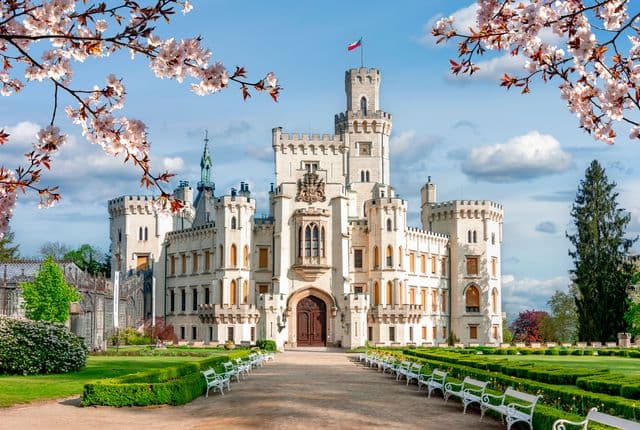
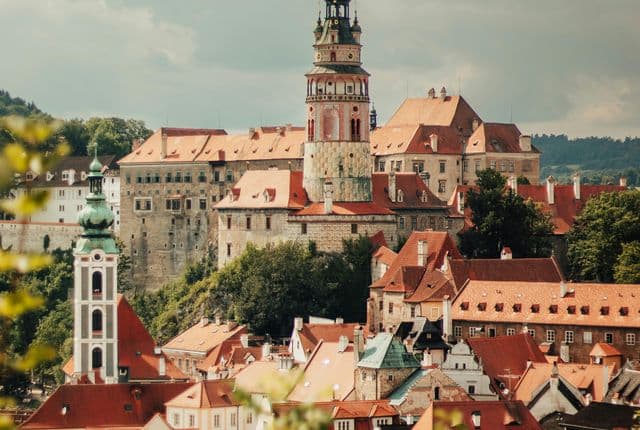
Prefer one of the better-known castles, or want to pair Blatná with another stop? We also run private trips to Hluboká Castle, the romantic town of Český Krumlov, Konopiště, and Karlštejn.
Ready to go? Book your Blatná Castle day trip. Pay by card online in advance OR in cash on the day. We never take card payments on site. Cancellation is free up to 24 hours before your tour.
FAQ
Who owns Blatná Castle?
Blatná is still privately owned by the Hildprandt family, who bought the estate in 1798. The current owner is Stephanos Germenis-Hildprandt, born in Athens in 1981 and a former London banker, who took over running the castle and grounds in 2014. The family lives in an Empire-style house in the park rather than in the castle itself.
Can you feed the deer at Blatná?
Yes. A herd of around 60 tame fallow deer roams the castle park, and deer feed is sold in small portions at the gate so you can hand-feed them. The one rule: keep your distance during the autumn rut, roughly October to December, when the bucks become unpredictable.
What is Blatná famous for?
Blatná is famous for being one of only three preserved water castles in the Czech Republic and for its deer park, where tame fallow deer and peacocks roam a 42-hectare English landscape garden. History lovers know it for the Hildprandt family, who emigrated to Ethiopia under Emperor Haile Selassie and returned after the Velvet Revolution.
How old is Blatná Castle?
The site was first recorded in 1235 and had the status of a castle by 1241, making it nearly 800 years old. What you see today blends Gothic, Renaissance, Baroque and 19th-century neo-Gothic work — including a palace by Benedikt Rejt, the architect of Prague Castle's Vladislav Hall.
How do you get to Blatná from Prague?
By car it's about about 1.5 hours via the D4 motorway, the easiest option. A direct bus from Prague's Smíchov station takes around 1.5 hours but runs only a few times a day, and the train takes 2.5 hours or more with a change on regional lines. A private day trip removes the transport headache entirely.
When is Blatná Castle open?
The park is open year-round, daily. The castle interiors are shown on guided tours mainly from April to October, with daily tours in July and August and reduced weekend hours in the shoulder months. English-language tour slots can fill up, so it's best to plan ahead.
What are the three Czech water castles?
The three preserved water castles in the Czech Republic are Blatná, Švihov (a Gothic fortress in the Plzeň region) and Červená Lhota (a red Renaissance château near Jindřichův Hradec). Blatná is generally regarded as the best-preserved of the three.
Is Blatná Castle worth visiting?
If you want a quieter, more personal castle experience than the big-name day trips offer, yes — emphatically. The combination of a moated fairy-tale setting, a genuinely moving family history and a hand-feedable deer park is something none of the famous castles near Prague can match. It's our pick for travellers on a second or third visit who want to see a side of Bohemia most people miss.
Want to see Prague for yourself?
Visit Prague Castle on our tour