Cesky Sternberk Castle: Visitor Guide & Day Trip from Prague
Quick Answer
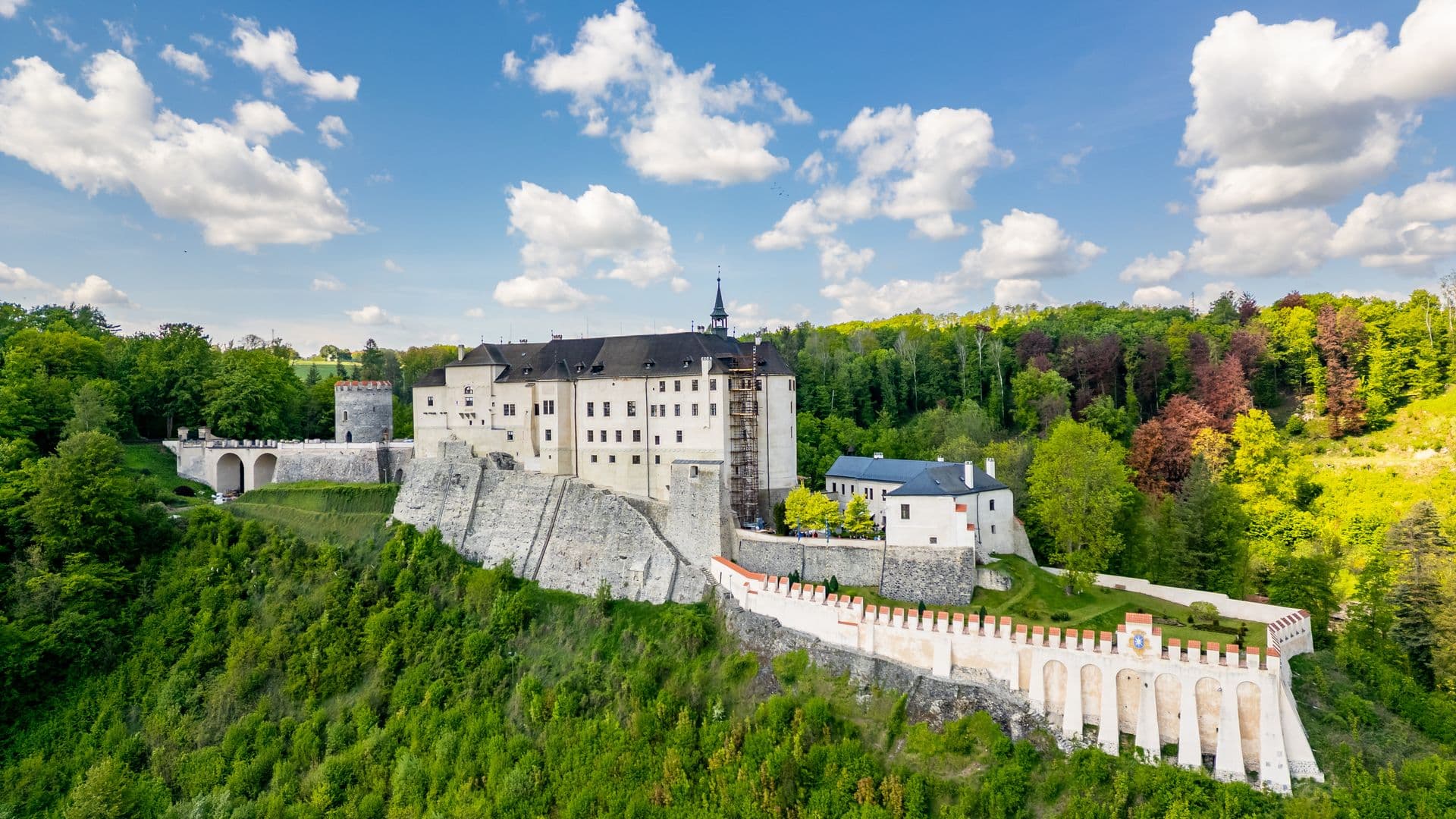
Český Šternberk Castle is an early Gothic castle perched on a granite cliff above the Sázava River, 39 km southeast of Prague. Built in 1241, it has been owned by the same family — the Sternbergs — for nearly 800 years (with two historical gaps), making it one of the few castles in Europe still in the hands of its founding family. Visitors tour 15 richly furnished rooms with a guide; tour duration is around one hour. Open weekends and holidays April–October; winter visits by prior arrangement. Reachable by car (about 1 hour via D1 motorway) or train (about 2 hours via Čerčany).
Table of Contents
- What Is Český Šternberk Castle?
- Getting There From Prague
- Nearly 800 Years in One Family
- The Sternberg Family Today
- What You'll See on the Tour
- Tickets, Hours, and Practical Info
- Combining With Other Day Trip Sites
- Who This Day Trip Suits
- Tips from a Licensed Prague Guide
- Frequently Asked Questions
Most day-trippers from Prague head west to Karlštejn or south to Český Krumlov. Those castles are spectacular and deserve their fame. But if you ask us — and we've been guiding visitors around Bohemia for 17 years — the most affecting castle within an hour of Prague is the one most foreign tourists have never heard of: Český Šternberk.
There's a reason. Český Šternberk isn't a tourist machine. It's a private home. The Sternberg family built it in 1241 and, with two short interruptions, has lived there ever since. The current administrator, Filip Sternberg, took over after his father's death in 2021. His ancestor, Zdeslav of Divišov, started construction nearly 800 years ago. That continuity — same family, same walls, same eight-pointed star carved into stone above the gate — is something Karlštejn and Český Krumlov, magnificent as they are, simply cannot offer.
This guide explains everything you need to know to plan a visit: how to get there, what to expect on the guided tour, the family's remarkable history, and how Český Šternberk fits into a Czech day trip.
What Is Český Šternberk Castle?
Český Šternberk is an early Gothic castle in Central Bohemia, in the Benešov District of the Czech Republic. It stands on top of a steep granite cliff on the western bank of the Sázava River, in the small market town that shares its name. The castle is widely considered one of the best-preserved Gothic Bohemian castles still standing, and it carries a distinction shared by very few European castles: it has been continuously owned by members of the same founding family since 1241, with only two interruptions in nearly eight centuries.
The name "Šternberk" comes from the German *Sternberg* — *Stern* meaning "star" and *Berg* meaning "mountain" — and originates with the eight-pointed golden star on the founder's coat of arms. That star still appears throughout the castle today and remains the heraldic emblem of the Sternberg family.
Locally, Český Šternberk is sometimes called the "Pearl of Posázaví" — Posázaví being the river valley region the castle dominates from its hilltop perch.
Getting There From Prague
Distances and travel times
Route | Distance | Travel time |
|---|---|---|
Drive via D1 motorway | 39 km | About 1 hour |
Train (Praha hl.n. → Čerčany → Český Šternberk) | — | About 2 hours each way |
By car
The drive is straightforward — head southeast on the D1 motorway, exit toward Český Šternberk, and follow signs through small Bohemian villages to the castle. Plan around an hour each way. Parking is available right at the foot of the castle hill.
By train
Take a train from Prague's main station (Praha hlavní nádraží) toward Čerčany or Světlá nad Sázavou. From Čerčany, switch to the local branch line that stops in Český Šternberk. The total journey time is around two hours each way. The train is scenic — the line follows the Sázava River through forested countryside — and lands you in the village a short walk below the castle.
The walk from the train station to the castle gate takes about 10–15 minutes, mostly uphill.
By organized tour
Many Prague-based tour operators run private day trips that combine Český Šternberk with Konopiště Castle — the two work together because they're close to each other and tell complementary stories of Czech aristocracy. We arrange this combination as a private tour with hotel pickup; see our contact page for details.
Nearly 800 Years in One Family
The story of Český Šternberk is, more than anything, the story of the Sternberg family.
In 1241, a Bohemian nobleman named Zdeslav of Divišov built a stone castle on the granite ridge above the Sázava. The site combined natural defenses — a steep cliff, the river below, forested approaches — with an ambitious investment in stone construction. Zdeslav adopted a new name to mark the occasion: he called himself "of Sternberg," after the eight-pointed star (*Stern*) on his family arms. From that moment, the Divišov family name disappeared and the Sternbergs were born.
The early centuries brought defensive challenges. The development of long-range firearms in the 14th century made the original 13th-century walls vulnerable, and the family responded with substantial fortification work — the three-story northern tower and connecting ramparts you can still see were added during this period.
The castle's only military defeat came in 1467, when King George of Poděbrady captured it during the religious and political conflicts of that era. The Sternbergs had backed the wrong side: Zdeněk of Sternberg led the Zelenohorská jednota, a Catholic noble league that opposed the Hussite king. The castle was damaged in the siege.
Within a generation, the family had reclaimed the castle and rebuilt it, adding the cylindrical southern tower and the dungeon to the north. By the early 16th century, Český Šternberk had been transformed into a stronger, more sophisticated fortress.
The Thirty Years' War (1618–1648) brought another crisis. Swedish forces threatened the region, and the castle saw famine and attacks but no successful capture. After the war ended, the Sternbergs invested in early Baroque renovations, transforming the interior from medieval stronghold into noble residence. The most spectacular work came in 1760, when the master Carlo Brentano completed elaborate stuccowork in the main halls — work still on display today.
The first interruption to Sternberg ownership came in 1712, when the local Holic branch of the family died out and the castle passed to other noble families. It returned in 1841, when Zdeněk of Sternberg from the Konopiště branch bought it back.
The second interruption was darker. The Communist government nationalized the castle in 1949. The family was given two small rooms in the building and stripped of ownership. Remarkably, Jiří Sternberg, the displaced patriarch, agreed to work as a steward in his own former home — giving guided tours to visitors of his ancestral property under the very government that had seized it. During his years as steward, he carefully catalogued the contents of the castle room by room, an act of preservation that proved invaluable when restitution laws restored the castle to his son Zdeněk Sternberg in 1992 after the Velvet Revolution. Many of the original family possessions could be located and returned only because of Jiří's careful records. Jiří himself did not live to see restitution — he died in 1965, and the family went into exile in 1968.
Zdeněk Sternberg lived in the castle and acted as its public face for almost three decades after restitution, becoming a beloved figure in Czech cultural life. He died in 2021. The castle is now administered by his son Filip Sternberg.
The Sternberg Family Today
The Sternbergs are one of the oldest still-existing noble families in the Czech lands. Their cultural footprint goes far beyond a single castle: family members helped found the National Museum in Prague, established the country's first art academy, and built Troja Chateau and Šternberk Palace in central Prague — the latter now home to part of the National Gallery's collection.
The family also still owns Jemniště Chateau, a Baroque country residence about 30 km southwest of Český Šternberk, also open to visitors. If you have time for a longer day trip, visiting both is possible.
What makes Český Šternberk feel different from most castles you'll visit is precisely this continuity. The portraits on the walls are family ancestors. The furniture has been used for generations. The library books are not props. The eight-pointed star carved above doorways is the same emblem the family used in the 13th century. The visit is closer to seeing a private home that happens to be 800 years old than to walking through a museum.
What You'll See on the Tour
All visits to Český Šternberk are guided tours only — there is no walk-around-on-your-own option. Czech-language tours run frequently (often every 30 minutes in peak season). English-language tours are available but on a more limited schedule and at higher cost; book ahead, especially in summer.
The standard tour covers 15 richly furnished rooms representing several historical periods, from Gothic foundations to 18th and 19th-century furnishings. Highlights include:
The Knights' Hall — typically the first room on the tour. It dates to around 1500 and features ornate 17th-century stucco on the walls and ceiling. Coats of arms relating to family marriages and political alliances cover the walls, including one commemorating the wedding of King George of Poděbrady to Kunhata of Sternberg.
The Hunters' Hall — decorated with hunting trophies from generations of family hunts.
The Library — holds approximately 3,500 books, many original to the family collection. Old leather-bound volumes line the walls floor to ceiling.
The Chapel — small, intimate, used historically by family members for private worship.
The Salons and Dining Room — Baroque and Rococo furniture, Renaissance chests, and family portraits across multiple generations.
The Šternberk Engraving Collection — one of the castle's most distinctive treasures. The Sternbergs assembled 545 copper engravings depicting episodes of the Thirty Years' War, considered one of the largest single-theme engraving collections in Europe. The collection is exhibited within the tour route.
The tour involves climbing approximately 120 steps as you progress through the castle's levels. There is no lift. Visitors with significant mobility limitations should consider this carefully before booking.
In summer, a falconry demonstration runs in the castle courtyard — falconry was inscribed on the UNESCO Intangible Cultural Heritage list in 2010, and these displays are popular with families. Schedules vary; check the official site before traveling.
A small café operates near the castle entrance, serving Czech soup, light meals, and drinks during the main season. Off-season, food options are reduced.
Tickets, Hours, and Practical Info
Opening hours
Český Šternberk does not work like a walk-in attraction — interiors are accessible only through scheduled guided tours. Check the official website before traveling, as schedules shift through the year.
Period | Schedule |
|---|---|
April | Weekends and holidays only |
May | Tue–Fri 10 AM and 1 PM; weekends and holidays hourly 10 AM–3 PM |
June–August | Tuesday through Sunday, 9 AM–6 PM, tours every 30 minutes |
September | Daily except Monday |
October | Reduced schedule (Sundays, then weekends only) |
November–March | Visits by prior arrangement only |
Closed: December 22 to December 26 (Christmas closure). The last tour each day starts approximately one hour before closing.
Tickets
Ticket prices vary by tour language and visitor age. Czech-language tours are the standard option (lower cost). English-language tours are available but at a noticeably higher cost — book in advance, especially in summer. Some visitors take the Czech tour with a printed multilingual leaflet provided free at the ticket desk.
Photography permits inside the castle cost extra — the staff will explain at the ticket desk if you want to photograph the interiors.
For current ticket prices, exact tour times, and to book English-language tours in advance, see the official site at hradceskysternberk.cz.
Parking
Parking is available right below the castle hill at modest rates — paid by hour or by day. A free parking area exists closer to the castle near the river but it's small and fills early in peak season. Arrive before 10 AM for the best chance.
Accessibility
The castle is built on a steep cliff. The walk from parking to the gate is uphill on uneven surfaces. Once inside, the tour climbs roughly 120 steps. Český Šternberk is not suitable for visitors with significant mobility limitations.
Address and contact
Hrad Český Šternberk, 257 27 Český Šternberk 1 Tel: +420 317 855 101 Email: info@hradceskysternberk.cz
Combining With Other Day Trip Sites
Český Šternberk is best combined with one or two other sites in the same region for a fuller day. Three pairings work especially well:
Sázava Monastery (12 km away)
The Sázava Monastery, just 12 km downstream, was a major center of Slavic education from 1032 until its closure in the 18th century. Its most famous treasure is the Sázava Madonna, a unique Gothic statue depicting Mary disciplining the young Jesus — believed to be the only such depiction in the world. The monastery is small, peaceful, and a natural complement to a castle visit.
Konopiště Castle (about 30 km away)
Konopiště is the four-winged château that Archduke Franz Ferdinand of Austria turned into his private residence. He was the heir to the Austro-Hungarian throne whose assassination in Sarajevo in 1914 triggered World War One. The château preserves his extensive hunting trophy collection, his weapon collection, and the rooms where he lived — a poignant glimpse into the world that ended in 1914. Pairing Konopiště with Český Šternberk is one of the most satisfying day trips from Prague: two castles, two very different aristocratic stories, both within an hour of the city.
Jemniště Chateau (about 30 km away)
The other Sternberg-owned property — Jemniště Chateau — is a Baroque country residence that contrasts beautifully with Český Šternberk's medieval atmosphere. Same family, two different eras of Czech noble life.
For a comprehensive Prague-and-castles experience, our Best of Prague Car Tour can be combined with day-trip extensions to Český Šternberk and Konopiště. For a deeper day trip focused on castles, see our day trips from Prague guide.
Who This Day Trip Suits
Best for travelers who've already seen Karlštejn
If you've visited Karlštejn and Český Krumlov and want a less-crowded castle experience, Český Šternberk is the natural next step. You'll meet far fewer foreign tourists, and the family-home atmosphere is unique among Czech castles.
Best for history-minded visitors
The 800-year continuous family ownership story, the Communist-era seizure and restitution, and the medieval-to-Baroque architectural layers make Český Šternberk a richer historical experience than its modest size suggests. If you read history while traveling, this is an excellent half-day investment.
Best for travelers with a car or willing to take a longer train ride
The drive is easy and quick. The train works but takes longer than driving. This is not a quick stop you can squeeze in between other Prague activities.
Best for couples and small groups
Český Šternberk feels intimate. Tours are small (often fewer than 20 people in off-season), and the castle's quiet hilltop setting makes it ideal for an unhurried half-day rather than a rushed group itinerary.
Possibly not for you if
- You have significant mobility issues — the 120 steps inside the castle and the uphill walk from parking are unavoidable
- You want a flexible self-guided visit — all tours are guided and follow fixed schedules
- You're visiting in winter without prior reservation — November through March is by appointment only
- You expect English signage and audio guides — this is a Czech-family-run castle, English support is more limited than at major state-run sites
- You want spectacular imperial scale — Český Šternberk is a noble residence, not a royal palace
Tips from a Licensed Prague Guide
Book English-language tours in advance. Czech tours run frequently; English tours are scheduled at fewer times and fill up in summer. Email the castle a week or more ahead during peak season.
Take the printed leaflet. Even if you're on a Czech-language tour, the staff provide free printed translations in several languages. The translation is good enough to follow the guide's narration.
Arrive early in peak season. Parking fills by mid-morning on summer weekends. The first tour at 9 AM is also the smallest and quietest of the day.
Combine with Sázava Monastery for a half-day, with Konopiště for a full day. Český Šternberk on its own takes about 90 minutes (tour + grounds). Adding one nearby site fills the day comfortably without rushing.
Wear sturdy shoes. The walk from parking to the castle gate is on uneven cobbles and a steep slope. Inside the castle, expect old stone steps that aren't always level.
Time your visit for autumn if you can. September and early October offer thinning crowds, golden hillside colors along the Sázava, and pleasant temperatures for the uphill walk.
Don't expect a gift shop or café spectacle. This is a working private home. The cafe is modest, the gift shop is small. Don't go expecting tourist-trap commerce; that's part of the charm.
Ask the guide about the Communist years. If your guide speaks English and you have time, ask about the family's life during 1949–1992. The story of Jiří Sternberg cataloguing his own confiscated property is one of the most moving in Czech aristocratic history, and most printed materials don't cover it in depth.
Frequently Asked Questions
Where is Český Šternberk Castle?
Český Šternberk Castle is in Central Bohemia, 39 km southeast of Prague along the D1 motorway. The castle stands on a granite cliff above the Sázava River, in the small market town of the same name in the Benešov District.
How do I get to Český Šternberk Castle from Prague?
The fastest way is by car — about 1 hour via the D1 motorway. By train, take a service from Prague's main station (Praha hlavní nádraží) toward Čerčany, then change to the local Sázava line that stops in Český Šternberk. The full train journey is around 2 hours each way, plus a short uphill walk from the station.
Is Český Šternberk Castle worth visiting?
For most travelers — especially those who have already seen Karlštejn or Český Krumlov — yes. Český Šternberk is one of the few European castles still continuously owned by its founding family (since 1241). The intimate guided tours, the Communist-era seizure-and-return story, and the dramatic hilltop setting above the Sázava combine into a memorable visit. It is, however, less spectacular than Karlštejn for first-time Czech castle visitors who want maximum drama.
Who owns Český Šternberk Castle?
The Sternberg family has owned Český Šternberk since founding it in 1241, with two historical interruptions: the Holic branch died out in 1712 (returned to the family in 1841), and the Communist government nationalized the castle in 1949 (returned in 1992 under restitution law). Zdeněk Sternberg, the post-restitution owner, died in 2021. His son Filip Sternberg now administers the castle.
Can you go inside Český Šternberk Castle?
Yes, but only on a guided tour. There is no self-guided walking access to the interior. Czech-language tours run frequently in peak season; English-language tours are available but on a more limited schedule and should be booked in advance.
How long does the tour of Český Šternberk take?
The standard tour lasts about one hour (sometimes 50 minutes). Adding the walk up from parking, the falconry demonstration in summer, and time at the courtyard café, allow about 90 minutes to 2 hours for the full visit.
What languages are tours offered in?
Czech and English are the two regular languages. Tours in German, French, Italian, Polish, and other languages may be available with advance booking. Free printed translation leaflets are provided in several languages for visitors taking the Czech tour.
Is there parking at Český Šternberk Castle?
Yes. A paid parking area sits in the valley below the castle, with paved access to the castle gate (about a 5-minute walk uphill). A small free parking area exists closer to the river but fills early. In summer, arriving before 10 AM gives you the best parking options.
When is Český Šternberk open?
The castle is open primarily April through October, with detailed schedules varying by month — June through August offers the most frequent tours (every 30 minutes, Tuesday through Sunday). November through March, the castle is open by prior arrangement only. The site is fully closed December 22–26 for the Christmas period. Check hradceskysternberk.cz for the current calendar.
What is the Sternberg family eight-pointed star?
The eight-pointed golden star is the Sternberg family coat of arms, dating to the founding of the castle in 1241. The name "Šternberk" itself means "Star Mountain" in German (Stern = star, Berg = mountain), reflecting the symbol on the founder's arms. The star appears throughout the castle on doorways, fireplaces, paintings, and family heraldry.
What is the Šternberk engraving collection?
The Šternberk collection of 545 copper engravings depicts the events of the Thirty Years' War (1618–1648). It is considered one of the largest single-theme engraving collections in Europe and is exhibited as part of the tour. The collection is a unique historical resource — the equivalent of period photojournalism for one of Europe's most devastating conflicts.
Can I combine Český Šternberk with another castle in one day?
Yes. The most popular combination is Český Šternberk and Konopiště — they are within 30 km of each other and tell complementary stories of Czech aristocracy. Sázava Monastery (12 km away) and Jemniště Chateau (also a Sternberg property) are other natural pairings. A car or a private day-trip tour makes these combinations easy.
Is Český Šternberk Castle suitable for children?
Older children who enjoy castles and history will likely find it engaging — the hunting trophies, the engraving collection, and the falconry demonstration in summer have wide appeal. Younger children may struggle with the guided-tour-only format and the climbing involved (about 120 steps inside). The tour pace is moderate, not rushed.
Are dogs allowed at Český Šternberk?
Dogs are not permitted inside the castle on tours. They are allowed in the outdoor grounds and at the parking area on a leash.
How do I book a private guided day trip from Prague to Český Šternberk?
You can arrange a private day trip through our contact page. Specify your preferred dates, number of travellers, and whether you'd like to combine Český Šternberk with Konopiště, Sázava Monastery, or Jemniště. Our Best of Prague Car Tour can also be extended to include a Český Šternberk day trip. A licensed guide adds significant value here — the family history is rich and the printed materials cover only a fraction of it.
*About the Author: Uliana Formina is a licensed Prague guide with 17 years of experience leading private tours through Prague and Bohemia. She has guided over 10,000 guests through Czech castles, including Český Šternberk, Karlštejn, Český Krumlov, and Konopiště.*
*Last fact-checked: April 2026. Castle ownership status updated to reflect Zdeněk Sternberg's death in 2021 and Filip Sternberg's current administration. Specific tour times, prices, and seasonal hours can change — confirm directly with hradceskysternberk.cz before your visit if details matter to your plans.*
Want to see Prague for yourself?
Visit Český Šternberk Castle