Czech Christmas Traditions — Carp, Gifts and Golden Pig
If you grew up with Santa Claus, a pine tree, and stockings by the fireplace, Czech Christmas traditions will feel like stepping into a parallel universe. There is no Santa here. Presents arrive on Christmas Eve, not Christmas morning. And the centerpiece of the holiday table is a freshwater fish that most of the country buys alive from a plastic tub on the street.
Christmas in the Czech Republic follows its own logic — older, stranger, and more rooted in folk superstition than anything you will find in Western Europe or North America. Understanding how Czechs celebrate makes December in Prague far more interesting than just browsing market stalls.
Christmas Eve — Štědrý den
The biggest day of Czech Christmas is not December 25th. It is December 24th — Štědrý den, which translates to "Generous Day." This is when the meal happens, the gifts are opened, and most of the traditions play out. December 25th and 26th are quiet family days by comparison.
The Carp Tradition
Starting in mid-December, large plastic tanks appear on street corners across Prague. Inside them: live carp. Czechs line up to pick their fish, which is sold by weight. Some families keep the carp swimming in the bathtub for a day or two before Christmas Eve — children name the fish, feed it bread, and then the father dispatches it in the kitchen.
We get asked about this constantly. Visitors walking through Old Town in mid-December spot the fish tanks and assume it is some kind of market novelty. It is not — this is how most Czech families source their Christmas dinner. The tradition goes back centuries, when freshwater fish was the most accessible protein during the Advent fast.
Not every family kills the carp themselves anymore. Many have it cleaned and filleted at the stall. And a growing number of Czechs — especially younger ones in Prague — skip carp entirely and serve something else. But the street tanks remain a fixture. If you are in Prague between December 18th and 24th, you will see them.
The Christmas Dinner
The traditional Štědrý den dinner is precise. It starts after sundown — no eating all day until the evening meal. The menu follows a pattern that most families stick to remarkably closely:
- Carp soup (fish broth, sometimes with vegetables and roe)
- Fried carp with potato salad — this is the main course and the dish Czechs feel most strongly about. Every family has their own potato salad recipe, and arguments about the correct version are a genuine part of the holiday
- Christmas cookies (cukroví) — Czech grandmothers start baking in late November. A proper household produces six to twelve varieties, and the selection is a matter of pride
The potato salad debate is real. Some families use mayonnaise, others do not. Some add peas and carrots, others insist on pickles and hard-boiled eggs only. Our guests who join a Czech family dinner are often surprised at how seriously this is taken — the salad recipe carries more emotional weight than the carp itself.
Gift-Giving
There is no Santa Claus in Czech Christmas. Gifts are brought by Ježíšek — the Baby Jesus. Children do not sit on anyone's lap at the mall. Instead, they write letters to Ježíšek, and on Christmas Eve after dinner, a bell rings somewhere in the house. The children rush to the living room, where the tree is now lit and presents have appeared underneath.
The bell is the signal that Ježíšek has visited. No one sees him — that is the point. Parents ring the bell from another room, and the magic depends on timing and misdirection. It works remarkably well, even with older children who have started to suspect the truth.
Gifts are opened on Christmas Eve, not Christmas morning. By 9 PM on December 24th, the presents are unwrapped, the carp bones are cleared, and most of the country is watching the same film on television — a fairy tale called Tři oříšky pro Popelku (Three Wishes for Cinderella), which plays every single year without exception.
Advent and the Weeks Before
Czech Advent starts four Sundays before Christmas, and the buildup is gradual. Advent wreaths with four candles appear in homes and churches — one candle lit each Sunday. Mikuláš (St. Nicholas) arrives on the evening of December 5th, and this is where things get interesting for visitors.
On Mikuláš evening, groups of three figures roam the streets: Mikuláš in bishop's robes, an angel, and a devil (čert). They stop children on the street and in restaurants, ask whether they have been good, and hand out small treats or — if the child has been naughty — pieces of coal or potatoes. The devil is genuinely scary, with fur, chains, and a blackened face. Small children sometimes cry. This is considered normal.
We have walked guests through Old Town on December 5th many times, and the reaction is always the same — a mix of fascination and disbelief. The devils are not cute. They rattle chains and growl. Parents watch calmly while their three-year-old screams. It is one of those Czech traditions that sounds extreme until you see how naturally everyone treats it.
The Christmas tree goes up on December 24th in most traditional households — not weeks before. Decorating the tree is part of the Štědrý den ritual, done during the afternoon while the carp is being prepared.
Czech Christmas Superstitions
Czech Christmas comes loaded with folk superstitions, and many families still observe at least a few. Some are charming. Some are strange. All of them reflect a culture that takes its winter rituals seriously.
A private guide makes all the difference when exploring this part of Prague.
- The golden pig: If you fast all day on Christmas Eve (no food until the evening meal), you will see a golden pig on the wall. This is told to children as motivation to avoid snacking, and it works better than you would expect
- Cut an apple in half: After dinner, each person cuts an apple crosswise. If the core forms a star shape, you will have good health in the coming year. A cross shape means illness. Every apple gets inspected
- Floating walnut shells: Half walnut shells with tiny candles are floated in a bowl of water. If your shell drifts toward the center, you will travel far. If it stays near the edge, you will stay home
- Shoe throwing: An unmarried woman stands with her back to the front door and throws a shoe over her shoulder. If the toe points toward the door, she will marry within the year. If the heel points out — another year of waiting
- Even number of diners: The table must seat an even number of people. An odd number is bad luck. If the headcount comes up odd, an extra place is set — sometimes for a deceased family member, sometimes simply left empty
These are not museum-piece customs. Our guests who visit Czech friends during the holidays report that the apple cutting and walnut floating happen at real dinner tables, not just in folklore textbooks.
Christmas Markets
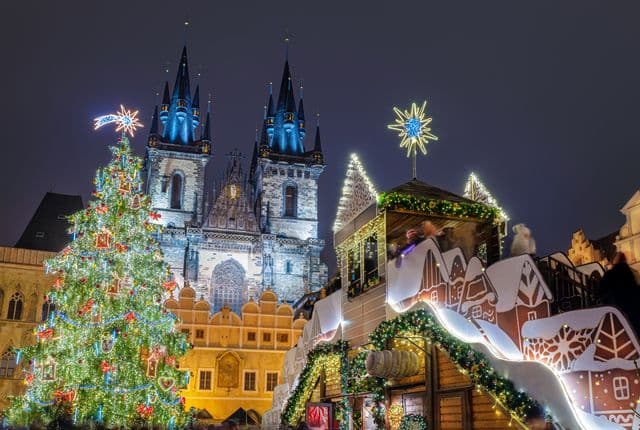
Prague's Christmas markets open in late November and run through early January. The largest fills Old Town Square, with a second major market on Wenceslas Square. Smaller markets appear at Náměstí Republiky, Havel's Market, and several neighborhood squares across the city.
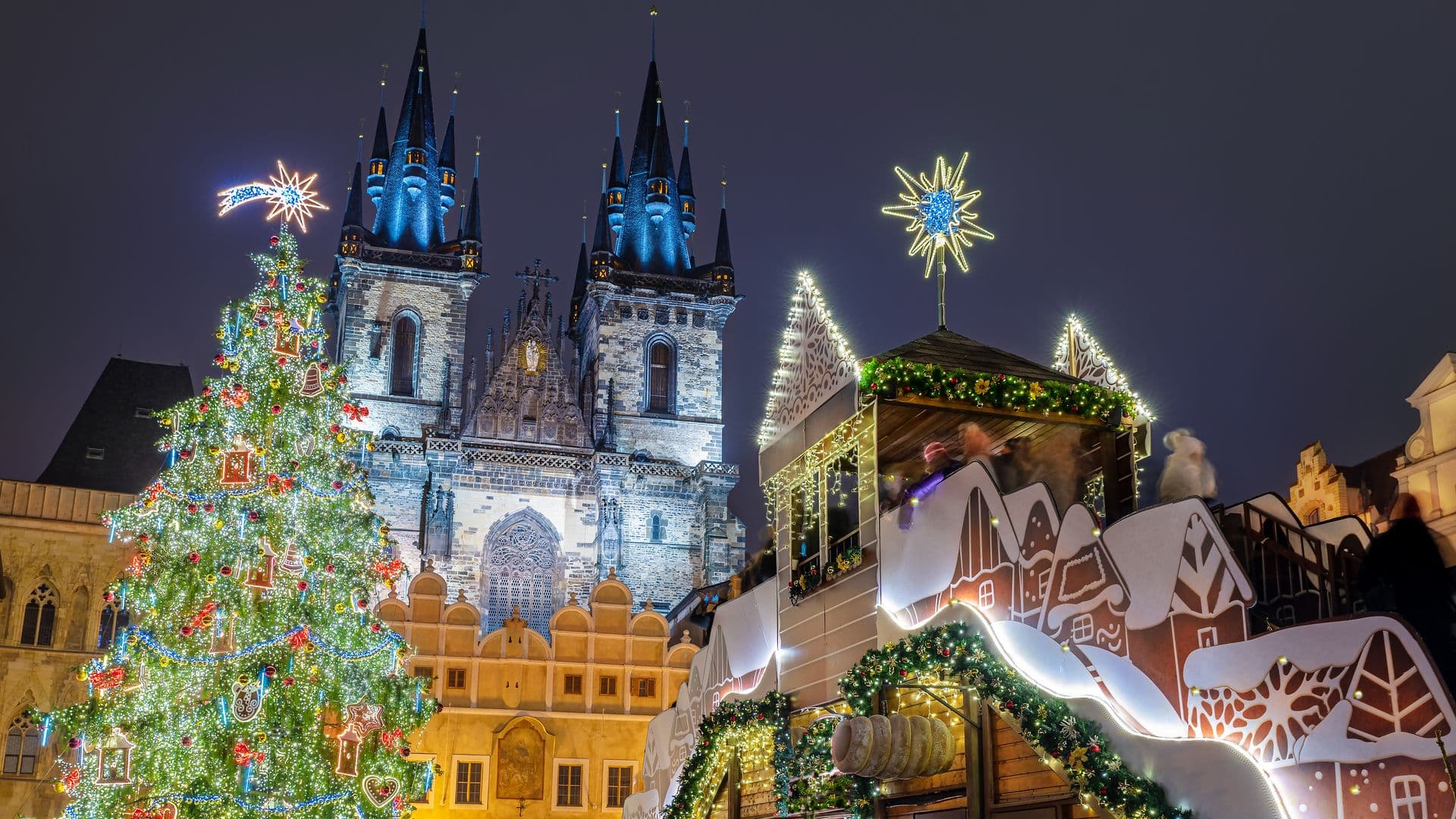
The Old Town Square market is the one most visitors see first. The tree is enormous — usually a spruce from the Krkonoše mountains — and the wooden stalls sell ornaments, candles, puppets, and food. The food is the real draw: trdelník (chimney cake rolled in sugar and cinnamon), klobása (grilled sausage), svařené víno (mulled wine), and roasted chestnuts.
A practical note we share with every December guest: the markets are least crowded on weekday mornings before 11 AM. By mid-afternoon on weekends, Old Town Square is packed tight enough that moving between stalls becomes slow. The lighting is best after 4 PM when the decorations are fully lit against the dark sky — but so is the crowd density.
The Wenceslas Square market tends to be slightly less congested and has the same selection of food and crafts. For something more local and less polished, the Náměstí Míru market in Vinohrady draws more Prague residents than tourists.
Experience It With a Private Guide
December in Prague is one of our favorite months to guide. The city looks and feels completely different — the light changes early, the stone facades glow under the market lights, and the pace slows down. Walking through Old Town with someone who can explain the carp tanks, the Mikuláš processions, and the superstitions behind the season turns a pleasant visit into something you actually remember.
On our medieval dinner evening at U Pavouka Tavern, the winter atmosphere adds another layer — candlelit stone vaults, mead, and fire shows feel entirely appropriate in December. It is the kind of evening that fits the Czech Christmas spirit of feasting and gathering.
Combine it with our All Prague in One Day private tour to see the city's major landmarks with Christmas decorations as a backdrop — the castle, Charles Bridge, and Old Town Square all take on a different character in winter light. Exclusively yours, with your own guide.
Browse all our private tours in Prague and let us know which dates work for your visit.
Frequently Asked Questions
What are the main Czech Christmas traditions?
The centerpiece is Štědrý den (Christmas Eve) — a day of fasting followed by a traditional dinner of fried carp and potato salad. Gifts are brought by Ježíšek (Baby Jesus), not Santa Claus. The weeks before include Mikuláš (St. Nicholas) on December 5th, Advent wreath candles, and extensive cookie baking.
Why do Czechs eat carp on Christmas?
The tradition dates back to medieval times, when the Catholic Church required fasting from meat during Advent. Freshwater fish — especially carp raised in Bohemian ponds — was the most practical alternative. The custom stuck long after the religious requirement faded.
When do Christmas markets open in Prague?
Prague's Christmas markets typically open in late November (around November 25th) and run through early January. The main markets are on Old Town Square and Wenceslas Square. Weekday mornings are the least crowded time to visit.
Who is Ježíšek?
Ježíšek means "Baby Jesus" in Czech. He is the gift-bringer on Christmas Eve — the Czech equivalent of Santa Claus, except no one sees him. A bell rings in the house, and presents appear under the tree. Czech children write letters to Ježíšek, not to Santa.
Is Prague worth visiting in December?
December is one of the most atmospheric times to visit Prague. The Christmas markets, holiday decorations, and winter light give the city a character you will not find in summer. The crowds at the markets can be dense on weekends, but weekday visits are manageable, and most indoor sights are far quieter than in peak season.
You May Also Like
Want to see Prague for yourself?
Discover Prague's hidden underground-6-640x430.jpg&w=3840&q=75)