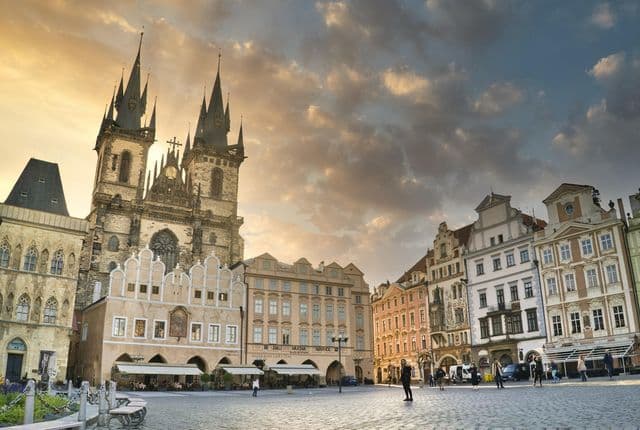
Jewish Quarter Prague — A Complete Guide to Josefov
Josefov is Prague's Jewish Quarter, a compact district wedged between Old Town Square and the Vltava river. For over 700 years it was a walled ghetto — a place of confinement, scholarship, mysticism, and survival against odds that would have broken most communities. Today it holds six historic synagogues, the oldest surviving Jewish cemetery in Europe, and a street of luxury boutiques that would look at home in Paris. The contrast is the point. Josefov is a place where memory and modernity sit side by side, and neither pretends the other isn't there. A guided Jewish Quarter walk turns the compact layout into a layered narrative — synagogue by synagogue, century by century.
This guide covers what to see, how the Jewish Museum ticket works, the legends that grew from these streets, and the details that most visitors walk past.
A History Written in Layers
Jews settled in Prague as early as the 10th century, making this one of the oldest Jewish communities in Central Europe. By the 13th century, the community was confined to a designated ghetto — the boundaries of today's Josefov roughly follow those medieval walls.
Life inside the ghetto was constrained but not static. The community built synagogues, maintained rabbinical courts, ran printing presses, and produced some of the most influential Jewish scholars in European history. The ghetto also survived events that destroyed Jewish communities elsewhere — the 1389 Easter pogrom killed an estimated 3,000 people, but the community rebuilt. The community endured expulsion orders under Maria Theresa in the 1740s that were later reversed.
Emperor Joseph II issued the Edict of Toleration in 1781, which relaxed the most restrictive laws and is the reason the quarter bears his name. Full emancipation came in 1848, and the ghetto walls came down. Jews were finally free to live anywhere in Prague.
What followed was paradoxical. Between 1893 and 1913, the city demolished most of the ghetto in a massive urban renewal project called the Asanace (sanitation clearance). The medieval streets, houses, and markets were torn down and replaced with Art Nouveau apartment buildings and the wide boulevard of Pařížská ulice. The synagogues and the cemetery survived because they had been declared historical monuments. Almost everything else was lost.
Then came the 20th century. The German occupation and the Holocaust nearly erased the community entirely. Of the roughly 118,000 Jews living in the Czech lands before the war, about 78,000 were murdered. The Nazis, in a grotesque twist, preserved the synagogues and collected Jewish artefacts from across Bohemia and Moravia, intending to create a "Museum of an Extinct Race." After the war, these collections became the basis of the Jewish Museum in Prague, which now operates as both a memorial and one of the most important Jewish museums in the world.
The Six Synagogues
Josefov contains six historic synagogues, each with a distinct character and story. Four of them are operated by the Jewish Museum and are included in the single museum ticket. The ticket also covers the Old-New Synagogue, which remains an active house of worship.
Old-New Synagogue (Staronová synagoga)
The oldest active synagogue in Europe, completed around 1270. The name comes from a tradition that the "new" synagogue was built near an older one, making it the "old-new." Another legend says the stones were brought by angels from the destroyed Temple in Jerusalem, with the condition they be returned — "al-tenai" (on condition) — which sounds like "alt-neu" in Yiddish.
The building is early Gothic, with a distinctive brick gable and a vaulted interior supported by two octagonal pillars. The five-ribbed vault (an unusual number — most Gothic vaults have four or six ribs) was possibly chosen to avoid the shape of a cross. A wrought-iron cage (the almemor) in the centre holds the bimah where the Torah is read. A red flag with a Star of David, granted by Emperor Ferdinand III in 1648 in recognition of the Jewish community's role in defending Prague against the Swedes, hangs from a pillar.
The attic is sealed. According to legend, the body of the Golem — the clay figure brought to life by Rabbi Loew — lies dormant up there, waiting to be awakened if the community faces danger again. The attic has never been opened to the public, which has kept the legend alive for four centuries.
Maisel Synagogue (Maiselova synagoga)
Built in 1592 by Mordechai Maisel, the richest man in Prague and financier to Emperor Rudolf II. The original Renaissance building was destroyed by fire in 1689; the current neo-Gothic structure dates from the late 19th century. Today it houses a permanent exhibition on the history of Jews in Bohemia and Moravia from the 10th to the 18th century.
Pinkas Synagogue (Pinkasova synagoga)
The most emotionally powerful space in Josefov. The interior walls are inscribed with the names of 77,297 Czech and Moravian Jews who were murdered during the Holocaust. The names are arranged by community of origin, written in red and black paint. The effect is overwhelming — the sheer visual weight of that many names covering every surface reduces most visitors to silence.
Upstairs, a permanent exhibition shows drawings by children imprisoned at the Terezín ghetto. These drawings — of butterflies, houses, family scenes — were hidden by a teacher named Friedl Dicker-Brandeis, who was later murdered at Auschwitz. Of the approximately 15,000 children who passed through Terezín, fewer than 1,500 survived.
Spanish Synagogue (Španělská synagoga)
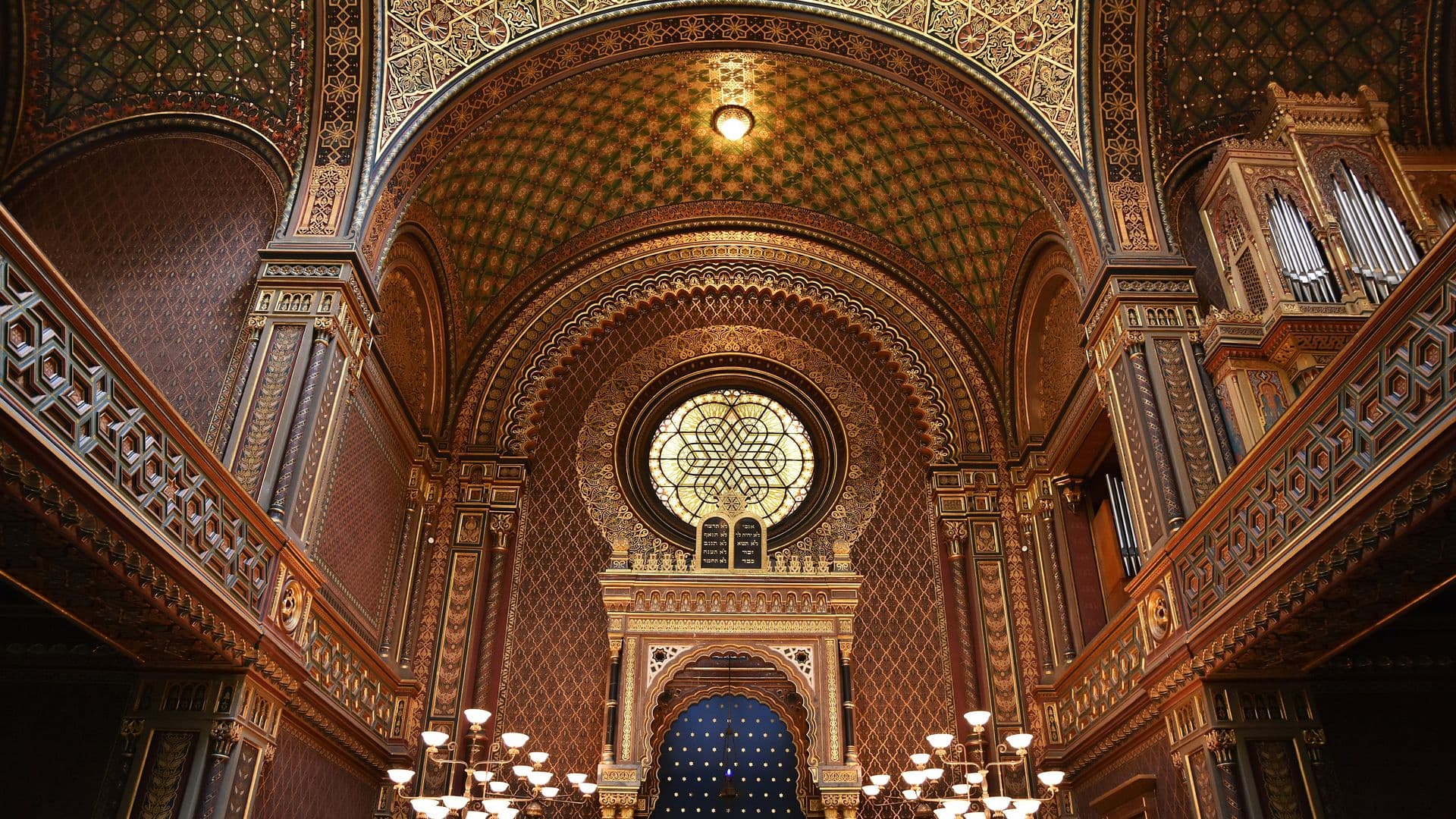
The newest and most visually striking synagogue in Josefov, built in 1868 in Moorish Revival style inspired by the Alhambra in Granada. The interior is covered floor to ceiling in ornate geometric patterns in gold, red, and green. Most visitors gasp when they step inside — the decoration is so dense and so unlike anything else in Prague that it takes a moment to recalibrate.
The synagogue houses exhibitions covering Jewish history from emancipation to the present, including the post-war period and the Communist era. Concerts are held here regularly, and the acoustics are remarkable.
Klausen Synagogue (Klausová synagoga)
Built in 1694 on the site of small prayer houses (klauses) that were destroyed in the 1689 fire. The baroque interior now houses exhibitions on Jewish customs and traditions — prayer, holidays, daily life, birth, marriage, and death. It's a quieter stop, less crowded than the Pinkas or the Spanish Synagogue, and worth the time.
Old Jewish Cemetery (Starý židovský hřbitov)
The cemetery is accessed through the Pinkas Synagogue and is often the most memorable part of the visit. Used from approximately 1439 to 1787, it contains an estimated 12,000 visible tombstones — but because the community could not expand the cemetery beyond its cramped boundaries, bodies were buried in layers up to twelve deep. The result is a surreal landscape of tilted, crowded headstones jutting at odd angles from earth that has risen several metres above the surrounding streets.
The most visited grave belongs to Rabbi Judah Loew ben Bezalel (known as the Maharal, died 1609), the scholar, philosopher, and — according to legend — creator of the Golem. Visitors leave small stones and written wishes on his tombstone, following Jewish memorial tradition. Another prominent grave is that of Mordechai Maisel.
Walk slowly here. The cemetery is small — you can see everything in fifteen minutes — but the atmosphere asks for more than that. The headstones carry carved symbols indicating the deceased's name or profession: a pair of hands for a Cohen (priestly blessing), a pitcher for a Levite, grapes for fertility, a lion for the name Judah.
The Golem Legend
No account of Josefov is complete without the Golem of Prague. The story, in its most common form, says that Rabbi Judah Loew created a figure from clay taken from the banks of the Vltava, inscribed the Hebrew word emet (truth) on its forehead, and brought it to life through a combination of prayer and Kabbalistic ritual. The Golem protected the Jewish community from anti-Semitic attacks.
When the danger passed, Rabbi Loew removed the first letter, turning emet (truth) into met (death), and the Golem returned to lifeless clay. According to tradition, the body was stored in the attic of the Old-New Synagogue, where it remains.
It's important to note that the Golem story in its current form is largely a 19th-century literary creation. Earlier traditions mention clay figures in Kabbalistic contexts, but the narrative linking Rabbi Loew specifically to a protective Golem was popularized by writers in the 1800s and cemented by Gustav Meyrink's 1915 novel Der Golem. The legend is culturally real and historically layered — it reflects genuine anxieties and hopes of the community — but it should be understood as legend, not history.
These stories come alive when told by someone who knows them deeply. Our licensed guides share what the plaques don't say.
Pařížská Street — The Modern Contrast
Pařížská ulice (Paris Street) runs from Old Town Square directly into Josefov, and it is the most expensive shopping street in Prague. Louis Vuitton, Dior, Prada, Hermès — the storefronts belong to a different world than the synagogues and cemetery a few metres away.
The street was built as part of the Asanace clearance. The Art Nouveau buildings that replaced the medieval ghetto were designed to project modernity and prosperity. The contrast with what they replaced is uncomfortable, and it should be. Walking from a Gucci boutique to the Pinkas Synagogue takes less than two minutes. That proximity is Josefov in a nutshell.
The Jewish Museum Ticket — How It Works
The Jewish Museum in Prague operates the Pinkas Synagogue, Maisel Synagogue, Spanish Synagogue, Klausen Synagogue, the Ceremonial Hall, and the Old Jewish Cemetery as a combined circuit.
A single ticket covers all these sites. Current adult price is around 600 CZK, with students under 26 at 400 CZK and children 7–15 at 200 CZK (under 7 free). The Old-New Synagogue is included in the same ticket.
The circuit takes two to three hours if you give each space proper attention. Most visitors underestimate the time needed, especially at the Pinkas Synagogue and the cemetery.
Hours: generally 9:00–18:00 (April–October) and 9:00–16:30 (November–March). Closed on Saturdays and Jewish holidays. Check the Jewish Museum website for current details.
Tip: Start at the Maisel Synagogue for historical context, then proceed to the Pinkas Synagogue, cemetery, Klausen Synagogue, and finally the Spanish Synagogue. This route follows a chronological arc that builds in emotional weight.
Pinkas Synagogue — 80,000 Names on the Walls
Pinkas Synagogue is the most emotionally powerful site in the entire Jewish Quarter. The interior walls are covered with the hand-painted names of 77,297 Czech and Moravian Jews who were murdered during the Holocaust. The names are organized by community — town by town, family by family.
The effect is overwhelming. Standing in the main hall surrounded by thousands of names, the scale of loss becomes tangible in a way that numbers alone cannot convey. The lettering was originally completed in the 1950s, then destroyed during the communist era, and painstakingly restored after 1989.
On the upper floor, there is an exhibition of children's drawings from Terezín — artwork created by children in the Theresienstadt ghetto during the war. Of the approximately 15,000 children who passed through Terezín, fewer than 1,500 survived. The drawings show houses, butterflies, and gardens — images of a normal childhood that most of these children never had.
Pinkas Synagogue is included in the Jewish Museum combination ticket, which covers all the synagogues and the Old Jewish Cemetery.
Josefov holds centuries of resilience in just a few narrow streets, but the synagogues and cemetery can feel overwhelming without someone to connect the dates and names to real human stories. Reading a plaque is not the same as hearing how a community survived — and nearly did not. Discover why a guide changes the Jewish Quarter experience and what insights a licensed local expert brings that no audio guide or brochure can match.
Experience It With a Private Guide
Josefov needs context. The buildings are beautiful, the cemetery is moving, and the Pinkas Synagogue is devastating — but without understanding how these pieces connect to each other and to Prague's wider history, you're seeing fragments. We walk you through the quarter in a sequence that builds meaning, explain the symbols on the tombstones, tell you which legends are documented and which are literary invention, and give you the space to feel what these places ask you to feel. Exclusively yours, with your own guide.
Our Charles Bridge and Old Town private tour includes Josefov as part of a walk through the Old Town that connects the medieval, Jewish, and baroque layers of the city.
For a wider view, our All Prague in One Day tour covers Josefov alongside Prague Castle, Charles Bridge, and the other landmarks — a full-day immersion.
And when you want to shift the mood entirely, a medieval dinner at U Pavouka Tavern takes you into a Gothic cellar for an evening of roast meats, fire dancers, and swordplay. After a day of deep history, the lightness is welcome.
Browse all our private tours from Prague.
Frequently Asked Questions
How long does it take to visit the Jewish Quarter?
Two to three hours for the full Jewish Museum circuit (four museum synagogues, cemetery, and Ceremonial Hall). Add 30 minutes if you also visit the Old-New Synagogue. Rushing through in an hour is possible but misses the point.
Is the Old Jewish Cemetery suitable for children?
The cemetery itself is appropriate for older children who can handle solemn settings. The Pinkas Synagogue — with its walls of names and the children's drawings from Terezin — may be too intense for younger visitors. Use your judgment based on your children's sensitivity and age.
Can I visit the Old-New Synagogue during services?
The Old-New Synagogue is an active house of worship. During Shabbat and holiday services, tourist visits are not permitted. On regular weekday and Sunday hours, you can visit with a ticket. Services are held in the evening and on Saturday mornings — check the schedule.
Do I need to cover my head in the synagogues?
Men are required to wear a head covering. Paper kippot are available at each entrance. Women do not need head coverings.
Is photography allowed?
Photography policies vary. The Pinkas Synagogue and the Old Jewish Cemetery generally do not allow photography. The other synagogues may allow photography without flash. Check at each entrance — policies are posted and staff will guide you.
Want a guided walk through the Jewish Quarter with a licensed local guide? Book our private Jewish Quarter tour — exclusively yours, door-to-door from your hotel.
You May Also Like
Want to see Prague for yourself?
Tour the Old Town and Jewish Quarter