David Cerny's Prague — A Guide to the City's Weirdest Art
David Cerny is the Czech Republic's most controversial living artist, and Prague is his gallery. His sculptures sit on rooftops, hang from buildings, crawl up towers and urinate on the Senate. They are provocative, politically charged, occasionally offensive and impossible to walk past without stopping. In a city defined by Gothic spires and Baroque facades, Cerny's work is the irreverent counterweight — Prague's way of reminding you it has a sense of humour.
This guide maps every major Cerny sculpture in Prague, with locations, backstories and the controversies that made each one famous.
The Babies — Zizkov Television Tower
Location: Mahlerovy sady, Zizkov (metro Jiriho z Podebrad, Line A)
Ten giant bronze babies crawl up and down the Zizkov TV Tower — Prague's most divisive building. The tower itself, a 216-metre concrete needle built in the 1980s, was voted the second-ugliest building in the world by various polls. Cerny's babies, installed in 2000, were meant to be temporary. They stayed.
Each baby is roughly 3.5 metres long, featureless — their faces are smooth with a slot where features should be. The effect is simultaneously cute and unsettling, which is precisely the point. Three additional babies sit at ground level in the park around the tower base, where visitors can examine them up close.
Insider detail: The babies were originally installed in 2000 for a temporary exhibition. Public opinion was divided — some hated them, some loved them. When they were removed, people complained about their absence more than they had about their presence. They were reinstalled permanently in 2001. The tower itself has an observation deck and a one-room hotel at the top.
Hanging Man — Husova Street
Location: Husova street, near Betlemske namesti, Old Town
Look up while walking along Husova street and you'll see a man hanging by one hand from a pole, high above the street, seeming to dangle over the void. The life-size figure represents Sigmund Freud — the father of psychoanalysis depicted at the moment of existential crisis.
The sculpture is called "Man Hanging Out" (Visici muz) and was installed in 1997. The figure's casual posture — one hand gripping the beam, the other hand in his pocket — creates a tension between danger and nonchalance. Is he about to fall? Does he care?
Insider detail: The sculpture is easy to miss if you're not looking up — it's mounted high between buildings. The best viewing angle is from the middle of Husova street, looking east. At night, when spotlit, the shadow it casts on the adjacent building adds a dramatic dimension.
Horse — Lucerna Passage
Location: Lucerna Palace passage, Stepanska 61, off Wenceslas Square
Inside the Lucerna Palace arcade — a passage connecting Vodickova street to Wenceslas Square — hangs an upside-down horse with a rider on its belly. This is Cerny's response to the St. Wenceslas equestrian statue that stands at the top of Wenceslas Square.
Where the original 1912 statue by Josef Myslbek depicts Wenceslas as a noble mounted saint, Cerny's version shows the horse dead, hanging from its legs, with Wenceslas seated on its stomach. The piece is called "Kun" (Horse) and is read as a commentary on Czech politics — the patron saint riding a dead mount, going nowhere.
Insider detail: The Lucerna Palace was built by Vaclav Havel's grandfather in the early 1900s. The passage itself is an architectural gem — Art Nouveau ironwork and glass. Cerny's sculpture hangs in the same building where the Havel family championed culture and democracy. The juxtaposition is intentional.
Kafka Head — Quadrio Shopping Centre
Location: Narodni trida / Charvátova, outside Quadrio centre (metro Narodni trida, Line B)
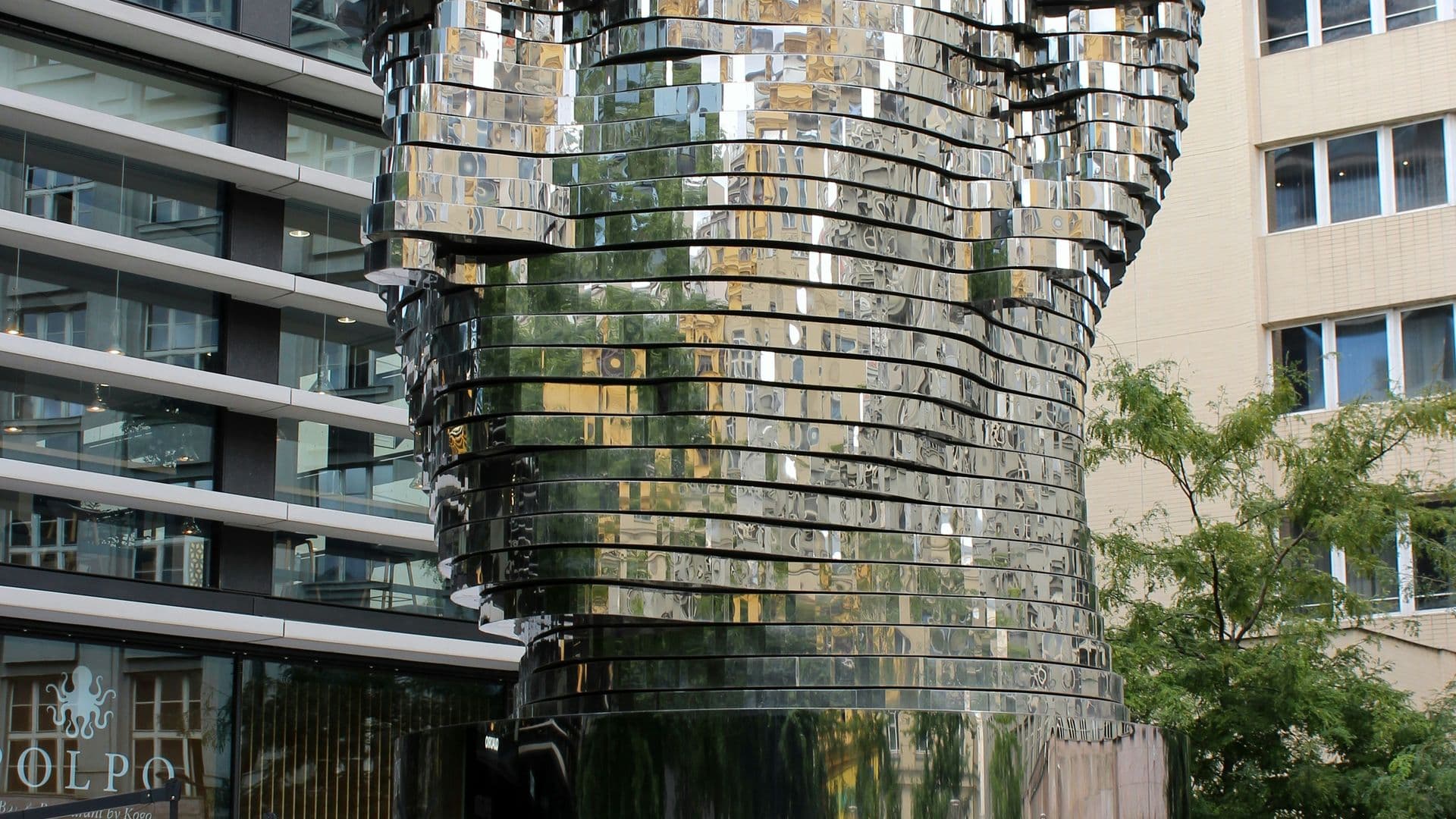
The rotating head of Franz Kafka is Cerny's most technically impressive Prague sculpture. It stands 11 metres tall and weighs 45 tonnes. The head is composed of 42 independently rotating layers of polished stainless steel that align and fragment, constantly forming and dissolving Kafka's face.
When all 42 layers align, Kafka's face appears complete. Seconds later, the layers rotate out of sequence and the face disintegrates into abstract horizontal planes. The cycle of formation and dissolution runs continuously — a mechanical meditation on identity, fragmentation and the impossibility of knowing someone fully.
Insider detail: The head is most striking at night, when the polished steel reflects city lights and the rotation creates shifting patterns of shadow and reflection. Stand directly beneath it and look up — the mechanical movement is visible, and the grinding sound of the rotation is audible in quiet moments. The sculpture was installed in 2014 and has become one of Prague's most photographed modern landmarks.
Piss — Kafka Museum
Location: Cihelna street, Mala Strana (near Kafka Museum / Hergetova Cihelna restaurant)
Two bronze male figures stand in a shallow pool shaped like the Czech Republic, directing streams of water at each other. They are urinating on the map of the country. Their hips rotate mechanically, and visitors can text a phone number to make the figures "write" messages in water with their streams.
The piece, officially titled "Proudy" (Streams), stands outside the Franz Kafka Museum. The interactive element — spelling out text messages with urine — is Cerny at his most provocative. The work references a passage from Kafka and satirizes nationalism, machismo and public art conventions simultaneously.
Insider detail: The SMS function still works. Send a text to the posted number and the figures will spell out your message in the water. Most visitors don't realize the sculpture is interactive until they read the small plaque. The best viewing is from the Hergetova Cihelna restaurant terrace next door.
A private guide makes all the difference when exploring this part of Prague.
Brown-Noser — Futura Gallery
Location: Holeckova street, Smichov (tram 9, 12, 15 to Arbesovo namesti)
This is Cerny's most confrontational work. Two large figures bend over, and visitors climb a ladder to peer inside the rear of one figure, where a video screen plays a loop of Czech politicians feeding each other slops — set to Queen's "We Are the Champions."
The sculpture's title — "Brownnosers" — leaves no ambiguity about the message. It was installed at the Futura Gallery in 2003 and remains there. The gallery itself hosts contemporary art exhibitions and is worth a visit beyond the Cerny piece.
Insider detail: The gallery is off the main tourist routes in Smichov. The walk from the tram stop takes 5 minutes. The building's courtyard contains the sculpture, visible from the street through the entrance gate. Inside the gallery, additional exhibitions rotate throughout the year.
Entropa — Fragments at DOX
Location: DOX Centre for Contemporary Art, Poupetova 1, Holesovice
Entropa was Cerny's most internationally controversial work — a massive installation created for the Czech Republic's 2009 EU Council presidency. It depicted each EU member state as a satirical national stereotype: Germany as a network of autobahns forming a vaguely swastika-like pattern, Bulgaria as a Turkish toilet, the Netherlands submerged underwater. Several countries protested diplomatically.
The full installation was dismantled after the presidency ended. Fragments and documentation exist at the DOX Centre, which is worth visiting regardless for its contemporary art programme and architecture.
Other Cerny Works in Prague
Embryo — a giant illuminated fetus mounted on the facade of the Zizkov Theatre (Divadlo na Vinohradech area). Visible from the street at night.
London Booster — a red London double-decker bus doing push-ups on mechanical arms, originally displayed near the Czech Olympic House. Its current location may vary.
K — a urinating figure mounted on a wall near the Lennon Wall in Mala Strana. Easy to miss — look up on the building facades along Velkoprevvorske namesti.
Planning Your Cerny Route
A dedicated Cerny walk covers the major sculptures in about 3 to 4 hours. A suggested route: Start at Kafka Head (Narodni trida), walk through Lucerna Passage (Horse), continue to Husova street (Hanging Man), cross to Mala Strana for the Piss sculpture at the Kafka Museum, then take the metro to Zizkov for the Babies on the TV Tower. Add the Brown-Noser in Smichov or DOX in Holesovice if time allows.
For a private exploration of Prague's art scene alongside its historical landmarks, our All Prague in One Day tour can include Cerny sculptures along the route. Our guides know the stories, the controversies and the Czech cultural context that makes these works meaningful beyond their shock value.
Complete your Prague day with the Medieval Dinner Show — a 15th-century tavern with fire dancers and unlimited mead. From contemporary provocation to medieval spectacle in one evening.
Browse all our private tours. Exclusively yours, with your own guide.
Frequently Asked Questions
Who is David Cerny?
David Cerny (born 1967) is a Czech sculptor known for provocative, politically charged public art. His works appear throughout Prague and have been exhibited internationally. He is controversial in the Czech Republic — admired for his irreverence and criticized for his confrontational approach in roughly equal measure.
How many Cerny sculptures are in Prague?
At least a dozen, depending on how you count permanent vs. temporary installations. The major permanent works are the Babies (TV Tower), Hanging Man (Husova), Horse (Lucerna), Kafka Head (Quadrio), Piss (Kafka Museum), and Brown-Noser (Futura Gallery).
Can I see the Cerny sculptures for free?
Almost all are in public spaces and free to view. The Brown-Noser is at the Futura Gallery (small admission for the gallery, the sculpture is visible from the courtyard). The DOX Centre charges admission for its exhibitions. The outdoor sculptures — Babies, Hanging Man, Horse, Kafka Head, Piss — are all free.
Is the Kafka Head always spinning?
The head operates continuously during daytime hours and into the evening. It occasionally stops for maintenance. The mechanism is weather-resistant and runs year-round.
You May Also Like
Want to see Prague for yourself?
Take our flagship Prague tour-6-640x430.jpg&w=3840&q=75)