Second Time in Prague — What Most People Miss on Their First Visit
You've walked Charles Bridge. You've climbed to Prague Castle. You've taken the photo of the Astronomical Clock with fifty strangers' selfie sticks in the frame. And now you're coming back — which means you already know what you love about this city, and you're ready for the parts that most visitors never discover.
We guide both first-timers and returning visitors, and the conversations are completely different. First-timers want to see the highlights. Return visitors want to understand the city. They want the side streets, the local restaurants, the neighbourhoods where no one speaks English because no one needs to. Prague rewards this kind of curiosity more than almost any city in Europe — the layers run deep, and the first visit barely scratches the surface.
Skip the Castle — You've Already Seen It
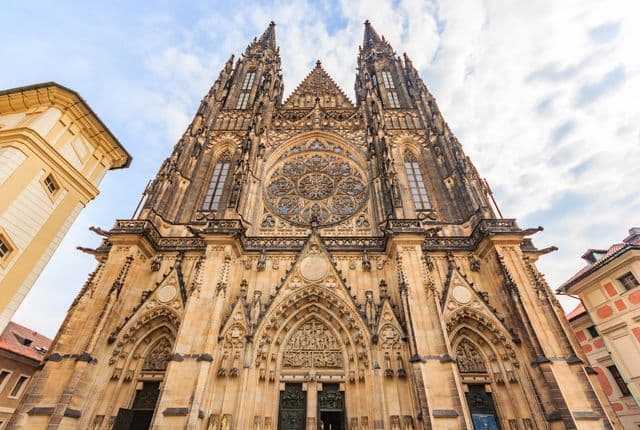
This is permission you may need to hear: you don't have to go back to Prague Castle. You've seen St. Vitus Cathedral. You've walked Golden Lane. The experience was magnificent, and it will be just as magnificent without you there again.
What this frees up is time — and in Prague, time spent in the right neighbourhood is worth more than a second pass through a tourist landmark. Your first visit was about the postcard. Your second visit is about the city behind it.
That said, if you loved the castle and want more depth, consider entering the spaces you probably skipped: the Lobkowicz Palace (privately owned, with a superb collection and a terrace overlooking the city), the Royal Garden (free, gorgeous in spring, and missed by 90% of castle visitors), or the Old Royal Palace, where the famous defenestration of 1618 — the incident that triggered the Thirty Years' War — happened through a window you can still look out of.
Neighbourhoods Locals Love
The first-visit itinerary covers a tiny slice of Prague — essentially Old Town, the castle, and the bridge between them. The city spreads far beyond that, and its best neighbourhoods are where you'll find the Prague that residents actually live in.
Karlín was devastated by the 2002 floods and rebuilt as Prague's most polished urban neighbourhood. The wide boulevards are lined with restored Art Nouveau buildings, and the ground floors house some of the city's best restaurants, bakeries, and wine bars. Walk along Křižíkova street on a Saturday morning and you'll pass specialty coffee shops, a French bakery, a Georgian restaurant, and a natural wine bar — all within three blocks. The Karlín Farmers' Market at Karlínské náměstí (Saturday mornings) sells produce from Czech farms alongside prepared food stalls. Karlín feels like what happens when a neighbourhood gets a second chance and uses it well.
Vinohrady is the neighbourhood most expats and young professionals call home, and for good reason. The tree-lined streets around Náměstí Míru and Riegrovy Sady park are elegant without being formal — a mix of Art Nouveau apartment buildings, quiet cafés, and a wine bar scene that rivals anything in the centre. Riegrovy Sady itself has a hilltop beer garden with a view of Prague Castle that costs nothing and attracts almost no tourists. On a warm evening, the entire park fills with locals sitting on the grass with bottles of wine and takeaway food. This is Prague's living room.
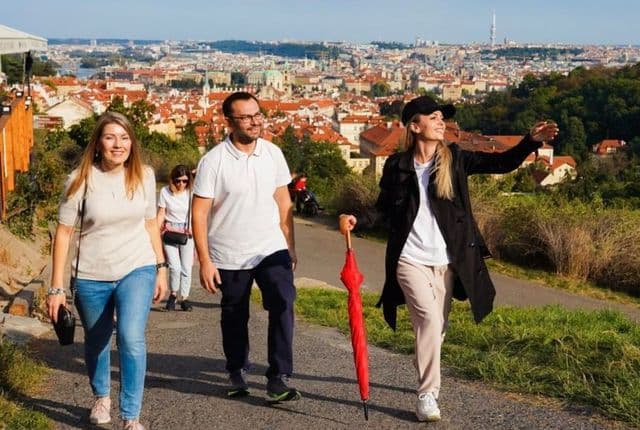
Letná is the plateau above the river where locals go to run, drink beer, and watch the sunset. The Letná beer garden is famous, but walking the full length of the park — from the Metronome to Stromovka — reveals a quieter, greener side of the city. The path through the chestnut trees in October, when the leaves turn gold, is one of the most beautiful walks in Prague.
Dejvice is where Prague's intelligentsia has lived since the First Republic. The streets around Vítězné náměstí (Victory Square) are lined with functionalist and Art Deco buildings from the 1920s and 1930s — an architectural period most visitors associate with Prague far less than Baroque or Gothic, but equally impressive. Dejvice has excellent Vietnamese restaurants (the Vietnamese community here is well-established), a covered market hall, and a university-town energy from the nearby Czech Technical University.
Vršovice is Vinohrady's scruffier, more affordable neighbour, and it's where much of Prague's younger creative scene has migrated. The streets around Krymská are packed with independent bars, coffee shops, vintage stores, and small galleries. It feels like Vinohrady did ten years ago — emerging, authentic, and still rough enough to be interesting.
Food Experiences Beyond the Tourist Centre
Your first visit probably included svíčková, trdelník, and a meal on or near Old Town Square. Your second visit should go deeper — and in different directions.
Denní menu (daily menu) culture — Czech office workers eat lunch at restaurants that post a rotating daily menu (denní menu or polední menu) between 11:00 and 14:00. Two courses — soup and a main — for 130–170 CZK (€5–7). The food is home-style Czech cooking: roast pork, beef goulash with bread dumplings, fried cheese with potato salad. The quality is often better than what tourist restaurants charge three times more for. Any neighbourhood restaurant in Vinohrady, Karlín, or Žižkov will have one.
Sapa Vietnamese Market — Prague's Vietnamese community is the largest in continental Europe (outside France), and the Sapa market in Libuš is its hub. A sprawling indoor marketplace with food stalls serving phở, bánh mì, bún chả, and dozens of dishes you won't find on any Prague restaurant menu. A complete meal costs 100–150 CZK. The atmosphere is chaotic, authentic, and completely unlike anything else in the Czech Republic. Take bus 113 or 197 from Kačerov metro.
Manifesto Market — Prague's answer to the food hall trend, with rotating pop-up restaurants in a converted shipping container setup. The Florenc location is the most established, with a dozen vendors serving everything from Korean fried chicken to Neapolitan pizza to craft cocktails. It's not cheap by Prague standards (main dishes 200–350 CZK), but the variety and quality are high, and the communal tables under string lights create a good evening atmosphere.
Moravian wine — If you drink wine, a crawl through Vinohrady's wine bars is one of Prague's best evening experiences. Czech and Moravian wines are almost completely unknown outside the country — the entire production is consumed domestically. Varieties like Pálava (aromatic white, honeyed), Ryzlink Vlašský (Welschriesling), and Frankovka (a robust red) are worth exploring with a knowledgeable bartender. Bottles start at 120 CZK by the glass.
Café Savoy — For a single splurge breakfast, this grand café near Malostranská square serves eggs Benedict, French toast, and pastries in a stunning neo-Renaissance interior with original ceiling paintings. It's popular, so arrive before 9:00 on weekdays. Breakfast runs 250–400 CZK per person — expensive by Prague standards, but the room alone is worth it.
Day Trips Most First-Timers Miss
Český Krumlov, Kutná Hora, and Karlovy Vary are the standard day trips — and if you haven't done them, you should. But if you have, or if you want something different, Prague sits at the centre of Bohemia with dozens of less-visited destinations within easy reach.
Mělník — A small town at the confluence of the Vltava and Elbe rivers, about 35 kilometres north of Prague. Mělník is the centre of Bohemian wine production — yes, Bohemian, not Moravian — and the Château Mělník has been producing wine since the 14th century when Charles IV ordered Burgundy grape vines planted on the south-facing slopes. You can tour the château, taste the wines, and walk down to the confluence viewpoint where two of Central Europe's major rivers merge. It's a half-day trip that pairs well with an afternoon in Prague.
Konopiště Castle — The last residence of Archduke Franz Ferdinand before his assassination in Sarajevo triggered World War I. The castle is filled with his private collections — an almost obsessive accumulation of hunting trophies, weapons, and art. The grounds include a rose garden and a park that's beautiful in late spring. Konopiště is 50 kilometres south of Prague and reachable by train in about an hour.
Křivoklát Castle — One of the oldest and best-preserved royal castles in Bohemia, set deep in the forests west of Prague. Křivoklát was a favourite hunting lodge of Czech kings from the 13th century onward — young Václav IV was educated here, and the library held one of Europe's most important medieval book collections. The surrounding Křivoklátsko forest is a UNESCO-designated biosphere reserve, and the drive or train ride through the Berounka river valley is spectacular. About 60 kilometres from Prague.
Průhonice Park and Castle — Just 15 kilometres from Prague's centre, Průhonice is a 250-hectare landscaped park designed in the English style during the 19th century. The park holds over 1,600 species of plants, and the colour in autumn — maples, oaks, beeches turning red and gold around a series of ponds — is extraordinary. The château at the park's edge is partially open to visitors. Entry to the park costs 100 CZK, and you can reach it by bus 325 or 363 from Opatov metro in 20 minutes.
Underground Prague — The Tour for People Who've Seen Everything
Beneath the streets you walked on your first visit, there's a city most people never see. Prague's underground is a network of medieval cellars, Romanesque rooms, flood tunnels, and alchemist workshops that stretch below the modern street level.
The reason this underground exists is practical: after devastating floods in the 14th and 15th centuries, the Old Town was raised — literally. New streets were built on top of old ones, and the ground floors of medieval buildings became basements. Walk through certain cellars in Staré Město today and you're standing at the original medieval street level, several metres below the current surface.
A private guide makes all the difference when exploring this part of Prague.
Our Hidden Prague: Underground and Alchemy tour takes you into these spaces with a guide who knows the history behind each cellar and passage. You'll see where alchemists worked under Rudolf II's patronage, where political prisoners were held, and where the city's flood defences were engineered centuries before modern hydrology existed. This is the tour we most often recommend to return visitors — it's the Prague experience that feels genuinely new, even if you've been here before.
Evening Experiences
Your first visit probably ended with a beer on Old Town Square. Your second visit opens up the city's deeper evening culture.
Medieval dinner — The Medieval Dinner Show at U Pavouka is one of the few evening experiences we actively recommend to returning visitors. It's not a tourist trap dinner theatre — it's a multi-course feast served in a vaulted stone tavern with fire dancers, sword swallowers, belly dancers, and unlimited medieval-recipe drinks. The atmosphere is genuinely immersive, and the performance quality is high. Groups of all sizes book this regularly, and the reaction is consistently surprised and delighted.
Jazz clubs — Prague has one of Europe's most vital jazz scenes, rooted in the communist era when jazz was a form of quiet resistance. Jazz Dock, built on the Vltava riverbank in Smíchov, hosts live performances in an intimate room where you can hear the river outside. AghaRTA Jazz Centrum in Old Town has been running since 1991 and books both Czech and international acts. Cover charges range from 150 to 350 CZK, and the quality on any given night is high.
Wine bar crawl in Vinohrady — Start at Veltlín on Krymská for a natural wine from a small Moravian producer, move to Vinograf near Náměstí Míru for a curated selection of Czech and international bottles, and finish at Bokovka for a late-night glass in a candlelit cellar. The walk between venues takes five minutes each time, and the neighbourhood is safe and pleasant at any hour.
Theatre and performance — The Estates Theatre (Stavovské divadlo) is where Mozart premiered Don Giovanni in 1787, and it still hosts opera, ballet, and drama in the original interior. Tickets start at 300 CZK for side balcony seats. Laterna Magika at the National Theatre blends film, dance, and visual effects in a uniquely Czech genre that's been running since the 1958 World Expo.
Off-Season Return — Why November and February Are Actually Better
Here's what experienced Prague visitors know: the city is at its most beautiful in the shoulder months that most tourists avoid.
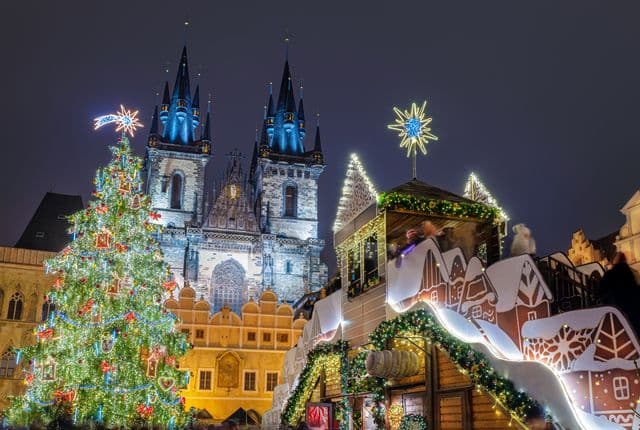
November in Prague is moody, atmospheric, and nearly tourist-free. Fog hangs over the Vltava in the early morning, Charles Bridge is quiet enough to hear your footsteps, and the cafés feel like they belong to you. Restaurant reservations are unnecessary. Hotel prices drop 30–50% from summer peaks. The first Advent markets open in late November, adding warmth and mulled wine to the cold air. November rain is intermittent, not constant — a good coat and waterproof shoes are all you need.
February is Prague's quietest month. The Christmas markets are gone, spring hasn't started, and the city belongs to its residents. This is when the museum visits, the long café afternoons, and the unhurried neighbourhood walks feel best. The Vltava sometimes freezes at the edges — a sight that locals pause to photograph. Hotel prices are at their annual lowest, and even the most popular restaurants have open tables.
The light is different too. Winter sun in Prague sits low on the horizon and turns the Baroque facades golden in a way that summer's overhead glare never achieves. Photographers who know Prague come back in winter for exactly this reason.
The practical trade-off is short days (sunset at 16:30 in November, 17:00 in February) and temperatures between -3 and 5 degrees Celsius. But Prague's interiors — the cafés, the museums, the restaurants, the concert halls — are where the city's character concentrates in winter, and you experience them without the crowds that dilute them in summer.
Returning to Prague means you can skip the tourist checklist and dig into the neighborhoods, stories, and hidden corners that first-timers never reach. A guide who knows you have already seen the highlights can build an entirely different route focused on what genuinely surprises repeat visitors. If you are planning a tour for your return visit, our article explains what to expect and why second-timers often rate their guided experience even higher than the first.
Experience It With a Private Guide
A return visit to Prague is the perfect time for a private tour — you already know the basics, and a guide can take you straight to the layers underneath. Our Best of Prague car tour reaches neighbourhoods and viewpoints that walking tours can't cover. The Underground and Alchemy tour reveals the medieval city beneath your feet. And the Medieval Dinner Show gives your evening an experience worth coming back for. Browse all our private tours — exclusively yours, with your own guide.
Frequently Asked Questions
What should I do in Prague if I've already been?
Focus on the neighbourhoods — Karlín, Vinohrady, Letná, Dejvice, and Vršovice offer a completely different Prague from the tourist centre. Take a day trip to a lesser-known destination like Mělník, Konopiště, or Křivoklát. Explore the underground with a guided tour. Eat at local restaurants using the denní menu system. Visit the Sapa Vietnamese Market. Prague has far more depth than a first visit reveals.
Is it worth returning to Prague?
Absolutely. First visits cover the landmarks, but Prague's real character lives in its neighbourhoods, its food culture, its evening scene, and the layers of history beneath the surface. Return visitors consistently tell us they enjoyed their second trip more than their first — because they stopped trying to see everything and started experiencing the city at a local pace.
What neighbourhoods should I visit in Prague beyond the centre?
Vinohrady for wine bars and elegant streets, Karlín for modern dining and restored architecture, Letná for the hilltop beer garden and park walks, Dejvice for interwar architecture and Vietnamese food, Vršovice and Krymská street for independent bars and a creative scene. Each is reachable within 15 minutes of the centre by tram or metro.
What are good day trips from Prague for repeat visitors?
Mělník (wine town at the confluence of two rivers), Konopiště Castle (Franz Ferdinand's last residence), Křivoklát Castle (medieval hunting lodge in a UNESCO forest), and Průhonice Park (a 250-hectare landscape garden 15 minutes from the city). These receive a fraction of the visitors that Český Krumlov or Karlovy Vary attract and offer equally rewarding experiences.
Is Prague worth visiting in winter?
November and February are some of Prague's best months for return visitors. Hotels cost 30-50% less than summer, restaurants are uncrowded, and the low winter light gives the city a golden atmosphere that summer never matches. Days are short (sunset by 16:30-17:00) and cold (around -3 to 5 degrees Celsius), but Prague's interiors — cafes, museums, concert halls — are where the city shines in winter.
You May Also Like
Want to see Prague for yourself?
Take our flagship Prague tour-6-640x430.jpg&w=3840&q=75)