Prague for Seniors — A Comfortable Guide Without Rushing
Prague rewards those who take their time. The city's spires, river bends and thousand-year history deserve more than a sprint between selfie spots. And yet most travel advice assumes you want to walk 25,000 steps a day, climb every tower and squeeze in three museums before lunch.
This guide is for travellers who prefer depth over distance. We'll cover routes that avoid steep hills, public transport that doubles as sightseeing, restaurants where you can actually sit in comfort, and why a private tour at your own pace may be the best investment of your trip.
Routes Without Steep Hills
Prague's topography divides neatly into two zones: the flat river plain on the east (Old Town, New Town, Josefov) and the hilly west bank (Malá Strana, Prague Castle). The east side is where most attractions cluster at street level. Old Town Square, the Astronomical Clock, the Estates Theatre and the Klementinum are all reachable on flat ground without a single staircase.
The challenge comes when crossing to Prague Castle. The traditional approach up Nerudova street involves a steep 15-minute climb on uneven cobblestones. The smarter route: take Tram 22 from Národní třída to Pražský hrad (Prague Castle) and start at the top. You descend through the castle courtyards, gardens and Malá Strana — gravity does the work. Your knees will thank you.
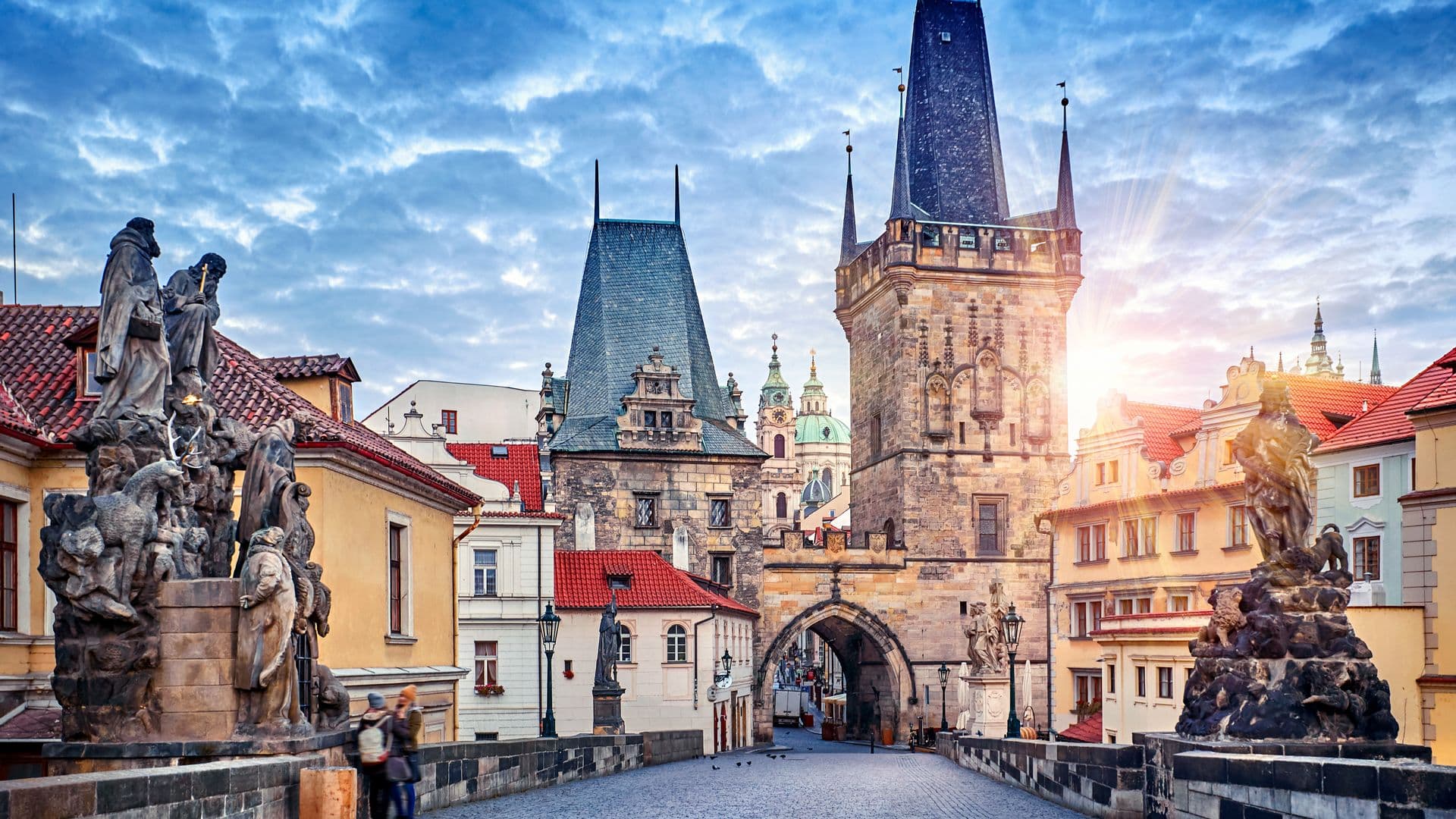
From Malá Strana, the walk back across Charles Bridge (Karlův most) to Old Town is flat and roughly 500 metres. The bridge has no steps, though the surface is stone and slightly uneven. Early morning or late afternoon avoids the densest crowds.
Insider detail: The Old Royal Palace inside Prague Castle has a purpose-built ramp — the Riders' Staircase — wide enough for mounted knights. It was designed in the 1500s, but it serves modern visitors with mobility concerns perfectly. No steps, gentle gradient, and it deposits you directly into Vladislav Hall.
Tram 22 — A Sightseeing Tour for the Price of a Ticket
Locals call Tram 22 "the tourist tram," and they mean it affectionately. The route runs from Národní třída through Malá Strana, past the Wallenstein Garden walls, up the hill beside Prague Castle, and onward to the Strahov Monastery area. For CZK 40 (a standard 30-minute ticket, as of 2026), you see more of Prague from your seat than many walking tours cover in three hours.
Board at Národní divadlo (National Theatre) for a riverside start. The tram crosses the Vltava on the Legií Bridge, turns through Újezd, and begins climbing. Watch for the Wallenstein Garden on your left, then the castle ramparts appearing above. Alight at Pražský hrad for the castle, or ride one more stop to Pohořelec for the Strahov Library and panoramic views.
Insider detail: Sit on the left side of the tram (facing forward, heading toward the castle). That side gives you unobstructed views of the Lesser Town rooftops, the Vltava valley and the castle walls as you ascend. The right side faces residential buildings for most of the climb.
The tram runs every 8 to 10 minutes during daytime. Modern trams on this route have low floors and designated seating areas. Older trams still operate occasionally and require stepping up, but you can wait for a low-floor vehicle if needed.
Prague Castle at Your Own Pace
Prague Castle (Pražský hrad) is a complex, not a single building. The grounds stretch 570 metres — the largest ancient castle complex in the world, according to Guinness. Most tour groups race through in 90 minutes. Seniors who take two to three hours see far more.
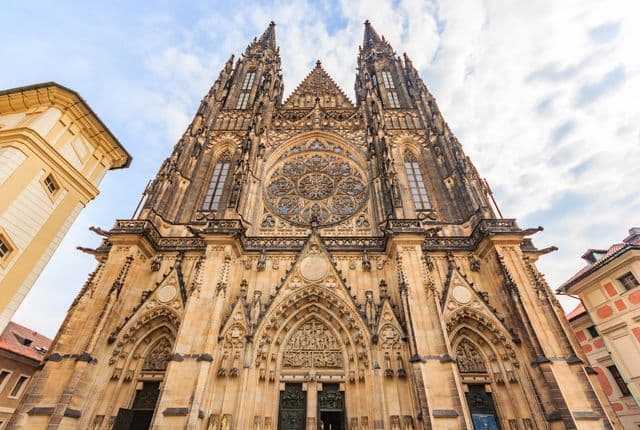
Start at the main entrance in Hradčanské náměstí. The courtyards are flat and paved. St. Vitus Cathedral (Katedrála sv. Víta) is the centrepiece — the interior is vast, cool in summer and shelter from rain. The stained glass by Alfons Mucha in the third chapel on the left is worth standing in front of for several minutes.
Skip the climb up the cathedral tower (287 steps, no elevator) and instead walk through the castle to Golden Lane (Zlatá ulička). This row of tiny houses dates to the 16th century — originally built for castle guards, later home to goldsmiths and even Franz Kafka for a winter. The lane is flat, sheltered and has benches.
After Golden Lane, exit through the eastern gate and descend the Old Castle Steps (Staré zámecké schody) toward Malostranská metro. These steps are manageable but long — about 200 steps down. If stairs are a concern, retrace your route through the castle and take Tram 22 back down instead.
Restaurants with Comfortable Seating
Prague dining can range from cramped beer-hall benches to spacious restaurant interiors. For comfort, look beyond the tourist centre.
Café Louvre on Národní třída has been operating since 1902. Einstein and Kafka both visited. The interior is spacious with wide aisles between tables, padded booth seating and attentive table service. Czech classics here are well-prepared — svíčková (marinated beef with cream sauce) is consistently good. Mains run 250 to 400 CZK (as of 2026).
Café Savoy on Vítězná street in Malá Strana occupies a beautifully restored Neo-Renaissance hall with high ceilings and generous table spacing. The brunch menu is superb. It is popular — reserve a day ahead for weekend mornings.
Insider detail: Many traditional Czech restaurants use narrow wooden benches with no backs. If comfort matters, ask for a table with chairs ("stůl s židlemi, prosím") or choose restaurants in the Vinohrady neighbourhood, where modern interiors dominate. Vinohrady's náměstí Míru square has half a dozen restaurants with proper seating within a two-minute walk.
For a truly memorable evening, our Medieval Dinner at U Pavouka features long wooden tables with bench seating, but the atmosphere — fire dancers, unlimited mead, sword fights — makes it an experience worth the rustic setup. Tables at the edges of the room have wall-back support.
Getting Around Comfortably
Prague's public transport system is reliable, affordable and largely accessible. The metro runs three lines, and all newer stations have elevators. Key stations with confirmed elevator access include Můstek, Muzeum, Florenc, Hlavní nádraží and Malostranská. Check the station entrance for the wheelchair symbol — if it's there, the elevator works.
Trams cover the entire central area. Low-floor trams (marked with a wheelchair symbol on the schedule) run on most routes during peak hours. The DPP (Prague Public Transport) app shows real-time arrivals and marks which approaching tram is low-floor.
Taxis are reasonable if you use reputable services. Lítačka (the official Prague transport app) includes taxi ordering. Bolt and Uber also operate in Prague. A trip from Old Town Square to Prague Castle runs roughly 150 to 200 CZK.
Insider detail: The Lítačka app lets you buy all public transport tickets — tap your phone at the validator and go. No queuing at machines, no fumbling with coins. Works on any smartphone with internet.
Medical Care If You Need It
Prague has excellent medical infrastructure. The Czech Republic's healthcare system consistently ranks in the top third in Europe. For visitors, the most relevant facilities are:
General University Hospital (Všeobecná fakultní nemocnice) on Karlovo náměstí is central, large and has an emergency department familiar with foreign patients. English is spoken by most younger doctors.
Canadian Medical Centre and UniClinic are private clinics with multilingual staff (English, German, Russian) that cater to tourists. Wait times are shorter, and they handle insurance paperwork for common travel insurance providers.
EU citizens should carry a European Health Insurance Card (EHIC) for subsidised emergency care at public hospitals. Non-EU visitors should have travel insurance — medical care is affordable compared to the US or UK, but costs can still add up for hospital stays.
Pharmacies (lékárna) are common in central Prague. Several operate 24 hours, including the pharmacy at Palackého 5, near the National Theatre.
A Private Tour at Your Own Pace
Group walking tours in Prague typically cover 6 to 8 kilometres in three to four hours, with minimal stops and a pace dictated by the fastest walkers. For seniors, this often means choosing between keeping up and actually enjoying what you're seeing.
A private walking tour changes that equation entirely. We set the pace based on you — not a group of twenty strangers. If you want to sit on a bench in the Wallenstein Garden for ten minutes and watch the peacocks, we sit. If you want to skip the climb and take Tram 22, we ride together and narrate as we go.
Our guides know every bench, elevator, accessible entrance and flat route in the city. We adjust the itinerary in real time — more resting stops on hot days, indoor detours on rainy ones. The stories and history don't change, but the experience fits you instead of the other way around.
For day trips beyond Prague, our Karlštejn Castle tour includes private transport — no navigating train schedules or carrying bags through stations. The castle itself involves some climbing (the interiors are in a hilltop fortress), but your guide plans the visit to minimize unnecessary walking.
Browse all our private tours. Exclusively yours, with your own guide. Every route can be adapted for comfort and pace.
Accessibility Guides
Prague's cobblestones and steep hills can be challenging for anyone with reduced mobility, but the city has made real progress in recent years. Newer tram lines are fully step-free, many attractions offer lift access, and an increasing number of restaurants sit at street level. These guides cover wheelchair-accessible routes and the best strategies for navigating Prague with a pushchair or stroller.
- Wheelchair-accessible Prague -- routes, attractions, and transport tips
- Prague with a stroller -- family-friendly paths and what to avoid
Prague's cobblestones and hills are manageable with a little planning, and the right tour makes all the difference between an exhausting march and an enjoyable stroll. A guide who adjusts the route, knows where the elevators and benches are, and keeps the pace comfortable turns a potentially tiring day into a genuine pleasure. Read more about finding a tour that matches your pace so you can enjoy every landmark without worrying about the next steep climb.
Frequently Asked Questions
Is Prague a good destination for seniors?
Excellent. The city is compact, public transport is extensive, medical care is strong, and the culture — classical music, architecture, cafés — suits travellers who appreciate depth over adrenaline. The east bank (Old Town, New Town) is largely flat. The castle area requires planning around hills, but Tram 22 eliminates most climbing.
How walkable is Prague for older travellers?
The central areas are very walkable, but surfaces vary. Old Town Square and Wenceslas Square are smooth. Side streets and Charles Bridge use cobblestones — flat, sturdy shoes with rubber soles are essential. Many visitors cover 8,000 to 12,000 steps per day comfortably, with tram rides bridging longer distances.
Do I need to pre-book attractions?
Prague Castle tickets can be bought on-site, but summer queues can mean 20 to 40 minutes of standing. Pre-booking online saves the wait. The Jewish Museum and National Gallery sometimes sell timed tickets — check before visiting. Most churches, gardens and squares require no tickets at all.
Is Prague safe for seniors travelling alone?
Prague is one of Europe's safest capital cities. Violent crime is rare in tourist areas. The main risks are petty pickpocketing on crowded trams and tourist-trap restaurants overcharging. Keep valuables in a front pocket, verify prices before ordering, and you'll have no problems.
Can a private tour be adjusted for limited mobility?
Absolutely. We routinely adapt tours for guests with knee replacements, hip issues, heart conditions and general fatigue. We can shorten distances, add taxi transfers, swap hilly sections for flat alternatives, and build in more seated breaks — all while covering the same history and highlights.
You May Also Like
Want to see Prague for yourself?
Take our flagship Prague tour-6-640x430.jpg&w=3840&q=75)