Prague Public Transport — Metro, Trams, Tickets and the Lítačka App
Prague has one of the best public transport systems in Europe, and that's not tourist-brochure exaggeration. Three metro lines, over thirty tram routes, a night tram network that runs until dawn, and a single ticket that covers all of them. The city was designed around trams before it was designed around cars, and that shows in how efficiently you can move through it.
Most visitors use the metro and trams instinctively within a day. But there are a few things that trip people up — ticket validation, inspector fines, the Lítačka app discount, and figuring out which tram takes you somewhere scenic instead of just functional. This guide covers all of it.
Metro — Three Lines and Everything You Need to Know
Prague's metro has three lines, and they're color-coded in a way that's genuinely easy to remember.
Line A (green) runs east-west and hits most tourist stops: Malostranská (Malá Strana and Prague Castle access), Staroměstská (Old Town Square), Můstek (Wenceslas Square), and Muzeum (National Museum). This is the line you'll use most.
Line B (yellow) runs east-west on a different axis. The key stations are Můstek (where it crosses line A), Národní třída (for the riverside and Náplavka), Karlovo náměstí (Charles Square and the New Town), and Smíchovské nádraží (Smíchov bus and train station). Line B is less useful for sightseeing but essential if you're heading to bus stations for day trips.
Line C (red) runs north-south. The main stations are Muzeum (where it crosses line A), Hlavní nádraží (the main railway station), Florenc (the main bus station), and Vyšehrad. If you're catching a train to Vienna or Budapest, this is your line.
Trains run every 2-3 minutes during rush hours and every 5-10 minutes at other times. The metro operates from approximately 5:00 AM to midnight. After midnight, you switch to night trams and buses.
One thing we always point out to guests: the escalators in Prague metro stations are some of the longest in Europe. The stations were built deep underground during the communist era, partly for civil defense reasons. At Náměstí Míru station, the escalator descent takes a full two minutes. Stand on the right, walk on the left — Praguers take this rule seriously.
Trams — The Best Way Locals Get Around
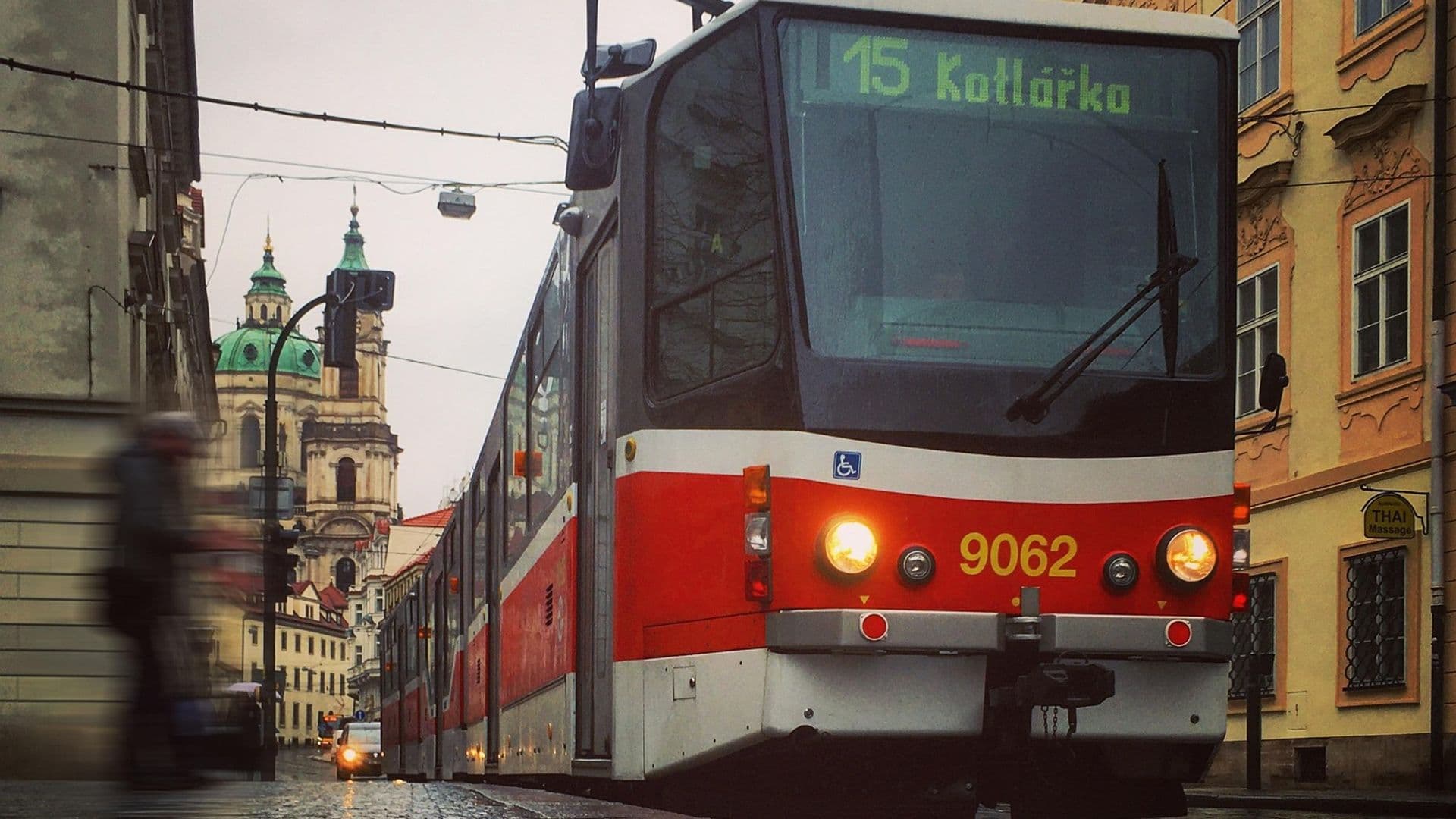
If the metro is Prague's backbone, trams are its nervous system. Over 30 daytime routes and 9 night routes crisscross the city, and for short distances, trams are often faster than the metro because you avoid the long escalator rides.
Tram 22 (sometimes labeled 23) is the line visitors love most, and rightly so. It runs from Národní třída through Malá Strana, up the hill past Prague Castle, and onward to Strahov. Riding the full route is essentially a free sightseeing tour — you pass under the castle walls, through the narrow streets of the Lesser Town, and along the Vltava embankment. We tell guests to take tram 22 at least once, preferably in the late afternoon when the light catches the castle towers.
Daytime trams run from approximately 4:30 AM to midnight. Frequency depends on the route — major lines like 9, 17, 22, and 24 come every 4-8 minutes. Smaller routes come every 10-15 minutes.
Night trams (numbered 91-99) take over after midnight and run until about 4:30 AM. They converge at Lazarská in the New Town, where you can transfer between most night lines. Night trams run every 30 minutes. The schedules are precise — if the timetable says 1:17 AM, the tram arrives at 1:17 AM. This reliability is something Prague locals take for granted, but visitors often find surprising.
A practical tip: trams stop only at marked stops, and you need to press the button on the door to open it. The doors don't open automatically at every stop. If nobody presses the button inside and nobody is waiting at the stop, the tram rolls past. This confuses newcomers — if your stop is coming up, press the green button near the door about 10 seconds before the tram arrives at the stop.
Tickets and Passes — 30 Minutes, 90 Minutes, 24 Hours, 72 Hours
Prague uses a time-based ticket system. Once you validate a ticket, it's valid for all metro, tram, and bus rides within the time window.
Main ticket types (prices approximate, as of 2026):
Ticket | Price | Valid For
30-minute | 39 CZK paper, 36 CZK app | Short hops, 1-2 stops
90-minute | 50 CZK paper, 46 CZK app | Most journeys across the city
24-hour | 150 CZK paper, 140 CZK app | Unlimited travel for a full day
72-hour | 350 CZK paper, 340 CZK app | Best value for multi-day stays
Children under 6 travel free. Children 6-15 and seniors 65-70 pay half fare. Seniors over 70 with a valid EU ID travel free.
The 90-minute ticket is the workhorse. It covers any combination of metro, tram, and bus rides within 90 minutes of validation. For most tourist journeys — hotel to Old Town, Old Town to Prague Castle, castle back to hotel — 90 minutes is plenty.
If you're spending three or more days in Prague and plan to use transport regularly, the 72-hour pass pays for itself quickly. Three 90-minute tickets per day over three days would cost 450 CZK; the 72-hour pass costs 350 CZK paper, or 340 CZK in the app.
Where to buy tickets:
- Lítačka app — cheapest option (see next section)
- Yellow ticket machines at metro stations — accept coins and cards
- Ticket machines at some tram stops — coin-only
- Newsagents (trafiky) and some tobacco shops — cash
- Contactless bank card on metro gates and tram validators — tap to pay (recent addition, works on most routes)
Lítačka App — Buy Tickets Cheaper and Skip the Machines
Lítačka is Prague's official transport app, and it's the single best tip we give every guest. Download it before you arrive, set it to English, and add a payment card. That's it.
The app sells the same tickets as the machines, but at a small discount — approximately 3 CZK cheaper per ticket compared to machine prices. The discount exists to encourage digital adoption and reduce machine maintenance costs. It's not a huge saving on a single ticket, but over a multi-day trip it adds up.
More importantly, the app eliminates every friction point: no hunting for coins, no trying to read Czech-language ticket machines, no worrying about whether you have the right change. You buy the ticket in the app, activate it when you board, and show it on your phone screen if an inspector asks.
The app also shows real-time tram and bus departures, which is genuinely useful. Standing at an unfamiliar tram stop wondering when the next tram 22 arrives? The app tells you it's three minutes away.
One insider detail: the Lítačka app also lets you buy longer passes (24-hour, 72-hour) and even monthly cards if you're staying longer. The interface is straightforward, and the English translation is better than most European transport apps.
How to Validate Your Ticket — and What Happens If You Don't
This is where visitors get caught. Prague operates an honor system — there are no ticket barriers at metro entrances or on trams. You board freely. But your ticket must be validated, and inspectors check regularly.
Tour Prague with highest-category Prague guides who handle the practical details.
For paper tickets: stamp the ticket in the yellow validation machine when you first enter a metro station or board a tram. The machine prints the date and time on the ticket. That's your proof.
For Lítačka app tickets: activate the ticket in the app before or when you board. The activated ticket shows a countdown timer.
For contactless card taps: tap your bank card on the yellow reader when entering the metro or boarding the tram. The system charges automatically.
What happens if you don't have a valid ticket? Plainclothes inspectors — they show a badge, not a uniform — can stop you at any point on the metro, tram, or bus. The on-the-spot fine is 1,500 CZK if you pay immediately in cash or card, or 2,500 CZK if you don't pay on the spot and receive a notice.
The inspectors are professional but firm. "I didn't know I needed to validate" is not accepted as an excuse. Neither is "I was going to buy one at the next stop." We've seen tourists get fined on their first tram ride because they assumed the ticket was valid without stamping it. Validate the moment you board.
An important note: some inspectors target tourists specifically at busy stations like Staroměstská, Malostranská, and Můstek. This isn't discrimination — it's just that tourists are statistically more likely to have unvalidated tickets. Have your ticket ready and validated, and the interaction takes five seconds.
Accessibility — Getting Around With a Wheelchair or Stroller
Prague's transport system is a mixed bag for accessibility. The metro is largely accessible — all three lines have elevators at most stations, though some older stations (especially on line A) have long escalators instead. Stations with elevator access are marked on the metro map and in the Lítačka app.
Trams are better. Most modern trams are low-floor and step-free. At marked stops, the tram floor aligns with the platform, allowing wheelchair and stroller access without ramps. Older trams with steps still run on some routes, but they're being phased out. The Lítačka app indicates which approaching tram is low-floor.
Buses are almost all low-floor and accessible.
For visitors with mobility concerns, we recommend trams over the metro for most journeys. The metro involves long underground walks between platform and street level even with elevators, while trams drop you at street level directly.
Funicular, Ferries and Other Quirky Transport
Prague has a few transport options that double as experiences.
The Petřín funicular climbs Petřín Hill from Újezd in Malá Strana to the top, stopping at Nebozízek restaurant halfway up. A 30- or 90-minute transit ticket is not valid on the funicular — you need a 24-hour or 72-hour Prague transport ticket, or a separate funicular ticket. The ride takes about four minutes and saves you a steep uphill walk. The funicular is closed for reconstruction — check dpp.cz for current status. For the full story on what awaits at the top, read our guide to Petřín Tower and Hill.
River ferries cross the Vltava at several points and are covered by your regular transport ticket. They're small boats, they're free with your pass, and they're a delightful way to cross the river without walking to a bridge. The most useful one for visitors runs between Císařská louka and Smíchovské nábřeží.
The historic tram 41 runs a loop through the city center on weekends and holidays using a vintage 1960s tram car. It runs on its own special fare (around 150 CZK) — regular transit tickets and Lítačka are not valid on it.
Buses — Filling the Gaps
Prague's bus network is extensive but less visible to tourists because buses mostly serve the outer neighborhoods and suburban connections. Within the city center, trams and metro handle everything. Buses become relevant in a few specific situations.
Bus connections to airports and bus stations: the most important bus for visitors is trolleybus 59 from the airport (see our airport transfer guide). Buses also connect to ÚAN Florenc (the main bus station) for inter-city travel.
Suburban day trips: some destinations near Prague are best reached by bus from a metro terminus. For example, buses from Zličín (metro B) serve destinations to the west, while buses from Černý Most (metro B) go east. Your Prague transport ticket is valid on these suburban buses within the Prague integrated zone.
Planning your visit? A private guide takes the logistics off your plate.
Night buses supplement the night tram network after midnight. They run every 30-60 minutes and cover routes the trams don't reach. If your hotel is in an outer neighborhood, a night bus may be your best late-night option.
Tips We Give Every Guest
Download Lítačka before you land. It saves time, money, and confusion.
The 90-minute ticket is almost always the right choice. Only buy the 30-minute ticket if you're making a quick one-stop hop.
Tram 22 from Národní třída to Pohořelec is the best free sightseeing ride in the city. Get on, ride the whole route, get off at Pohořelec and walk downhill to the castle.
Night trams are safe and reliable. Prague is one of the safest capitals in Europe, and the night tram network is used by locals of all ages. The Lazarská hub is well-lit and busy even at 2:00 AM.
Google Maps works well for Prague transport. It shows real-time metro and tram departures and suggests routes. But for buying tickets, Lítačka is better.
Explore Prague With a Guide Who Knows Every Shortcut
Public transport gets you to the neighborhoods. A local guide shows you what's inside them — the courtyards behind the facades, the streets where the crowds never go, the details carved into buildings that you'd walk right past. Our All Prague in One Day private tour covers Prague Castle, Charles Bridge, Old Town, and the Jewish Quarter in a single walk. Exclusively yours, with your own guide.
For something completely different after a day of exploring, the Medieval Dinner Show at U Pavouka Tavern is a multi-course feast with fire dancers, sword swallowers, and Renaissance music in a 500-year-old cellar.
If you're planning a day trip from Prague — to Karlovy Vary, Český Krumlov, or Kutná Hora — a private tour with transport included means no bus stations, no timetables, and flexibility to stop wherever catches your eye.
Browse all our private tours in Prague and Czech Republic.
E-Scooters Banned in Prague Since January 2026
If you were planning to zip around Prague on a Lime, Bolt, or other shared e-scooter — you can't. As of January 2026, Prague has implemented a full ban on shared e-scooter services across the entire city.
Why the ban happened:
The decision followed years of escalating problems. Shared e-scooters — introduced to Prague around 2019 — created genuine safety and livability issues that the city council ultimately decided couldn't be managed through regulation alone:
- Sidewalk clutter — Scooters abandoned on narrow medieval pavements blocked pedestrian flow, particularly in the historic centre where sidewalks are sometimes barely a metre wide. Wheelchair users and parents with pushchairs were regularly forced into the road.
- Injury statistics — Prague emergency departments reported a sharp year-over-year increase in e-scooter-related injuries, including serious head trauma. Riders unfamiliar with Prague's cobblestone surfaces and tram tracks were especially vulnerable — tram rails catch thin scooter wheels at certain angles, causing abrupt falls.
- Heritage concerns — Scooters parked (and crashed) against historic facades, on Charles Bridge approaches, and across accessibility ramps drew sustained criticism from heritage preservation bodies.
Prague joined a growing number of European cities — including Paris, which banned shared e-scooters in 2023 after a public referendum — in concluding that the negative externalities outweighed the transportation benefits.
What about private e-scooters?
The ban targets shared (dockless rental) services, not privately owned e-scooters. If you own a scooter, you can still ride it — but you're subject to the same traffic rules as cyclists, including mandatory use of bike lanes where available and a ban on riding on pavements.
Alternatives for getting around:
- Bike sharing — Nextbike operates Prague's public bike-sharing system with stations across the city. The bikes are heavier and slower than scooters but stable on cobblestones.
- Public transport — Prague's tram, metro, and bus network covers the entire city efficiently. A 24-hour pass costs 150 CZK paper, 140 CZK in the app, and is valid on all services, including the Petřín funicular (once reopened). Download the Lítačka app for mobile tickets.
- Walking — Prague's historic core is compact. Old Town Square to Prague Castle is a 25-minute walk. Most major attractions are within 30 minutes of each other on foot.
How Far Is Prague From Other Cities?
Prague sits almost exactly in the centre of Europe, which makes it an excellent base for multi-city trips — or a natural stopover between Western and Eastern Europe. Here are the most popular connections, with realistic travel times by train and bus:
Destination | Train | Bus | Distance
Vienna | ~4 h (direct ÖBB/ČD Railjet) | ~4 h (FlixBus, RegioJet) | 330 km
Nuremberg | ~3 h (direct Alex/ČD) | ~3.5 h | 300 km
Berlin | ~4.5 h (direct ČD/DB EuroCity) | ~4.5 h | 350 km
Munich | ~4.5-5 h (direct Alex) | ~4.5 h | 380 km
Salzburg | ~4.5 h (1 change) | ~5 h | 300 km
Wrocław | ~3.5 h (direct Leo Express) | ~3.5 h | 280 km
Budapest | ~6.5 h (direct RegioJet) | ~6.5 h | 530 km
Bratislava | ~3.5 h (direct) | ~3.5 h | 330 km
Dresden | ~2 h (direct EuroCity) | ~2 h | 150 km
Kraków | ~5.5 h (1 change via Ostrava) | ~6 h | 540 km
Train vs. bus — which to choose?
For Vienna, Berlin, and Dresden, trains win clearly: they depart from Praha hlavní nádraží (the main station, right in the city centre), offer more legroom, and arrive at central stations. The RegioJet private trains to Vienna and Budapest are particularly good value — leather seats, free coffee, and onboard service for a fraction of Western European rail prices.
For Nuremberg and Munich, buses are competitive and sometimes cheaper. Both FlixBus and RegioJet operate modern coaches with Wi-Fi, and the highway routes are direct.
Booking tip: Czech rail tickets (ČD) are cheapest when bought online at cd.cz in advance. Walk-up prices at the station can be 2-3 times higher on international routes.
One thing our guests often underestimate: Prague's main train station (Praha hl.n.) is a 10-minute walk from Wenceslas Square. And the Florenc bus terminal — where most long-distance buses depart — sits directly above a metro station. Getting out of Prague is genuinely easy.
Getting Beyond Prague
Once you have mastered the metro and trams, the next step is exploring beyond the city limits. Prague's main train station connects directly to several Central European capitals, making it easy to add a cross-border day trip or onward journey to your itinerary.
- Prague to Berlin by train -- schedules, tickets, and what to expect
- Prague to Munich by train -- the scenic Bavarian route
- Prague to Krakow -- the best ways to travel between the two cities
- Prague to Bratislava -- a quick trip to the Slovak capital
Frequently Asked Questions
Do I need to buy separate tickets for metro and trams?
No. A single time-based ticket covers all Prague metro lines, trams, and buses within the time window. Buy one 90-minute ticket and transfer freely between metro, tram, and bus.
How late does the Prague metro run?
The metro operates from about 5:00 AM until midnight. After midnight, night trams (lines 91-99) and night buses take over and run until approximately 4:30 AM.
Can I use contactless payment on Prague trams?
Yes. Most trams and metro gates now accept contactless bank cards — tap the yellow reader when boarding. The system charges the correct fare automatically. This is a recent addition and works on the majority of routes.
How much is a fine for riding without a ticket?
The on-the-spot fine is 1,500 CZK (about 60 EUR) if paid immediately. If you can't pay on the spot, you receive a notice for 2,500 CZK. Inspectors are plainclothes and check regularly, especially at tourist-heavy stations.
Is the Litacka app available in English?
Yes. The app has a full English interface and works with international payment cards. It shows real-time departures, lets you buy all ticket types, and costs slightly less than machine tickets — about 3 CZK discount per ticket.
You May Also Like
Want to see Prague for yourself?
Take our flagship Prague tour

-6-640x430.jpg&w=3840&q=75)