Prague Street Food Guide — Klobasa, Langos, Chlebicky and More
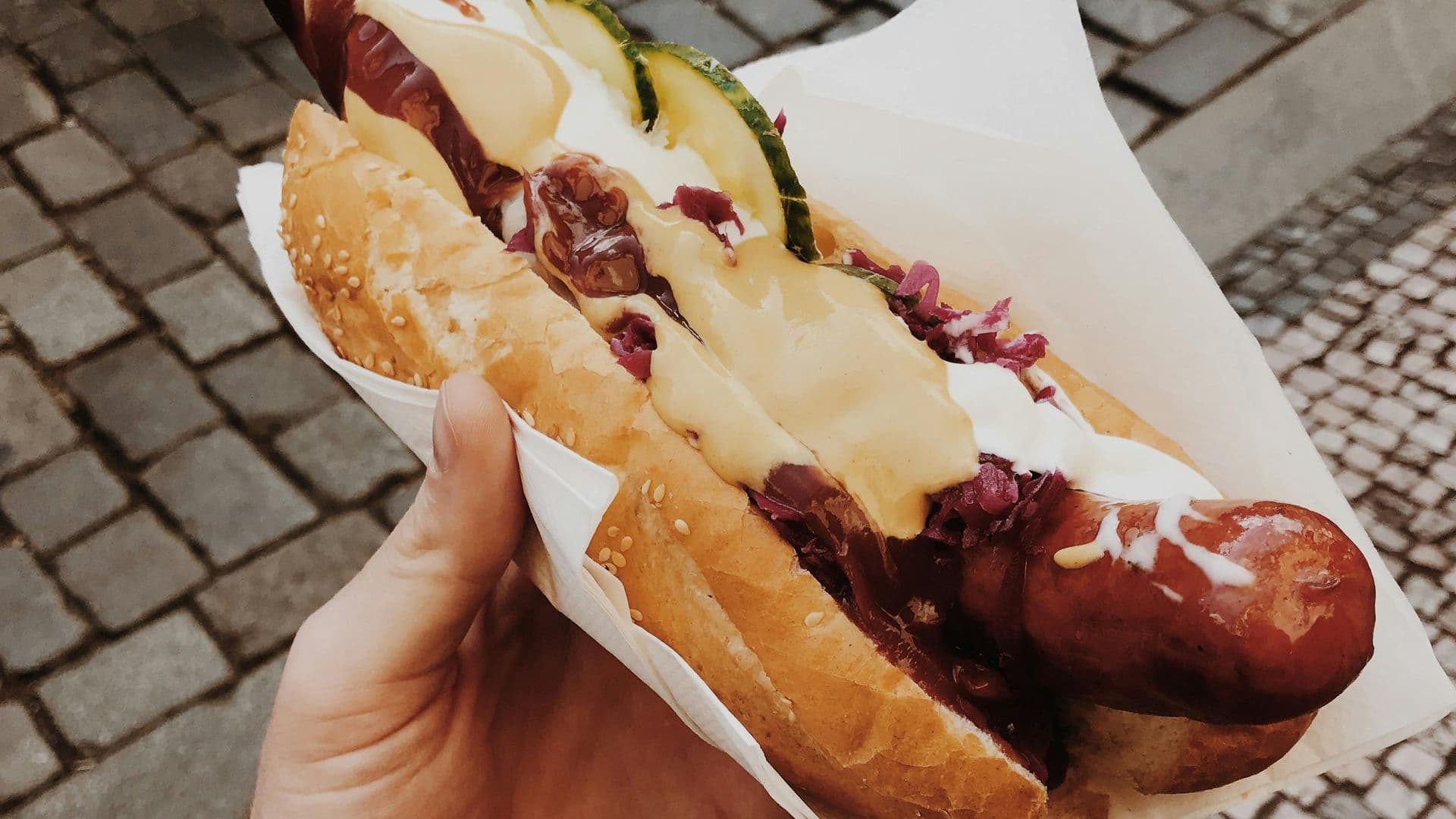
Czech street food does not try to impress you. There are no artfully plated tacos or Instagram-ready bowls. What Prague offers is honest, filling, cheap food — grilled sausages eaten standing at a market stall, fried dough torn apart with your hands, and open-faced sandwiches assembled behind deli counters by women who have been making them the same way for thirty years.
Our guests are often surprised by how good the street food is — and how little it costs. A full street-food lunch in Prague runs 80–150 CZK (roughly 3–6 EUR), which makes it one of the cheapest quality meals in any European capital. This guide covers the essential items, where to find them, and what to skip.
Klobása — The King of Czech Street Food
Klobása (klo-BAH-sah) is a thick grilled pork sausage served on a piece of bread with mustard and optionally horseradish. It is the food you eat at football matches, Christmas markets, beer gardens, and train stations. And it is deeply satisfying.
A good klobása is coarse-ground, smoky, juicy, and slightly charred from the grill. The bread soaks up the fat. The mustard — sharp Czech hořčice — cuts through the richness. The whole thing is eaten standing up, usually with a beer.
Where to find it: Náplavka market on Saturdays, Havelská market daily, Christmas and Easter markets, beer gardens in Letná and Riegrovy sady. Some butcher shops in residential neighborhoods grill klobásy outside on weekends.
Price: 80–120 CZK at markets and beer gardens (as of 2026).
Insider detail: At Náplavka market, the klobása vendors near the southern end of the embankment (closer to Výtoň) tend to use better-quality sausages from small producers. The stands near the entrance sometimes use generic commercial sausages. Look for the queues — the longest line is usually the best sausage.
Langoš — Fried Dough Done Right
Langoš (LAN-gosh) is a disc of fried dough, crispy on the outside and soft inside, served with garlic, ketchup, and grated cheese — or just plain with salt. It comes from Hungarian street food tradition and has been part of Czech culture for generations. At its best, it is addictive. At its worst (cold, greasy, reheated), it is forgettable.
The key is to eat it fresh — within two minutes of leaving the fryer. The garlic version is the classic: the dough is rubbed with raw garlic and drizzled with a garlic-oil mixture. The cheese version adds a pile of shredded Eidam or Gouda on top.
Where to find it: Christmas and Easter markets, Náplavka market, swimming pool kiosks (a Czech tradition — langoš and swimming pools are inseparable in Czech culture), and some beer gardens.
Price: 60–100 CZK.
Chlebíčky — Czech Open-Faced Sandwiches
Chlebíčky (khleh-BEECH-ky) are the most elegant Czech street food — small open-faced sandwiches on white bread, topped with combinations like ham and potato salad, egg and anchovy, salami and pickled pepper, or smoked mackerel with horseradish. Each piece is a miniature composition, usually finished with a cornichon or olive.
Czechs eat chlebíčky at parties, office meetings, train stations, and whenever they need a quick lunch. They are the universal Czech snack — cheap, portable, and available everywhere.
Where to find them: Any pekařství (bakery) or lahůdky (deli) in Prague sells them. Sisters Bistro (Dlouhá 39, Prague 1) has elevated the format with high-quality ingredients while keeping prices reasonable. Traditional delis in residential neighborhoods (Prague 2, 3, 5) sell them for 30–50 CZK per piece.
Price: 30–60 CZK per piece at traditional delis, 60–90 CZK at upscale versions (as of 2026).
Insider detail: The classic chlebíček combination is šunka-vajíčko (ham and egg) with potato salad and a slice of pickle on top. It looks simple but the balance of flavors — smoky ham, creamy salad, sharp pickle — is a precision job when done well. At traditional lahůdky, the chlebíčky are assembled fresh each morning and sold from behind glass counters. Point at what looks good — the staff expects it.
Bramboráky — Garlic Potato Pancakes
Bramboráky (bram-bor-AH-ky) are Czech potato pancakes — grated potato mixed with egg, garlic, marjoram, and flour, fried until golden and crispy. Marjoram is the defining ingredient — it gives bramboráky their distinctive Czech flavor, earthy and slightly floral.
Eat them immediately. They lose their crunch within five minutes. Sour cream on the side is the traditional accompaniment, though many people eat them plain.
Where to find them: Christmas and Easter market stalls (fried to order in huge pans), some beer gardens, and traditional restaurants. At markets, you can watch them being fried — the batter hits the hot oil and the edges start crisping immediately.
Price: 60–100 CZK for 2–3 pieces at market stalls.
Trdelník — The Tourist Favorite (That Is Not Czech)
We have a whole article on this — the trdelník truth — but the short version: trdelník is not a traditional Czech food. It is a Slovak-Hungarian pastry that was introduced to Prague's tourist areas in the 2000s and marketed as a "traditional Old Bohemian" treat. No Czech grandmother has a trdelník recipe.
That said, it is enjoyable if you understand what you are getting — warm dough wrapped around a cylinder, coated in sugar and cinnamon, sometimes filled with ice cream. Just know that locals do not eat it, and the "traditional Czech" labeling is pure marketing.
Our guides know the best local spots — far from the tourist traps. Learn more about our team.
Price: 100–180 CZK in tourist areas. The ice-cream-filled versions run higher.
Párek v Rohlíku — The Czech Hot Dog
A boiled sausage (párek) tucked inside a hollowed-out bread roll (rohlík), topped with mustard and ketchup. It is the most basic Czech street food — the equivalent of a New York hot dog stand. You find them at train stations, bus stops, and kiosks throughout Prague.
Not gourmet. Not trying to be. But at 40–60 CZK for a quick lunch, it fills a gap.
Svařák — Mulled Wine (Winter Only)
Svařák (svah-RZAK) is Czech mulled wine — red wine heated with cinnamon, cloves, star anise, orange peel, and sugar. It is the winter companion to klobása at Christmas markets, and drinking a cup while standing in lightly falling snow is one of Prague's most atmospheric seasonal experiences.
Quality varies enormously between stands. The best svařák uses decent wine and fresh spices. The worst uses wine-flavored syrup diluted with hot water. Price correlates loosely with quality — pay 60–80 CZK for a cup at market stands, not 40 CZK.
Insider detail: Some Christmas market stalls add a shot of rum or Becherovka (a Czech herbal liqueur from Karlovy Vary) to the svařák. It costs 20–30 CZK extra and makes a significant difference on cold evenings. Ask for svařák s rumem (with rum).
Medovník and Trubičky — Sweet Street Snacks
Medovník (honey cake) — dense, layered, and richly sweet. Available at bakeries and some market stalls. Best paired with a strong coffee.
Trubičky — wafer tubes filled with cream. A Czech fairground classic that appears at markets and festivals. They are best eaten fresh; pre-packaged versions from souvenir shops are noticeably worse.
Where to Find the Best Street Food in Prague
<a href="/en/blog/prague-food-markets" target="_blank" rel="noopener noreferrer">Náplavka Market</a> (Saturday mornings, April–November) — the best all-around street food experience in Prague. Klobásy, langoš, coffee, Moravian wine, artisan bread.
Christmas Markets (late November–early January) — svařák, bramboráky, klobása, trdelník, langoš. Atmospheric but touristy and overpriced at Old Town Square. The Náměstí Míru market in Vinohrady is cheaper and calmer.
Manifesto Market — modern international street food in a curated setting. Vietnamese, Mexican, Czech, vegan options. Higher prices but higher quality.
Beer gardens — Letná and Riegrovy sady both have kiosks serving klobásy and basic food alongside cold beer.
Experience Czech Food Culture With a Private Guide
Street food is just the beginning. Our All Prague in One Day private walking tour passes through neighborhoods where the best street food, bakeries, and delis are found — and we enjoy sharing our recommendations. The Kozel Brewery tour takes you into the Bohemian countryside, where beer and food traditions run even deeper.
For an evening that turns Czech food into an event, the Medieval Dinner Show at U Pavouka serves a five-course feast with live entertainment in a 15th-century cellar. A very different experience from a klobása at Náplavka — but equally memorable.
See all our private tours in Prague and the Czech Republic. Exclusively yours, with your own guide.
Frequently Asked Questions
What is the most popular street food in Prague? Klobása (grilled sausage on bread with mustard) is the most traditional and widely eaten Czech street food. Trdelník is the most popular with tourists, though it is not actually Czech.
How much does street food cost in Prague? Very cheap by European standards. Klobása 80–120 CZK, langoš 60–100 CZK, chlebíčky 30–60 CZK per piece, bramboráky 60–100 CZK. A full street food meal costs 100–180 CZK.
Is trdelnik a traditional Czech food? No. Trdelník originated in Slovakia and Hungary and was introduced to Prague's tourist areas in the 2000s. Locals do not consider it Czech. It is enjoyable but the "traditional Bohemian" marketing is misleading.
Where is the best street food market in Prague? Náplavka farmers' market on Saturday mornings (April through November) offers the best combination of quality, variety, and atmosphere. For year-round options, Manifesto Market serves modern international street food.
You May Also Like
Want to see Prague for yourself?
Try our medieval dinner experience